
 Worksheets
mid term physics revsion grade 10
Total questions: 107
Worksheet time: 2hrs 2mins
"the amount of matter in a substance"
Volume
Mass
Length
Weight
"mass of 1 L of water at 4 degrees Celsius"
gram
pound
kilogram
ounce
Mass is independent of gravity.
True
False

The SI unit for time is the __?__.
hours (h)
liter (L)
gram (g)
second (s)
What SI unit is used to measure length?
meters
liters
centimeters
kilograms
Which SI unit is used to measure amount of a substance?
K
kg
mol
kg/m3
The SI unit for mass is _________.
Pounds
Inches
Kilograms
Ounces
Which two units of volume are the same? (select all that apply)
cm3
L
cm2
mL
A system of units of measure widely accepted by the scientific community (SI for short)
International System of Units
World Wide Weight
Science Instruments
Use These Measures
Average speed is measured in
meters per second (m/s)
miles per day (m/d)
kilograms per second (k/s)
newtons per meters (n/m)
Acceleration is measured in
m/d3
g/n
m/s2
k/j2
Is this an SI base unit: second (s)?
Yes
No
Is this an SI base unit: Ampere (A)?
Yes
No
Is this an SI base unit: kilometre (km)?
Yes
No
Is this an SI base unit: Newton (N)?
Yes
No
Is this an SI base unit: Joule (J)?
Yes
No
Is this an SI base unit: Volt (V)?
Yes
No
Convert 17 mm to km.
0.00017km
0.000017km
0.0017km
1.7km
A man travels 5.9km by car before walking 2750m by foot. What is the total distance in metres travelled by him.
8650km
8650m
865m
865.5m
A box contains 4 weights marked 2kg, 2.5kg, 500g and 750g. Find the total weight in kg.
55.7kg
5.75g
5.75kg
57.5kg
Convert 37 minutes to seconds.
2202s
2022s
2200s
2220s
David travels 60 kilometers in two hours. How many meters of distance will he cover in one minute ?
500km
0.5m
500m
0.05m
In our chemistry lab, what tool would you use to measure volume of a liquid?
balance/scale
graduated cylinder
thermometer
ruler
In our chemistry lab, what unit would you use to measure temperature?
Kelvin (K)
Celsius (C)
Fahrenheit (F)

The diagrams show the readings on a measuring cylinder before and after a small metal cube is added.
How many MORE identical cubes can be added to the cylinder, without causing the water to overflow? DO NOT INCLUDE THE CUBE ALREADY IN THE CYLINDER.
1
2
3
4
Which fundamental quantity is measured in amperes?
electric current
amount of substance
temperature
intensity of light
How many fundamental quantities are there?
10
5
7
8
Force is a
fundamental quantity
derived quantity
What is the correct statement for velocity
Rate of change of speed
Displacement devide by time
Si unit: km/hr
Rate of change of acceleration
What is the correct symbol and SI unit for force
F and si unit: Pa
F and SI unit: N
W and SI unit: Nm
F and SI unit:N/m
What is the formula for density?
Weight/volume
Energy/time
Volume/mass
Mass/volume
What is formula for Pressure?
P=FA
P=F/A
P=E/A
P=gh
Identify all the scalar quantities
mass
acceleration
volume
force
Select the scalar quantity from the list
acceleration
volume
force
momentum
A vector quantity has
direction only
magnitude only
magnitude and direction
magnitude, direction and more
1 nm (nano-meter) = .... m
1 x 10-12
1 x 10⁹
1 x 10⁻⁹
1 x 10¹²
Distance and direction of an object's change in position from a starting point (HINT: Direct path from starting point to end point)
displacement
distance
motion
reference point
Jasmine runs exactly 3 laps around a 400 meter track. What is the DISPLACEMENT?
800 m
400 m
0 m
1200 m
David walks 3 km north, and then turns east and walks 4 km. What is the DISTANCE?
7 km
3 km
4 km
1 km
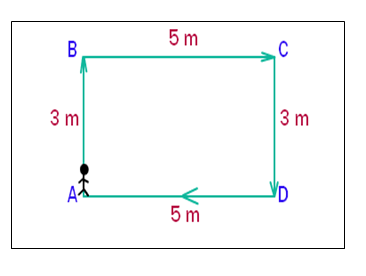
Michael walks in the following order: from Point A, to Point B, and finally to Point C. Which is true?
Distance and displacement are EQUAL
Distance is less than displacement
Displacement is less than distance.
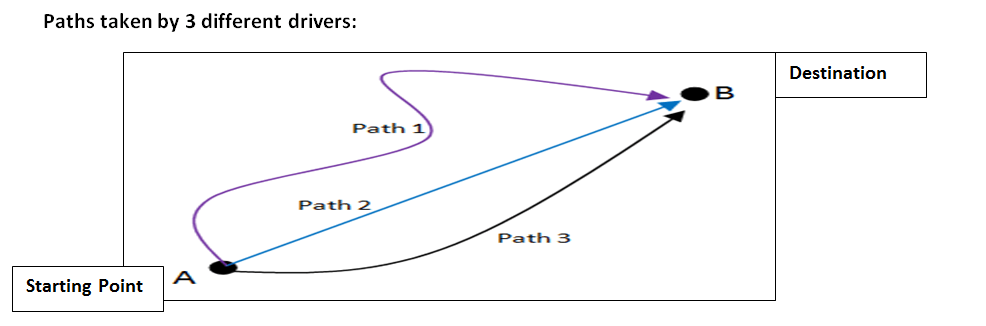
Which driver has an equal distance and displacement at B?
1
2
3

6cm
7cm
8cm
9cm
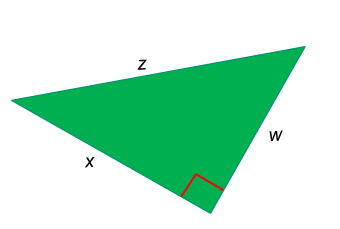
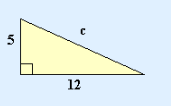
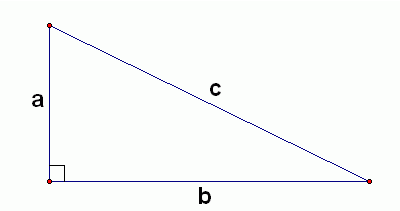
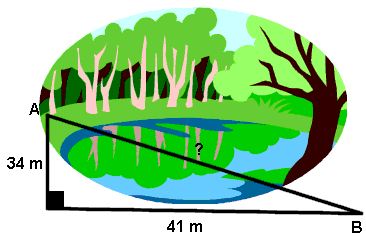
Identify which of the following quantities would be scalars:
Mass
Temperature
Length
Gravity

A runner races in the 100 meter dash. It takes her 10 seconds to finish. What is her average speed?
10 m/s
1000 m/s
100 seconds
10 seconds

Velocity is speed with __________________________.
a unicycle helmet
direction
fight
A vehicle travels 2345 m in 315 s toward the evening sun. What is its speed?
7.44 m/s
0.13 m/s
738,675 m/s
7.44m
A runner runs 2 laps around a track with a circumference of 400 m. What is their total displacement?
800 m
0
400 m
400 m North
If a puppy runs across a park at a speed of 15 m/s. The puppy has a time of 5 seconds. How far did the puppy run?
75 m
30 m
45 m
105 m
What is a difference between distance and displacement
Distance is measured in seconds and displacement is measured in meters
Distance is always shorter than displacement
Displacement can be equal to zero if the object ends in the place it began in
Distance can be equal to infinite when only a small distance has been travelled
An astronaut travels at a speed of 400 m/s for 250 seconds, what is the total distance he traveled?
0.625 m
100,000 m
1.6 m
650 m

Which is true about this graph?
The displacement of the object is 200 m
The distance traveled by the object is 200 m
The distance traveled by the object is 0m
The displacement of the object is 0 m
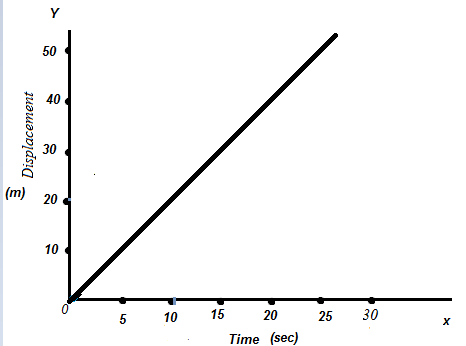
What is shown in this displacement vs time graph?
uniform velocity
uniform speed
no speed (at rest)
acceleration
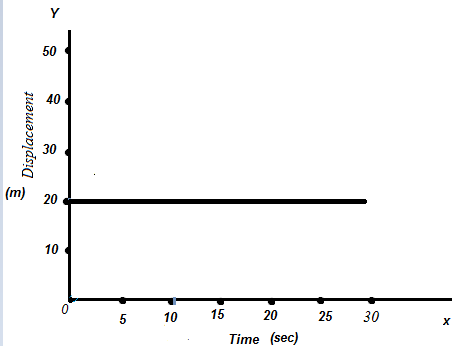
What does this graph mean?
no velocity (at rest)
uniform velocity
uniform speed
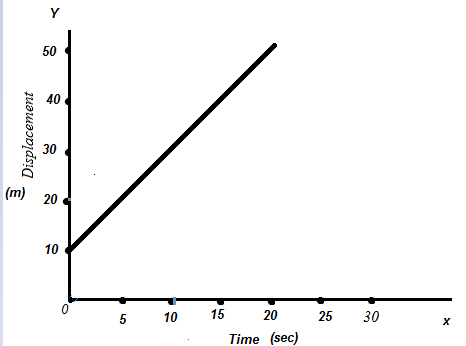
What is shown in this graph?
uniform velocity and initial displacement 10m
uniform velocity and initial velocity 10m
acceleration
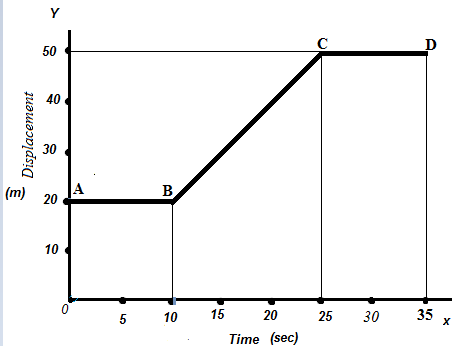
What is happening between B and C in this graph?
constant acceleration
uniform velocity
at rest
What is happening between C and D in this graph?
constant acceleration
uniform velocity
at rest
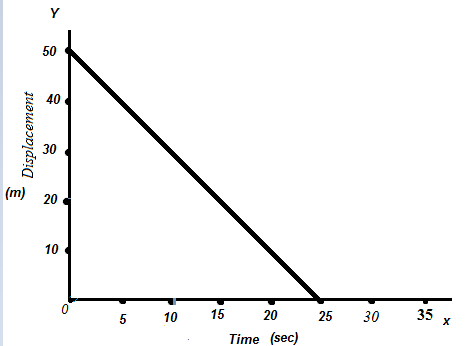
What is happening in this graph?
constant positive velocity
constant negative velocity
negative acceleration
gravity
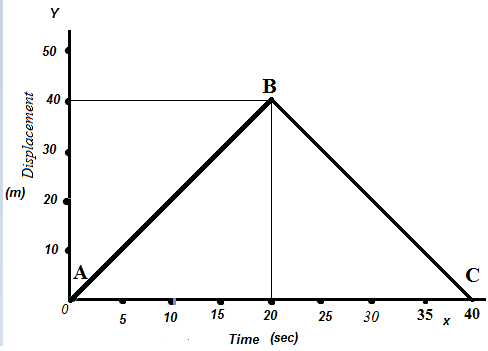
What is happening from A to B?
acceleration
uniform velocity
uniform acceleration
What is happening from B to C?
acceleration
uniform negative velocity
uniform acceleration

Use the picture above to choose the most accurate description of the object's motion
object is at rest
object is slowing down
object is moving at a constant speed
object is speeding up

What is the total distance traveled at the end of 16 seconds?
0 meters
16 m
8 m
24 m
What is the total displacement at the end of 16 seconds?
0 meters
16 m
8 m
24 m
What is the average velocity at the end of 16 seconds?
0 m/s
1.5 m/s
8 m/s
24 m/s
A car has an initial velocity of 24 km/h, the car then accelerates at 2 m/s2 for 6 seconds. Calculate the final velocity in km/h.
18.67
5.19
67.2
134.4
A car decelerates at 2.5 m/s2 for 6 seconds to a velocity of 20 km/h. Calculate the initial velocity in km/h.
20.56
74
5.71
35
An airplane take s 5s to lift off on a runway, it's launch speed is 300m/s, how long is the runway? (first find the acceleration)
18325
2025
3025
2100

Describe this graph
constant acceleration
constant deceleration
object move to the left
constant velocity
The second equation of linear motion is
v=u + at
s= ut + 1/2at2
v2=u2 + 2as
A student is asked to solve the following problem:
An object is thrown upwards with a speed of 25 m s-1. How high will it be when the speed is 12 m s-1 ?
Which equation will allow the problem to be solved in a SINGLE calculation?
s=ut+21at2
s=2(u+v)t
v=u+at
v2=u2+2as
The third equation of linear motion is
v=u + at
s= ut + 1/2at2
v2=u2 + 2as
According to the kinetic theory of gases, gas particles
Do not always move in straight lines
Have most their volume occupied by empty space
Attract each other
Do not always move randomly
The kinetic energy of a gas is dependent on temperature
True
False
Energy is lost when particles collide with each other or the walls of the container
True
False
Gas pressure is caused by
Molecules colliding with each other
Molecules condensing to a liquid
Molecules colliding with the walls of containers
Barometers
Absolute zero is defined as
Oo Celcius
O Kelvin
273.15o Celcius
273.15 Kelvin
An ideal gas is
Not a real gas
A gas that only occurs under certain conditions
A gas that has particles that are slightly attracted to each other
A gas that behaves according to the laws of the Kinetic Theory
The kinetic theory states
Particles won't move if you don't apply energy to it.
Particles only move in liquids and gases.
Particles are always in motion.
At the same temperature the object that has the most mass heats quicker.
Collisions between molecules are perfectly elastic (that is, no energy is gained nor lost during the collision).
TRUE
FALSE

Average kinetic energy of molecules is
Directly proportional to square root of temperature
Directly proportional to absolute temperature
Independent of absolute temperature
Inversely proportional to absolute temperature

pressure acts on all direction
true
false

which hole has the longest distance?
highest one
the middle one
the deepest one
all of them have the same distance
The pressure exerted by a liquid
increases with depth.
decreases with depth.
is constant
first increases and then decreases.
A diver is at 90 m depth in a sea. If density of the sea water is 1025 kg m-3 , calculate the actual pressure acting on the diver?
[atmospheric pressure = 100kPa]
905 kPa
1005 kPa
1019 kPa
1025 kPa

What is the pressure at point X?
Density = 1000 kgm-3
29.43 Pa
6.87 Pa
22.56 Pa
23.45 Pa

Water is stored in a large tank as shown by the the shaded rectangle in the diagram. This water tank is 3m tall and elevated at a height of 22m above the ground.
M is, a smaller storage tank, located inside the house at a height of 15m above the ground.
Calculate the pressure of the water at position M inside the house.
[Density of water = 1 000 kg m−3 and g = 10N/kg]
1.0 × 10⁵ N m−2
1.5 × 10⁵ N m−2
2.2 × 10⁵ N m−2
2.5 × 10⁵ N m−2
Elasticity is the property of material that enables an object to return to its original ___________ after the force applied on it is removed.
kekenyalan ialah sifat bahan yang membolehkan suatu objek kembali kepada ___________ asalnya selepas daya yang bertindak ke atasnya dialihkan.
shape and size
bentuk dan saiz
colour and size
warna dan saiz
type and shape
jenis dan bentuk
height and weight
tinggi dan berat
ability of a deformed material body to return to its original shape and size when the forces causing the deformation are removed.
kinetic energy
potential energy
elasticity
What happens when the stretching force on an elastic material is released?
The material breaks.
The material remains stretched out.
It does nothing
The material snaps back to its original shape.

