
 Worksheets
Covalent and Ionic Bonding Review Part 1
Total questions: 40
Worksheet time: 21mins

In a covalent bond both non-metals _____ electrons.
transfer
share
Beryllium and sulfur will form a ______ bond
ionic
covalent
metalloid
Sodium and Bromine will make a _____ bond.
ionic
covalent
metallic
When sodium loses an electron to bromine, sodium becomes a...
positive ion
negative ion
Carbon and Oxygen will make a ___________ bond.
ionic
covalent
metallic
Nitrogen and Oxygen will make a ____________ bond
ionic
covalent
metallic
What type of bond is formed by NaCl
ionic
covalent
metallic
If two fluorine atoms bond they will make a _____ bond.
ionic
covalent
metallic
Hydrogen and Chlorine will from a _________ bond
ionic
covalent
metallic


dinitrogen pentoxide
N2O5
NO5
N5O2
N2O6
P₄S₁₀
tetrapotassium decasulfide
phosphorus decasulfide
tetraphosphorus decasulfide
phosphorus (X) sulfide
SO₃
sulfate
sulfur oxide
sulfur trioxide
monosulfur trioxide
tetraphosphorus heptoxide
K₄O₁₀
P₄O7
KO
P₁₀O₄
chlorine dioxide
ClO2
ClO
ClO3
HClO2
hexaboron monosilicide
B6Si
BSi
BSi6
B6Si6
pairs of electrons are shared between two non-metal atoms.
two non-metal atoms are attracted to each other by opposite charges.


CO2


Nitrogen
Lithium
Sodium
Potassium
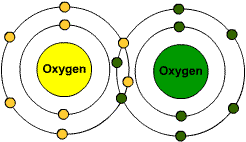

Which of the following describe a COVALENT bond?
Shared valence electrons
Low melting points
Mostly liquids and gases at room temperature
Can conduct electricity when dissolved in water
Which of the following describe a IONIC bond?
Transfer valence electrons
High melting points
Mostly crystalline solids room temperature
CANNOT conduct electricity when dissolved in water
Which statement about covalent bonds is true?
Covalent bonds are weaker because they are just the best!
Covalent bonds are weaker than ionic bonds because they form charged particles.
Covalent bonds are generally stronger than ionic because they have positive and negative charged elements involved.
Covalent bonds are usually weaker than ionic bonds because they do not have positive and negative charged elements, instead they share electrons to fill the outer shell.
True or False: The correct chemical name for the formula PCl3 is monophosphorus tetrachloride.
True
False
Generally high melting & boiling points
Ionic compounds
Covalent compounds
Poor electrical conductivity
Ionic compounds
Covalent compounds
Conducts electricity well when melted or dissolved
Ionic compounds
Covalent compounds

How many single bonds does this have?
1
2
3
4

How many double bonds does this have?
1
2
3
4
triple covalent occurs when two atoms share____
one pair of electrons
two pairs of electrons
three pairs of electrons
three pair of protons

