
Font size
 Worksheets
Midterm Exam in Biochemistry (1st 21-22)
Total questions: 90
Worksheet time: 2hrs 30mins
Proteins are polymers in which:
Branched chains of amino acids are present.
Both unbranched and branched chains of amino acids are present.
Unbranched chains of amino acids are present.
Alternating amino acid and glucose monomer units are present.
Which of the following statements concerning standard amino acids is incorrect?
There are four main categories of amino acids.
They are all alpha-amino acids.
None of the standard amino acids are chiral.
All of the answers are correct.
How do the standard amino acids differ from one another?
in whether or not the amino group is chiral
in whether or not the carboxyl group is chiral
in the number of chiral carbon atoms between the carboxyl group and the amino group
in the identity of the R group (side chain)
During the formation of the peptide bond which of the following takes place?
Hydroxyl group is lost from its carboxyl group of one amino acid and a hydrogen atom is lost from its amino group of another amino acid.
Hydrogen atom is lost from its carboxyl group of one amino acid and a hydroxyl group is lost from its amino group of another amino acid.
Hydroxyl group is lost from its carboxyl group of one amino acid and a hydroxyl group is lost from its amino group of another amino acid.
Hydrogen atom is lost from its carboxyl group of one amino acid and a hydrogen atom is lost from its amino group of another amino acid.
Which part of the amino acid gives it uniqueness?
Amino group
Side chain
Carboxyl group
None
Which of the following sets of elements is a possible composition for a standard amino acid?
carbon, hydrogen, oxygen, and sulfur
carbon, hydrogen, nitrogen, and sulfur
carbon, hydrogen, and nitrogen
carbon, hydrogen, oxygen, nitrogen, and sulfur
The joining together of two amino acids to form a dipeptide involves the reaction between:
two amide groups
an amino group and an alpha-carbon
an amino group and a carboxyl group
an alpha-carbon and a hydroxyl group
How many peptide linkages are present in a tripeptide?
two
three
four
five
In the tetrapeptide Phe-Gln-Trp-His, the C-terminal amino acid is:
Phe
Gln
Trp
His
How many different tripeptides can be formed from two molecules of leucine (Leu) and one molecule of glutamic acid (Glu)?
two
three
four
five
To which of the following levels of protein structure is the sequence of amino acids in a protein directly related?
primary
secondary
tertiary
quaternary
Interactions between amino acid R groups is responsible for which of the following levels of protein structure?
primary
secondary
tertiary
both secondary and tertiary
Quaternary structure is possible for a protein only when:
The amino acid cysteine is present.
All amino acids have nonpolar R groups.
Two or more protein chains are present.
A protein chain bends back on itself.
The non-amino acid portion of a conjugated protein is called a
side chain
prosthetic group
hydrophobic group
hydrophilic group
Which of the following is an incorrect characterization for the protein hemoglobin?
multimeric protein
globular protein
simple protein
conjugated protein
Which of the following is an incorrect statement about glycine, the amino acid with the simplest structure?
It does not contain a chiral center.
It has a side chain that does not contain the element carbon.
It is one of the 20 standard amino acids.
Its amino group and carboxyl group are directly bonded to each other.
Which of the following amino acids has an amide side chain?
Aspartic acid
Glutamic acid
Asparagine
Methionine
Which of the following amino acids does NOT have an aromatic ring?
tyrosine
histidine
tryptophan
proline
Which of the following is NOT a part of the primary protein structure?
The amino acid sequence
the disulfide linkages
The planar nature of the amide linkage
The conformation of the polypeptide backbone
Which of the following is NOT an example of secondary structure found in proteins?
Β-pleated sheet
alpha helix
hydrophobic folding
random coil
What does the quaternary structure of a protein involve?
The complete three-dimensional conformation
Partial denaturation
The association of two or more peptide chains.
Random coil alternating with α-helix
Which of the following is NOT considered part of the tertiary structure of proteins?
The hydrophobic effect
The restricted rotation in amide bonds.
The electrostatic interactions
The hydrogen bonds.
Which of the following statements concerning the tripeptide Val–Ala–Gly is correct?
The C-terminal amino acid residue is Val.
The N-terminal amino acid residue is Gly.
Three peptide linkages are present.
No correct response
In which of the following pairs of proteins are both members of the pair fibrous proteins?
collagen and hemoglobin
alpha-keratin and collagen
hemoglobin and myoglobin
collagen and hemoglobin
The shape of protein is determined by_________.
The type and order of its amino acids
its size
its cell location
none of these
Two amino acids of the standard 20 contain sulfur atoms. They are:
Cysteine and serine
Cysteine and threonine
methionine and cysteine
methionine and serine
Which of the following statements about an enzyme is FALSE?
An enzyme is usually a large protein.
An enzyme is a catalyst for biological reactions.
An enzyme is a chiral molecule.
An enzyme changes the equilibrium constant of a reaction.
What is the main function of enzymes in biological systems?
catalysis of a reaction
altering the equilibrium of a reaction
energy transport
protein synthesis
Pepsin and trypsin are enzymes that are characterized as______.
sugars
carbohydrates
lipids
proteins
After an enzyme catalyzes a chemical reaction, the enzyme is released from the complex and the enzyme is then__________.
destroyed
Chemically changed
Converted to an electrically charged molecule
restored to its original state
Which of the following enzyme groups can catalyze oxidation reactions?
Phosphorylases
dehydrogenases
hydrolases
isomerases
Which one of the following conditions is LEAST likely to denature an enzyme?
a high temperature
a low temperature
heavy metal ions
an extreme pH
Which type of enzyme catalyzes the conversion of a dipeptide into two separate amino acids?
decarboxylase
oxidoreductase
hydrolase
dehydrogenase
The action of an enzyme depends on the specific structure of its active site. Which of these bonds are not important in maintaining the shape of the active site?
ionic
hydogen
disulfide
phosphodiester
The enzyme fumarase catalyzes the reversible hydration of fumaric acid to 1-malate, but it will not catalyze the hydration of maleic acid, the cis isomer of fumaric acid. This is an example of:
Biological activity
Chiral activity
racemization
stereospecificity
Which are the two most common endings for the name of an enzyme?
–ase and –ose
–in and –ogen
–ase and -in
–in and -ine
Which of the following pairs in INCORRECT?
lipase – hydrolysis of ester linkages in lipids
reductase- reduction of a substrate
dehydrogenase- introduction of a double bond through hydrogen removal
kinase-transfer of amino groups between substrates
Which of the following is always present in both conjugated enzymes and simple enzymes?
protein
vitamin
cofactor
coenzyme
Which of the following is true for a conjugated enzyme?
It contains only protein.
It does not contain protein.
It has a non-protein part.
It always contains a metal ion.
Which of the following statements concerning cofactors is INCORRECT?
All conjugated enzymes contain cofactors.
Some cofactors are metal ions.
A cofactor is the non-protein portion of an enzyme.
Vitamins cannot be cofactors.
What happens to substrate molecules at an enzyme active site?
They always react with O2.
They become covalently bonded to the enzyme.
They become catalysts.
They undergo change to a desired product.
Which of the following statements about a reversible noncompetitive inhibitor is CORRECT?
It prevents substrate from occupying the enzyme active site.
It must resemble the substrate in general shape.
The substrate can simultaneously occupy the active site.
It binds to the enzyme at a location other than the active site.
It is the limitation of an enzyme to catalyze specific reactions with specific substrates.
substrate specificity
enzyme specificity
catalysis
coenzyme
What is the structure of all DNA molecules?
double helix
circular
single strand
varied
Which of the following nitrogen bases would NOT be found in DNA?
thymine
cystosine
uracil
adenine
What is the structural difference between DNA and RNA?
RNA is double stranded, while DNA is single stranded
DNA utilizes 16 nitrogen bases, while RNA uses 4
There are no structural differences, they are exactly the same.
DNA is double stranded, while RNA is single stranded
What are the three parts of every DNA nucleotide?
Deoxyribose Sugar, Phosphate, Oxygen Bases
Deoxyribose sugar, phosphate, nitrogen bases
Ribose Sugar, Phosphate, Oxygen Bases
Ribose Sugar, Phsphate, Nitrogen Bases
Where does the process of DNA replication occur?
ribosomes
nucleus
cytoplasm
mitochondria
Where does the process of transcription start?
ribosome
nucleus
rough ER
cytoplasm
Information sources used by Watson and Crick to determine the structure of DNA included_____.
Nuclear magnetic resonance analysis of DNA.
Electron micrographs of individual DNA molecules.
X-ray crystallography and double stranded DNA
Light micrographs of individual bacterial chromosomes.

In what process is mRNA synthesized?
Transcription
Translation
DNA Replication
Mitosis
Why must transcription occur in the nucleus?
because DNA can't leave the nucleus
because ribosomes are in the nucleus
because DNA polymerase is found there
because helicase unzips the DNA
How are DNA and RNA different? (CHECK ALL THAT APPLY)
Only DNA can leave the nucleus
RNA contains Thymine; DNA contains Uracil
DNA is double stranded, RNA is a single stranded
DNA contains Thymine, RNA contains Uracil
Which organelle contains rRNA and reads the mRNA to synthesize a protein?
Ribosome
Nucleus
Cytoplasm
Nucleotide
Choose the sequence of the mRNA strand that would match up with to the following DNA strand:
GTACAT
CATGTA
GAUCUA
CAUGUA
CUTGTU

What brings the amino acids to the ribosome to assemble a protein?
DNA
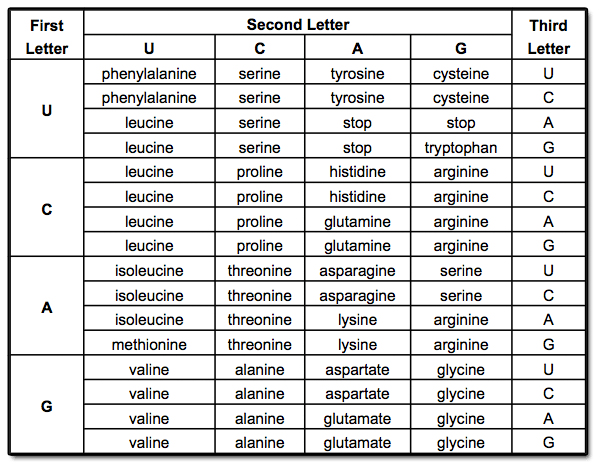
How many nucleotides code for 1 amino acid?
1
2
3
4

Which anticodon would be placed in spot #2
GGC
CCA
GGA
GGT

Which process does this diagram illustrate?
transcription
DNA replication
translation
What determines the shape and function of a protein?
The sequence of amino acids
The type of ribosome that assembles the protein
The cell that manufactures the protein

True or False: mRNA contains anticodons and tRNA contains codons.
True
False
How can a mutation in the DNA sequence result in NO change to the protein that is made?
There are multiple codons that can code for the same amino acid and result in the same protein
There is always a change in the protein when a mutation occurs
Only the mRNA is used in protein synthesis so a mutation in the DNA would have no effect on the protein
DNA replication creates two strands of DNA from one. If pink is parental DNA and blue is new DNA - which picture demonstrates the accepted model of DNA replication after the SECOND replication cycle?


The picture below shows an enzyme unwinding and unzipping DNA.
What is the name of this enzyme?
DNA Helicase
DNA Ligase
DNA polyermase
RNA Polymerase
You are given the DNA strand 5'ATGCTCAGCTGA3'. What is the corresponding DNA strand?
5'UACGAGUCGACU3'
5'TACGAGTCGACT3'
3'UACGAGUCGACU5'
3'TACGAGTCGACT5'
Many enzymes are involved in DNA replication. Which is the correct order of enzymes involved in DNA replication from beginning to end?
Helicase, DNA primase, DNA polymerase, Ligase
RNA primase, Helicase, DNA polymerase, Ligase
Helicase, RNA primase, DNA polymerase, Ligase
DNA primase, Helicase, RNA polymerase, Ligase
Which is the role of DNA polymerase?
Unwinds the original DNA strand
Lays down RNA primer for new nucleotide bases.
Builds new strands by bringing in new nucleotide bases.
Remove Okazaki fragments for new nucleotides.
Which is the last step of DNA replication?
RNA Helicase unwinds original DNA strand
DNA Primase lays down RNA primer for new nucleotide bases.
RNA polymerase builds new strands by bring in new nucleotide bases.
Ligase knits together fragments on lagging strand

Which letter in the picture below depicts the leading strand in DNA replication?
A
C
B
None of the above
Which letter in the picture below depicts the lagging strand in DNA replication?
Letter A since it is copied from 5' to 3'
Letter A since it is copied from 3' to 5'
Letter B since it is copied from 3' to 5
Letter B since it is copied from 5' to 3'
Which letter in the given picture depicts the okazaki fragments?
A - lagging strand
C - leading strand
B - lagging strand
C - replication fork
DNA replication puts down nucleotides ______' to _____' and is said to be ______________________
5, 3, antiparallel
3, 5, antiparallel
5, 3, parallel
3, 5, parallel
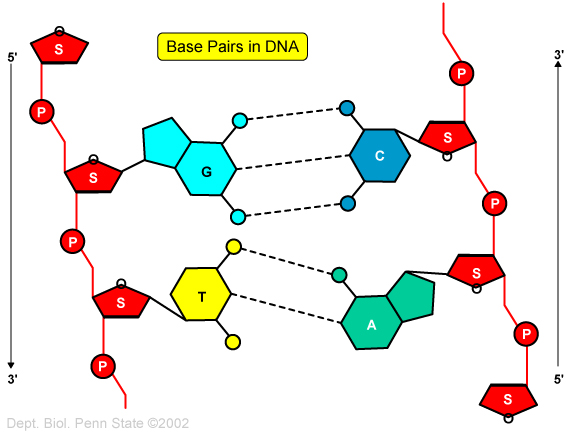

What is the charge of a DNA molecule?
Positive because of the purine bases
Negative because of the phosphate groups
Positive because deoxyribose has a positive charge
Negative because of the hydrogen bonds
What's the difference between purine and pyrimidine nitrogen bases?
Pyrimidines are only found in DNA, not RNA
Pyrimidines have two rings, Purines have one
Purines are only found in DNA, not RNA
Purines have two rings, Pyrimidines have one
What is the process in which protein synthesis happens?
DNA-->RNA--> Proteins
DNA-->Proteins-->RNA
Protein--->DNA--->RNA
Protein Synthesis--> Transcription-->Translation
Who discovered the structure of DNA
Francis/Crick
Crick/ Williams
James/Watson
Crick/Watson
Base Pairing for DNA means the what bases are attracted to each other
(A)denine->(T)hymine, (G)uanine->(C)ytosine
(A)denine-> (C)ytosine,
(T)hymine->(G)uanine
(A)denine->(U)racil, (G)uanine-> (C)ytosine
None of these
What is considered to be our blueprints?
DNA
RNA
Nucleus
Protein
Which one is not a stopping Codon?
UAG
UAA
AUG
UGA
What is the rule for base pairing in RNA
A-->T
C--->G
A-->U
U--->T

