wayground logo

Free Printable Worksheets

Font size

S
M
L
XL
Worksheets

Module Eight Test Review

Total questions: 73

Worksheet time: 1hrs 8mins

Name
Class
Date
1.
A flash flood carried a raft of Amazon ants away from their original population. There is enough distance between the two groups, that they will never meet in nature again. What type of reproductive barrier is this?
a)
behavioral isolation
b)
temporal isolation 
c)
gametic isolation
d)
geographic isolation 
2.
The genitalia of the male damselfly varies in shape. Certain males can only hold onto & mate with females whose genitalia fit.  What type of reproductive barrier is this?
a)
behavioral isolation
b)
temporal isolation 
c)
gametic isolation
d)
mechanical isolation 
3.
Some female peacocks prefer males with large, colorful tales while other female peacocks prefer males with no tail at all. Females are beginning to only mate with the type of males with the tail they prefer. What type of reproductive barrier is this?
a)
behavioral isolation
b)
hybrid sterility 
c)
temporal isolation
d)
mechanical isolation 
4.
The flowers of pink tulips open in the morning, while the flowers of lavender tulips open in the early afternoon. The bees that pollinate these tulips cannot carry pollen back & forth between the two types of tulips because of their flowers being closed at different times of day. What type of reproductive barrier is this?
a)
behavioral isolation
b)
hybrid sterility 
c)
temporal isolation
d)
mechanical isolation 
5.
The term for the formation of new and distinct species over the course of evolution is...
a)
speciation
b)
biological species concept
c)
reproductive barrier
d)
natural selection
6.
What is a species? 
a)
A group of organisms that can mate with each other and produce fertile offspring. 
b)
A group of organisms that can mate and produce offspring even if those offspring are infertile.
c)
A group of organisms that genetically are very different from each other. 
d)
Indivual organisms that live in the same environment. 
7.
If an environment changes, populations with ______________ have a better chance of survival.
a)
No genetic variations
b)
Genetic variations
c)
A small number
d)
A large number
8.
The climate of a certain area is cold, and snow is found on the ground most of the year. Equal numbers of two populations of rabbits are introduced into this climate by a group of scientists. One of the populations is brown and the other is white. Predict what will happen over several generations.
a)
There will be equal numbers of brown and white rabbits
b)
There will be more brown rabbits that white rabbits
c)
There will be more white rabbits than brown rabbits
d)
There is no way to predict what will happen to the rabbit population
9.

When the Grand Canyon in Arizona formed, two populations of one squirrel species were separated by the giant canyon. This is an example of _____________.

a)

Temporal isolation

b)

Behavioral isolation

c)

Geographic isolation

10.
What is genetic drift?
a)
The movement of genes in/out of a population
b)
A small, random change in the DNA
c)
Any change in the allelic frequencies in a population that is due to chance
d)
›The process in which humans select for or against particular features in organisms
11.
When has speciation occurred?
a)
When populations no longer look the same
b)
When populations no longer have the same frequency of alleles
c)
When populations are living in different environments
d)
When populations can no longer interbreed
12.

Three populations of crickets look very similar, but the males have courtship songs that sound different. What function would this difference in song likely serve if the populations came in contact?

a)

A temporal reproductive isolating mechanism

b)

A postzygotic isolating mechanism

c)

A behavioral reproductive isolating mechanism

d)

A gametic reproductive isolating mechanism

13.

The common edible frog of Europe is a hybrid between two species, Rana lessonae and Rana ridibunda. The hybrids were first described in 1758 and have a wide distribution, from France across central Europe to Russia. Both male and female hybrids exist, but when they mate among themselves, they are rarely successful in producing offspring. What can you infer from this information?

a)

Postzygotic isolation exists between the two frog species.

b)

Prezygotic isolation exists between the two frog species.

c)

These two species are likely in the process of fusing back into one species.

d)

The hybrids form a separate species under the biological species concept.

14.

Rocky Mountain juniper (Juniperus scopulorum) and one-seeded juniper (J. monosperma) have overlapping ranges. Pollen grains (which contain sperm cells) from one species are unable to germinate and make pollen tubes on female ovules (which contain egg cells) of the other species. These two juniper species are kept separate by _____.

a)

Habitat isolation

b)

Temporal isolation

c)

Gametic isolation

d)

Behavioral isolation

15.

How are two different species most likely to evolve from one ancestral species?

a)

Sympatrically, by a point mutation affecting morphology or behaviorn

b)

Sympatrically, due to extensive inbreeding

c)

Allopatrically, due to extensive inbreeding

d)

Allopatrically, after the ancestral species has split into two populations

16.

What is founder effect?

a)

A process in which random events cause unpredictable fluctuations in allele frequencies from one generation to the next.

b)

When a few individuals become isolated from a larger population and form a new population whose gene pool composition is not reflective of that of the original population.

c)

When the size of a population is reduced, as by a natural disaster or human actions, he surviving population is no longer genetically representative of the original population.

d)

The evolutionary process that occurs when a population is exposed to environmental factors that cause individuals with certain heritable traits to have greater reproductive success

17.

A new river forms and splits two populations, causing ______________ speciation

a)

Sympatric

b)

Allopatric

c)

Extreme

d)

Convergent

18.

Two organisms are of the same species if they _. Select 3

a)

Interbreed

b)

Produce viable offspring

c)

Produce fertile offspring

d)

Share many morphological characteristics

e)

Share many molecular (DNA, RNA, and protein) similarities

19.

Which of the following terms describes when interbreeding to produce viable and fertile offspring is no longer possible?

a)

Reproductive isolation

b)

Allopatric isolation

c)

Sympatric isolation

d)

Prezygotic isolation

e)

Postzygotic isolation

20.

What are the two forms of speciation?

a)

Allopatric

b)

Sympatric

c)

Prezygotic

d)

Postzygotic

e)

Genetic drift

21.

Which form of speciation involves geographic barriers?

a)

Allopatric

b)

Sympatric

c)

Prezygotic

d)

Postzygotic

e)

Genetic drift

22.

Why does geographic isolation result in speciation?

a)

The populations are exposed to different selective pressures in different environments

b)

The populations are exposed to different selective pressures within the same environment

c)

The populations are exposed to the same selective pressures in different environments

d)

The populations are exposed to the same selective pressures within the same environment

23.

Both prezygotic and postzygotic barriers maintain reproductive isolation between populations by preventing _

a)

Gene flow

b)

Genetic drift

c)

Natural selection

d)

Mutations

e)

All mechanisms of evolution

24.

Prezygotic barriers impede _. Select 2

a)

Mating

b)

Fertilization

c)

Hybrid viability

d)

Hybrid fertility

25.

Postzygotic barriers impede _. Select 2

a)

Mating

b)

Fertilization

c)

Hybrid viability

d)

Hybrid fertility

26.

What is habitat isolation (prezygotic)?

a)

Species occupy different living or mating spaces within the same environment

b)

Species mate at different times (day, season, year)

c)

Species have differences in courtship and mating

d)

Species have different genitalia; sex and subsequent fertilization is highly unlikely

e)

The sperm of one species is unable to fertilize the egg of another 

27.

What is temporal isolation (prezygotic)?

a)

Species occupy different living or mating spaces within the same environment

b)

Species mate at different times (day, season, year)

c)

Species have differences in courtship and mating

d)

Species have different genitalia; sex and subsequent fertilization is highly unlikely

e)

The sperm of one species is unable to fertilize the egg of another 

28.

What is hybrid breakdown?

a)

The offspring of two species are unable to fully develop or survive

b)

The offspring of two species are sterile (unable to have offspring)

c)

Some offspring of two species are viable and fertile, but when they mate with one another or either parent species, the offspring are inviable or sterile

d)

Mating between two species fails to produce hybrid zygotes

e)

Mating between two species produces geographically isolated hybrids

29.

What word describes a trait that helps an organism survive in its environment?

a)

natural selection

b)

mutation

c)

camouflage

d)

adaptation

30.

How do you "win" at natural selection?

a)

survive

b)

go extinct

c)

survive & reproduce

31.
Which organisms are most likely to survive?
a)
the best adapted
b)
the fastest
c)
the strongest
d)
the most domesticated (tamed)
32.
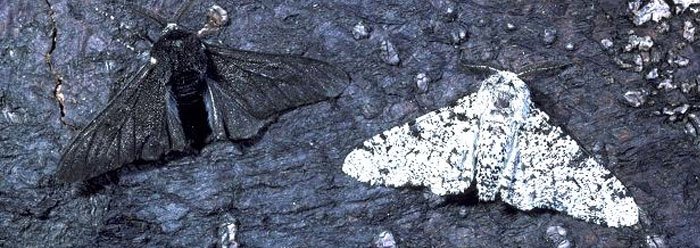
The trees these moths used to live on were white, but have been covered in soot from coal factories. Which moth will be more successful in this environment?
a)
Dark moth
b)
Light moth
c)
Both will be equally successful
d)
Neither will be successful
33.
These moths are all the same species. The differences between their wings is an example of ________________
a)
Natural Selection
b)
Variation
c)
Homeostasis
d)
Extinction
34.
Which of the following explains adaptation.
a)
An individual organism changes to meet its needs in the environment. These changes pass down to their offspring.
b)
The species as a whole changes their characteristics.
c)
Beneficial traits allow organism to survive and pass on those traits
d)
New characteristics arise in a species as needed.  If these traits are helpful, they are passed down.
35.
When an environment changes faster that an species can adapt, the most likely outcome is...
a)
...biological evolution.
b)
...voluntary mutation
c)
...species extinction
d)
...selective breeding
36.
Evolution works by 
a)
individuals changing to suit their environment
b)
Individuals learned new traits and pass them on
c)
sudden change in the environment cause a species change 
d)
small changes pass down through many generations
37.
Mutations are important because they bring about
a)
death of the organism in which they develop
b)
genetic variation needed for a population to evolve
c)
benefits for the individual, not for the population
d)
Hardey-Weinberg equilibrium within a population
38.
What is another name for natural selection?
a)
survival of the smartest
b)
survival of the fastest
c)
survival of the biggest
d)
survival of the fittest
39.

Natural selection results in change in a population's _____________ traits over time.

a)

inherited

b)

acquired

40.

Individuals undergo evolution.

a)

True

b)

False

41.
Magda is a tall, 11 year old drummer. She has a scar on her right cheek. She is good at swimming. Which of her traits did Magda most likely inherit?
a)
height
b)
the scar
c)
ability to swim
d)
ability to play drums
42.
Which of the following is a factor in natural selection?
a)
Individuals of species compete with one another to survive.
b)
All species are genetically diverse.
c)
Individuals better able to adapt to changes leave more offspring.
d)
All are correct 
43.

Charles Darwin observed that finches of different species on the Galápagos Islands have many similar physical characteristics, this supports the hypothesis that these finches

a)

are twins

b)

acquired traits through use and disuse.

c)

all eat the same type of food.

d)

descended from a common ancestor.
44.
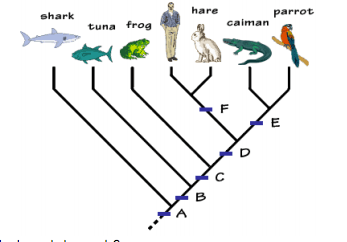
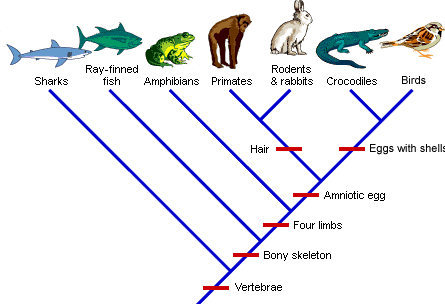
According to this cladogram, birds are LEAST related to -
a)
Amphibians
b)
Sharks
c)
Ray Finned Fish
d)
Crocodiles
45.
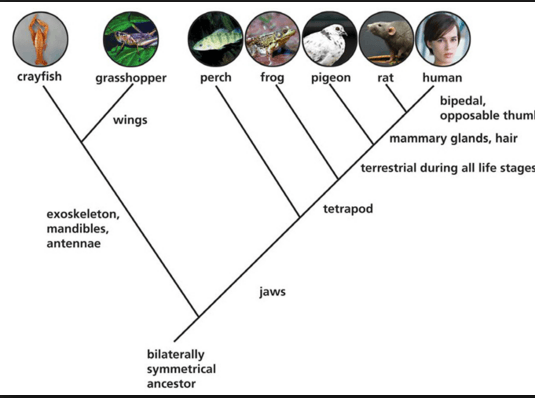
On the cladogram, which organism is the closest relative of the human?
a)
Frog
b)
Hare
c)
Caiman
d)
Parrot
46.
According to this cladogram, sharks are MOST closely related to which organism? 
a)
Amphibians
b)
Ray finned fish
c)
Crocodiles
d)
Birds
47.
Which trait do only humans have, according to the cladogram?
a)
jaws
b)
mammary glands & hair
c)
terrestrial during all life stages
d)
bipedal & opposable thumbs
48.
What trait separates sharks from ray-finned fish?
a)
Vertebrae
b)
Bony skeleton
c)
Four limbs
d)
None
49.

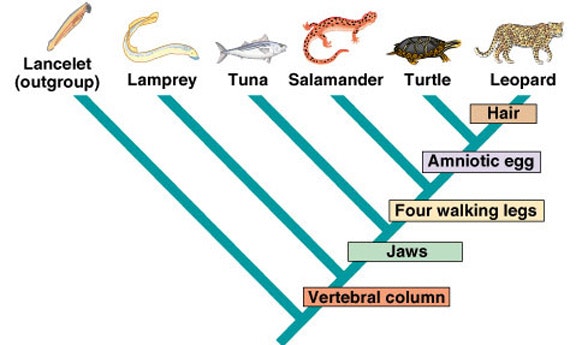
Which is the newest trait?

a)

Amniotic egg

b)

Walking legs

c)

Jaws

d)

Hair

50.

This diagram shows a cladogram of six species based on amino acid similarities. Which two species are most closely related?

a)

I and II

b)

II and IV

c)

I and V

d)

V and VI

51.

Which statement concerning the evolution of species A, B, C, D and E is supported by the diagram?

a)

Species B and C can be found in today's environments.

b)

Species A and D evolved from E.

c)

Species A and C can still interbreed.

d)

Species A, B, and E all evolved from a common ancestor and are all successful today.

52.

Of the choices listed, which species is the oldest?

a)

H

b)

D

c)

C

d)

A

53.

What is the most recent common ancestor of species G and H?

a)

B

b)

C

c)

D

d)

E

54.

Which two species are most closely related?

a)

H and B

b)

F and J

c)

F and H

d)

B and C

55.

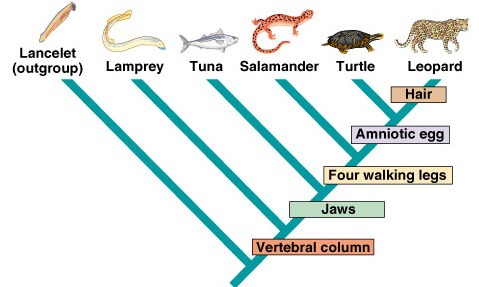
What trait separates lampreys from tuna on this cladogram?

a)

Hair

b)

Vertebral column

c)

amniotic egg

d)

jaws

56.
Structures with the same parts have different functions; suggests that organisms share a common ancestry
a)
vestigial structures
b)
homologous structures
c)
adaptive radiation
d)
fossil
57.
Study of embryos of various organisms to show a common ancestor because of similarities in development
a)
natural selection
b)
embryology
c)
speciation
d)
evolution
58.
Some organisms that share a common ancestor have features that have different functions, but similar structures.  These are known as
a)
vestigial structures
b)
analogous structures
c)
homologous structures
d)
fossil structures
59.
How do fossils provide evidence that evolution has happened on Earth?
a)
Fossils show how the sizes of certain animals has changed drastically over millions of years
b)
Fossils show that some species have gone extinct
c)
Fossils show how life forms present today are different than those from the past
d)
Different sedimentary rock layers provide evidence for how the environment has changed over time
60.
The diagram illustrates an embryonic stage of two organisms.

Which of the following can be determined by observing the embryos shown in the diagram
a)
The organisms share a common ancestry.
b)
The organisms belong to the same genus.
c)
The organisms are native to the same geographic areas.
d)
The organisms will grow into anatomically similar adults.
61.
Humans, birds, whales, and lizards all have similar arm bones. What is the reason for this?
a)
The function of these bones is the same in all animals
b)
They live in similar environments
c)
They have a common ancestor
d)
All organisms resemble humans
62.

Vestigial structures

a)

structures that perform a similar function but are not similar in origin

b)

remnants of once-important structures that have slowly lost all or most of their function

c)

features found in different organisms that share structural similarities but may have very different functions

d)

preserved remains of an organism

63.
Which layer is the youngest
a)
1
b)
2
c)
3
d)
4
64.
The changes of species over time
a)
Embryonic 
b)
Natural selection 
c)
Mimicry 
d)
Evolution 
65.

The picture shows a/an ___________

a)

homologous structure

b)

vestigial structure

66.

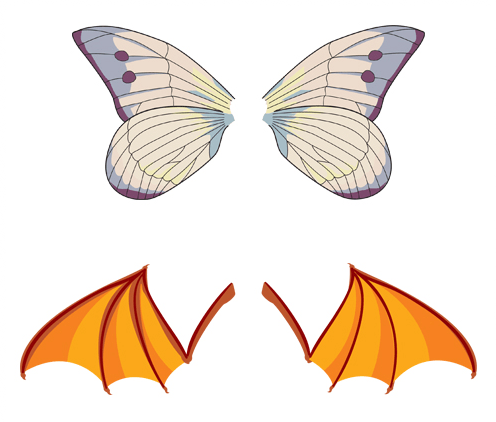
What is this an example of?

a)

Homologous structure

b)

Analogous structure

c)

Vestigial organs

d)

Functional adaption

67.
Study of embryos of various organisms to show a common ancestor because of similarities in development
a)
natural selection
b)
embryology
c)
speciation
d)
evolution
68.
How do fossils provide evidence that evolution has happened on Earth?
a)
Fossils show how the sizes of certain animals has changed drastically over millions of years
b)
Fossils show that some species have gone extinct
c)
Fossils show how life forms present today are different than those from the past
d)
Different sedimentary rock layers provide evidence for how the environment has changed over time
69.
The diagram illustrates an embryonic stage of two organisms.

Which of the following can be determined by observing the embryos shown in the diagram
a)
The organisms share a common ancestry.
b)
The organisms belong to the same genus.
c)
The organisms are native to the same geographic areas.
d)
The organisms will grow into anatomically similar adults.
70.

What best describes the hind leg bones seen in the whale?

a)

The bones are analogous structures to the fins of living fish.

b)

The bones are vestigial structures that had a function in an ancestor.

c)

The bones are homologous structures to the wings of butterflies.

d)

The bones are fossil structures from an extinct ancestor.
71.
Which layer is the youngest
a)
1
b)
2
c)
3
d)
4
72.
If two organisms have similar traits of DNA they are probably
a)
share a common ancestor
b)
share a common environment
c)
share a common population
d)
speciation
73.
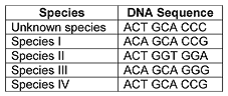
According to this data, the unknown bacterial species is most closely related to: 
a)
Species I
b)
Species II
c)
Species III
d)
Species IV