
 Worksheets
8th Grade Midterm Review
Total questions: 161
Worksheet time: 2hrs 29mins
Units used to measure Mass of an object
Centimeters
Milliliters
Grams

What is the name of this metric tool?
Triple Beam Balance
Graduated Cylinder
Massometer

Find the mass.
550.4 g
559.4 g
550.6 g

Find the mass.
285.3 g
275.5 g
275.3 g
What statement is true?
Mass never changes. Weight does.
Weight never changes. Mass does.
Both mass and weight change because they are affected by gravity.
Neither mass nor weight change. They are always the same.
What do you use to measure the mass of an object?


Weight is the measure of the force of ______ on an object.
Density
Mass
Matter
Gravity
Velocity
What unit of measurement is used for mass in physics?
Liters
Kilograms
Meters
Kelvins
Newtons
6) Which measurement would be different if you were on the Moon versus on Earth?
Mass
Weight
The law of _________ of mass states that the mass of a closed system must remain constant over time.
Weight
Density
Consistency
Elasticity
Conservation
The common tool used to measure length is the
graduated cylinder.
thermometer.
stopwatch.
meter stick.
An accepted international system of measurement, also known as SI units, is the
International System of Units
System of International Measurements
System of Intellectual Units
Units of International Measurement
The basic unit of volume in the metric system is
gram.
liter.
second.
meter.
How many centimeters are in a meter
1000
10
100
1
Mass - SI unit : kilogram
Temperature - SI unit : Celcius
What is volume?
the measure of the force of gravity
a measure of the energy of motion of the particles in a substance
the amount of space taken up by an object or substance
the measure of how much mass is contained in a given space
What is the SI unit for length?
m
N
kg
ml
In our chemistry lab, what unit would you use to measure temperature?
Kelvin (K)
Celsius (C)
Fahrenheit (F)
In our chemistry lab, what unit would you use to measure length?
meter (m)
inch (in)
centimeter (cm)
What is the SI base unit for amount of substance?
mole (mol)
iguana (iga)
shark (sk)
What does SI stand for?
So Ingenious
Incredible Science
International System of Units
Which SI unit is used to measure time?
K
s
mol
N
Which SI unit is used to measure mass?
s
m
kg
Pa
Which SI unit is used to measure length?
mol
m
kg
m2
What is the symbol for the prefix kilo-?
L
m
k
kg
Which SI unit is used to measure area?
m
m2
m3
kg/m3
The way something looks, feels, smells, and tastes are physical properties.
True
False

Ability of substance to dissolve into another substance:
magnetism
malleability
solubility
appearance

How a substance reacts to a magnet (attract or repel):
solubility
malleability
state of matter
magnetism

The final product of any physical change is still composed of the same matter.
True
False
Anything that has mass and takes up space.
(everything is made of this)
mass
matter
volume
reflectivity
ability for energy, such as electricity and heat, to move through an object.
conductivity
solubility
mass
volume
When matter reacts with fire?
toxicity
flammability
oxidation

color
physical property
chemical property

flammable
physical property
chemical property

hardness
physical property
chemical property

odor/smell
physical property
chemical property

tarnish/rust
physical property
chemical property

taste
physical property
chemical property

texture
physical property
chemical property

reactivity
physical property
chemical property
A property that can be observed WITHOUT changing the chemical composition of an object
chemical property
physical property
Which of the following is NOT a physical property?
flammability
melting point
density
luster
The temperature at which a liquid turns into a gas
melting poing
boiling point
At what temperature does water freeze?
0ᵒC or 32ᵒF
0ᵒF or 32ᵒC
100ᵒC or 212ᵒF
100ᵒF or 212ᵒC
Which of the following is NOT an example of a chemical reaction?
flammability
oxidation
reactivity
melting point
What is the formula for density?
volume/mass
volume x mass
mass/volume

the ability of a material to bend or be hammered into other shapes without breaking.
Ductility
Malleability
Toxicity
Solubility
Which of the following is true?
A physical property can only be seen.
A physical property describes how matter can change when exposed to air.
A physical property is something that can be observed about the substance by itself.
A physical property can only be observed when two types of matter interact.

Jack leaves solid butter near a warm surface. When Jack returns, the butter has turned into a liquid. Jack's friend Elijah insists this is a chemical change. Is Elijah right?
no, because no new matter was formed
yes, because the matter changed states
no, because the butter didn’t have enough time to go through a chemical change
yes, because melted butter is a new type of matter
When you increase the energy by heating a liquid what happens to the motion of the molecules
They slow down
They speed up
Heat doesnt change the motion of the molecules

Is this an example of a physical or chemical change?
physical
chemical

Is this an example of a physical or chemical change?
physical
chemical
Which of these actions cause a PHYSICAL change?
rusting of metal pipes
burning a log
cooking an egg
crushing an aluminum can
Rusting metal is an example of a ____ change.
chemical
phase
state
physical
Salt water, a mixture, is made by dissolving salt in water. Mixtures like this can be separated by using the physical properties of the mixture. Which would be the best way to separate a mixture made of salt and water?
evaporation
chromotography
magnetism
filtering
Which is an example of a chemical change?
baking a cake
ripping paper
stretching a rubber band
chopping wood
Which of the following options provides evidence of a CHEMICAL change?
Wood is burned releasing ash and smoke
Rocks separate when soil is sifted
Boiling water bubbles when heated
Salt dissolves in water

Use the basic properties of solids, liquids, and gases to identify the correct state of matter in the image.
(A) gas, (B) liquid, (C) solid
(A) solid, (B) liquid, (C) gas
(A) liquid, (B) solid, (C) gas
(A) solid, (B) gas, (C) liquid
What is physical change?
How two chemicals react with one another when combined
A property that we can measure or observe with our 5 senses or other tools
When two chemicals react with one another to form a new substance
When a change occurs but it does not result in the formation of a new substance

The three types of mixtures are..
solutions, solutes, solvents
solutions, colloids, suspensions
solutions, colloids, sediments
concentrates, dilutes, dissolvers
If a substance is soluble is means...
that it can dissolve into another substance
that it cannot dissolve into another substance
it must be a concentrated substance
it must be a diluted substance
An example of an insoluble substance would be..
cordial in water
chocolate power in milk
sugar in water
oil in water
A suspension is a mixture that has
a solute and a solvent
a sediment
a cloudy appearance
oil in it
Which best describes the word sediment?
a substance that something else can dissolve into
small particles that easily dissolve
medium sized particles that block light
large particles that settle to the bottom of a mixture
A feature of a colloid is that..
they are cloudy
they are transparent
they are colourless
they have a sediment
Solutions has ______________ sized particles, colloids have _________________ sized particles, and suspensions have _________________________ sized particles.
small, medium, large
large, medium, small
medium, small, large
medium, large, small

Fog
Solution
Colloid
Suspension

Soda
Colloid
Solution
suspension

Sand in water
colloid
solution
suspension

Sunscreen
Colloid
Solution
Suspension

Milk
Colloid
Solution
Suspension

Snow globe
Colloid
Solution
Suspension

Vinegar
Colloid
Solution
Suspension

Brass
Homogenous
Heterogeneous

Mayonnaise
Homogeneous
Heterogeneous

Italian dressing
Homogeneous
Heterogeneous

What is it called when light passes through a colloid and scatters/spreads out?
Tyndall Effect
Fog Effect
Timer Effect
Substance Effect
Transition from a liquid to a gas
Condensation
Freezing
Evaporation
Melting
Gas condenses to a liquid
Evaporation
Melting
Freezing
Condensation
What happens to molecules when their kinetic energy increases?
The molecules move slower
The molecules move faster
The molecules get heavier
It depends on the type of molecule

Three containers with the same amount of the same material are shown below. Which container has the substance with the highest amount of energy?
The container on the left
The middle container
The container on the right
All have an equal amount of energy
Three containers with the same amount of the same material are shown below. Which container has the substance with the lowest amount of energy?
The container on the left
The middle container
The container on the right
All have an equal amount of energy
Amy was sitting outside on a hot, summer day, enjoying a glass of sweet iced tea. She notices some water droplets on the outside of her glass. What is causing those water droplets?
The outside air is heating up the ice, causing it to melt into a liquid.
The cold liquid in the glass is cooling the air around it, making it condense into a liquid.
The outside air is heating up the liquid in the glass, causing it to evaporate.
The liquid in the glass is cooling the air around it, causing it to evaporate.
When you boil water in a pot, some of the water escapes as steam. Which of the following choices explains what is happening with the water molecules in this scenario?
The molecules slow down as the kinetic energy increases and move farther apart from one another.
The molecules slow down as the kinetic energy decreases and move closer together.
The molecules speed up as the kinetic energy increases and the molecules move farther apart from one another.
The molecules speed up as the kinetic energy decreases and the molecules move closer together.
Which statement best describes what happens when heat is added to a substance?
Energy moves out of the substance causing the molecules to slow down.
Energy moves out of the substance causing the molecules to speed up.
Energy moves into the substance causing the molecules to slow down.
Energy moves into the substance causing the molecules to speed up.
The slower the particles in a substance move,
the colder it is.
the warmer it is.
the more energy it has.
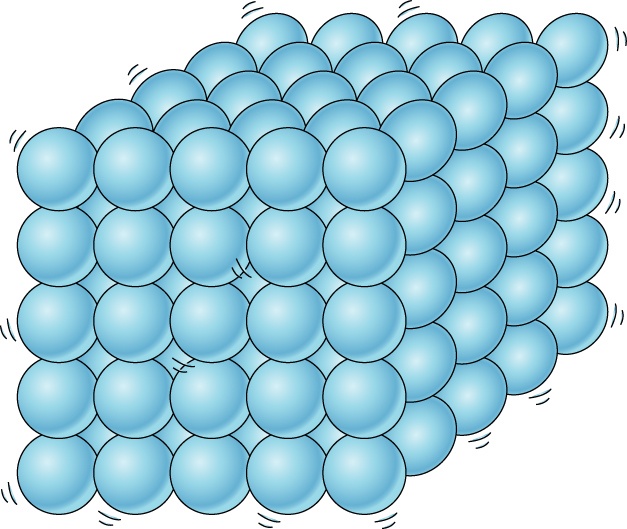
What state of matter?
Solid
Liquid
Gas
Plasma!!!
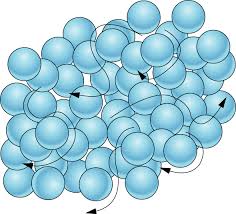
What state of matter?
Solid
Liquid
Gas
Transition from a solid to a liquid
Condensation
Melting
Freezing
Evaporation
Transition from a liquid to a solid
Freezing
Sublimation
Melting
Evaporation
In which time period are we currently living?
Precambrian Time
Paleozoic Era
Mesozoic Era
Cenozoic Era
Dinosaurs, small mammals, and birds are found in this time period.
Precambrian
Paleozoic
Mesozoic
Cenozoic
What are fossils that are abundant, easily recognizable, short lived, and widespread called?
Preserved fossils
Index fossils
Imprints
Radioactive dating
Preserved remains of plants and animals from the remote past are called?
Sedimentary rocks
Radioactive dating
Decayed organisms
Fossils
The Law of Superposition states
Younger rocks layers are on top of older rock layers
Fossils are found in sedimentary rocks
Older rock layers are on top of younger rock layers
Absolute age dating
Which era was the longest, taking up 88% of geologic time?
Precambrian
Paleozoic
Mesozoic
Cenozoic
What does absolute age tell us about a rock layer or fossil?
The 'exact' age of a fossil determined by radiometric dating
The relative age of a fossil determined by radiometric dating
Younger rock layers sit on top of older rock layers
Older rock layers sit on top of younger rock layers

Which fossil would make the best index fossil?
Beetle
Flower
Frog
Fish
Which of the following organizes the divisions of geologic time from longest to shortest?
eons, eras, periods, epochs
epochs, periods, eras, eons
periods, eons, epochs, eras
eras, epochs, eons, periods
Which series shows the divisions of geologic time arranged in order, from longest to shortest?
eon>era>epoch> period
eon>era>period> epoch
era>eon>epoch>
period
era>eon>period> epoch
Which of the following is used as evidence to construct the geologic time scale?
fossils
radiometric age data
comparative studies of different rock sequences
all of the above
Which of the following is NOT a division of geologic time?
eons
periods
generations
epochs
_________ is a space in rock in the shape of a living thing.
trace fossil
body fossil
cast fossil
mold fossil
________ is when minerals harden into the shape of the mold.
trace fossil
cast fossil
mold fossil
body fossil
All matter is made of _________.


Atoms are made up of ________________
energy
electrons
subatomic particles
gasses

The subatomic particles that make up an atom.
solid, liquid, gas
electrons, protons, nucleus
energy, protons, nucleus
electrons, protons, neutrons

__________ are negatively charged particles that are in the orbitals around the nucleus.
protons
nucleus
neutrons
electrons

A proton has a ___________ charge.
positive
negative
neutral
massive.
An electron has a _________ charge
positive
neutral
negative
massive
A neutron has _________ charge or is ________.
negative ... neutral
positive .... neutral
no .... negative
no ... neutral


The smallest part of any element. Made up of protons, neutrons and electrons.
Atom
AMU
Ion
Isotope
Which TWO of the following subatomic particles are inside the nucleus?
protons
electrons
neutrons
There are no subatomic particles in the nucleus of an atom.
What is the correct formula for calculating how many neutrons are in an atom?
Protons + Electrons= Neutrons
Atomic mass - Atomic number= Neutrons
Atomic mass + Atomic number = Neutrons
Atomic mass - Protons = Neutrons

How many neutrons does nitrogen have?
7
14
0
6

What is the atomic number of this atom?
2
4
6
8

What is the atomic number of this element?
17
18
35
35.453

Use the periodic table below to determine the number of protons in Bromine (Br).
35
79.904
36
83.798

Use your periodic table to determine the number of protons in Neon (Ne).
18.998
20.18
10
12

What is the atomic mass for this element? (Round to the nearest WHOLE number.) (This information for this element can be found on the periodic table!)
11
19
24
23

The sum of the number of protons and the number of neutrons is called the _____
Atomic Number
Atomic Mass
Atomic Symbol
Atomic Name

In the Bohr model of the atom, what is the maximum number of electrons in the first shell?
2
8
1
6
•What elementary particles are the building blocks for protons and neutrons?
•Quarks
• Leptons
• Photons
• Gluons

Name the type of graph.
pie chart
tally chart
pictograph
bar graph

Name the type of graph.
pie chart
tally chart
pictograph
bar graph

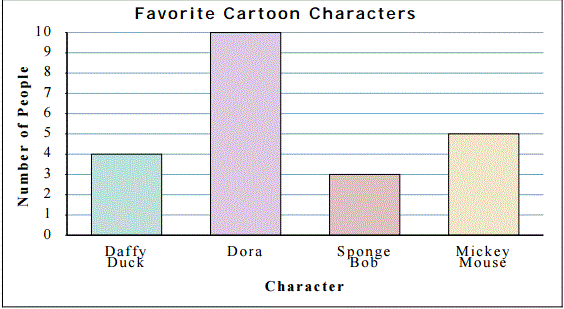


Bar Graph
Circle Graph

What two properties do you need to find density?
Volume and weight
Mass and volume
Only volume
Only mass
The formula for finding density is:
The volume divided by the mass.
The mass multiplied by the volume.
The mass divided by the volume.
The volume multiplied by the mass.

The mass of the jade is 13g, what is the density?
1.3 g/mL
0.81 g/mL
1.24 g/mL
0.77 g/mL

What is the same about the cubes?
Density
Weight
Mass
Volume

What is this tool called....
Ruler
Thermometer
Beaker
Graduated Cylinder
What is the density of water?
34 g/mL
1 g/mL
29 g/mL
6 g/mL

