
 Worksheets
Biological molecules
Total questions: 91
Worksheet time: 1hrs 1mins
Bonds between multiple water molecules are called ____________.
Hydrogen Bonds
Covalent Bonds
Ionic Bonds
Water Bonds
Bonds that hold a water molecule together are called ____________.
Covalent Bonds
Ionic Bonds
Hydrogen Bonds
Water Bonds

There are partial charges within a water molecule which cause water to have special properties. This makes water a ________ molecule.
Polar
Nonpolar
Hydrophobic
Ionic
When water rises up a thin straw or moves up a tree from the roots to the leaves, it is called _____________.
Capillary Action
Surface Tension
Heat of Vaporization
Density of Water
Water is liquid at room temperature and takes a lot of energy (heat) to reach the boiling point and turn to a vapor. What is this called?
Heat of Vaporization
Cohesion
Heat of Fusion
Surface Tension
Very light insects can sit on top of water because of
Water's High Heat of Vaporization
Surface Tension
Water's High Specific Heat
Capillary Action
What makes water a universal solvent?
It is a polar molecule that can form hydrogen bonds, allowing it to dissolve many substances.
It is a nonpolar molecule that can form hydrogen bonds, allowing it to dissolve many substances.
It is a polar molecule with a low specific heat, allowing it to dissolve many substances.
It is a nonpolar molecule with a low specific heat, allowing it to dissolve many substances.
What property allows water molecules to stick to each other to form drops?
Cohesion
Adhesion
Surface Tension
Capillary Action
Why is it important that water has a high heat of vaporization and high specific heat capacity?
If they were lower, water would change temperatures and evaporate much faster.
If they were lower, there would be too much water on the Earth.
The properties allow for the rapid change of temperature and vaporization of water.
These properties allow water to freeze at high temperatures.
What is the monomer that makes up carbohydrates?
Monosaccarides
Fatty Acids
Amino Acids
Nucleotides

The bonds that join monosaccharides are called:
Glycosidic Bonds
Cellulose, starch and glycogen are examples of:
monosaccharides
disaccharides
lipids
polysaccharides

What is the following molecule?
alpha glcuose
beta glucose
amino acid
disaccharide
Glucose, fructose and galactose are examples of:
monosaccharides
disaccharides
lipids
polysaccharides
Sucrose, maltose and lactose are examples of:
monosaccharides
disaccharides
lipids
polysaccharides
Sucrose
Glucose + fructose
Lactose
Glucose + galactose
Maltose
Glucose + glucose
Which polysaccharide is used by plants to store glucose?
glycogen
cellulose
starch
chitin
What is the polysaccharide used by animals to store glucose?
glycogen
fructose
starch
cellulose
Which polysaccharide is used by plants to make their cell wall?
starch
glycogen
cellulose
chitin

Monomers of Lipids include
amino acids
monosaccharides
nucleotides
glycerol and fatty acids
Which of the following is a main function of a lipid?
source of quick energy
stores energy, insulates us, and makes up the cell membrane
transport substances in and out of the cell
stores genetic information
A triglyceride is made up of __ glycerol and __ fatty acids.
3; 1
1; 3
1; 2
What is the monomer that makes up triglycerides?
Monosaccarides
Fatty Acids
Amino Acids
Nucleotides

What is the following molecule?
triglyceride
phospholipid
steroid
protein

What is the following molecule?
glucose
saturated fat
unsaturated fat
peptide

The bonds that join fatty acids and glycerol to form triglycerides are called:
Glycosidic Bonds

Which type of molecule is shown?
saturated fatty acid
unsaturated fatty acid
cholesterol
starch
Lipid molecules used primarily for storing energy
phospholipid
triglyceride
fatty acid
saturated fatty acid
Which of these form a triglycerides?
two fatty acids + one glycerol + nitrogen group
three fatty acids + one glycerol
four carbon rings
Which of the following elements make-up Lipids?
Carbon, Hydrogen, Oxygen
Oxygen, Nitrogen, Hydrogen, Carbon
Carbon, Hydrogen, Oxygen, Nitrogen, Sulfur
speeding up chemical reactions
transporting things through cell membranes
What is a long chain of amino acids called?
Polysaccharide
Lipid
Carbohydrate
Polypeptide
Nucleic acid

What is the name of the bond that joins two amino acids together?
Ester bond
Glycosidic bond
Peptide bond
Nucleic bond
Which protein structure describes the sequence of amino acids?
Primary
Secondary
Tertiary
Quaternary
Alpha helix and beta sheet are examples of what type of protein structure?
Primary
Secondary
Tertiary
Quaternary
Which protein structure describes a protein's three-dimensional shape?
Primary
Secondary
Tertiary
Quaternary
Which protein structure is only found in proteins with more than one polypeptide chain?
Primary
Secondary
Tertiary
Quaternary
Which of the following can cause protein denaturation?
High heat
Cold temperatures
Strong acids
Strong bases
High pressure

Condensation
Hydrolysis
Pepysis
Oxidation

Each amino acid is different from the other due to....
The R group
The amino group
The carboxyl group
The central carbon

Which colored box highlights the amino group?
Blue (left)
Turquoise (top)
Orange
Red
Purple

Which colored box is different for every amino acid?
Blue (left)
Turquoise (top)
Orange
Red
Purple

Which colored box highlights the carboxyl group?
Blue (left)
Turquoise (top)
Orange
Red
Purple
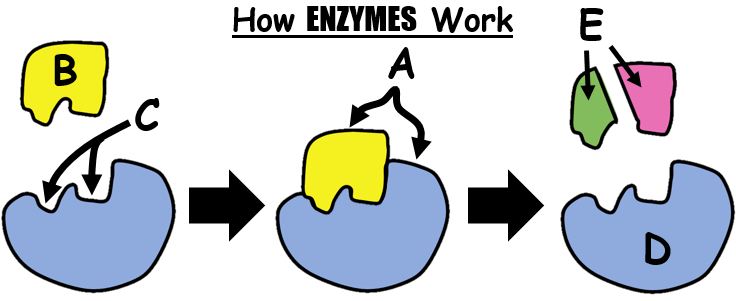
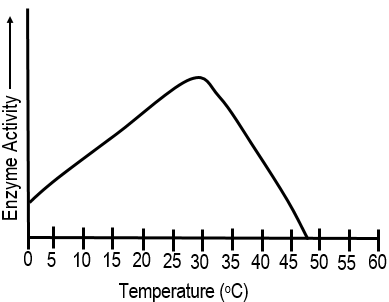
What happens to the reaction rate if an enzyme is denatured or nonfunctional?
No change in the reaction rate
Increase in reaction rate
Decrease in reaction rate
Decrease then increase in reaction rate
How does a noncompetitive inhibitor decrease reaction rates?
Binds to the active site
Binds to the allosteric site
Increases the free energy
Increases the substrate concentration
Which of the following is a way to overcome competitive inhibition of an enzyme?
Increase product concentration
Increase substrate concentration
Decrease enzyme concentration
Decrease environmental temperature
Which of the following would NOT denature an enzyme?
HIGH temperature
LOW pH
HIGH pH
LOW temperature
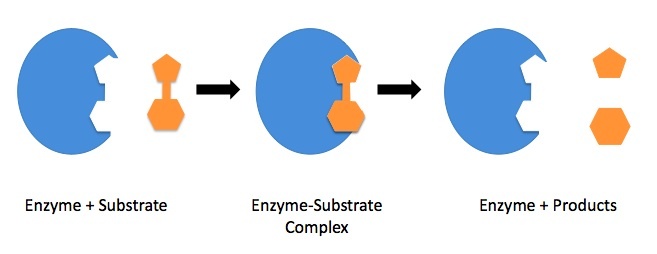
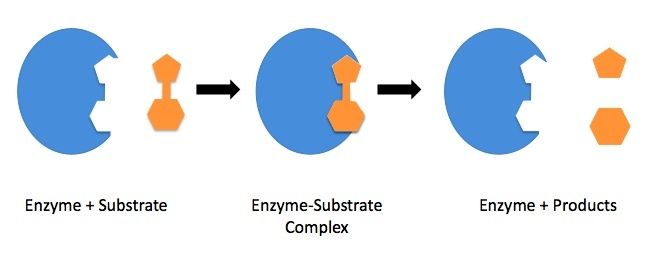
A receptor site that a molecule can bind to that changes the shape of the active site is called a(n):
Allosteric Site
Active Site
Activation site
Reactant site
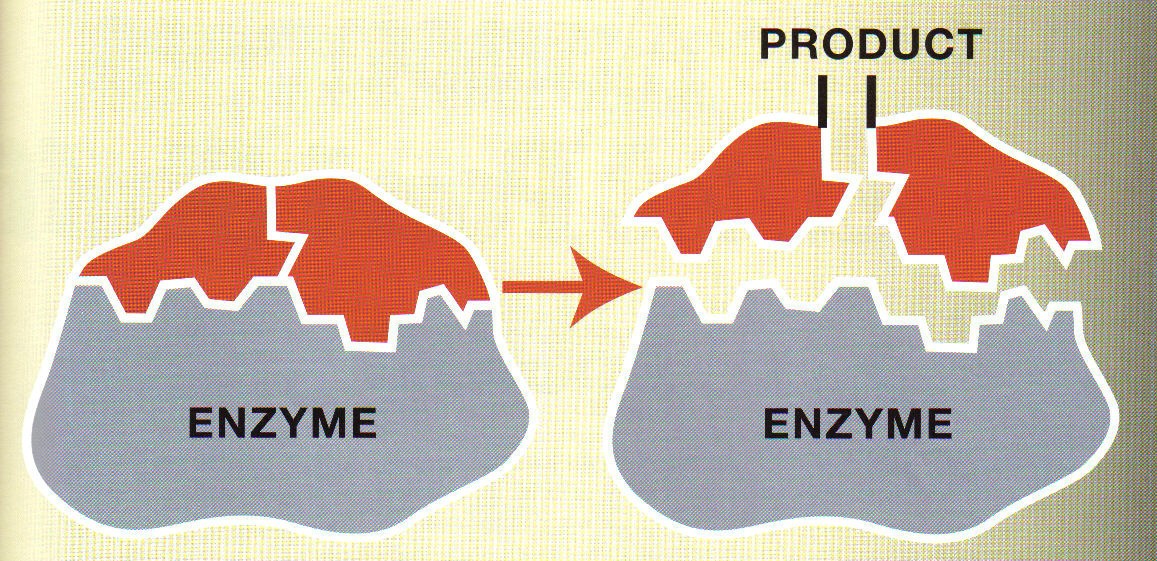
Molecules that bind to enzymes and enhance an enzyme's ability are called:
CoFactors
Competitive Inhibitors
Allosteric Inhibitors

You perform an enzyme-controlled reaction. Based on your results, which of the following is true?
The enzyme works best when the pH is alkaline
The enzyme was most active at pH 4.6
The temperature must have increased and then decreased during the course of the experiment
The salinity was altered during the experiment
Which of the following is NOT true about allosteric regulation?
Regulatory molecules will bind to a place on the enzyme that is not the active site
It can amplify or inhibit enzyme activity
Allosteric inhibitors will compete with substrate for the active site
It helps a cell regulate its metabolism
Which of the following can be used to determine the rate of an enzyme-catalyzed reaction?
The rate of substrate formed
The decrease in temperature in the system
The rate of enzyme used up
The rate of substrate used up
DNA is a nucleic (a) .
The backbone of the DNA ladder is made of what two things?
deoxyribose sugars and phosphate groups
nitrogen bases and hydrogen bonds
phosphate groups and nitrogen bases

The steps, or rungs, of a DNA ladder are formed from nitrogen bases joined together by which?
peptide bonds
hydrogen bonds
phosphodiester bonds
Adenine, Thymine, Cytosine, and Guanine are what?
nitrogen bases
amino acids
hydrogen bonds
sugars
in DNA, the nitrogen base adenine pairs with which?
thymine
cytosine
guaning
uracil
in DNA, the nitrogen base cytosine pairs with which?
thymine
adenine
guanine
uracil

If a template strand of DNA reads AAA, type in its complementary strand sequence.
(a)
If a template strand of DNA reads CCC, type in its complementary strand sequence.
(a)
If a template strand of DNA reads AATT, type in its complementary strand sequence.
(a)
If a template strand of DNA reads CTAAG, type in its complementary strand sequence.
(a)

If a DNA template strand sequence reads TAC-GGA-CGA, what is its complementary sequence in the other strand?
TAC-GGA-CGA
ATG-CCT-GCT
AAA-CCC-GGG-TTT
GAT-GTG-CCA

The DNA replication process produces duplicate DNA molecules that are half original parent DNA and half new nucleotides. Which term is used to describe this?
semiconservative
fully conservative
pseudo conservative
filthy liberal
Which is NOT true of RNA?
it's single stranded
it's double stranded
there are three types
it moves around the cell

What are these structures called?
Centrioles
Centromeres
Chromosomes
Chromatin
A segment of DNA is 40% thymine. How much guanine is present?
25%
60%
100%
10%

The diagram represents a small piece of DNA. Which number represents hydrogen bonds?
1
2
3
4
Imagine that all ribosomes in a cell are destroyed. Which would be true?
The cell couldn't build carbs
The cell couldn't build proteins
The cell couldn't replicate DNA
The cell would be unaffected

What does the region labeled "A" represent?
A gene
A chromosome
A protein
A nucleotide
ATP stands for:
adenine triphosphorus
adenine triphosphate
adenosine triphosphate
What kind of biomolecule is it classified as?
nucleic acid
protein
carbohidrate
lipid
ATP is composed of three parts:
sugar
phosphate
base
lipid
The cell produces ATP through three different processes: aerobic respiration, anaerobic respiration and fermentation.
True
False
What molecule is broken down to produce ATP?
phosphate
adenosine
ribose
glucose
Who needs ATP?
bacteria
humans
fungi
plants
All of them!
When ATP is hydrolyzed, it consumes energy.
True
False
How is the energy released?
Water breaks the bond of the third phosphate and it becomes a more stable molecule, releasing energy.
Water adds a fourth phosphate and it becomes a more unstable molecule, an exergonic reaction.
Glucose attaches to the phosphate, creating a bond that releases energy.
What does ATP do?
Transports proteins and molecules.
Produces glucose for energy.
Provides energy for cellular processes.

