wayground logo

Free Printable Worksheets

Font size

S
M
L
XL
Worksheets

Midterm Exam Review

Total questions: 97

Worksheet time: 2hrs 39mins

Name
Class
Date
1.

If you conduct an experiment where you place 5 of the same red candies in different types of soda, all in the same amount of liquid and same type cups the indipendent variable is what? 

a)

Kind of soda

b)

Type of cup

c)

Amount of soda

d)

Color of candy

2.

If you are testing the buoyancy (galleggiabilità) of a cotton ball and you leave one plain, cover one half in oil, and cover the third in oil completely then place each in water, what is the independent variable?

a)

Time

b)

Water

c)

Cotton ball

d)

Amount of oil

3.

According to the graph, which animal has a life span that is longer than a giraffe's but shorter than a lion's?

a)

Tiger

b)

Chipmunk

c)

Camel

d)

Mouse

4.

A brown paper bag is filled with color tiles for a science experiment. How many tiles are in the bag?

a)

48

b)

20

c)

25

d)

50

5.
What is a dependent variable?
a)
A variable being tested in an experiment.
b)
A variable that changes depending on another variable.
c)
A variable that is kept the same in an experiment.
6.
What is a controlled variable?
a)
A variable being tested in an experiment.
b)
A variable that changes depending on another variable.
c)
A variable that is kept the same in an experiment.
7.
Glucose is a _____.
a)
carbohydrate
b)
lipid
c)
protein 
d)
nucleic acid
8.
Proteins are composed of what smaller building blocks?
a)
amino acids
b)
nucleic acids
c)
fatty acids
d)
nucleotides
9.
Which group of organic molecules serve as long-term energy storage and make the cell membrane is?
a)
proteins
b)
carbohydrates
c)
lipids
d)
nucleic acids
10.
The primary purpose the body uses monosaccharides for is?
a)
Building muscles
b)
Helping the Immune System
c)
Immediate Energy
d)
Generating Heat
11.
Building blocks of polymers.
a)
monomer
b)
polypeptide
c)
monosaccharide
d)
glycerol
12.
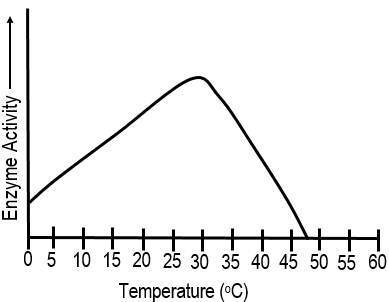
Based on the graph, what temperature does this enzyme work best? 
a)
15 C
b)
40 C
c)
30 C
13.
Which of the following binds to the active site of an enzyme? 
a)
substrate
b)
product
c)
codon
d)
none of the above
14.
Letter C...
a)
active site
b)
enzymes
c)
substrate
d)
products
15.
Enzymes are
a)
nucleic acids
b)
proteins
c)
lipids
d)
carbohydrates
16.

Which is the wrong polymer/monomer pair?

a)

nucleic acids : nucleotides

b)

lipids: monosaccharides

c)

carbohydrates: monosaccharides

d)

proteins : amino acids

17.
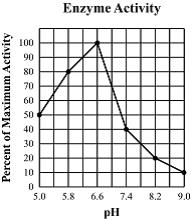
Which of the following conclusions can be drawn from this graph?
a)
The optimum pH of the enzyme is 6.6.
b)
The optimum pH of the enzyme is 5.8
c)
The enzyme’s activity increases as pH increases 5.0 to 9.0
d)
The enzyme’s activity is greater around pH of 8.0 .
18.
What is the purpose  of an enzyme?
a)
give permission for the reaction
b)
raise activation energy
c)
speed up reactions
d)
control how many reactions occur
19.
What is the function of nucleic acids?
a)
store genetic information
b)
store energy (long-term)
c)
store energy (short-term)
d)
build skin, hair, nails, muscles
20.
Carbohydrates are made of... 
a)
C H O
b)
C H O N
c)
C H O N P
d)
C H O N S
21.

What organelle acts as a clean up crew and breaks down waste products?

a)

Nucleus

b)

Lysosome

c)

Mitochondria

d)

Golgi Apparatus

22.

What provides external support to the cell in plants?

a)

Cell membrane

b)

Cell wall

c)

Chloroplast

d)

Nucleus

23.

Converts food into energy for the cell

a)

Nucleus

b)

Golgi Apparatus

c)

Mitochondria

d)

Lysosome

24.

Simple cells that have no nucleus or membrane bound organelles

a)

Prokaryotes

b)

Eukaryotes

c)

Plant cells

d)

Animal cells

25.

Where are proteins made?

a)

Cell membrane

b)

Mitochondria

c)

Ribosomes

d)

Golgi Apparatus

26.

Which one is a phospholipid bilayer that controls what enters and leaves the cell?

a)

Cell wall

b)

Cell membrane

c)

Ribosomes

d)

Vacuole

27.

What is number 2?

a)

Mitochondria

b)

Chloroplast

c)

Golgi Apparatus

d)

Nucleus

28.

What is number 9

a)

Chloroplast

b)

Smooth Endoplasmic Reticulum

c)

Mitochondria

d)

Vacuole

29.

What is the large blue oval looking structure?

a)

Chloroplast

b)

Mitochondria

c)

Smooth ER

d)

Vacuole

30.

This image is an example of a phospholipid. Which part of a phospholipid is HYDROPHILIC?

a)

the phosphate "head"

b)

the lipid "tails"

31.

What does "hydrophilic" mean?

a)

water loving, associates with water

b)

water fearing, does not associate with water

c)

a world war II submarine

d)

an example would be solutes like oil or fat

32.

The animal cell on the left is in a(n) __________________ environment

a)

Hypertonic

b)

Hypotonic

c)

Isotonic

33.

Some celery sticks were placed in distilled water. What type of solution are they in? What will happen to the celery sticks?

a)

hypotonic, the celery sticks increase in size

b)

hypertonic, the celery sticks reduce in size

c)

isotonic, the celery sticks remains in size
34.

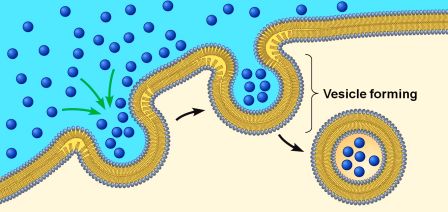
Which form of active transport is being shown?

a)

Facilitated Diffusion

b)

Exocytosis

c)

Endocytosis

d)

Proton pump

35.
Osmosis is the movement of _____ across a membrane.
a)
food
b)
energy
c)
oxygen
d)
water
36.

The movement of particles from an area of high to low concentration is known as--

a)

Passive Transport

b)

Active Transport

37.

What is it called when large molecules move across the cell membrane from an area of high concentration to an area of low concentration through a protein channel?

a)

Diffusion

b)

Osmosis

c)

Active Transport

d)

Facilitated Diffusion

38.

How does a cell maintain homeostasis?

a)

By controlling what enters and leaves the cell

b)

Flexibility

c)

Protective barrier

d)

Structure and support

39.

Cell membrane transport that occurs without energy is called--

a)

active transport

b)

endocytosis

c)

passive transport

d)

exocytosis

40.

What is the name of the process in which small molecules move from an area of high concentration to an area of low concentration across the cell membrane

a)

Diffusion

b)

Osmosis

c)

Active Transport

d)

Facilitated Diffusion

41.
What is the difference between active and passive transport?
a)
Active does not need energy and passive uses ATP (energy)
b)
Active uses ATP (energy) and passive does not need energy
c)
Active stores transport proteins and passive releases 
d)
Active uses hormones and passive does not 
42.

The movement of molecules from low to high is known as

a)

simple diffusion

b)

facilitated diffusion

c)

active transport

d)

osmosis

43.
This cell structure helps organisms maintain homeostasis by controlling what substances may enter or leave cells.
a)
vacuole
b)
nucleus
c)
cell membrane
d)
cell wall
44.
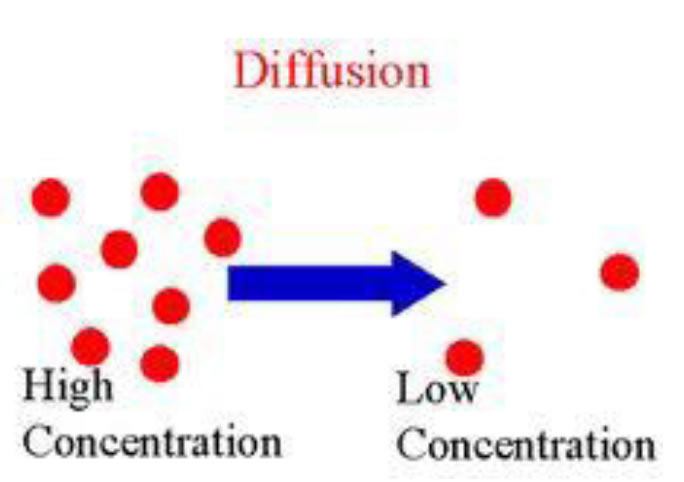
The picture is an example of...
a)
active tranport
b)
passive transport
c)
diffusion
d)
osmosis
45.

DNA stands for

a)

Dioxyribo Nucleic Acid

b)

Dunder Nucleic Acid

c)

Dopamine Nucleic Acid

d)

Deciduous Nucleic Acid

46.

What are the parts of a nucleotide?

a)

phosphate, sugar, base

b)

A, T, G, C

c)

Nucleic Acids

d)

two base pairs connected

47.

Which of the following is correctly matches: ATT GTA CGA

a)

TAA CAT GCT

b)

ATT GTA CGA

c)

TAA GTA TCG

d)

GCC ACG TAC

48.

The 'backbone' or 'ribbon' of the DNA strand is made of:

a)

phosphate and sugar

b)

phosphate only

c)

phosphate and base

d)

sugar and base

49.

What is this a picture of?

a)

nucleotide

b)

DNA strand

c)

chromosome

d)

gene

50.

Hydrogen bonds occur:

a)

on the ribbon (between the sugar)

b)

between the bases

c)

only between A & T

d)

only between G & C

51.

Which of the following correctly matches: GCT AGA TCG

a)

CGA TCT AGC

b)

TAG CTC GAT

c)

ATC GAG CTA

d)

ATG CTC CGT

52.
What phase of mitosis is occuring in the picture?
a)
Prophase
b)
Metaphase
c)
Cytokinesis
d)
Telophase
53.
In which phase does the cell spend most of it's life?
a)
Interphase
b)
Nuclear Division
c)
Telophase
d)
Mitosis
54.
What phase of mitosis is pictured?
a)
Metaphase
b)
Telophase
c)
Prophase
d)
Anaphase
55.
Which of the following is NOT occuring during interphase?
a)
Cell growth
b)
DNA being copied
c)
DNA condensing
d)
Two new cells are made
56.

What is the next phase of mitosis?

a)
Prophase
b)
Metaphase
c)
Anaphase
d)
Telophase
57.

What are the "X" shaped things in the drawing.

a)

PMATs

b)

Chromosomes

c)

Ribosomes

d)

Telophase

58.

In which phase of Mitosis do the Chromosomes pull Apart

a)

Metaphase

b)

Prophase

c)

Anaphase

d)

Telophase

59.
DNA is replicated during the ______ phase of the cell cycle.
a)
G1
b)
Synthesis
c)
G2
d)
G0
60.
What do the cells look like at the end of mitosis?
a)
different from original cell
b)
similar to the original cell
c)
identical to the original cell
d)
none of these
61.

Which of the following is a base pair?

a)

Adenine - Cytosine

b)

Cytosine - Thymine

c)

Deoxyribose - Cytosine

d)

Cytosine - Guanine

62.
Responsible for creating sex cells are gametes called sperm and egg. 
a)
Meiosis
b)
Mitosis
c)
Metaphase I
d)
Photosynthesis
63.
What type of cells does meiosis produce? 
a)
2 Genetically identical cells
b)
2 Genetically different cells
c)
4 genetically identical cells
d)
4 genetically different cells
64.
A human being has a somatic cell that has 46 chromosomes.  What is the haploid number found in a gamete?
a)
23
b)
46
c)
69
d)
92
65.
A heterozygous yellow pea plant's genotype would be:
a)
YY
b)
yy
c)
Yy
d)
Yg
66.
A corn plant heterozygous for tall sprouts mates with a corn plant with short sprouts. If tall sprouts are dominant, how many different phenotypes are possible in the offspring?
a)
1
b)
2
c)
3
d)
4
67.
If T=Tall & t=short, what is the genotypic ratio?
a)
1:3
b)
3:1
c)
1:2:1
d)
2:2
68.
If a heterozygous tall pea plant is crossed with a short pea plant, what are the possible genotypes of the future offspring?
a)
100% Tt
b)
50% Tt, 50% tt
c)
75%Tt, 25%tt
d)
25%TT, 50%Tt, 25%tt
69.
A dog gives birth to 5 puppies. What percentage of the chromosomes does each puppy share with the mother?
a)
25%
b)
50%
c)
75%
d)
100%
70.
This is an example of ___________?
a)
Incomplete dominance
b)
Co-Dominance
71.
What type of inheritance do two alleles have if their traits blend together? 
a)
Incomplete Dominance
b)
Co-Dominance
72.

Some flowers are controlled by codominance. Red flowers (RR), blue flowers (BB) and Speckled flowers (RB).


Cross a red flower with a speckled flower. What is the phenotypic ratio?

a)

2 red, 2 speckled

b)

2 red, 2 blue

c)

2 blue, 2 speckled

73.

In mice coat color is incompletely dominant. Black and white are homozygous. Brown mice are heterozygous.


What is the genotype for a brown mouse?

a)

BB

b)

Bb

c)

bb

74.

In cattle red coats are represented as RR, and white coats are represented as WW.


What is the genotype for Roan color?

a)

RR

b)

RW

c)

WW

75.
What gamete possibilities could come from this parent's genotype?
a)
AB, AB, aB, aB
b)
Ab, AB, Ab, ab
c)
Ab, Ab, Ab, Ab
d)
AB, aB, ab, aB
76.
What goes in box 1
a)
AABb
b)
AABB
c)
aabb
d)
AaBb
77.
What genotype is missing from this Punnett Square?
a)
RrYy
b)
RRYY
c)
rryy
d)
RrYY
78.
Based off this punnett square, what fraction of the offspring will have wrinkled, yellow seeds?
a)
9/16
b)
3/16
c)
1/16
d)
16/16
79.
Which of the following genotypes is homozygous dominant?
a)
A
b)
Aa
c)
AA
d)
aa
80.
parent 1: GgBB
parent 2: ggBb
Find the gametes for parent 1.
a)
GB, GB, gB, gB
b)
gB, gb, gB, gb
c)
Gg, BB, GB, GB
d)
gg, Bb, gB, gb
81.
A process in which DNA has the unique ability to make an exact copy of itself.
a)
Replication
b)
Translation
c)
Transcription
82.
RNA contains the sugar
a)
ribose
b)
deoxyribose
c)
glucose
d)
lactose
83.

Transcribe the following DNA strand: CTG AAT

a)

GAC TTA

b)

CTG AAT

c)

GAC UUA

d)

CUG AAU

84.
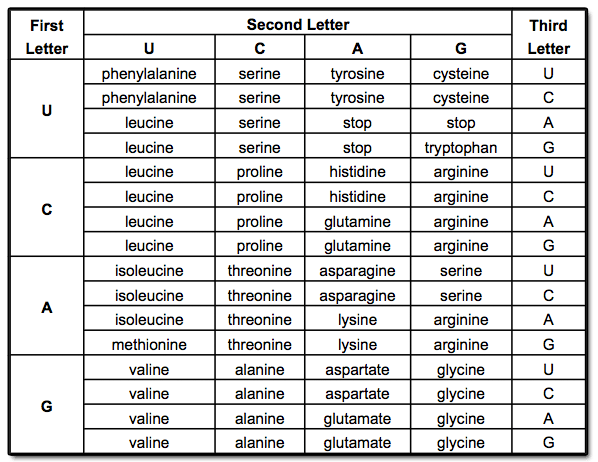
What is the correct amino acid sequence for the mRNA code AUGCCAGUAUGA
a)
Met-Pro-Ala-Val
b)
Met-Pro-Val
c)
Tyr-Gly-His
d)
Tyr-Gly-Arg-His
85.
The anti-codon 
a)
contains a sequence the same as the codon
b)
contains a sequence complementary to the codon 
c)
contains the base thymine
86.
tRNA is involved in
a)
carrying amino acids 
b)
carrying ribosomes
c)
carrying glucose
d)
carrying lipids
87.
Which organelle is DNA usually found in?
a)
cell membrane
b)
vacuole
c)
chloroplast
d)
nucleus
88.
Which process is happening in this picture?
a)
Transcription
b)
Translation
c)
Replication
89.
Which of the following molecules is created during TRANSCRIPTION?
a)
Protein
b)
DNA
c)
mRNA
d)
tRNA
90.
Which of the following molecules is created during TRANSLATION?
a)
Protein
b)
DNA
c)
mRNA
d)
tRNA
91.
What is the three base sequence of mRNA that codes for a single amino acid?
a)
Anticodon
b)
Codon
c)
Protein
92.
Which of the following units are repeatedly joined together to form a strand of DNA? (This is the MONOMER of DNA.) 
a)
amino acids
b)
nucleotides
c)
fatty acids
d)
polysaccharides
93.

Why must transcription occur in the nucleus?

a)

because DNA can't leave the nucleus

b)

because ribosomes are in the nucleus

c)

because DNA polymerase is found there

d)

because helicase unzips the DNA

94.

How are DNA and RNA different? (CHECK ALL THAT APPLY)

a)

Only DNA can leave the nucleus

b)

RNA contains Thymine; DNA contains Uracil

c)

DNA is double stranded, RNA is a single stranded

d)

DNA contains Thymine, RNA contains Uracil

95.

Choose the sequence of the mRNA strand that would match up with to the following DNA strand:

GTACAT

a)

CATGTA

b)

GAUCUA

c)

CAUGUA

d)

CUTGTU

96.

Which process does this diagram illustrate?

a)

transcription

b)

DNA replication

c)

translation

97.

True or False: mRNA contains anticodons and tRNA contains codons.

a)

True

b)

False