wayground logo

Free Printable Worksheets

Font size

S
M
L
XL
Worksheets

Biology Semester 1 Exam Review

Total questions: 120

Worksheet time: 2hrs 11mins

Name
Class
Date
1.

In a controlled experiment, the variable that is changed to test the hypothesis is called the –

a)

Controlled Variable

b)

Responsive Variable

c)

Dependent Variable

d)

Independent Variable

2.
The measurable factor in an experiment is known as the: 
a)
Control
b)
Independent Variable
c)
Constant
d)
Dependent Variable
3.
A possible explanation to a problem that has not yet been tested. 
a)
data
b)
theory
c)
hypothesis
d)
fact
4.
A series of steps used by scientists to solve a problem or answer a question. 
a)
scientific method
b)
recipe
c)
data collection
d)
metric system
5.

The parts of an investigation that remain the same so that the dependent variable can be measured.

a)

independent variable

b)

dependent variable

c)

hypothesis

d)

control variable

6.
What type of graph is this?
a)
Line Graph
b)
Pictograph
c)
Bar Graph
d)
Histogram
7.
What type of graph is this?
a)
Line Graph
b)
Pictograph
c)
Bar Graph
d)
Histogram
8.

The information you collect while doing your experiment is called

a)

conclusions

b)

data

c)

hypotheses

d)

procedures

9.
Proteins are made of monomers called ___________
a)
Nucleotides
b)
Monosaccharides
c)
Amino Acids
d)
Glycerol and fatty acids
10.
The element _______is found in all of the organic compounds.
a)
Iron
b)
Nitrogen
c)
Carbon
d)
Oxygen
11.
DNA and RNA are examples of 
a)
Carbohydrates
b)
Lipids
c)
Proteins
d)
Nucleic Acids
12.
Monosaccharides are monomers of
a)
Carbohydrates
b)
Lipids
c)
Proteins
d)
Nucleic Acids
13.
Nucleotides are monomers of
a)
Carbohydrates
b)
Lipids
c)
Proteins
d)
Nucleic Acids
14.
Waxes, oils and fats are examples of
a)
Carbohydrates
b)
Lipids
c)
Proteins
d)
Nucleic Acids
15.
The organic compounds that have many structural purposes and are used in many processes within the
cell are called ____________________.
a)
Carbohydrates
b)
Lipids
c)
Proteins
d)
Nucleic Acids
16.
Which macromolecule stores energy, insulates us, and makes up the cell membrane?
a)
lipids
b)
proteins
c)
carbohydrates
d)
nucleic acids
17.
Which of the following decreases the activation energy necessary to initiate the chemical change within the body?
a)
nucleotides
b)
enzymes
c)
amino acids
d)
fatty acids
18.
What is the primary function of carbohydrates in your body?
a)
Speed up chemical reactions.
b)
Give immediate energy.
c)
Help to store energy.
d)
Build cell walls in plants.
19.
Enzymes are considered to be 
a)
Lipids
b)
Carbohydrate
c)
Protein
d)
Nucleic Acid
20.
What is the purpose  of an enzyme?
a)
give permission for the reaction
b)
raise activation energy
c)
speed up reactions
d)
control how many reactions occur
21.
Enzymes are capable of increasing the rate of a chemical reaction within a living cell.  Enzymes accomplish this through which of the following means?
a)
reducing the number of products   
b)
reducing the activation energy
c)
increasing the temperature of the cell
d)
increasing the concentration of reactants 
22.
What 3 letters do enzymes typically end in?
a)
-ose
b)
-ase
c)
-ese
d)
-tic
23.
Any substance that is acted upon by an enzyme is called a(n)?
a)
Coenzyme
b)
Substrate
c)
Vitamin
d)
Polypeptide
24.
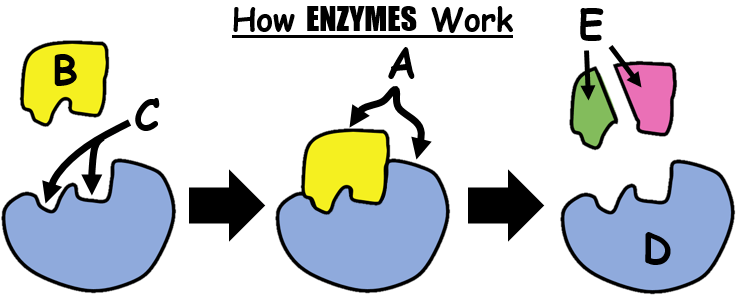
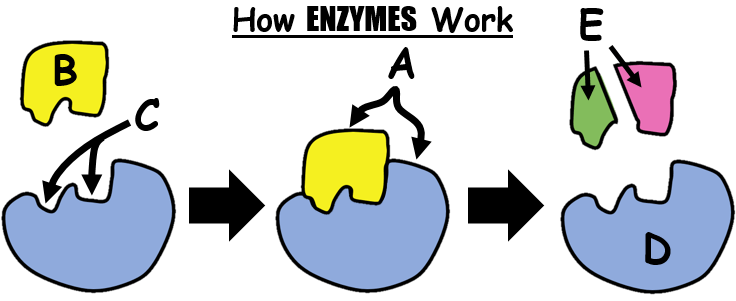
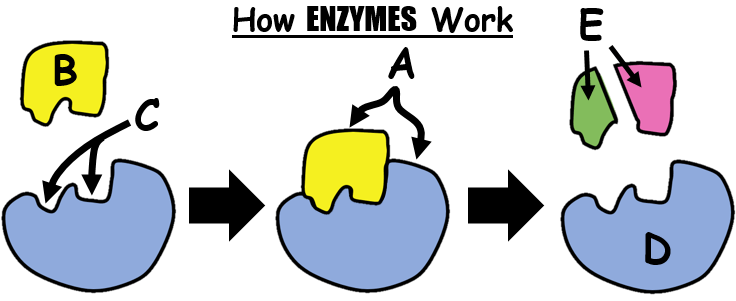
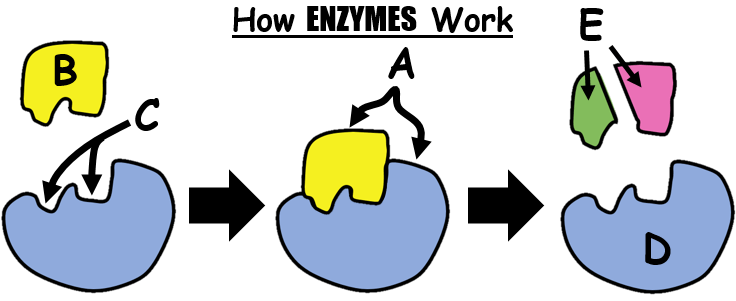
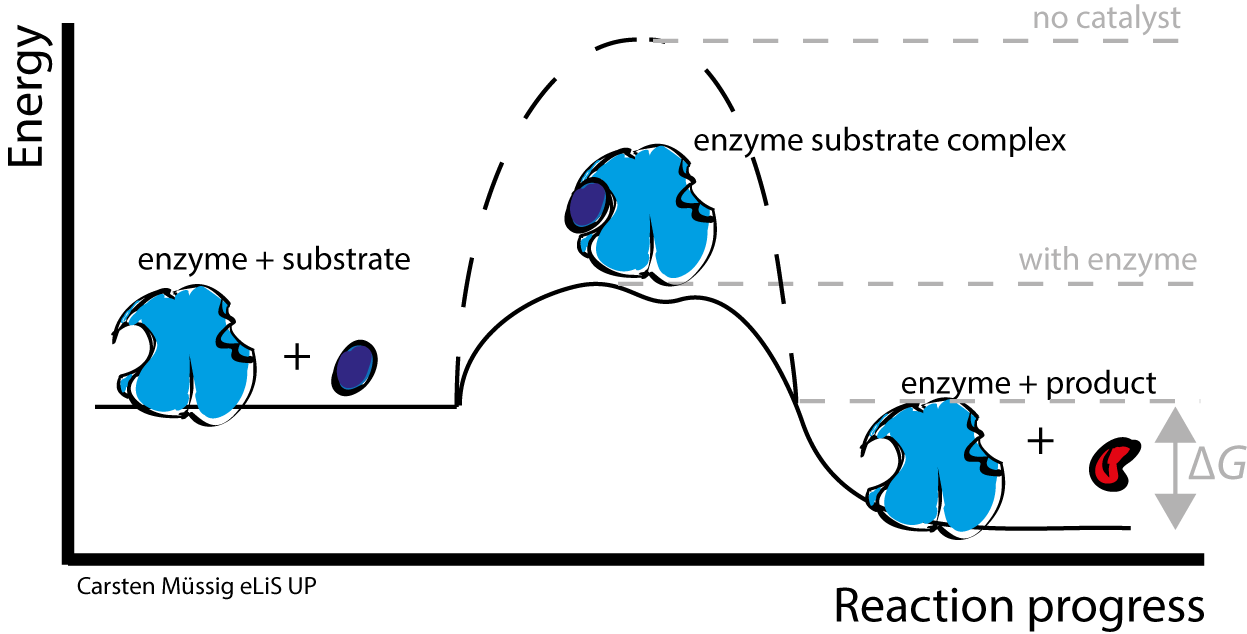
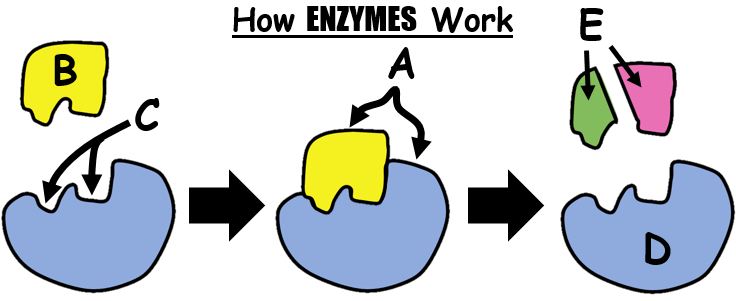
In the diagram, what is letter A? 
a)
product
b)
substrate
c)
enzyme-substrate complex
d)
active site
25.
Letter D...
a)
active site
b)
enzyme
c)
substrate
d)
products
26.
Letter B...
a)
active site
b)
enzyme
c)
substrate
d)
products
27.
Letter C...
a)
active site
b)
enzymes
c)
substrate
d)
products
28.
Letter E...
a)
active site
b)
enzyme
c)
substrate
d)
products
29.
An enzyme speeds up a reaction by
a)
lowering the activation energy.
b)
raising the activation energy.
c)
releasing energy.
d)
absorbing energy.
30.
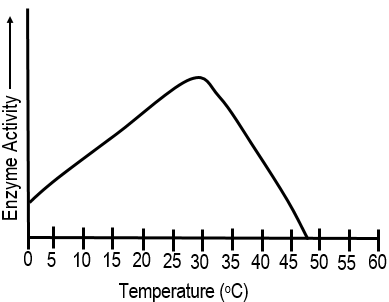
Based on the graph, what is the optimal temperature for this enzyme? 
a)
15oC
b)
40oC
c)
30oC
d)
35oC
31.
An enzyme speeds up a chemical reaction in the cell but can only be used once.  True or False? 
a)
true
b)
false
32.
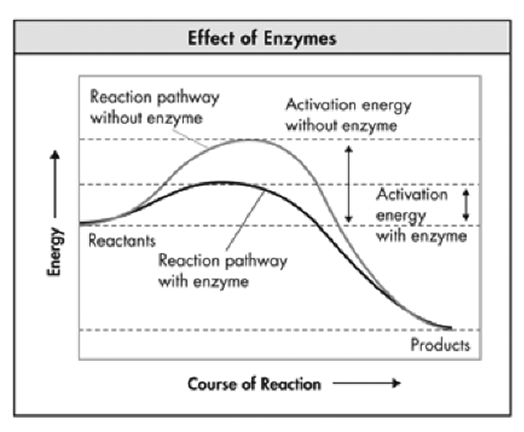
The graph shows how enzymes affect reactions in cells. Which statement best summarizes the information shown in the graph?
a)
Enzymes increase the energy of the reactants.
b)
Enzymes decrease the energy level of the products.
c)
Enzyme decrease the activation energy of the reaction.
d)
Enzymes reverse the direction of the reaction.
33.
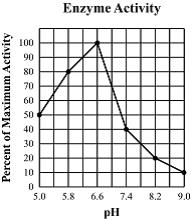
Which of the following conclusions can be drawn from this graph?
a)
The optimum pH of the enzyme is 6.6.
b)
The optimum pH of the enzyme is 5.8
c)
The enzyme’s activity increases as pH increases 5.0 to 9.0
d)
The enzyme’s activity is greater around pH of 8.0 .
34.
The "lock and key hypothesis" attempts to explain the mechanism of?
a)
Vacuole formation
b)
Pinocytosis
c)
Sharing of electrons
d)
Enzyme specificity 
35.
Enzymes need certain environmental conditions in order to function properly.  What happens when enzymes are heated to a high temperature?
a)
they die
b)
they denature
c)
they change their amino acid sequence
d)
they work better
36.
What makes an enzyme substrate specific?
a)
Size
b)
Shape
c)
Name
d)
Location it is found in
37.
Which substrate would this enzyme catalyze?
a)
Δ
b)
σ
c)
d)
μ
38.
What factors affect an enzyme's reaction rate?
a)
temperature 
b)
pH
c)
substrate concentration
d)
all of these
39.
Which of these is most likely an enzyme?  (Based on the suffix)
a)
Sucrose
b)
Saccharide
c)
Fructose
d)
Amylase
40.

Which type of cell?

a)

Prokaryote

b)

Eukaryote

41.

Has membrane bound organelles

a)

Prokaryote

b)

Eukaryote

c)

Both

42.

Where is the DNA found in a prokaryotic cell?

a)

In the nucleus

b)

In the mitochondria

c)

Floating around in the cytoplasm

d)

In the ribosome

43.

In what organelle is the genetic material found inside?

a)

Nucleus

b)

endoplasmic reticulum

c)

Mitochondria

d)

Lysosome

44.

I store water in both plant and animal cells. What am I?

a)

Mitochondria

b)

Lysosome

c)

Vacuole

d)

Cytoplasm

45.

What can only be found in plant cells?

a)

Chloroplast

b)

Vacuole

c)

Nucleus

d)

Cell membrane

46.

The two kinds of cells are Prokaryotes and Eukaryotes. How are they different?

a)

Prokaryotes are plant cells

b)

Eukaryotes have a nucleus

c)

Prokaryotes have a nucleus

d)

There is no difference

47.

Bacteria are a type of...

a)

Prokaryote

b)

Eukaryote

c)

Both

48.

What cell part is NOT found in all cells

a)

Cytoplasm

b)

Genetic material

c)

Cell membrane

d)

Cell wall

49.

What is the function of this part of the cell?

a)

Structure

b)

Flexability

c)

Regulates what comes in and out of the cell

d)

Stores genetic information

50.

Where are proteins made?

a)

Golgi Body

b)

Ribosomes

c)

Chromosomes

d)

Mitochondria

51.

What is the gel-like substance inside of cells called?

a)

Cytoplasm

b)

Cytoskeleton

c)

Cell membrane

d)

Vacuole

52.
This is the "brain" of what controls all the activities of the cells.
a)
Mitochondria
b)
Cell membrane
c)
nucleus
d)
nucleus membrane
53.
Which organelle provides storage of food, water, and nutrients?
a)
Cell membrane
b)
mitochondria
c)
Vacuole
d)
Vacuume
54.
Which level of organization is in order from smallest to largest?
a)
Cells, organs, tissues,organ systems
b)
Tissues, cells, organ systems, organs
c)
Organ system, organs, tissues, cells
d)
cells, tissues,organs, organ systems
55.
The main function of the cell wall is to direct the activities of the cell.
a)
True
b)
False
56.
Plant cells are the same as animal cells.
a)
True
b)
False
57.
Plant cells ......
a)
are called Prokaryotic cells.
b)
have a cell wall and chloroplast.
c)
are usually circular in shape
d)
All choices are correct.
58.
I produce the energy a cell needs.  I am a mighty power house.  Who am I?
a)
Mitochondria
b)
Nucleus
c)
Lysosome
d)
Cell Membrane
59.
Where do chloroplasts get energy from to help make food?
a)
Chlorophy
b)
Leaves
c)
Stored Sugar
d)
Sun
60.
Which organelle is like a post office because it receives materials, packages, and distributes them?
a)
Chloroplasts
b)
Ribosomes
c)
Golgi Bodies
d)
Nucleolus
61.
I am the "cleaner" because I break down food. Which organelle am I?
a)
Lysosomes
b)
Mitochondria
c)
Nucleus
d)
Cyto
62.
Plant cells have these but animal cells do not. 
a)
Nucleus and cell mem
b)
cell membrane and cell wa
c)
chloroplast and cell wall
d)
Chloroplasts and mitochondria
63.

Which of the following is the BEST definition for passive transport?

a)

Movement of substances through a cell membrane from a high to low concentration without the use of energy

b)

Movement of substances through a cell membrane from a low to high concentration requiring the use of energy

c)

Movement of substances through a cell membrane from a low to high concentration without the use of energy

d)

Movement of substance through a cell membrane from a high to low concentration requiring the use of energy

64.

Which of the following IS NOT an example of passive transport?

a)

Diffusion

b)

Facilitated Diffusion

c)

Osmosis

d)

Endocytosis

65.

_____________ occurs when a substance is too large to flow through a cell membrane and it uses a protein "door".

a)

Diffusion

b)

Osmosis

c)

Exocytosis

d)

Facilitated Diffusion

66.

Select the correct definition for "Osmosis":

a)

A molecule is too large to pass through a cell membrane and therefore uses a transport protein

b)

The movement of substances from a low to high concentration; cell energy is used

c)

The movement of water from a high to low concentration through a selectively permeable membrane

d)

The movement of substances from a high to low concentration

67.

What is the main difference between passive and active transport?

a)

Passive transport requires energy; active transport does not require energy.

b)

Active transport requires energy; passive transport does not require energy.

c)

Both passive and active transport require energy

d)

Neither passive or active transport require energy.

68.

Which of the following is a process of materials only exiting the cell?

a)

Exocytosis

b)

Active Transport

c)

Facilitated Diffusion

d)

Passive Transport

69.

Which of the following transport methods moves substances from a high to low concentration?

a)

Endocytosis

b)

Exocytosis

c)

Osmosis

d)

Active Transport

70.

Which of the following transport methods moves substances from a high to low concentration?

a)

Diffusion

b)

Endocytosis

c)

Exocytosis

d)

Active Transport

71.

Which of the following transport methods moves substances from a low to high concentration?

a)

Active Transport

b)

Facilitated Diffusion

c)

Osmosis

d)

Passive Transport

72.

Which of the following transport methods moves substances from a low to high concentration?

a)

Endocytosis

b)

Diffusion

c)

Osmosis

d)

Passive Transport

73.

A type of active transport where the cell membrane envelops the substance creating a vesicle.

a)

Endocytosis/Exocytosis

b)

Diffusion

c)

Facilitated Diffusion

d)

Passive Transport

74.
The process where only water is allowed to pass through the cell membrane from a high to low concentration.
a)
meiosis
b)
respiration
c)
diffusion
d)
osmosis
75.

In passive transport, substances move across the cell membrane ________ the concentration gradient

a)

AGAINST

b)

ALONG

c)

DOWN

d)

BETWEEN

76.
This picture represents what type of cell transport?
a)
endocytosis
b)
exocytosis
c)
osmosis
d)
passive transport
77.
Active transport requires ______, moves materials from __________________, and goes _______ the concentration gradient.
a)
No energy, low to high, against
b)
ATP, high to low, with
c)
ATP, low to high, with
d)
ATP, low to high, against
78.
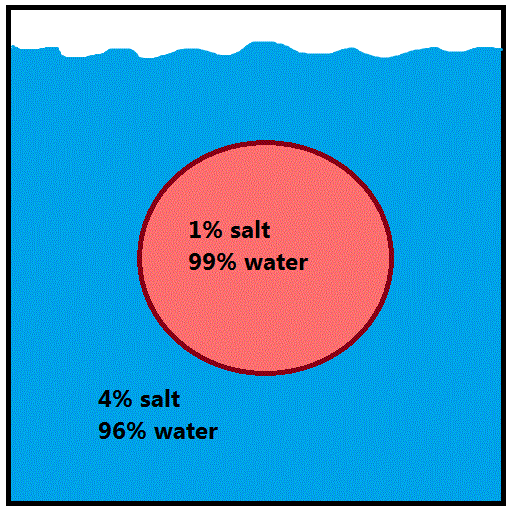
Where will the water go?
a)
Into the cell
b)
Out of the cell
c)
Equally in & out - it's isotonic
d)
There is no water
79.
Mr. Slug was salted. Where was there more solute immediately after salting?
a)
Outside of the slug
b)
Inside of the slug
c)
There was no solute anywhere
80.
A blood cell is placed into the jar, as seen. Where will the water go?
a)
Into the cell
b)
Out of the cell
c)
Equally in & out - it's isotonic
d)
The water is a lie
81.
 If a cell containing 5% salt is placed into a glass of water with 20% salt, the water is _______ compared to the cell.
a)
hypertonic
b)
hypotonic
c)
isotonic
82.
HYPO means...
a)
Low
b)
High
c)
Equal
d)
Fat
83.
ISO means...
a)
Low
b)
A lot
c)
Equal
d)
Mammal
84.
What happens if someone gives you a 90% salt saline drip?
a)
Your cells will shrivel and you'll die
b)
Your cells will swell and you'll die
c)
Nah you'll be fine.
85.
Why can't you drink salt water?
a)
It's hypertonic to your cells
b)
It's hypotonic to your cells
c)
It's isotonic to your cells
d)
It's paratonic to your cells
86.
What is the type of solute we mainly talked about in our examples?
a)
Salt
b)
Sugar
c)
Calcium
d)
Mercury
87.
Osmosis is the diffusion of _____ across a selectively permeable membrane.
a)
food
b)
air
c)
water
d)
oxygen
88.
During diffusion
a)
substances (things) moves from high to low concentration
b)
water moves when energy is used
c)
large or oddly shaped molecules move across a cell membrane
d)
water moves from high to low concentration
89.
 In the given scenario what will happen?  An egg with a dissolved shell is placed in pure water for 48 hours.
a)
Water will move in and out of the cell equally, and the cell with neither shrink nor swell.
b)
The egg will gain water and swell.
c)
The egg will lose water and shrink.
90.
 An animal cell placed in a hypertonic (salty) solution will
a)
Stay the same
b)
Shrink- get smaller
c)
Swell- get bigger
91.
The movement of water through a semi-permeable membrane is called?
a)
cell membrane
b)
respiration
c)
osmosis
d)
diffusion
92.
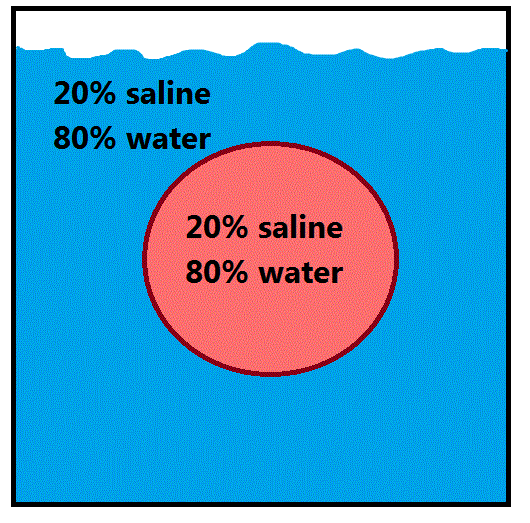
The picture  is an example of _________________.
a)
isotonic
b)
diffusion
c)
osmosis
d)
active transport
93.
When both inside and outside of a cell have the same amount of water it is said that the cell has reached a state of ___________.
a)
osmosis
b)
equilibrium
c)
diffusion
d)
hypertonic
94.
What does selectively-permeable mean?
a)
The cell controls what passes in and out of the cell
b)
Nothing gets through
c)
The cell lets only large substances through
95.
Mrs. Crandall placed 2 tablespoons of salt into a glass of water and then placed a selectively- permeable membrane into the glass that divided the glass into left and right halves.  The left side is _______ to the right side.
a)
isotonic
b)
hypertonic
c)
hypotonic
96.

Which is a form of energy?

a)

Photosynthesis

b)

Fermentation

c)

Cellular Respiration

d)

Heat

97.

The primary source of energy for life on Earth is __

a)

ATP Energy

b)

Kinetic Energy

c)

Oxygen

d)

Sunlight

98.

True or False. All forms of life use ATP Energy for cellular functions.

a)

True

b)

False

99.

Plants (Select all that apply)

a)

Perform photosynthesis

b)

Perform cellular respiration

c)

Lactic Acid Fermentation

d)

Ethanol Fermentation

100.

Chlorophyll

a)

Is a pigment

b)

is an orgenelle

c)

is a phase of mitosis

d)

is a form of energy

101.

Yeast ____

(Mark all that apply)

a)

Is an autotroph

b)

Is a hetrotroph

c)

Performs fermentation

d)

Performs cellular respiration

e)

Performs photosynthesis

102.
Fermentation in muscle cells produces
a)
lactic acid
b)
glucose
c)
bacteria
d)
oxygen
103.
Cellular respiration is the process by which 
a)
cells use oxygen to create energy from food
b)
plant cells create glucose
c)
cells grow and reproduce
d)
cells breakdown food without using oxygen
104.
Fermentation is the process by which 
a)
cells break down food without using oxygen
b)
plant cells create glucose
c)
cells use oxygen to produce energy 
d)
cells grow and reproduce
105.
Why would plants be better able to survive in a world without animals than animals in a world without plants?
a)
plants can produce their own carbon dioxide and water for cellular respiration
b)
animals do not produce anything plants need
c)
plants already produce glucose needed for photosynthesis
d)
animals only make oxygen for plants so animals are not needed
106.
Cellular respiration takes place in
a)
chloroplasts
b)
mitochondria
c)
the nucleus
d)
endoplasmic reticulum
107.
The reactants (raw materials) of photosynthesis are
a)
water and carbon dioxide 
b)
water and oxygen
c)
carbon dioxide and oxygen
d)
glucose and oxygen
108.
The products of photosynthesis are
a)
oxygen and glucose (food)
b)
oxygen and carbon dioxide
c)
carbon dioxide and water
d)
water and glucose
109.
What types of energy transformation occurs in photosynthesis?
a)
light energy is changed to chemical energy as food
b)
heat energy is transformed into light energy
c)
light energy is made into ATP
d)
chemical energy is changed into ATP
110.
The end products of cellular respiration are
a)
carbon dioxide, water, and ATP
b)
ATP and light energy
c)
glucose and oxygen
d)
oxygen and carbon dioxide
111.
The picture best represents what important cell process?
a)
cellular respiration
b)
photosynthesis
c)
fermentation
d)
osmosis
112.
The picture best represents what process?
a)
photosynthesis
b)
osmosis
c)
cellular respiration
d)
fermentation
113.
A marathon runner completes two-thirds of a race when he suddenly collapses. He experiences rapid breathing, abdominal pain, and episodes of vomiting. What most likely happened to him?
a)
he was using energy without having enough oxygen
b)
he suddenly contracted a stomach virus
c)
his muscles were tearing due to the length of the race
d)
he was starving and needed to eat
114.
Why is blood so important for the process of cellular respiration to take place?
a)
blood carries oxygen to the cells of our body 
b)
blood carries carbon dioxide to the cells of our body
c)
blood carries nitrogen to the cells of our body
d)
blood carries glucose away from the cells of our body
115.
Bacteria and yeast cells produce energy only through the process of
a)
fermentation
b)
cellular respiration
c)
photosynthesis
d)
lactic acid
116.
Fermentation is also known as
a)
anaerobic respiration
b)
aerobic respiration
c)
photosynthesis
d)
lactic acid
117.
potted plant is placed inside a clear, sealed vacuum container that has water pumped into it on a regular basis. The container is placed in the sun and the plant’s growth is monitored. Which statement best describes what will most likely happen to the plant over time?
a)
The plant will grow faster because it is sheltered from the wind.
b)
The plant will die because it does not have oxygen for photosynthesis.
c)
The plant will die because it does not have carbon dioxide for photosynthesis
d)
The plant will grow at a slower rate because it requires more water.
118.
If your body needed to do anaerobic respiration what would be the side effect?
a)
extra energy
b)
lucid muscles
c)
build up of lactic acid
d)
Constant hunger
119.
What term means without oxygen?
a)
aerobic
b)
hydrophobic
c)
anaerobic
d)
hydrophillic
120.
Photosynthesis gives what to humans?
a)
oxygen
b)
food
c)
energy
d)
all of these