
Font size
S
M
L
XL
 Worksheets
Fall Semester Exam 22
Total questions: 77
Worksheet time: 3585secs
Name
Class
Date
1.
Which of the following occur at convergent boundaries?
a)
Mountains and Islands
b)
Trenches
c)
Volcanoes
d)
All of the above
2.
Which 2 occur at divergent boundaries?
a)
Mountains
b)
Rift Valleys
c)
Mid-Ocean Ridges
d)
Volcanoes
3.

True or False
The Sun is the biggest star in the sky.
The Sun is the biggest star in the sky.
a)
True
b)
False
4.

What word best describes our sun?
a)
Average
b)
Supergiant
c)
Dwarf
d)
Red Giant
5.
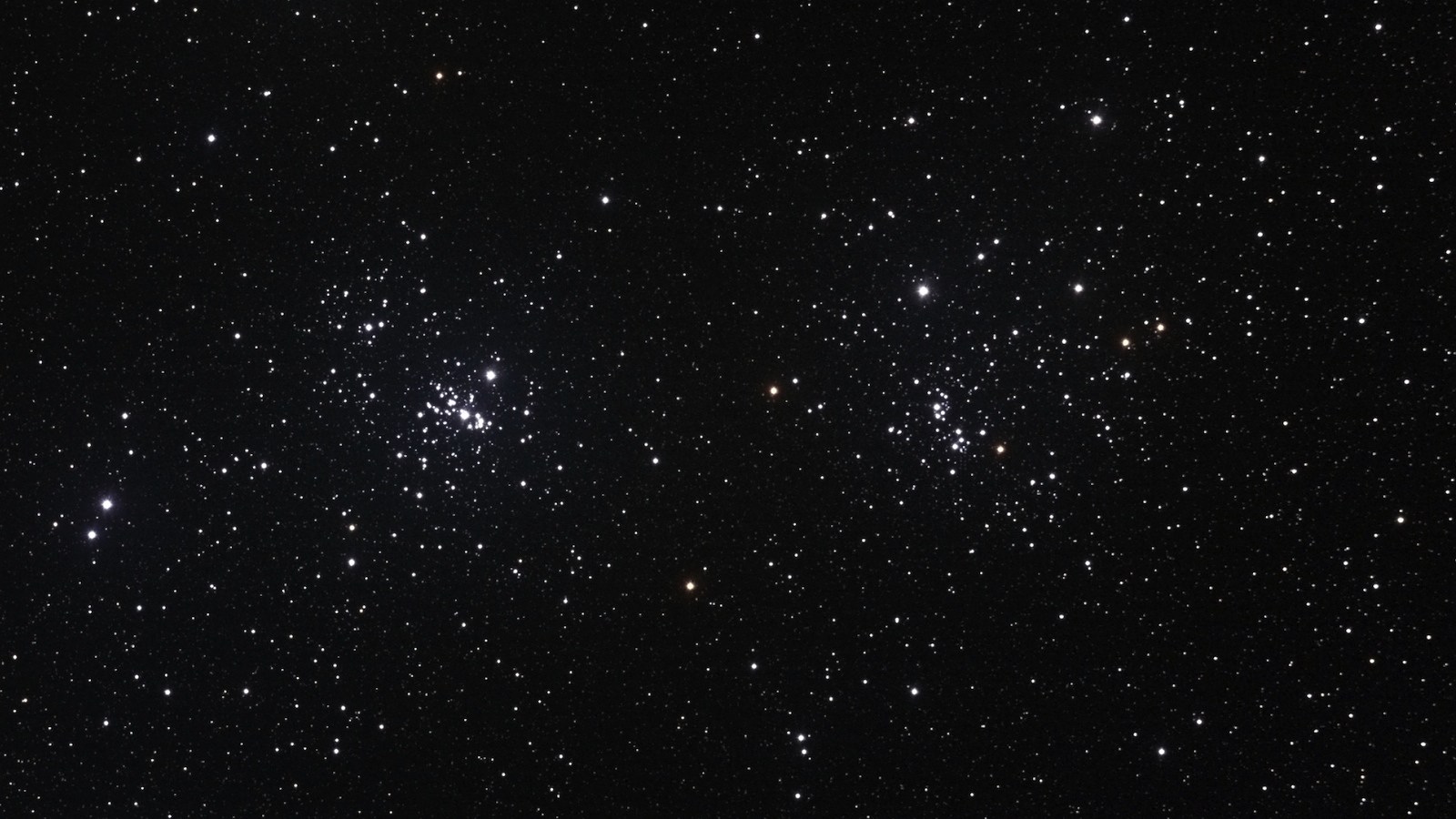
Why do other stars appear so much smaller than the sun?
a)
They are much smaller
b)
They are so far away
c)
They are not as bright
d)
They are dwarf stars
6.

What color of star is the hottest?
a)
Blue
b)
Red
c)
Yellow
d)
Orange
7.

What is the name of the largest stars?
a)
Protostars
b)
Supergiants
c)
Red Giants
d)
Dwarf Stars
8.

What color of star is the coolest?
a)
Red
b)
Yellow
c)
Blue
d)
White
9.
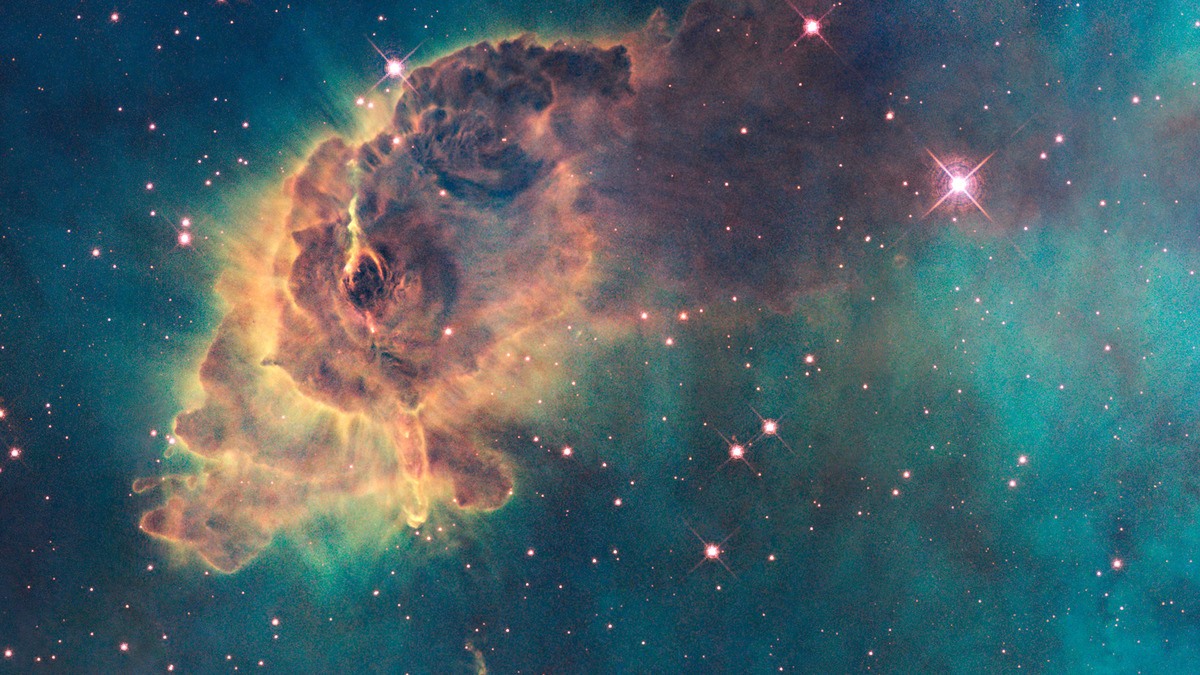
What is the name of the gas/dust clouds that form stars?
a)
Nebulas
b)
Protostars
c)
Supernova
d)
Neutron Star
10.

What are stars?
a)
Rocky bodies
b)
Hot exploding balls of gas
c)
5 pointed shapes
d)
Hollywood actors
11.
Which of the following is the smallest unit of life that can carry out all life functions?
a)
the mitochondria
b)
the vacuoles
c)
the nucleus
d)
the cell
12.
A __________ includes all living and non-living things in an environment.
a)
population
b)
niche
c)
abitotic
d)
ecosystem
13.
_______ are consumers that eat only meat.
a)
Herbivore
b)
Omnivore
c)
Carnivore
14.
________ are consumers that eat plants and meat.
a)
Herbivore
b)
Omnivore
c)
Carnivore
15.
Which group do fungi, bacteria, and termites belong to?
a)
decomposers
b)
producers
c)
herbivores
d)
omnivores
16.
Which organism make their own food through the process of photosynthesis?
a)
decomposer
b)
consumer
c)
herbivore
d)
producer
17.
Field mice eat corn. Which would most likely happen if the field mouse population grew?
a)
There would be more corn to feed the field mice.
b)
There would be less corn due to the mice eating it.
c)
The habitat would get overpopulated because the mice woudl eat too much.
18.
If the population of prey increases, the population of predators will ________because of the availability of food.
a)
decrease
b)
stay the same
c)
increase
19.
Examples of how humans negatively affect local ecosystems are
a)
Building dams, deforestation (cutting down trees), adding point sources to nearby streams to allow for run-off, building roads and structures, and salting roads.
b)
Creating laws to prohibit fishing from local streams.
c)
Planting trees and other plants to attract native species.
d)
Removing non-native species from the environment.
20.
All food chains_____________________
a)
have more consumers than producers
b)
produce and use same amount of energy
c)
begin with a producer
d)
are unhealthy
21.
A lion, captures and eats other animals. What is he considered?
a)
prey
b)
predator
c)
producer
d)
healthy
22.
Which moon phase is when you can't see the moon at all?
a)
Waning crescent
b)
Full moon
c)
Waxing gibbous
d)
New moon
23.
About how long does it take the moon to make one complete cycle around the earth?
a)
65 days
b)
8 days
c)
365 days
d)
28 days
24.
Phases of the moon in which the moon appears to be getting larger are referred to as _.
a)
waxing
b)
waning
c)
new
d)
eclipse
25.

What Moon phase is this?
a)
Full Moon
b)
Waxing Gibbous
c)
New Moon
d)
Half Moon
26.

What Moon phase is this?
a)
Waxing Crescent
b)
Waning Gibbous
c)
Waning Crescent
d)
Waxing Gibbous
27.

What Moon phase is this?
a)
Last Quarter
b)
New Moon
c)
Third Quarter
d)
First Quarter
28.

What Moon phase is this?
a)
Waxing Gibbous
b)
Waning Crescent
c)
Waning Gibbous
d)
Full Moon
29.

What Moon phase is this?
a)
Old Moon
b)
Far Side of the Moon
c)
New Moon
d)
Waxing Gibbous
30.

What Moon phase is this?
a)
Waning Crescent
b)
Waxing Crescent
c)
Waxing Gibbous
d)
Waning Gibbous
31.

What Moon phase is this?
a)
Waxing Crescent
b)
Waning Gibbous
c)
Waxing Gibbous
d)
Waning Crescent
32.

What phase comes AFTER this one?
a)
Waning Crescent
b)
Waning Gibbous
c)
Waxing Crescent
d)
Third Quarter
33.

What phase comes BEFORE this one?
a)
Waxing Gibbous
b)
Waxing Crescent
c)
Waning Gibbous
d)
Waning Crescent
34.

What phase comes BEFORE this one?
a)
Full Moon
b)
Third Quarter
c)
New Moon
d)
First Quarter
35.

What phase comes BEFORE this one?
a)
Waxing Crescent
b)
Waxing Gibbous
c)
Waning Gibbous
d)
Waning Crescent
36.

What phase comes BEFORE this one?
a)
New Moon
b)
Third Quarter
c)
Waxing Crescent
d)
Full Moon
37.

What phase comes AFTER this one?
a)
Waxing Crescent
b)
Waning Gibbous
c)
Waxing Gibbous
d)
Third Quarter
38.
The complete cycle of the moon lasts about a _.
a)
day
b)
year
c)
week
d)
month
39.

Why do globes lean sideways?
a)
To allow them to spin easier.
b)
To demonstrate the tilt of Earth's axis.
c)
To demonstrate the effects of gravity.
d)
To demonstrate day and night.
40.

What happens when the area in which you live tilts away from the sun?
a)
It is summer.
b)
It is spring.
c)
It is winter.
d)
It is fall.
41.

What season is it in the Southern Hemisphere when it is fall in the Northern Hemisphere?
a)
winter
b)
spring
c)
summer
d)
fall
42.

Why does the area around the equator stay the same temperature all year?
a)
The equator rotates slower than the poles.
b)
The equator remains the same distance from the sun.
c)
The equator always receives direct sunlight.
d)
The equator has 18 hour days.
43.
In the Northern Hemisphere, on which day will you receive the most daylight?
a)
September 21
b)
December 21
c)
March 21
d)
June 21
44.

Which season is taking place in the Southern Hemisphere in Position 1?
a)
Winter
b)
Spring
c)
Summer
d)
Fall
45.

Which season is taking place in the Northern Hemisphere in Position 2?
a)
Winter
b)
Spring
c)
Summer
d)
Fall
46.

Which season is taking place in the Southern Hemisphere in Position 4?
a)
Winter
b)
Spring
c)
Summer
d)
Fall
47.
What is Earth's annual motion around the sun called?
a)
Rotation
b)
Revolution
48.
One rotation of Earth is equal to
a)
a day.
b)
a year.
49.
What would seasons be like if Earth's axis were straight up and down?
a)
Seasons would be the same.
b)
Seasons would be more extreme.
c)
There would be no seasons.
50.
If Earth rotated slower, we would have...
a)
shorter days.
b)
longer days.
c)
shorter years.
d)
longer years.
51.
When will the sun reach the highest altitude at noon?
a)
December
b)
March
c)
September
d)
June
52.
Which season has the least amount of daylight in the Northern Hemisphere?
a)
Winter
b)
Spring
c)
Summer
d)
Fall
53.
When moisture condenses out of air and falls to the ground as rain, snow, sleet or hail, we are experiencing____________
a)
evaporation
b)
condensation
c)
precipitation
d)
transpiration
54.
a(n)______________is a large body of air that has the same properities as Earth's surface over which it develops
a)
air mass
b)
cloud
c)
tornado
d)
front
55.
a _________forms where cold and warm air masses meet
a)
front
b)
cloud
c)
climate
d)
flood
56.
violent storms generally form along a(n) __________
a)
occluded front
b)
cold front
c)
warm front
d)
stationary front
57.
Warm air near the Earth’s surface rises and then cools and drops, this creates a _________________ in the atmosphere.
a)
run-off
b)
Greenhouse Effect
c)
convection current
d)
water cylce
58.
Where does a hurricane form?
a)
Over a cold body of water
b)
Over a warm body of water
c)
Over cold land
d)
Over warm land
59.
What kind of weather is usually associated with a low pressure system?
a)
Sunny weather
b)
Precipitation (rain, snow, etc.)
60.
What kind of weather is usually associated with a high pressure system?
a)
Sunny weather
b)
Precipitation (rain, snow, etc.)
61.
The type of plate boundary where two plates come together is a .....
a)
Convergent Boundary
b)
Divergent Boundary
c)
Transform Boundary
d)
Plate Boundary
62.
Which of the following causes Earth's tectonic plates to move?
a)
Energy from the Sun
b)
Magnetic Pole Reversal
c)
Convection currents in the mantle
d)
Faults in Mountain Ranges
63.

What type of event will occur at this boundary?
a)
Earthquake
b)
Volcano Eruption
c)
Tornado
d)
Mountain Building
64.
A divergent boundary occurs when plates ....
a)
Pull apart
b)
Come together
c)
Slide past each other
d)
subducting
65.
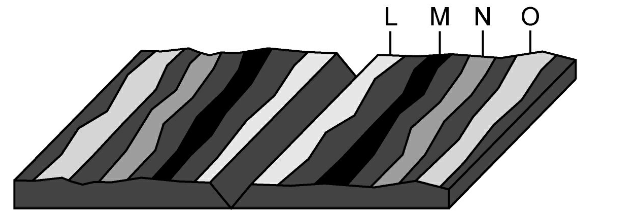
Where would the oldest rock be found?
a)
L
b)
M
c)
N
d)
O
66.
Mountains are created when....
a)
Two continental plates collide
b)
Two oceanic plates pull apart
c)
An Oceanic plate subducts under a Continental Plate
d)
Two continental plates pull apart
67.

Scientists think that convection currents that move the plates flow in Earth's
a)
Continental crust
b)
Oceanic crust
c)
Asthenosphere
d)
Lithosphere
68.

What would happen to the convection currents if the heat from the inner core disappeared?
a)
They would stop.
b)
They would change directions.
c)
It would not change.
d)
They would speed up.
69.
The area around the pacific plate where boundaries form is called...
a)
death ring
b)
fire zone
c)
ring of fire
d)
zone of fire
70.
Which of the following is where one plate slides under another plate?
a)
submarine zone
b)
divergence zone
c)
subduction zone
d)
lower zone
71.

Which of the following organisms is in competition with the wild cat for their food source?
a)
jackel
b)
goat
c)
mouse
d)
rabbit
72.

A snake eats a mouse. The snake and mouse are demonstrating _________.
a)
mutualism
b)
predator/prey
c)
competition
d)
parasitism
73.

What is one way humans are trying to positively impact the ocean?
a)
Fishing
b)
Drilling for oil and natural gas
c)
Creating artificial reefs
74.

What is the profile view to Topographic Map #1?
a)
A
b)
B
c)
C
d)
D
75.

What do close contour lines represent on a map?
a)
waterfall
b)
steep area
c)
gradual area
d)
river
76.

Determine the contour interval:
a)
5 m
b)
10 m
c)
15 m
d)
20 m
77.

Which direction is the river flowing?
a)
north
b)
south
c)
east
d)
west
Reset

