
NEW
Font size
 Worksheets
Plant&Soil Semester 1 Review
Total questions: 56
Worksheet time: 56mins
Which of the following processes do plants utilize to create energy?
Digestion
Respiration
Photosynthesis
Inhalation
Which of the following is NOT a classification of taxonomy
Breed
Phylum
Class
Family
Which of the following components are NOT found within most plant cells?
Lysosomes
Chloroplasts
Cell walls
Mitochondria
Which of the following cellular components are included in both plant and animal cells?
Cell walls
Lysosomes
Golgi apparatus
Chloroplasts
Which of the following is the product of photosynthesis
Protein
Sugar
Sodium
Cholesterol
Which of the following is NOT a type of flower?
Complete
Finished
Perfect
Imperfect


Which soil horizon is contains decomposed plants and animals?
A Horizon
B Horizon
C Horizon
O Horizon
Soil erosion is the process by which the
the land surface(top soil) is removed by wind, water or ice
formation of soil form rocks
rusting of soil
None of the above



For the soil to read balanced or neutral, it must fall were of the pH scale?
5.4
7.0
10.0

The tubes and support that transport water
and nutrients up, down and around in plants
Vascular System
Shoot System
Root System
Reproductive System

Pores under leaves
that allow for transpiration
and gas exchange
Xylem
Stomata
Phloem
Transpiration
Define deficiency.
too much of a nutrient
just enough of a nutrient
not enough of a nutrient

How do you fix a Nitrogen Deficiency?
Add drainage, like pebbles or sand, to the soil.
Add fertilizer to the soil and leaves.
Move the plant into full sun.
Add organic compost, like manure or coffee grounds, to the soil.
How many nutrients are needed for a plant's growth and survival?
13
nine
16
none of the above
The elements are organized into what two groups?
gaseous; liquid
liquid; solid; gas
macronutrients; micronutrients
none of the above
What nutrient is required for photosynthesis?
hydrogen
oxygen
carbon
all of the above
Other than hydrogen, nitrogen, carbon and oxygen, plants take in what element the most?
potassium
zinc
phosphorus
none of the above
Nitrogen is essential for photosynthesis and chlorophyll formation.
True
False
___________ are used in relatively large quantities by plants.
macronutrients
micronutrients
trace elements
none of the above
___________ are elements needed in smaller amounts. They are often called trace elements.
macronutrients
micronutrients
all of the above
none of the above


Tissues with active cell division
Permanent
Meristematic
Which of the following is NOT a type of asexual reproduction?
Apomixis
Induced Propagation
Syngamy
Vegetative Propagation
Which of the following is an advantage of sexual reproduction?
Genetic Variation
Females produce offspring
Rapid and effective method for spreading an organism
No males are needed
Which of the following occurs only in sexually reproducing organisms?
M phase
Meiosis
Mitosis
Metephase
Which of the following is similar to mitosis?
Meiosis II
Meiosis I
S Phase
G1 Phase
Which of the following is NOT a reason Mendel used pea plants in his experiments for plant breeding?
They are easily grown in large numbers
Their reproduction can be readily manipulated
They contain several different traits visible to the eye
They require special attention when growing
Which of the following best describes the Law of Independent Assortment?
The inheritance of one trait does not influence the inheritance of another trait
Traits remain distinct in successive generations and do not blend
The mating of certain parent plants increases the likelihood of producing a particular offspring
Each of these statements provides an accurate description of the Law of Independent Assortment
Which of the following best describes genetic engineering?
The process of moving genes from one organism to another
The process of rapid in vitro propagation of plants from cells, tissues or organs
The use of natural enemies to control pests
The study of DNA to increase agricultural productivity
Which of the following is an advantage of using biological pest control?
Produces results quicker than pesticides
It is less time intensive
Reduction in the use of chemicals
Requires less training than the use of pesticides
Which of the following is an advantage of agricultural biotechnology?
Increased crop yields
Increase in biodiversity
Long-term effects prove to be harmless
It greatly reduces expenses for the producer
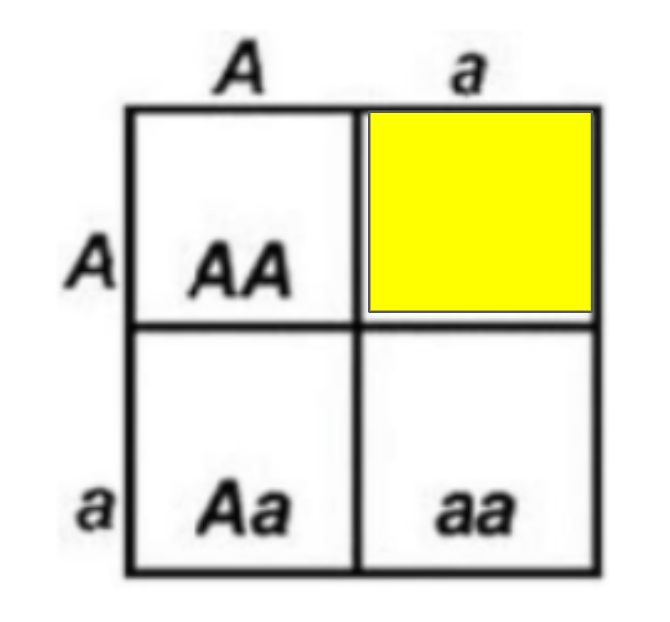
Fill in the Yellow Box
AA
Aa
aa
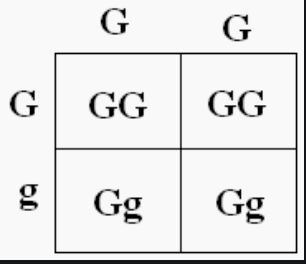
How chance the offspring born from this cross will have a homozygous dominant genotype?
25%
50%
75%
100%

