wayground logo

Free Printable Worksheets

Font size

S
M
L
XL
Worksheets

2022-23 Midterm Review

Total questions: 105

Worksheet time: 3hrs 51mins

Name
Class
Date
1.
A pure substance containing only one kind of atom.
a)
element
b)
mixture
c)
compound
2.
Can only be separated by chemical means.
a)
element
b)
mixture
c)
compound
3.
This picture represents which of the following?
a)
element
b)
compound
c)
mixture
4.
The amount of mass in a specific volume
a)
density
b)
weight
c)
matter
d)
state
5.
The ability of a substance to be pulled into wires
a)
Malleability
b)
Flexibility
c)
State
d)
Ductility
6.
Physical or Chemical Property? If copper comes in contact with water, it will turn green.
a)
Physical
b)
Chemical
c)
Neither
7.
Physical or Chemical Property?  The temperature of boiling water is 100 degrees Celsius.
a)
Physical
b)
Chemical
c)
Neither
8.
What is matter?
a)
Any subtance that doesn't take up space or have mass.
b)
Any substance that takes up space or have mass.
c)
Any substance that exists on Earth.
d)
Any substance that exists in space.
9.
Boiling point,melting point, and density are some of an element's
a)
pure properties
b)
physical properties
c)
chemical properties
10.
A mixture that appears to be evenly mixed throughout:
a)
an atom
b)
a compound
c)
a homogeneous mixture
d)
a heterogeneous mixture
11.
 mixture that does NOT appear to be evenly mixed throughout:
a)
an atom
b)
a compound
c)
a homogeneous mixture
d)
a heterogeneous mixture
12.
Which of these is an example of a chemical property?
a)
density
b)
melting point
c)
ductility
d)
flammability
13.
What type of mixture is this?
a)
heterogeneous 
b)
homogeneous
14.
What type of mixture is this?
a)
heterogeneous 
b)
homogeneous
15.
There are ___ meters in 25 kilometers (km)
a)
250 m
b)
2500 m
c)
25,000 m
d)
.025 m
16.
Convert 0.25 m to mm
a)
25
b)
2.5
c)
250
d)
0.025
17.
Convert 6570 cm to km
a)
.06570 km
b)
.6570 km
c)
6.570 km
d)
657.0 km
18.

The metric base units for length is

a)

gram

b)

liter

c)

meter

d)

seconds

19.

Convert the following:

0.00046 ks = ? cs

a)

4,600,000 cs

b)

46 cs

c)

4.6 cs

d)

46,000 cs

20.

Convert the following:
36.45 cL = ?  μL\mu L  

a)

364,500  μL\mu L  

b)

0.003645  μL\mu L  

c)

3,645  μL\mu L  

d)

0.3645  μL\mu L  

21.

Convert: 253 °C to K:

a)

526 K

b)

625 K

c)

0 K

d)

186 K

22.

If 1 in = 2.54 cm how many centimeters is 11 inches?

a)

4.33

b)

.23

c)

27.94

d)

12

23.

How many sec are in 19 mins?

a)

0.3 secs

b)

570 secs

c)

1140 secs

d)

0.6 secs

24.

There are 8 fwoops in a berg. How many bergs are in 2.4 fwoops?

a)

19.2 bergs

b)

0.3 bergs

c)

24 bergs

d)

0.5 bergs

25.

There are 10 botts in a flop. How many flops are in 38 botts?

a)

380 flops

b)

3.8 flops

c)

38 flops

d)

None of these

26.
What is the formula for density?
a)
density = mass x volume
b)
density = mass / volume
c)
density = mass + volume
d)
density = mass - volume
27.
What is the volume of Object X?
a)
10.0 cm3
b)
15.0 cm3
c)
20.0 cm3
d)
25.0 cm3
28.

Calculate the density of the cube.

a)

2 g/cm3

b)

4 g/cm3

c)

6 g/cm3

d)

8 g/cm3

29.

what is the volume of the cube?

a)

123

b)

144

c)

244

d)

150

30.
What is the volume of 150 grams of lead if it has a density of 11.3 g/cm3?
a)
13.3 g
b)
13.3 cm3
c)
.075 g
d)
1695 cm3
31.
If a block of wood has a density of 0.6 g/cm3 and a mass of 120 g, what is its volume?
a)
200 cm3
b)
0.005 cm3
c)
200.0 ml
d)
72 ml
32.

Your lab has 3 digital balances and you periodically check them against a 50.00 gram mass standard to monitor their accuracy and precision.


You place the 50.00 g weight on each balance three times and record the masses they read.


Balance #1: 49.67 g ; 50.32 g ; 49.85 g


Balance #2: 47.83 g ; 58.35 g ; 36.87 g


Balance #3: 53.24 g ; 53.25 g ; 53.15 g


Which balance would be described as precise, but not accurate?

a)

1

b)

2

c)

3

33.

What is the correct numerical setup to calculate the percent error for a measurement of 49.67 g if the accepted value is 50.00 g ?

a)

49.67 g  50.00 g49.67\ g\ -\ 50.00\ g

b)

(49.67 g 50.00 g50.00 g) \left(\frac{49.67\ g\ -50.00\ g}{50.00\ g}\right)\

c)

(49.67 g 50.00 g50.00 g) x 100\left(\frac{49.67\ g\ -50.00\ g}{50.00\ g}\right)\ x\ 100

34.

What is the percent error if the measured value is 2.65 g/cm3 and the accepted value is 2.70 g/cm3 ?

a)

1.85 %

b)

5 %

c)

1.89 %

d)

0.05 %

e)

0.0185 %

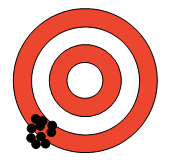
35.
This bullseye demonstrates...
a)
High Accuracy & High Precision
b)
High Accuracy & Low Precision
c)
Low Accuracy & High Precision
d)
Low Accuracy & Low Precision
36.

What is the number 455000 in scientific notation?

a)

45.5 x 10⁵

b)

4.55 x 10⁵

c)

4.55 x 10⁻⁵

d)

455 x 105

37.

The number 3.6 x 10⁻⁴ in standard notation is what?

a)

0.000036

b)

0.0000036

c)

0.00036

d)

0.0036

38.
Which of the following is correct scientific notation?
a)
20.35 x 10⁴
b)
.2035 x 104
c)
2035 4
d)
2.035 x10⁴
39.

Which of these numbers is the smallest?

a)

3.5 x10⁷

b)

3 x10⁷

c)

5 x10⁷

d)

5.5 x10⁷

40.
How many neutrons in C-14?
a)
6
b)
7
c)
14
d)
8
41.
The dense, positively charged mass located in the center of the atom.
a)
nucleus
b)
proton
c)
isotope
d)
molecule
42.
How many protons are in this element?
a)
79
b)
196
c)
117
d)
Cannot be determined
43.
How many protons are in an atom with an atomic number of 20, an atomic mass of 45, and a charge of +2?
a)
20
b)
10
c)
2
d)
18
44.
How many electrons are in an atom that has an atomic number of 34, an atomic mass of 74 and a charge of -2?
a)
34
b)
36
c)
2
d)
40
45.
What do these isotopes of carbon all have in common?
a)
neutrons & mass number
b)
atomic number and neutrons
c)
atomic number and electrons
d)
protons, atomic number, and mass number
46.
How many neutrons does uranium-235 have?
a)
238
b)
92
c)
146
d)
143
47.

What is the average atomic mass of chlorine?


Chlorine has 2 isotopes: Cl-35 and Cl-37

a)

35

b)

36

c)

37

d)

35.45

48.
24.1% of all the isotopes of a an element have a mass of 75.23 amu, 48.7% have a mass of 74.61 amu, and 27.2% have a mass of 75.20 amu.
What is the average mass of this element?
a)
74.92 amu
b)
24.97 amu
c)
75.01 amu
d)
74.51 amu
49.
Nitrogen has three occurring isotopes: Nitrogen-13, Nitrogen-14, Nitrogen-15. Which isotope is the most abundant?
a)
Nitrogen-13
b)
Nitrogen-14
c)
Nitrogen-15
d)
Based on the information given, it cannot be determined
50.
Which conversion factor should be used to solve the following, "How many moles in 28 grams of CO2?"
a)
1 mol = 22.4 L 
b)
1 mol = 44.01 g
c)
1 mol = 6.02x10²³ atoms
d)
more than one
51.
Which conversion factor should be used for the following question " How many molecules are there in 4.00 moles of glucose, C6H12O6
a)
1 mole = 78.12 g
b)
1 mole = 22.4 L 
c)
1 mol = 6.02x 10²³ particles 
d)
more than one
52.
What is the molar mass of Hydrogen Peroxide (H2O2)?
a)
48 g/mole
b)
34.02 g/mole
c)
36.5 g/mole
d)
35.5 g/mole
53.

What is the mass of 0.89 mol of H2O?

a)

20.2 grams

b)

0.049 grams

c)

16.0 grams

d)

5.4x10²³ grams

54.
How many atoms of carbon are in 6.00g of carbon?
a)
1.20x1024atoms C
b)
6.02x10²³atoms C
c)
3.01x10²³atoms C
d)
1.50x10²³atoms C
55.
How many moles are in 16.94g of water?
a)
16.94 mol H2O
b)
0.9401 mol H2O
c)
305.3 mol H2O
d)
1.063 mol H2O
56.

Find the percent composition of hydrogen in H2O

a)

11.2%

b)

12.6%

c)

88.9%

d)

33.4 %

57.

Determine the mass of 4.20 moles of C6H12

a)

353.5 g

b)

72.06 g

c)

337.5 g

d)

421 g

58.

Which element in the compound potassium cyanide, KCN, has a percent composition of 60.97%?

a)

K

b)

C

c)

N

d)

None of the above

59.

Whose model suggested that negative particles were mixed in with positively charged material - like seeds in a watermelon?

a)

J.J. Thomson

b)

Ernest Rutherford

c)

Niels Bohr

d)

Albert Einstein

60.

Who discovered that the atom had an small, dense, positively charged center?

a)

Ernest Rutherford

b)

J.J Thomson

c)

Robert Millikan

d)

John Dalton

61.

Which scientists believed an atom was indivisible? (Choose all correct responses.)

a)

Democritus

b)

Dalton

c)

Thomson

d)

Rutherford

62.

In the atomic model nicknamed the "plum pudding" model, what do the plums represent?

a)

the nucleus

b)

the atom

c)

the electrons

d)

the positive material

63.

What is Neils Bohr's contribution to the atomic theory?

a)

Created the atomic theory

b)

Created a model of the atom with electrons moving around the nucleus in a fixed orbits

c)

Discovered that the proton had a positive charge

d)

Believed that atoms of a given element are identical

e)

Discovered the electron

64.

The red section of the wave is measuring _________________.

a)

wavelength

b)

crest

c)

trough

d)

amplitude

65.

Which of the following is proportional to energy?

a)

Wavelength

b)

Frequency

c)

Amplitude

d)

Speed

66.

As the frequency of an electromagnetic wave increases, the speed of light ____.

a)

increases.

b)

decreases.

c)

stays the same.

67.

A photon of visible light has an energy of 3.6 x 10⁻¹⁹ J. What color is this light? (Hint: calculate the wavelength of this light)

a)

red

b)

violet

c)

yellow

d)

green

e)

blue

68.

An argon ion laser (shown) emits light at 488 nm. What is the frequency of this radiation?

a)

4.07 x 10⁻¹⁹ Hz

b)

6.15 x 10¹⁴ Hz

c)

1.46 x 10² Hz

d)

2.05 x 10⁶ Hz

69.

A common infrared laser operates at a wavelength of 1.06 x 10³ nm. What if the energy of a photon of this light?

a)

7.02 x 10-40 J

b)

6.25 x 10⁻²⁸ J

c)

3.54 x 10⁻¹⁵ J

d)

1.87 x 10⁻¹⁹ J

70.

Choose the correct electron configuration for Chlorine (Cl).

a)

1s2 2s2 2p1

b)

1s2 2s2 2p6 3s2

c)

1s2 2s2 2p6 3s2 3p5

71.

Which of the following will have similar properties to 1s2 2s2 2p6 3s2 3p2?

a)

carbon

b)

calcium

c)

chlorine

d)

cesium

72.
What do you start electron configuration with?
a)
1s2
b)
1d10
c)
1f14
d)
1p6
73.

What is the noble gas notation electron for Sulfur?

a)

[Ne] 3p4

b)

[He] 3s2 3p4

c)

[Ne] 3s2 3p4

d)

[Na] 3s2 3p4

74.

There are _____ types of atomic orbitals.

a)

1

b)

2

c)

3

d)

4

75.

Valence electrons are the

a)

outer most electrons in an atom

b)

total electrons in an atom

76.

This could be the dot diagram of

a)

Mg

b)

Cl

c)

C

d)

O

77.

This is a correct dot diagram for neon (Ne)

a)

true

b)

false

78.

USE THE PERIODIC TABLE

How many valence electrons does Phosphorus have?

a)

31

b)

5

c)

15

d)

4

79.

Which element has a larger radius?

a)

Oxygen (O)

b)

Sulfur (S)

c)

Tellurium (Te)

d)

Polonium (Po)

80.

Which has a higher ionization energy?

a)

Xenon (Xe)

b)

Rubidium (Rb)

c)

Strontium (Sr)

d)

Iodine (I)

81.

Which element has the highest electronegativity?

a)

Potassium (K)

b)

Titanium (Ti)

c)

Bromine (Br)

d)

Krypton (Kr)

82.

The most reactive nonmetal is named ______

a)

fluorine

b)

flourine

c)

F

83.

The most reactive metal is _____

a)

F

b)

Cs

c)

Li

d)

K

84.

The number of valence electrons cannot exceed

a)

2

b)

4

c)

8

d)

16

85.
What is the name of family I
a)
Alkaline Earth Metals
b)
Boron Family
c)
Alkali Metals
d)
Halogen Family
86.
In the modern periodic table elements are arranged by:
a)
atomic mass
b)
atomic number
c)
valence electrons
d)
number of isotopes
87.
Why were there blank spaces left in Mendeleev's periodic table?                                              
a)
He didn't know what to put there.
b)
 Undiscovered elements not yet known.
c)
Multiple elements could have fit
d)
He forgot to add the elements in.
88.
Who arranged the periodic table by increasing atomic number?
a)
Mendeleev
b)
Rutherford
c)
Bohr
d)
Mosely
89.

What is the name for the group of elements in the second column of the periodic table?

a)

alkali metals

b)

alkaline earth metals

c)

noble gases

d)

halogens

90.

What is the name for the group of elements in the seventeenth column of the periodic table?

a)

alkali metals

b)

alkaline earth metals

c)

noble gases

d)

halogens

91.
Each row in the periodic table is called a 
a)
group or family
b)
period
c)
cluster
d)
unit
92.
The family in the periodic table that contains the most reactive metals is the_______
a)
Alkaline Earth Metals
b)
Transition Metals 
c)
Alkali Metals
d)
Other Metals
93.
The yellow atoms are called 
a)
metals
b)
nonmetals
c)
metalloids
d)
noble gases
94.
The atoms along the stair step or zig-zag line are called 
a)
metals
b)
nonmetals
c)
metalloids
d)
noble gases
95.
How many valence electrons do atoms in group 16 have?
a)
4
b)
5
c)
6
d)
7
96.

Name this ionic compound: K3N

(a)  

97.

What is the formula for this ionic compound: Magnesium Fluoride

a)

MgF

b)

Mg2F

c)

Mg2F2

d)

MgF2

98.
In the chemical formula for an ionic compound, which item is written first?
a)
positive ion
b)
negative ion
c)
subscript
d)
the female
99.
Magnesium bromide is an ionic compound with the chemical formula MgBr₂.  What does the "2" tell you?
a)
There are 2 bromide ions for every magnesium ion
b)
Bromide has a 2- charge
c)
Bromide has a 2+ charge
d)
There are 2 magnesium ions to every bromide ion
100.
What is the formula of Sodium oxide?
a)
Na2O
b)
NaO2
c)
Na2O2
d)
Na2O
101.

How many significant figures are in the following number?

34.900

(a)  

102.

15.773 + 2.8 = ?

(a)  

103.
Solve and give your answer with the correct number of significant figures
129.6/3
a)
43.0
b)
43
c)
 4x101
d)
40
104.

How many sig figs are in 1010?

a)

1

b)

2

c)

3

d)

4

105.
calculate the following to the correct number of sig figs.
0.00401  x  2.00  x  501
a)
4.02
b)
4
c)
4.0
d)
4.0180