
 Worksheets
Spiraled Space Test Review
Total questions: 115
Worksheet time: 2hrs 39mins

Name the moon phase that would come AFTER this moon.
(a)
Spring tides happen during which two Moon phases?
First Quarter and Third Quarter
Full Moon and new Moon
Full Moon and Third Quarter
What does "waning" mean?
Staying the same
Having one side illuminated
Getting bigger and brighter
Getting smaller and darker

Name the phase of the Moon is in:
(a)

Name the moon phase
(a)

Based on the image, what lunar phase will be visible from Earth next?
waxing gibbous
first quarter
full moon
new moon

When is a neap tide most likely to occur?
January 12th and 28th
January 5th and 20th
January 1st, 4th, and 9th
January 13th through the 16th
The moon affects...
(a)

Sun
Moon

What is the name of the lunar phase that comes BEFORE this one?
(a)
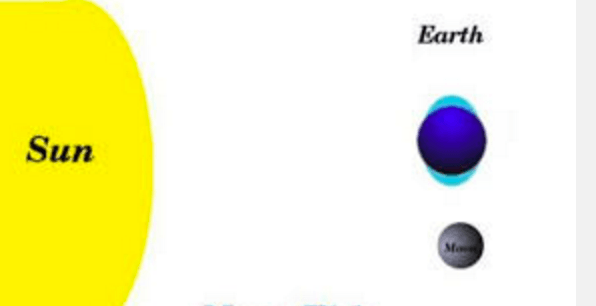
Which moon phase is shown in this diagram?
(a)

What is the name of the lunar phase that comes BEFORE this one?
(a)

Name the moon phase that would come BEFORE this one.
(a)

Name the moon phase
(a)
As the moon moves from a new moon to a full moon, you see...
The moon appearing increasingly lighter.
The amount of light the moon is receiving is decreasing.
The amount of light the moon gets stays constant.
More light and then less light.
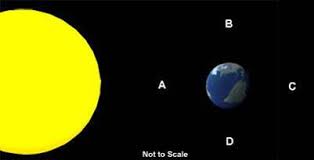
What type of tide would occur when the Moon is in the position of Letter A?
spring
neap
What type of tide would occur when the Moon is in the position of Letter C?
spring
neap
What type of tide would occur when the Moon is in the position of Letter B?
spring
neap
What type of tide would occur when the Moon is in the position of Letter D?
spring
neap
Name the moon phase.
(a)
What is the name of this lunar phase?
(a)

(Pick Two)
During the moon phases shown in the image Earth will experience a -
Spring Tide
Neap Tide
Strong
Weak

(Pick Two)
During the moon phases shown in the image Earth will experience a -
Spring Tide
Neap Tide
Strong
Weak

During the moon phases shown in the image Earth will experience a -
Spring Tide
Neap Tide

During the moon phases shown in the image Earth will experience a -
Spring Tide
Neap Tide
As the moon moves from a full moon to a new moon, you see...
The moon appearing increasingly lighter.
The amount of light the moon is receiving is decreasing.
The amount of light the moon gets stays constant.
More light and then less light.
Neap tides happen during which two Moon phases?
First Quarter and Third Quarter
Full Moon and new Moon
Full Moon and Third Quarter
What does "waxing" mean?
Staying the same
Having one side illuminated
Getting bigger and brighter
Getting smaller and darker
The following is evidence scientists use to support the Big Bang Theory:
dark matter, Blue shift
cosmology, Red Shift
Parallax, Doppler Effect (Blue Shift)
Background Radiation, Doppler Effect (Red Shift).
Hottest stars are 30,000- 60,000 K and are ________.
Red
Blue
Green
White
How does the sun compare to other stars in the universe?
It is larger than most
It is smaller than most
It is an average size star
What type of stars are cooler in temperature AND of high luminosity?
Blue Giants
Red Supergiants
White Dwarfs
Main Sequence
A star that is several times brighter than the sun and has temperatures around 5000 K would be classified as
White Dwarfs
Super Giants
Giants
Arrange the following from smallest to largest:
Stars
Galaxies
Nebulae
Planets
Stars, Planets, Galaxies, Nebulae
Planets, Stars, Galaxies, Nebulae
Planets, Stars, Nebulae, Galaxies
Galaxies, Stars, Planets, Nebulae
Which electromagnetic waves have the shortest wavelengths and highest frequencies?
Gamma rays
Radio waves
X-rays
Ultraviolet rays
What type of galaxy does not have a distinct shape due to a probable collision?
Elliptical
Spiral
Irregular
A star’s brightness depends on its _________.
Its color depends on its ___________________.
Its life cycle depends on its __________.
(a)
A light year is the ______________ light travels in a ____________. It is used to measure _____________ in space.
(a)
_____________ are made of gases, dust, and billions of stars and have different shapes.
Universe
galaxies
solar systems
planets
As stars begin to reach the end of their life cycle their levels of
hydrogen increase.
hydrogen decreases.
hydrogen stays the same.
helium decreases.
When stars or galaxies increase their distance, they are said to be red shifted. How would you describe the lightwaves of a redshift?
high frequency, compressed wave lengths
low frequency, stretched wave lengths

This is a photograph of a(n)
elliptical galaxy.
irregular galaxy.
regular galaxy.
spiral galaxy.

Which of the following is the brightest star?
Sun
Procyon B
Betelgeuse
Aldebaran

Which one of the following is a white dwarf?
Sun
Procyon B
Betelgeuse
Aldebaran
What determines the length of a star's life?
Color
Diameter
Mass
Temperature
What type of galaxy is a spiral?


Which of the following represents the correct order of objects from smallest to largest?
Planet, Galaxy, Universe, Planetary System
Planet, Planetary System, Galaxy, Universe
Galaxy, Universe, Planet, Planetary System
Universe, Planetary System, Galaxy, Planet
About how long does it take Earth to make one complete orbit?
24 hours
1 month
7 days
1 year
What causes the seasons of the Earth?
Axial tilt
Distance from the Sun
Rotation
Precession
What type of galaxy is a spiral?
What type of galaxy is an elliptical?
During which season is the northern hemisphere tilted toward the Sun?
Fall
Summer
Winter
Spring
During the winter months the northern hemisphere is ____________.
tilted closer toward the Sun
tilted farther away from the Sun
spinning slower than in Summer
spinning faster than in Summer
During which two seasons is neither hemisphere of Earth tilted toward or away from the Sun?
Fall and Spring
Fall and Winter
Spring and Summer
Spring and Winter
Which MOST affects the ocean's tides?
the rotation of the Earth
the revolution of Earth around the Sun
the water cycle
the gravitational pull of the Moon
Which of the following is the result of the rotation of Earth?
Day and night
Weather
Cloud formation
Seasons
As wavelength decreases, frequency
increases
decreases
stays the same
there is no relationship
What is the evidence we have that demonstrates that the universe is constantly expanding?
red shift (Doppler Effect)
blue shift (Doppler Effect)
Nebula expansion
Black holes


Name the phase of the moon for letter a
First Quarter
Third Quarter
Waxing Gibbous
Waning Gibbous
Name the phase of the moon for letter b
First Quarter
Waxing Crescent
Waxing Gibbous
Waning Gibbous
Name the phase of the moon for letter c
New Moon
Full Moon
Waxing Gibbous
Waning Gibbous
Name the phase of the moon for letter d
Waning Crescent
Waxing Crescent
Waxing Gibbous
Waning Gibbous
Name the phase of the moon for letter e
First Quarter
Third Quarter
Waxing Gibbous
Waning Gibbous
Name the phase of the moon for letter f
First Quarter
Third Quarter
Waxing Gibbous
Waning Gibbous
Name the phase of the moon for letter g
Full Moon
New Moon
Waxing Gibbous
Waning Gibbous
Name the phase of the moon for letter h
First Quarter
Third Quarter
Waxing Gibbous
Waning Gibbous


If we are experiencing a new moon on March 6 what will the moon look like on 15?


Use the calendar to predict the moon phase on March 9th.
New Moon
Full Moon
Third Quarter
First Quarter
How long after a new moon will it take to see another new moon?
14 days
about one month
3-4 days
7 days

What moon would you expect to see on March 23rd?


Neap tides occur when the Earth, Sun and Moon are
At a 90 degree angle
In a straight line
Spring tides occur when the Earth, Sun and Moon are
At a 90 degree angle
In a straight line
What is the density of an object if it has a mass of 6g and a volume of 3cm3? (Hint: Density = mass/volume)
6 g/cm3
3 g/cm3
2 g/cm3
1/3 g/cm3

You calculated the density of an unknown substance to be 7.8g/cm3. According to the chart, which of the substances doe you most likely have?
Zinc
Copper
Tin
Iron

You calculated the density of an unknown substance to be 5.7g/cm3. According to the chart, which of the substances do you most likely have?
Aluminum
Iron
Tin
Zinc
How many atoms are in O2 ?
1
2
3
How many atoms of each element are in NaCl?
Na=1, Cl=1
Na=2. Cl=2
Na=1, Cl-2
5 N2O represents the laughing gas you might have at the dentist. How many atoms of nitrogen are present here?
1
2
7
10
How many Hydrogen atoms in 3(NH₄)₂CrO₄?
4
2
8
24
Which of the following elements is least likely to form a compound?
Hydrogen
Sodium
Argon
Potassium
The smallest particle with characteristics of an element is known as the
Periodic Table
Atom
Proton
Electron

These are the SMALLEST subatomic particles
Proton
Neutron
Electron
C + O2 → CO2
Balanced
Unbalanced
6C + 6H2O → C6H12O6
Balanced
Unbalanced
CH4 + O2 → CO2 + 2H2O
Balanced
Unbalanced
H2O2 → H2O + O2
Balanced
Unbalanced
2C2H6 + O2 → 4CO2 + 3H2O
Balanced
Unbalanced

Which group of elements could have the characteristic of brittle?
Metal
Nonmetal

Metals appear to the _______ of the dark ziz-zag line on the periodic table.
A. right
B. middle
C. left
Elements are organized by REACTIVITY into.....
Periods
Groups
Elements that appear horizontally on the periodic table
Periods
Groups
Energy Levels best describe .....
Periods
Groups
What group is the most reactive non metals?
1
17
2
1
What group is the most reactive metals?
2
18
1
16
Which elements have the most similar chemical properties?
boron and carbon
oxygen and sulfur
aluminum and bromine
argon and silicon
What type of galaxy is an irregular?

