Worksheets
Forces Unit Review
Total questions: 93
Worksheet time: 23hrs 15mins
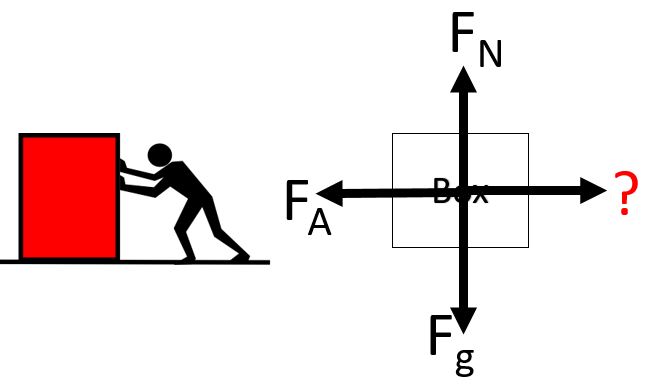
a car traveling on a straight part of the highway with a cruise control set at constant velocity

Name that law: Law of Inertia
1st Law of Motion
2nd Law of Motion
3rd Law of Motion
Law of Universal Gravitation
Name that law: If you use the same force to push a truck and push a car, the car will accelerate more than the truck.
1st Law of Motion
2nd Law of Motion
3rd Law of Motion
Law of Universal Gravitation
A rock climber pulls down on the wall (action force). What is the reaction force?
The wall pushing down on the climber.
The climber pushing up on the wall.
The climber pulling down on the wall.
The wall pushing up on the climber.
A car is driving south and hits a tree. What is the direction of the reaction force?
East
West
North
South
The English Scientist who developed three laws of motion was called:
Sir Isaac Newman
Sir Isaac Newton
Albert Einstein
Mr. Fig Newton
Because of inertia, a resting object ________.
will remain at rest
will move at a constant speed
will eventually move
is unbalanced
The first law of motion states that objects in motion will:
stop
accelerate
stay in motion
rest
The first law of motion states that objects at rest will stay at rest unless acted upon by an unbalanced:
motion
force
inertia
acceleration
Newton's second law of motion states that an unbalanced force is equal to mass times:
acceleration
force
motion
inertia
Newton's third law of motion states that for every action there is:
an opposite, but equal reaction.
an opposite and equal reaction.
a reaction.

Name the law: An object at rest stays at rest and an object in motion stays in motion with the same speed and in the same direction unless acted upon by an unbalanced force.
The First Law of Motion
The Second Law of Motion
That other law... you know?
The Third Law of Motion

This is the vector sum of all the forces that act upon an object.
Total Force
Net Force
Next Force
May The Force is With You... Always

This a unit of force that will accelerate one kilogram of mass one meter per second squared.
Fig Newton
Sir Issac Newton
Gravity
A Newton

This is the force that resists motion.
Fraction
Friction
Quark
Gravity

This is the amount of matter in volume.
Volume
Matter
Mass
Motion

This is a force that causes a change in motion of an object.
A changing force
Gravity
A balanced Force
An unbalanced force

This is the measurement of change in an object's velocity (speed).
Work
Gravity
Force
Acceleration

This is a quantity that has both magnitude and direction.
A Victor
A Victoria
A Vakter
A Vector

This law states that the greater the mass of an object, the more force it will take to accelerate the object.
Newton's second Law of Motion
Newton's first Law of Motion
Newton's third Law of Motion
Newton's Eleventeenth Law of Motion
This is the measure of force.
Miles Per Hour
The force of pushing
Newtons
Grams

This equation goes with which law?
Newton's first law of motion
Newton's second law of motion
Newton's third law of motion
A person is pushed forward into their seat belt when a car stops. Which law is this?
Newton's 1st Law
Newton's 2nd Law
Newton's 3rd Law

When the force on a car is doubled, the acceleration is doubled.
Newton's 1st Law
Newton's 2nd Law
Newton's 3rd Law

A skater pushes another skater forward, but the one pushing moves backwards.
Newton's 1st Law
Newton's 2nd Law
Newton's 3rd Law

The harder you hit a baseball, the faster it accelerates.
Newton's 1st Law
Newton's 2nd Law
Newton's 3rd Law

You push against a wall and the wall is pushing back on you.
Newton's 1st Law
Newton's 2nd Law
Newton's 3rd Law

You are carrying a lunch tray when you bump into the edge of a table. Although the tray did not tip, your milk falls off of the front of the tray.
Newton's
1st
Law of Motion
Newton's
2nd
Law of Motion
Newton's
3rd
Law of Motion

Which law best explains why more force must be applied to the bowling ball to make it accelerate at the same rate as the tennis ball.
Newton's 1st Law
Newton's 2nd Law
Newton's 3rd Law
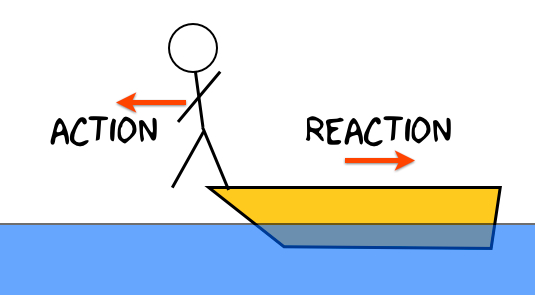
A sports car speeds up much faster than a dump truck when a traffic light turns from red to green. Which law is this?
Law 1
Law 2
Law 3
Newton's Third Law says that forces must always occur in _____.
pairs
groups of 20 or more
individual circumstances
friction
What measurement is used to measure force?
Newtons
Kelvin
Kilos
Moles

Categorize this situation based on the size of the scale reading, aka normal force ( Fnorm )
Fnorm > Fg
Fnorm<Fg
Fnorm=Fg
Not enough info to conclude
What is the frictional force on a 25-N object sliding along a horizontal surface at constant speed if the coefficient of kinetic friction is 0.40?
10 N
25 N
4.0 N
8.0 N
A 50.0-N box rests on an inclined plane whose angle of inclination is 30.0 degrees. What is the normal force acting on the object?
25 N
32 N
43 N
50 N
A 25-N box lies on top of a 50-N box. What is the normal force acting on the 50-N box?
There is none.
25 N
50 N
75 N
A 65-N box rests on an a 40.0-degree inclined plane. What is the coefficient of static friction if the box were to experience pending motion at this angle?
0.50
0.64
0.72
0.83
A 60-N box moves on a 65-degree inclined plane. If the coefficient of kinetic friction is 0.25, by how much is the box accelerated?
7.8 m/s/s
9.8 m/s/s
3.2 m/s/s
1.9 m/s/s
Which of the following statement about friction is not true?
Friction is always parallel to the contact surface.
Friction is always opposite the direction of motion.
Frictional force is inversely proportional to the normal force of the object.
Friction depends on the types of surface in contact with each other
Which is the unit for the coefficient of friction?
newton
N/m2
N-m
It is dimensionless.
What is the normal force exerted by the ground on a 65-kg metal bar?
65 N
640 N
-65 N
-640 N
Which explains why there is less force needed once a heavy object starts moving from an initial state of rest?
The inertia of the object is now less than when it is at rest.
The force exerted is now greater than the normal force.
The parallel force is now greater than the weight of the object.
The coefficient of kinetic friction is less than the coefficient of static friction.
The normal force on an object is a consequence of which law?
First Law of Motion
Second Law of Motion
Third Law of Motion
Law of Universal Gravitation
(Use Fnet=ma), A 10 kg bowling ball would require what force to accelerate down an alleyway at a rate of 3 m/s2?
30 N
13 N
3.3 N
0.3 N
(Using Fnet=ma), What net force is required to accelerate a car at a rate of 2 m/s2 if the car has a mass of 3,000 kg?
6,000 N
1,500 N
3,002 N
2,998 N
(Use Fnet=ma). What is the mass of a falling rock if it produces a force of 147 N? (Acceleration due to gravity = 9.8 m/s2)
15 kg
1,440.6 kg
156.8 kg
137.2 kg
(Use Fnet=ma). What is the mass of a truck if it produces a force of 14,000 N while accelerating at a rate of 5 m/s2?
2,800 kg
0.0004 kg
70,000 kg
13,995 kg
(Use Fnet=ma). What is the acceleration of a softball if it has a mass of 0.5 kg and hits the catcher's mitt with a force of 25 N?
0.5 kg
50 kg
25.5 kg
12.5 kg
(Use Fnet=ma). Your parents' car has a mass of 2,000 kg. If your car produces a force of 5,000 N, at what rate will it accelerate?
2.5 m/s2
0.4 m/s2
10,000,000 m/s2
3,000 m/s2

(Use Fnet=ma). Use the diagram to determine the net force, assume the object is accelerating at a rate of 2 m/s2 and determine the mass of the object.
2 kg
4 kg
6 kg
8 kg

(Use Fnet=ma). Use the diagram to determine the net force, assume the object is accelerating at a rate of 3 m/s2, and determine the object's mass?
3 kg
5 kg
60 kg
75 kg
8 N to the left and 4 N to the right.
(a) Find the net force.
(b) Is this balanced?
(a) 12 N Right
(b) No
(a) 4 N Left
(b) No
(a) 12 N Right
(b) Yes
(a) 4 N Left
(b) Yes

If the force of the person in the yellow is pushing right with 30N, and the force of the person in blue is also pushing is 30N left, what is the net force?
0N
60N
900N
1N
FN=100N, Ff=20N
μ=5.0
μ=0.2
μ=1.2
μ=0.1
A 2.0-N force acts horizontally on a 10-N block that is initially at rest on a horizontal surface. The coefficient of static friction between the block and the surface is 0.50.What is the magnitude of the frictional force that acts on the block?
5 N
8 N
2 N
0 N
There are 25N of friction that keep a 10kg brick moving at a constant rate. What is the coefficient of friction?
0.25
0.25N
4
4N
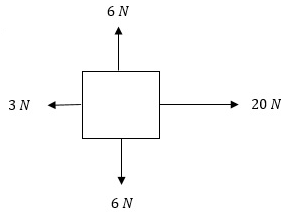
What is the NET FORCE of this diagram?
17 N, right
17 N, left
23 N, right
12 N, up

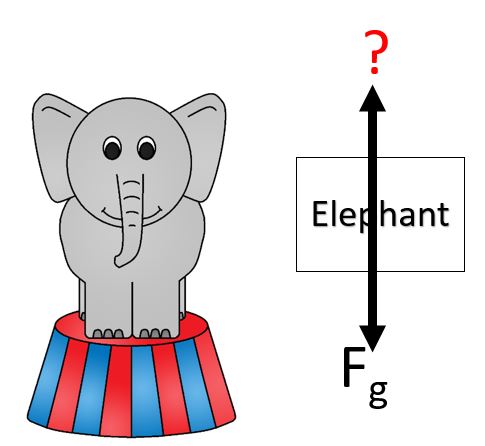
A rightward force is applied to a dresser to accelerate it to the right across the bedroom floor.


Which freebody diagram best represents a desk being pushed across the classroom floor?


Whenever an object is moving, there is always this force opposing the motion:
inertia
momentum
friction
applied force
What is the NET FORCE of this diagram?
17 N, right
17 N, left
23 N, right
12 N, up

What is the net force?
3 N Right
3 N Left
17 N Right
17 N Left

A man pushes a box across the floor at a constant velocity. There is a force on the box pulling it toward the center of the earth. This is called the
force of gravity
normal force
friction force
applied force