wayground logo

Free Printable Worksheets

Font size

S
M
L
XL
Worksheets

PS Midterm Review Spring 2023

Total questions: 127

Worksheet time: 2hrs 58mins

Name
Class
Date
1.

Alicia wants to know how drinking milk affects how tall a Monica grows. Which is the independent variable?

a)

Monica's growth

b)

drinking milk

2.

Does the type of shoe worn during a 30 meter dash affect the speed of the runner? The speed of the runner is the...

a)

independent variable

b)

dependent variable

3.
Marcos wants to know: Does the type of gasoline put in a car effect how fast the car can drive? What is the independent variable?
a)
Type of gasoline
b)
which car the gas is put into
c)
how fast the car can drive
d)
how much gas is put into the car
4.

How does increasing the slope of a ramp affect how far a marble travels? Increasing the slope is the...

a)

independent variable

b)

dependent variable

5.

What effect does decreasing the temperature of a room have on a lifespan of a battery? The temperature of the room is the...

a)

independent variable

b)

dependent variable

6.

How does adding cardio to one’s daily schedule affect their heart rate? The heart rate is the...

a)

independent variable

b)

dependent variable

7.

Does changing the scent of a brand of dog food affect how much the dog eats? How much the dog eats is the...

a)

independent variable

b)

dependent variable

8.

How does the amount of sunlight affect how many tulip flowers a plant grows? The sunlight is the...

a)

independent variable

b)

dependent variable

9.
Qualitative or Quantitative:
The butterfly is on a pink flower. 
a)
Qualitative
b)
Quantitative
10.
There are nine dolphins in this pod.
a)
qualitative
b)
quantitative
11.
Dolphins have smooth skin.
a)
qualitative
b)
quantitative
12.
There are 16 red marbles in the bag.
a)
Qualitative
b)
Quantitative
c)
Both
d)
Neither
13.
The speed of the car was 45 mph.
a)
Qualitative
b)
Quantitative
c)
Both
d)
Neither
14.
The mass of the beaker was 122 grams.
a)
Qualitative data
b)
Quantitative data
15.
The flower is red.
a)
Qualitative data
b)
Quantitative data
16.
The candy was sour.
a)
Qualitative data
b)
Quantitative data
17.
He ran 50 miles.
a)
Qualitative data
b)
Quantitative data
18.
One leaf is 9 cm long.
a)
Qualitative data
b)
Quantitative data
19.
The leaves are stiff.
a)
Qualitative data
b)
Quantitative data
20.
My cat is twelve years old.
a)
Qualitative data
b)
Quantitative data
21.
What words would be most appropriate to see if a student was describing the QUALITATIVE properties of a planet? 
a)
13,500,000 miles in diameter
b)
16 light years away
c)
orbits a star in 854 days
d)
gaseous 
22.
What words would be most appropriate to see if a student was describing the QUALITATIVE properties of a metal? 
a)
 melts at 1,500 degrees F
b)
density of 1.75 pounds per cubic inch
c)
reflective shine
d)
15.3% copper
23.
What words would be most appropriate to see if a student was describing the QUANTITATIVE properties of a classmate?
a)
He is short
b)
He is tall
c)
He is 5 foot 11
d)
He needs to loose weight
24.
What words would be most appropriate to see if a student was describing the QUANTITATIVE properties of an organism? 
a)
grey skin
b)
big ears
c)
2 1/2 tons
d)
mammal
25.
What words would be most appropriate to see if a student was describing the QUALITATIVE properties of an organism? 
a)
rough skin
b)
fourteen pounds
c)
twice as many teeth
d)
16 inches long
26.

The Question in an experiment that is being tested

a)

Hypothesis

b)

Problem (Question)

c)

Procedure

d)

Conclusion

27.

An explanation or prediction that can be tested

a)

Hypothesis

b)

Procedure

c)

Observation

d)

Inference

28.

A set of organized steps to follow- like a checklist.

a)

Procedure

b)

Problem

c)

Variable

d)

Inference

29.

The final summary of data and results

a)

Conclusion

b)

Control

c)

Procedure

d)

Analysis

30.

If a laboratory fire erupts, immediately _________.

a)

Run for the fire extinguisher.

b)

Notify your instructor.

c)

Throw water on the fire.

d)

Open the windows.

31.

If a lab experiment is not completed you should _______.

a)

Discuss the issue with your teacher.

b)

Sneak in after school and work alone.

c)

Come in durin glunch and finish.

d)

Make up some results.

32.

You are heating a substance in a test tube. Always point the open end of the test tube ________.

a)

Toward yourself.

b)

Toward your lab partner.

c)

Toward another classmate.

d)

Away from all people.

33.

You are heating a piece of glass/metal and now want to pick it up. You should ________.

a)

Use a rag or paper towel.

b)

Pick up the end that looks cooler.

c)

Use tongs.

d)

Pour cold water on it.

34.

Personal eyeglasses provide as much protection as ________.

a)

A face shield.

b)

Safety goggles/glasses.

c)

Splash proof chemical goggles.

d)

None of these.

35.

The following footwear is required in the lab ________.

a)

Sandals.

b)

Open-toe shoes.

c)

Closed-toe shoes.

d)

Shoes appropriate for the weather.

36.

True or False:

IF acid splashes on your skin you should rinse ONLY with lots of water, no soap.

a)

True

b)

False

37.

True or False:

Return all unused chemicals to their original containers.

a)

True

b)

False

38.

True or False:

Chipped or cracked glassware is ok to use.

a)

True

b)

False

39.

You are required to wear goggles when ________.

a)

chemicals are used.

b)

heated glass is used.

c)

working with fire.

d)

chemicals, heated glass, or fire are being used.

40.

Match the following

a)

Step 1

1.

Question

b)

Step 2

2.

Hypothesis

c)

Step 3

3.

Experiment

d)

Step 4

4.

Data

e)

Step 5

5.

Analyze

41.

What is the last step of the Scientific Method

a)

Report

b)

Repeat

c)

Hypothesis

d)

Analyze

42.
A possible explanation to a problem that has not yet been tested. 
a)
data
b)
theory
c)
hypothesis
d)
fact
43.
This part of the experiment serves as a basis of comparison; the one variable being tested has been omitted. 
a)
experimental group
b)
control group
c)
data
d)
variables
44.
This variable in an experiment is the one being deliberately changed by the scientist. 
a)
dependent variable
b)
independent variable
c)
data
d)
control group
45.
What step does every scientific experiment begin with?
a)
hypothesis
b)
question/problem
c)
procedures
d)
conclusion
46.
An experiment is performed on plants to see how different liquids affect plant growth. Each plant in the experiment is given a different liquid; water, apple juice, or milk. Each plant has the same amount of soil, sunlight, and listens to the same music. In this investigation, the independent variable is ...
a)
The type of plant
b)
The amount of sunlight
c)
The type of music
d)
The type of liquid
47.
The summary at the end of an experiment that explains the results. 
a)
conclusion
b)
procedures
c)
materials
d)
responding variable
48.
Testing a hypothesis often involves a(n):
a)
answer
b)
experiment
c)
problem
d)
safety check
49.
A student wants to test the effects of type of exercise on heart rate.  What is the dependent variable?
a)
heart rate
b)
type of exercise
c)
amount of exercise
d)
time of day exercise occurs
50.
Observations made during an experiment are called:
a)
data
b)
problems
c)
conclusions
d)
questions
51.
On what axis should the independent variable always be?
a)
X
b)
Y
52.
An experiment is performed on plants to see how different liquids affect plant growth. Each plant in the experiment is given a different liquid; water, apple juice, or milk. Each plant has the same amount of soil, sunlight, and listens to the same music. In this investigation, what are the controlled variables?
a)
Type of plant, amount of music, and sunlight
b)
Water, apple juice, milk
c)
Plant growth
53.
An experiment is performed on plants to see how different liquids affect plant growth. Each plant in the experiment is given a different liquid; water, apple juice, or milk. Each plant has the same amount of soil, sunlight, and listens to the same music. In this investigation, the independent variable is ...
a)
The type of plant
b)
The amount of sunlight
c)
The type of music
d)
The type of liquid
54.
Which is NOT a step in the scientific method?
a)
Make observation
b)
Form a theory
c)
Collect data
d)
Form a hypothesis
55.
Squidward found new reeds to tryout for his clarinet.  He used an APPLAUSOMETER to measure applause after playing  Under the Sea with each reed.  The results were put in the table.
What was controlled?
a)
The Song
b)
The Reed
c)
The Applause
56.
Squidward found new reeds to tryout for his clarinet.  He used an APPLAUSOMETER to measure applause after playing  Under the Sea with each reed.  The results were put in the table.
What was the independent variable?
a)
The Song
b)
The Reed
c)
The Applause
57.
Squidward found new reeds to tryout for his clarinet.  He used an APPLAUSOMETER to measure applause after playing  Under the Sea with each reed.  The results were put in the table.
What was the dependent variable?
a)
The Song
b)
The Reed
c)
The Applause
58.
The data collected supports which of the following questions that Squidward could have tested?
a)
Which song does the audience prefer?
b)
Which instrument does the audience like best?
c)
Which reed length creates the best sound?
d)
How do applause affect performance?
59.
Frank has a paper clip. It has a mass of 9g and a volume of 3cm3. What is its density?
a)
3 g/cm3
b)
1/3 g/cm3
c)
27 g/cm3
d)
39 g/cm3
60.
Frank has an eraser. It has a mass of 4g, and a volume of 2cm3. What is its density?
a)
8 g/cm3
b)
2 g/cm3
c)
1/2 g/cm3
d)
24 g/cm3
61.
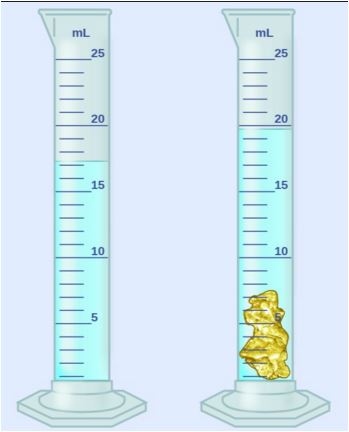
An irregularly shaped piece of gold was lowered into a graduated cylinder holding a volume of water equal to 17 ml. The height of the water rose to 20 ml. If the mass of the gold was 27 g, what was its density?
a)
9 g/mL
b)
10.5 g/mL
c)
6.5 g/mL
d)
8 g/mL
62.
How much water has been displaced in the image shown?
a)
40 mL
b)
65 mL
c)
20 mL
d)
25 mL
63.
How much water has been displaced in the image shown?
a)
80 mL
b)
100 mL
c)
20 mL
d)
60 mL
64.
A lead cylinder has a mass of 540 grams and a volume of 2.70 mL.  Calculate the density of the lead cylinder. Remember to move the decimal on both sides of the problem.
a)
15 g/mL
b)
19 g/mL
c)
20 g/mL
d)
12 g/mL
65.

Find the volume if a substance has a density of 19.3g/cm3 and a mass of 10g.

a)

.52cm3

b)

193cm3

c)

1.93cm3

d)

29.3cm3

66.
Find the density of a 2 cm x 2 cm x 2 cm cube with a mass of 64 g.
a)
6 cm3
b)
12 g/cm3
c)
128 g/cm3
d)
8  g/cm3
67.
What is the density of water?
a)
0 g/ml
b)
1 g/ml
c)
10 g/ml
d)
100 g/ml
68.
Find the volume of the given figure.
a)
308.9 cm3
b)
308.2 cm3
c)
312.8 cm3
d)
302.9 cm3
69.
Find the Volume
a)
428.4 cm3
b)
412.8 cm3
c)
404.2 cm3
d)
400 cm3
70.

An object is is placed into 45 mL of water. The water rises to 48 mL. What is the volume of the object?

a)

3 mL

b)

93mL

c)

8 mL

d)

83 mL

71.
The tool used to measure the mass of a substance or object is a ______________.
a)
balance
b)
graduated cylinder
c)
ruler
d)
thermometer
72.
Veal finds a gold colored rock in a river.  It has a mass of 9.65 grams and a volume of 0.5 cm3.  What is the density of the rock?
a)
10.15 g/cm3
b)
19.3 g/cm3
c)
9.15 g/cm3
d)
4.825 g/cm3
73.
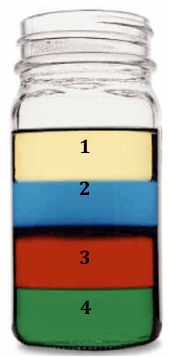
Put the liquids in order from most dense to least dense?
a)
4, 3, 2, 1
b)
1, 2, 3, 4
c)
3, 4, 2, 1, 
d)
4, 3, 1, 2
74.

What 2 measurements are used for DENSITY

a)

Mass and Weight

b)

Mass and Acceleration

c)

Mass and Volume

d)

Length and Width

75.

Calculate the density in the following question: A star has a mass of 15 g and a volume of 25 mL.

a)

0.7 g/mL

b)

0.6 g/mL

c)

0.5 g/mL

d)

0.4 g/mL

76.

Calculate the density in the following question: A flower pot has a mass of 95 g and a volume of 92 mL.

a)

1.03 g/mL

b)

0.97 g/mL

c)

1.01 g/mL

d)

0.99 g/mL

77.
If a piece of matter changes shape, what happens to its mass?
a)
It increases
b)
It decreases
c)
it changes randomly
d)
it stays the same
78.
Which of the following is a unit of mass?
a)
kilogram
b)
liter
c)
meter
d)
pound
79.
Anything made of matter must _____________________.
a)
take up space and have mass
b)
have mass and be a solid
c)
be a solid and not move
d)
take up space and be a liquid
80.
The mass of an object ___________________________.
a)
changes, depending on where it is located
b)
changes randomly
c)
changes, depending on temperature
d)
does not change
81.
One piece of matter is cut into two pieces.  What would be the mass of the two new pieces if we combined them?
a)
the two pieces would have the same mass as the original piece
b)
the two pieces would have more mass than the original piece
c)
the two pieces would have less mass than the original piece
d)
there is no way to tell which would have more mass
82.
John measures a rock and finds it to be 16 grams.  What does John know about the rock?
a)
its mass
b)
its weight
c)
its volume
d)
its momentum
83.
Mass is a property of ___________.
a)
waves
b)
energy
c)
matter
d)
light
84.
Which of these things contains matter?
a)
rocks
b)
x-rays
c)
light
d)
heat
85.
The mass of an object WILL change if ____________.
a)
it changes shape
b)
it loses a piece
c)
it gets hotter
d)
it gets cooler
86.
Which of these would you use to measure mass?
a)
a barometer
b)
a thermometer
c)
a balance scale
d)
a ruler
87.
If you added or removed matter from an object, what would change?
a)
the color
b)
the melting point
c)
the mass
d)
the texture
88.
Dixon wants to measure how much mass her science book has.  Which tool does she need to use?
a)
a balance scale
b)
a graduated cylinder
c)
a ruler
d)
a chronometer
89.
Mass is expressed in what type of units?
a)
meters and kilometers
b)
grams and kilograms
c)
liters and milliliters
d)
ounces and pounds
90.
Hampton finds a gold colored rock in the river behind her house.  She measures it and discovers it is 96.6__.  What unit of measurement could go in that blank?
a)
pounds
b)
ounces
c)
neither of those are correct
d)
both of those could be correct
91.
What is mass?
a)
the force of an object caused by gravity
b)
the amount of space something takes up
c)
the amount of matter in an object
d)
how fast something is moving
92.
If we were measuring the mass of Professor Tesfay, the most appropriate unit to use would be _________________.
a)
milligrams
b)
ounces
c)
grams
d)
kilograms
93.
Suppose an astronaut were to visit a planet where the gravity is half that of Earth.  His MASS on that planet would be ______________.
a)
half his Earth mass
b)
the same as his Earth mass
c)
twice his Earth mass
d)
zero
94.
Suppose an astronaut were to visit a planet where the gravity is half that of Earth.  His WEIGHT on that planet would be _______________.
a)
half his Earth weight
b)
the same as his Earth weight
c)
twice his Earth weight
d)
zero
95.
Mass is measured using a __________________.
a)
beaker
b)
graduated cylinder
c)
ruler
d)
balance scale
96.
In order to reduce the mass of a piece of matter, you would have to ____________________.
a)
lower its temperature
b)
take away some energy
c)
add some matter
d)
remove some matter
97.

The unit for volume is...

a)

Milliliters (mL)

b)

Grams (g)

c)

Meters (m)

d)

Degrees Celsius (C)

98.
What is the volume of the liquid in the graduated cylinder?
a)
52.0 ml
b)
51.0ml
c)
51.8ml
d)
51ml
99.
What is the volume of the liquid in this graduated cylinder?
a)
58.8ml
b)
58.0ml
c)
58ml
d)
62ml
100.

Before you begin a lab on liquid measurement, why is it important to check the measurement scale on your lab tools?

a)

To determine how many milliliters each dash represents

b)

To see how much liquid will fit into the cylinder

c)

To determine how many grams the cylinder can hold

101.

Why is it important to keep the graduated cylinder flat on the table?

a)

The water level could be wrong if you don't

b)

You are measuring from a spot called the meniscus

c)

Some water may spill

d)

The results of your experiment may be wrong

102.

What is the amount of space that an object occupies?

a)

Volume

b)

Mass

c)

Matter

d)

Gravity

103.

What units are used for the volume of a solid?

a)

cm3

b)

mL

c)

g

d)

inches

104.

What units are used for the volume of a liquid?

a)

mL

b)

g

c)

m3

105.

What is the difference between the volume of a solid and the volume of a liquid?

a)

The tools that are used

b)

The units that are used

106.

What is matter?

a)

everything

b)

things that occupy space

c)

things that have mass

107.

What is weight dependent upon?

a)

mass

b)

volume

c)

gravity

108.

Mass does not change.

a)

True

b)

False

109.

Weight can change.

a)

True

b)

False

110.

What is a variable?

a)

The thing in an experiment that changes

b)

The thing that stays the same

c)

A prediction

d)

A conclusion

111.

In the milk experiment, what was the variable?

a)

The milk

b)

The food coloring

c)

The soap

112.

In our seed experiment, what is the variable?

a)

The seeds

b)

The paper towel

c)

The water

d)

The 20% and 40% solutions

113.

A shop owner records information about his customers.


The average amount of money spent is _____ data

a)

Qualitative

b)

Quantitative

114.

What are observations made using our five senses called?

a)

qualitative data

b)

quantitative data

115.

The petals are smooth and silky.

a)

qualitative data

b)

quantitative data

116.

The bearded iris smells sweet.

a)

qualitative data

b)

quantitative data

117.

The rose has three leaves.

a)

qualitative data

b)

quantitative data

118.

What is a solution?

a)

Substances are well mixed

b)

One substance is dissolved into another

c)

Substances can be easily separated

119.

What is a hypothesis?

a)

A piece of data gathered during an experiment

b)

A final conclusion about an experiment

c)

A prediction about what is going to happen during an experiment

120.

The tool that is used to measure the volume of a liquid:

a)

Petri dish

b)

Beaker

c)

Graduated Cylinder

d)

Balance

121.

What does it mean to germinate?

a)

Sprout seeds

b)

Plant seeds

c)

Grow bacteria

122.

In our seed germination lab, what variables (things that changed) were involved?

a)

The processes used

b)

The tools that were used

c)

The solutions that were used

d)

The time of the experiment

123.

What is the name of the measuring system used by Americans?

a)

Metric

b)

Customary

124.

Which of the following are American measurements?

a)

Inches

b)

Grams

c)

Ounces

d)

Liters

125.

What is the distance between 2 points?

a)

Length

b)

Mass

c)

Gravity

d)

Volume

126.

What is the base unit for length in the metric system?

a)

kilometers

b)

meters

c)

centimeters

d)

millimeters

127.

What is the amount of matter in an object?

a)

Mass

b)

Volume

c)

Weight