
Font size
 Worksheets
REVISION
Total questions: 81
Worksheet time: 1hrs 23mins
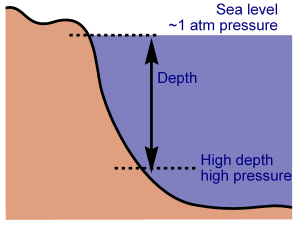
When you increase your depth under water, the water pressure on your body
increases
decreases
stays the same
How do you Calculate Pressure
Force(N)/Area(m2)
Force(kg)/Area(mi2)
Area(m2)/Force(N)
Why won't you sink in mud if you wear boots?
Because the surface area is larger creating less pressure.
Has air in it to keep you floating.
Because the mud won't want you.

Diagram shows the design of a dam. Why does the thickness of the dam increase with its depth?
The design of this structure is stronger.
Water pressure increases with depth.
The cost of construction is lower.
Water pressure acts uniformly in all directions.
What is pressure?
The amount of force exerted on a surface
The surface area of an object
The weight of an object


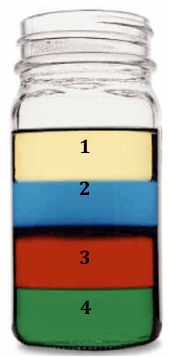
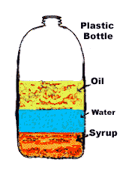

What is the formula for Mass?
Mass/Volume
Density x Volume
Mass/Density
What is the formula for Volume?
Mass/Volume
Density x Volume
Mass/Density

Define Specific Latent Heat of Fusion
is the amount of thermal energy required to change one kilograms of the substance from liquid state to gaseous state or vice versa, without a change in temperature
is the amount of thermal energy required to change one kilograms of the substance from solid state to liquid state or vice versa, without a change in temperature
is the amount of thermal energy required to change one kilograms of the substance from liquid state to gaseous state or vice versa by one Kelvin or one degree celcius
is the amount of thermal energy required to change the substance of any of any mass from liquid state to solid state or vice versa, without a change in temperature
What is heat capacity ?
The amount of thermal energy required to raise the temperature of a substance by 1K or 1°C
The amount of thermal energy required to raise the temperature of a 1kg mass of substance by 1K or 1°C
The amount of thermal energy required to change a substance from liquid state to gaseous state without a change in temperature
The amount of thermal energy required to change 1kg of the substance from liquid state to gaseous state, without a change in temperature
The specific heat of platinum is 0.133 J/g°C. How much heat (∆E) is released when a 10 g piece of platinum cools from 100°C to 50°C?
66.5 J
665 J
0.0266 J
0.665 J
20 g of water. specific heat of water is 4.18 J/g°C. temperature changes from 25° C to 20° C, how much heat energy (∆E) moves from the water to the surroundings?
418 J
209 J
83 J
4.18 J
What is the formula to calculate heat energy required to raise the temperature of any substance?
∆E=mc∆t
∆E=mc
∆E= ½mv
m=∆EC
Latent heat is
the heat absorbed or released at a boiling process during a change of phase
the heat absorbed or released at a constant temperature during a change of phase
the heat absorbed or released at a constant temperature during a change of phase per 1 kg
the heat absorbed or released by an object to increase or decrease its temperature by 1 degree Celsius
What is the formula to calculate specific latent heat of vaporisation?
L = ∆E/m
c = ∆E/(mΔƟ)
∆E = mcΔƟ
∆E = m/L

The graph shows the cooling curve of a substance. At which stages the specific latent heat released?
AB and CD
BC and DE
AB and EF
BC and CD

How much energy is required to freeze 150 g of water?
( Lvaporisation=2260 J/g and LFusion =334 J/g)
50 100 cal
339 000 J
339 000 cal
50 100 J
The temperature shown by a mercury -in glass thermometer increases.Which of the following is constant.
the density of the mercury
the internal energy of the mercury
the mass of the mercury
the volume of the mercury

A block of ice is heated until it has melted. The water produced is heated until it boils. Which choice is correct?
A
B
C
D

When a liquid evaporates, some molecules escape from it and its temperature changes. Where do the molecules escape from and what is the effect of evaporation on the liquid temperature?
A
B
C
D
A heater supplies 80 J of energy to a block of metal. The temperature of the metal increases by 20 degC. What happens to the internal energy of the same block when its temperature falls by 10 degC?
decrease by 40 J
decrease by 160 J
increase by 40 J
increase by 160 J
A hot drink is left in a room which has a temperature of 20 degC. What happens to the drink in 10 minutes?
density becomes lower
internal energy becomes lower
particles move more quickly
energy of particles become equal
Ice at 0 degC is placed in warm water. The ice melts. As ice melts, which statement is correct?
internal energy of ice decreases
internal energy of water decreases
temperature of ice increases
temperature of water increases

A sample of liquid at a temperature of 80 degC cools down and solidifies. The graph shows the temperature against time as the sample cools. How long does the process of solidification take?
2 min
3 min
4 min
5 min
Some statements about boiling and evaporation are below. Which is incorrect?
Boiling occurs at the liquid surface.
Boiling forms bubbles as liquid turns to gas.
Evaporation occurs at any temperature.
Rate of evaporation is affected by exposed surface area of the liquid.

The bar graph shows the temperature at which some substances change state.
Which substance freezes at 800 degC?
carbon dioxide
ethanol
sodium chloride
water
When rubbed with ethanol the hand feels cold because ...
the temperature of the ethanol is lower than the body temperature
ethanol on the skin prevents the loss of heat from the body
thermal energy is transferred from ethanol to the body
heat is removed from the body as ethanol evaporates
Blocks of gold are made by pouring hot, melted gold into moulds. The gold cools to its melting point and begins to solidify. As it solidifies, its temperature ............................
stays constant and energy is lost from the gold
stays constant and no energy is lost from the gold
decreases and energy is lost from the gold
decreases and no energy is lost from the gold.
The flow of heat due to a temperature difference is called...
Heat Transfer
Conduction
Convection
Radiation
Heat transfer is also called...
Thermal Energy
Conduction
Convection
Radiation
When heat energy moves in a solid it is called....
Conduction
Convection
Radiation
When the motion of particles in the hotter part transfer their energy through vibrations to nearby ones it is what type of heat transfer...
Conduction
Convection
Radiation
Touching a hot stove is an example of...
Conduction
Convection
Radiation

This picture is an example of...
Conduction
Convection
Radiation
Walking without shoes on a hot day is an example of...
Conduction
Convection
Radiation
When heat energy moves in a liquids or gases it is called...
Conduction
Convection
Radiation
The rising and sinking in fluids is called a
Conduction
Convection Current
Radiation
Boiling water is an example of...
Conduction
Convection
Radiation
A radiator heating a cold room is an example of...
Conduction
Convection
Radiation

This picture is an example of...
Conduction
Convection
Radiation

This picture is an example of...
Conduction
Convection
Radiation
When heat energy can travel in space by infrared or thermal radiation it is called...
Conduction
Convection
Radiation
A type of heat transfer that does not rely on physical contact of substances is called...
Conduction
Convection
Radiation

This picture is an example of...
Conduction
Convection
Radiation

This picture is an example of...
Conduction
Convection
Radiation
The higher the temperature the higher the...
Kinetic Energy
Potential Energy
Sound Energy
Chemical Energy
The more heat the more the particles...
Stay in a fixed psoition
Vibrate

This picture is an example of
Conduction
Radiation
Convection
All of the above

