
 Worksheets
Cycle 6 Review
Total questions: 114
Worksheet time: 2hrs 28mins
Structures that may have similar function but do NOT come from common ancestors
analogous structures
homologous structures
adaptations
vestigial structures
Which is an inherited trait that increases an organism’s chance of surviving and reproducing in its environment?
adaptation
camouflage
natural selection
variation
William discovered that two modern-day species have very similar DNA. He concludes that the two species are closely related. What type of evidence did William MOST LIKELY use to reach his conclusion?
fossil evidence
DNA evidence
structural evidence
Which is true about the Theory of Natural Selection?
Not all organisms that are born survive to reproduce,
Organisms compete with each other to survive.
Variations exist among organisms.
All of answers are true.
Wisdom teeth have no purpose and are often removed to make room for the other teeth. Wisdom teeth are
homologous structures
vestigial structures
analogous structures
Why do woodpeckers have long beaks to dig into trees for insects?
As insects became more common, birds that ate more insects grew longer beaks.
The long beak is an adaptation that helps the bird eat more insects.
A harmful mutation occured.
The long beak helps woodpeckers fight off predators.

Many animals who live where it snows have fur. Explain how white fur makes surviving in the snowy environment easier.
Orange fur make them easier to spot.
White fur allows them to better blend in with their habitat.
The color of fur doesn't effect an animals chance of survival.
White fur is cooler then other fur colors.
Explain how the fossil record is evidence for the scientific theory of evolution.
It proves what future species of animals will look like in the future.
It shows that extinct animal have become a fossil through selection.
It shows that extinct species share similarities with current species.
It allows scientist to compare fossils from the past to undiscovered fossils.

The pictures are from different types of animals. What can be said about them that is true?
They all have different bones, which implies that they all share a different ancestor.
They all have different bones, which implies that they all share a common ancestor.
They all have similar bones, which implies that they all share a different ancestor.
They all have similar bones, which implies that they all share a common ancestor.
What type of evidence is the absolute best proof that supports the Theory of Evolution?
rocks
concrete evidence
fossil evidence
analogous structures
A theory is...
a specific explanation of how the faux events may be modified with new evidence.
A scientific theory is an explanation of the natural world that can be repeatedly tested and verified in accordance with the scientific method.
an explanation of what is happening in the natural world that can be modified by new evidence.
a generated out come that explains how the natural world functions through empirical evidence.
Select the Evidence for Evolution
Comparative Anatomy
Natural Selection
DNA Comparison
Species Distribution
Fossil Record
Select the Causes for Evolution
Migrations
Mutations
DNA Comparison
Genetic Drift
Natural Selection
At the most basic level, all living organisms share:
Nothing
The same genetic material
The same molecular building blocks, such as amino acids
Adaptations
Looking at species in the fossil record along with the living species, there is evidence of gradual (a) over time
Fossils are a piece of evidence that help scientists reconstruct evolutionary (a) and make connections to evolutionary ancestry
Similar features are developed due to organisms living under similar ecological conditions
DNA Comparison
Mutations
Species Distribution
Geography
A cause for evolution is random genetic (a) that result in a phenotypic (physical) trait
Mistakes when making copies of a cell’s chromosomes can occur as the cell is dividing
migration
replication error
mutation
variation
As some individuals from a species (a) , they may create new herds/groups of organisms
In each generation, some individuals may, just by chance, leave behind a few more offspring (and genes) than other individuals.
species distribution
allele frequency
Genetic Drift
Natural Selection
Effects of genetic drift are strongest in ________ populations
small
medium
large
doesn't matter
is the idea that organisms that are best suited for environment will live longer, reproduce, and pass on those favorable traits to their offspring
evolution
natural selection
artificial selection
theroy

The graphs below show the changes in crab color at one beach.
Which of the following is most likely to have caused the change in the distribution?
A new predator arrived that preferred dark-tan crabs.
A new predator arrived that preferred light-tan crabs.
A change in beach color made medium-tan crabs the least visible to predators.
A change in beach color made medium-tan crabs the most visible to predators.
Which of the following best illustrates natural selection?
An organism with favorable genetic variations will tend to survive and breed successfully.
A population monopolizes all of the resources in its habitat, forcing other species to migrate.
A community whose members work together utilizing all existing resources and migratory routes.
The largest organisms in a species receive the only breeding opportunities.

What is the most likely explanation of the data shown below?
There has been a drought in the area that is affecting all life forms.
The population of natural predators of the moths has gotten smaller.
The moths are living in an environment with light trees.
The moths are living in an environment with dark trees.

Which of the following statements best describes what will most likely occur to the moth populations in the image above?
The light moths will be captured by predators more easily than the dark moths, and the population of dark moths will rise.
The light moths will be captured by predators more easily than the dark moths, and the population of light moths will rise.
The dark moths will be captured by predators more easily than the light moths, and the dark moths will probably go extinct.
The light moths will change their wing color to match that of the dark moths.
determines which traits are beneficial and which are not
evolution
natural selection
adaptations
phenotypes
the change in the inherited traits of a population over many generations
evolution
natural selection
adaptations
phenotypes
species produce more offspring than can survive
overproduction
variations
adaptations
competition
a difference between individuals of the same species.
overproduction
variations
adaptations
competition
the members of the species must compete with each other to survive.
overproduction
variations
adaptations
competition
Evolution by Natural Selection occurs in (a)
measurement of how common a certain allele (trait) is in a population is called allele (a)
Which of the following best describes the scientific theory of evolution?
A. It represents
scientists' best guess of why animals look the way they do.
B. It offers the strongest scientific explanation of how organisms have changed over very long periods of time
C. It offers a very
tentative and continually changing explanation about animal species.
D. It provides an explanation, developed by one scientist, to explain why some animals look similar to each other.
Why do scientists use fossil evidence to help support the scientific theory of evolution?
A. Fossils help show which organisms have lived over the last 100 years.
B. Fossils are exact replicas of animals from the past.
C. There are fossils from every species of animal that has ever lived.
D. Fossils can show patterns of change that happened over millions of years

He developed the theory of evolution
Linnaeus
Lamarck
Darwin
Aristotle
He believed that traits acquired during an organism’s lifetime could be passed onto offspring
Linnaeus
Lamarck
Darwin
Aristotle
The theory of evolution states that humans evolved directly from monkeys.
True
False
A(n) _____ is any variation that makes an organism better suited to its environment.
variation
mutation
adaptation
evolution
A(n) _____ is a trait that makes an individual different from other members of its species.
variation
mutation
adaptation
evolution
What animal characteristic did Darwin observe on the Galapagos Islands that caused him develop his theory of evolution?
penguin feathers
bird dances
finch beaks
iguana tails
Variations are important in populations because they can lead to new
species
extinctions
habitat loss
populations

True or False: Evidence from the fossil record shows that species change gradually over time.
True
False
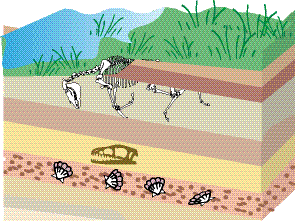
According to the law of superposition, the oldest fossils are found
At the top of the rock layers
Near the bottom of the rock layers
Somewhat near the surface
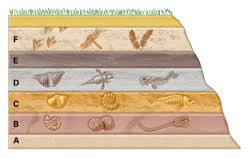
Which rock layer contains the newest fossils?
B
C
D
E
F
In which time period are we currently living?
Precambrian Time
Paleozoic Era
Mesozoic Era
Cenozoic Era
Dinosaurs, small mammals, and birds are found in this time period.
Precambrian
Paleozoic
Mesozoic
Cenozoic
What are fossils that are abundant, easily recognizable, short lived, and widespread called?
Preserved fossils
Index fossils
Imprints
Radioactive dating
Preserved remains of plants and animals from the remote past are called?
Sedimentary rocks
Radioactive dating
Decayed organisms
Fossils
The Law of Superposition states
Younger rocks layers are on top of older rock layers
Fossils are found in sedimentary rocks
Older rock layers are on top of younger rock layers
Absolute age dating
What does relative age tell us about a rock layer or fossil?
The age of one rock layer or fossil compared to another.
The relative age of a fossil determined by radiometric dating
Younger rock layers sit on top of older rock layers
Older rock layers sit on top of younger rock layers
Preserved remains of plants and animals from the remote past are called?
Sedimentary rocks
Radioactive dating
Decayed organisms
Fossils

Use relative age dating to put the rock layers in correct order from oldest to youngest.
B, D, A, E, C
C, E, D, A, B
A, C, E, D, B
C, E, D, B, A

An animal has sharp, pointy teeth, what can we infer about this animal?
The animal lived in the water
The animal lived near the beach.
The animal is a carnivore.
The animal only ate plants.
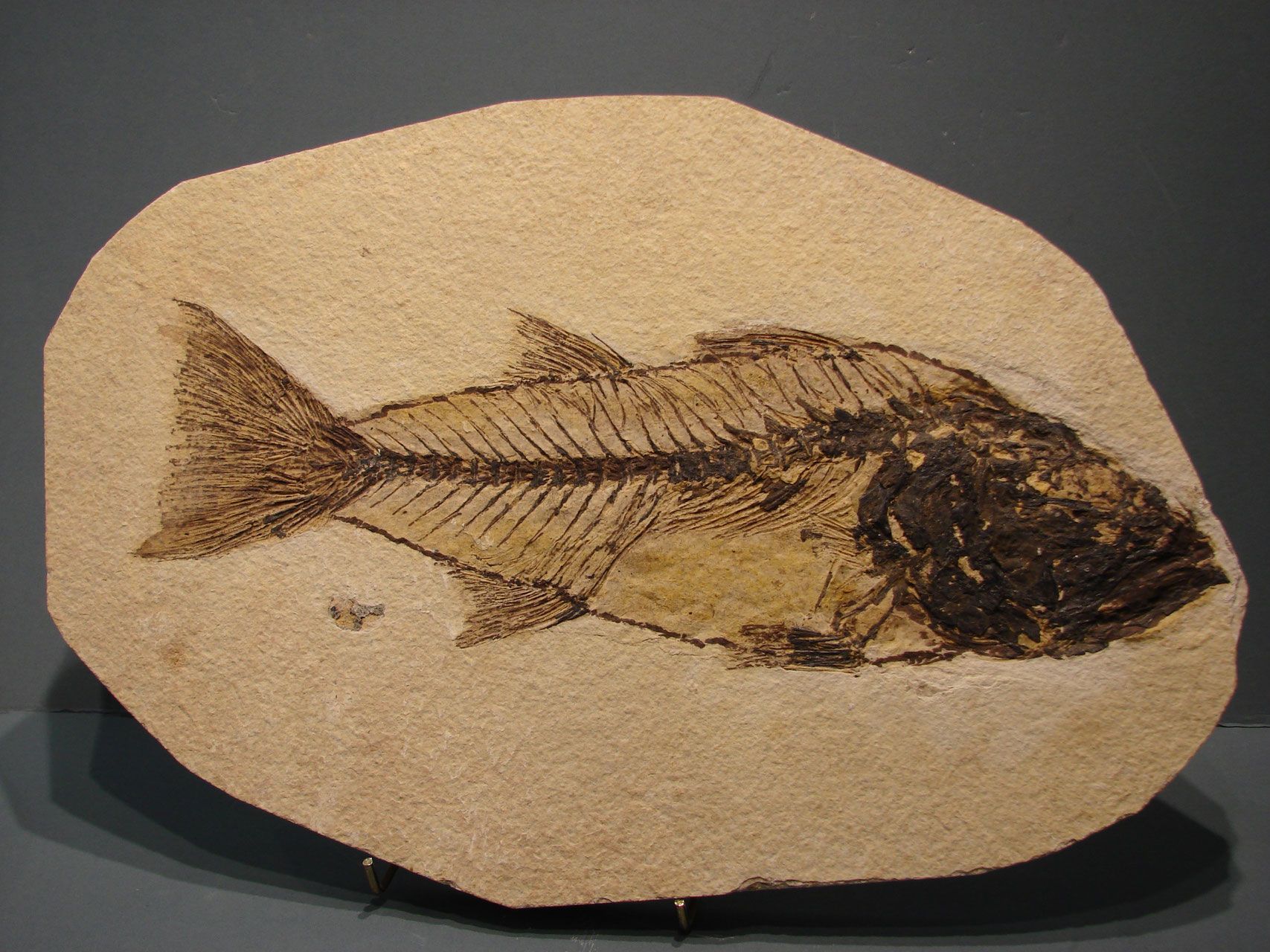
If a scientist found a fish fossil in the desert, what can they infer?
An animal ate the fish.
The water covered the area long ago.
Today's fish looks the same
The fish is endangered.
With ________ dating, a rock’s exact age can be determined, whereas with ________ dating, a rock’s age is compared to the ages of other rocks.
absolute, relative
relative, absolute
true, absolute
relative, approximate
the tool we use to organize Earth's events as they happened
era
law of superposition
geologic time scale
original horizontality
The Earth is _____________________ years old.
4.6 million
4.6 billion
4.6 trillion
4.6 zillion
What two methods are used to divide and classify the geological time scale?
Living organisms
rock strata or layers
DNA
fossils
Finding the age of a rock based on comparing the amounts of unstable, radioactive particles to stable particles in a sample is called:
radiometric dating
relative dating
Solve this problem.
The half-life of isotope X is 2.0 years. How many years would it take for the 4.0 mg sample of X to decay and have only 0.50 mg of it remain?
Approximately what percentage of decay occurs in each half-life an isotope experiences?
20%
50%
75%
The answer varies depending on the size of the nuclei.
Geologist use the time it takes for a radioactive isotope to decay to half its original mass called a___________.
radioactive decay
isotope
half-life
carbon dating


This rock was another type of rock that experienced heat and pressure over time. What type of rock is this?
Sedimentary
Igneous
Metamorphic

What type of rock is formed from chemical deposition when water evaporates and leaves solid material behind? such as stalagtites?
Igneous
Metamorphic
Sedimentary
Both Sedimentary and Metamorphic
Mold Fossils
Hard parts of an organism are buried in sediment & decay leaving a hollow imprint
Cast Fossils
Sediment fills all empty spaces creating a solid copy of the dead organism
Trace Fossils
provide evidence of the ACTIVITIES of organisms such as a footprint
Petrified Fossil
minerals seep in & replace all or part of an organism making them rock-like.
Carbon Films
A thin layer of the organisms exterior parts like the leaves of a plant
Preserved Remains
Original remains of an organism. Can be preserved in amber, ice, or tar
What can fossils tell you about an area?
What kinds of plants used to be in an area
What kinds of animals used to be in an area
How Earth's surface has changed
What life used to be like
A geologist finds a series of footprints of a Stegosaurus (Dinosaur) in a sedimentary rock layer. Which fossil best describes what was found?
Cast Fossils
Trace Fossils
Petrified Wood
Carbon Film
What type of rock would you most likely find a fossil in?
Any Type of Rock
Sedimentary Rocks
Igneous Rocks
Metamorphic Rocks

When a piece of wood "turns into a rock" it's called a __________________ fossil.
Carbon
Cast
Petrified
Mold
Scientists recently discovered shark fossils in Mammoth Cave in Kentucky. What does this tell us about the history of the environment in that area?
That area used to be under an ocean
Sharks used to be land creatures
The remains of the sharks were used by natives for tools
The cave used to be volcanic.

What kind of fossil is produced when a cavity created by a decaying organism is filled with sediment?
Mold
Cast
Inclusion
Trace

What type of fossil is a footprint?
Trace
inclusion
mold
cast
As time progresses organisms become more ______________.
simple
Complex
devolved
unrecognizable
How do most fossils form?
An insect becomes trapped in amber.
An entire organism becomes frozen in ice.
A dead organism becomes buried in sediment.
A dead organism becomes buried in tar.
Index fossils must meet two criteria, they must have existed for a short period of time and ...
be few in numbers
lived for a long time
be widely distributed
be really old in age
If scientists found this fossil, what could they infer?
what fish are like today
that this fish lacked oxygen
that water once covered the area where this fossil was found
What can scientists learn from studying the relationships between fossils?
how old all rock layers are
how life changed over time
how many relatives fossils had
What type of fossils proved evidence of the ACTIVITIES of ancient organisms?
Trace Fossils
Mold Fossils
Cast Fossils
Inclusion Fossils
Which types of structures are most likely to be fossilized?
Soft-bodied structures, such as jellyfish or skin & hair.
Hard-bodied structure, such as teeth and bones
Both hard and soft bodied structures.

