
 Worksheets
2023 Midterm Review
Total questions: 80
Worksheet time: 1hrs 15mins
Matter is
Anything that is heavy
Everything in the universe
Anything that has mass and takes up space (volume)
Anything that has no mass, but takes up space
Matter that has an indefinite shape and an indefinite volume is a
solid
liquid
gas
Select ALL that apply. What can be classified as a pure substance?
Homogeneous Mixture
Heterogeneous Mixture
Element
Solution
Compound
Select ALL the homogeneous mixtures.
Chicken Noodle Soup
Koolaid
Black Coffee
A mixture of oil and water
Chopped garden salad
Air is considered
an element
a compound
a heterogeneous mixture
a homogeneous mixture
Any material consisting of only one type of atom is classified as what?
element
compound
homogeneous mixture
heterogeneous mixture

What is considered a compound?
A
B
C
D
Both A & B
What is NOT considered a physical property?
color
density
ability to dissolve in water
conductivity
reactivity
Select ALL that apply. Which of the following are chemical changes?
Bleaching your hair
Cutting a piece of paper
Melting butter
Burning Leaves
Frying an egg
Select ALL that apply. Which are physical changes?
Boiling water
Lighting magnesium on fire
Rusting bicycle
dissolving salt in water
exploding fireworks

How many neutrons does Iron - 54 have?
26
28
80
13

What element is this?
Beryllium
Boron
Lithium
Silicon

What element is this?
Beryllium
Nitrogen
Lithium
Neon
What subatomic particle has a positive charge?
(a)
What subatomic particle has a negative charge?
Neutron
Negatron
Electron
Positron
Two isotopes of Beryllium would not have the same number of which subatomic particle?
nucleus
electrons
neutrons
protons


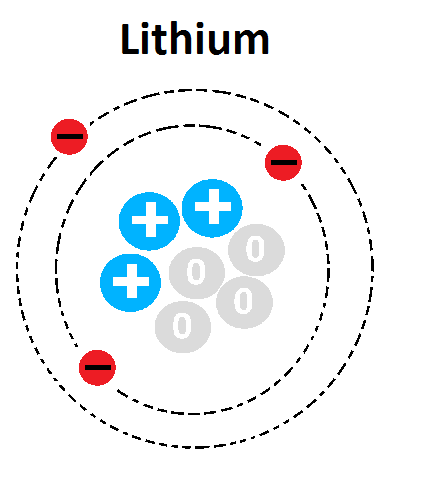
What element is represented in this Bohr Model?
Carbon
Hydrogen
Aluminum
Lithium




A horizontal row in the periodic table
Period
Group
Atomic Number
Column
Which elements will have similar properties?
H, He, Li
B, C, N
N, P, As
Al, Zn, Ag
Which elements are in the same group?
F, S, As
Mg, K, Sr
Be, Mg, Ca
B, Si, As
Match the name of the special families of elements to their group number
Group 18
Noble Gasses
Group 1
Alkali Metals
Group 17
Halogens
Group 2
Alkaline Earth Metals
Groups 3-12
Transition Metals
The name of FeCl₂ is
iron chloride
iron (II) chloride
iron (I) chloride
iron dichloride
LiBr is called
lithium bromine
lithium (I) bromine
lithium bromide
lithuim (I) bromide
Which of the following combinations would need roman numerals in the name?
potassium + fluorine
beryllium + oxygen
boron + iodine
lead + oxygen
What is the name of the compound Na2(SO4)?
Sodium sulfate
Sodium sulfide
Sodium sulfite
Sodium sulfuroxide
What is the correct molecular formula for barium hydroxide?
Ba(OH)2
Ba2OH
BaOH
Ba2OH
Which of these combinations is an ionic compound made of?
Metal and Metal
Nonmetal and Nonmetal
Metal and Nonmetal
Cation and Cation
When naming ionic compounds with transition metals you need to include roman numerals to show the _____ of the metal..
atomic number
mass number
charge
ionization energy
A covalent bond is formed when two atoms ____ electrons
share
lose
transfer
gain
Which is the correct name for the compound N2O3
Dinitrogen triple oxide
Nitrogen oxide
Dinitrogen trioxide
Trioxide nitrogen
Sulfur Hexachloride is represented by which chemical formula?
Cl6S
SCl6
S6Cl6
ClS6
What is the name of
N4O9
nitrogen monoxide
tetranitride nonoxide
tetranitrogen nonoxide
tetranitrogen decoxide

As4O10
arsenic (IV) oxide
quadarsenic decoxide
tetraarsenic decoxide
arsenic decoxide
Disilicon hexabromide covalent formula
K2Br6
Si6Br2
Si2Br6
Se2Br6
NO
Mononitrogen monoxide
nitrogen oxide
nitrogen monoxide
mononitrogen oxide
What is the chemical formula for dinitrogen heptachloride?
N2Cl7
2N7Cl
2NCl7
N2Cl5
Match the following prefixes with the correct number
Hexa
6
Hepta
7
Nona
9
Tetra
4
Deca
10
What is mass?
The amount of space an object takes up
The amount of matter in a given space
The amount of matter in an object
What is volume?
The amount of space an object takes up
The amount of matter in a given space
The amount of matter in an object
What is density?
The amount of space an object takes up
The amount of matter in a given space
The amount of matter in an object
What is the unit for mass?
Grams (g)
Milliliters (mL)
Grams/Milliliter (g/mL)
What is the unit for volume?
Grams (g)
Milliliters (mL)
Grams/Milliliter (g/mL)
What is the unit for Density?
Grams (g)
Milliliters (mL)
Grams/Milliliter (g/mL)
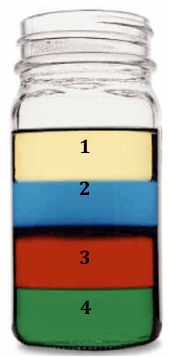
Why does oil float on top of the water in an oil spill?
Oil has the same density of water
Oil is less dense than water
Oil is more dense than water
Frank has a paper clip. It has a mass of 9g and a volume of 3cm3. What is its density?
3 g/cm3
0.33 g/cm3
27 g/cm3
39 g/cm3
A mechanical pencil has the density of 3.0 g/mL. The volume of the pencil is 15.8 mL. What is the mass of the pencil?
47.4 g
50 g
0.190 g
5.27 g
A screwdriver has the density of 5.5 g/mL. It has a mass of 2.3 g. What is the screwdriver’s volume?
2.4 mL
0.42 mL
12.65 mL
0.42 g
A student has a rectangular block. It is 2 cm wide, 3 cm tall, and 25 cm long. It has a mass of 601 g. What is the density of the block? (V = L x W x H)
150 cm3
4 g/cm3
0.25 g/cm3
150 g/cm3

Is an ice cream cone melting a physical or chemical change?
Physical
Chemical

Is toasting bread a physical or chemical change?
Physical
Chemical
Pure Substance
Matter that always has the exact same composition.
Element
A substance that cannot be broken down into simpler substances
Compound
A substance that is made of 2 or more simpler substances.
Heterogeneous
The parts of this mixture are noticeably different.
Homogeneous
The parts of this mixture are indistinguishable from one another.
What makes something a compound? Mark all that apply.
Different atoms or elements are not chemically bonded
An element contains only one kind of atom.
Compounds contain 2 or more elements.
Different atoms or elements must be chemically bonded.
Based on the size of their largest particles.
Physical Property
Any characteristic of a material that can be observed or measured.
Melting Point
The temperature at which a substance turns from solid into liquid.
Viscosity
A resistance to flowing.
Conductivity
A material's ability to allow heat to flow.
Malleability
The ability of a solid to be hammered without shattering.
When can chemical properties be observed? Mark all that apply.
When substances are changing into other substances.
When there is a change in color, the production of a gas,
or the formation of a precipitate.
During a change of form or a substance.
When a substance has a color or smell.
How do chemical changes differ from
physical changes? Mark all that apply
Physical changes are when substances are changing into other substances, chemical changes are not.
Physical changes are change in color, the production of a gas,
or the formation of a precipitate.
Chemical change produces new
substances, Physical change does not.
Color changes, gases, heat, and new substances result from chemical changes not physical changes.

