
 Worksheets
Energy Transfer Review
Total questions: 91
Worksheet time: 1hrs 21mins

The greenhouse effect is about
warming the atmosphere because of increased CO2 levels
warming the atmosphere because of decreased CO2 levels
cooing the atmosphere because of increased CO2 levels
cooling the atmosphere because of decreased CO2 levels

Which of the gases is NOT a greenhouse gas?
water vapour
carbon monoxide
carbon dioxide
methane

Which of the following are greenhouse gases?
Carbon dioxide
Methane
Water vapor
All answers are correct
Which of the following shows increasing energy of electromagnetic waves?
Gamma Rays, X-rays, Ultraviolet, Visible Light, Infrared, Microwave and Radio wave.
Gamma rays, Ultraviolet, X-rays, Visible light, Infrared, Microwave and Radio wave
Radio wave, Microwave, Infrared, Visible light, Ultraviolet, X-rays and Gamma rays.
Radio wave, Microwave, Infrared, Visible light, X-rays, Ultraviolet and Gamma rays
Which type of radiation on the diagram has the longest wavelength?
Gamma Rays
Infrared
Ultraviolet
Radio Waves
Name the type of wave that comes from the Sun, reaches Earth, and can cause skin cancer.
X Rays
Ultraviolet
Infrared
Microwaves
Name the type of radiation that comes from the sun that you can "SEE"
Utraviolet
Infrared
Radio Waves
Visible Light
If I were a spy, and needed to see things at night, I would need special lenses (goggles). Which type of radiation allows you to see heat coming off of people and places?
X Rays
Ultraviolet
Infrared
Visible Light
Which type of radiation overlaps radio waves and infrared?
X Rays
Ultraviolet
Microwaves
Radio Waves
Which type of radiation overlaps gamma rays and ultraviolet?
X Rays
Infrared
Radio Waves
Visible Light
Which color of visible light has the shortest wavelength?
Violet
Green
Orange
Red
Which color of visible light has the longest wavelength?
blue
green
orange
red

According to the ESRT, which material would require the most heat energy to increase the temperature of 1 gram of the material one Celsius degree?
Ice
Water
Basalt
Granite

Which material would require the greatest amount of heat energy to raise its temperature from 5oC to 10oC? [Refer to the Earth Science Reference Tables.]
Iron
Lead
Granite
Dry Air

If the same amount of heat is added to each sample, the smallest change in temperature will occur in the
Iron
Dry Air
Granite
Water

What would heat up the fastest if left out in the sunlight on a clear, summer day?
Liquid Water
Dry Air
Lead
Granite
Why does water heat heat up and cool down VERY SLOWLY?
High Specific Heat
Low Specific Heat
It's solid
It's always cold
Which process of the water cycle occurs when water absorbs 2260 Joules of heat energy per gram?
melting of ice
condensation of water
evaporating of water
freezing of water

Which list correctly identifies the energy transfer between A, B and C
A- Conduction, B-Convection, C-Ratiation
A- Convection, B- Radiation, C- Conduction
A- Convection, B- Conduction, C- Radiation
A- Conduction, B- Radiation, C- Convection
The amount of heat energy required to change the temperature of a substance is referred to as its...
density
specific heat
half-life
According to page 1 of the ESRT, what is the specific heat value of liquid water (in joules per gram)?
0.45
0.84
2.11
4.18
The specific heat value of copper is higher than the specific heat value of lead. This means that...
copper heats up at a faster rate than lead
copper heats up at a slower rate than lead
Materials with high specific heat values, such as liquid water, take _________to heat up and cool down.
more time
less time
Equal masses of basalt, iron, and copper are placed in the Sun for 30 minutes. Based on their specific heat values, which material will heat up at the fastest rate?
basalt
iron
copper
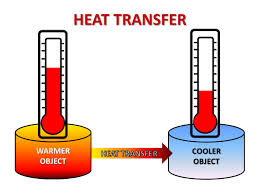
How does heat move?
from a warmer to a cooler object
from a cooler to a warmer object
toward a hot object
away from a cold object
Energy transmitted by electromagnetic waves
conduction
convection
radiation
__________ is the transfer of heat by the movement of a fluid.
Conduction
Convection
Radiation

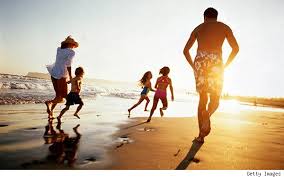
When you touch hot sand, heat is transferred by _________ to your skin.
conduction
convection
radiation

Two fluids, one warm and one cold, mix. The warm fluid rises and the cool fluid sinks
Conduction
Convection
Radiation

TRANSFER OF HEAT BY CIRCULATORY MOVEMENT IS CALLED
CONVECTION
CONDUCTION
RADIATION
TRANSFER OF HEAT BY DIRECT CONTACT IS CALLED
CONVECTION
CONDUCTION
RADIATION

Conduction
Convection
Radiation

Convection
Conduction
Radiation

Imagine you drew a dot on the paper. At which angle would the dot receive the most intense amount of light?
90 degrees (shown as A in the image)
60 degrees (shown as B in the image)
30 degrees (shown as C in the image)

Imagine you drew a dot on the paper. At which angle would the dot receive the LEAST intense amount of light?
90 degrees (shown as A in the image above)
60 degrees (shown as B in the image above)
30 degrees (shown as C in the image above)

At which angle would the imaginary dot on the paper be warmed the MOST by the flashlight?
90 degrees, as shown by A in the image.
60 degrees, as shown by B in the image.
30 degrees, as shown b C in the image.

At which angle would the dot be warmed the LEAST by the sunlight?
90 degrees (shown as A in the image)
60 degrees (shown as B in the image)
30 degrees (shown as C in the image)

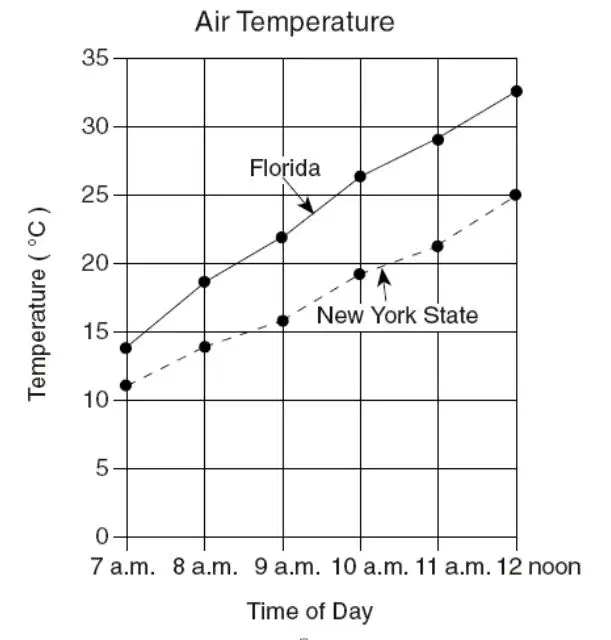
Where on Earth does the sunlight hit the surface at an average angle of 90 degrees?
Alaska
Florida
Equator

Where on Earth does the sunlight hit the surface at an average angle of 60 degrees?
Alaska
Florida
Equator

Where on Earth does the sunlight hit the surface at an average angle of 30 degrees?
Alaska
Equator
Florida
Which change in the heat energy content of water occurs when water changes phase from a liquid to a solid?
gain of 334 Joules of heat energy per gram
release of 334 Joules of heat energy per gram
gain of 2260 Joules of heat energy per gram
release of 2260 Joules of heat energy per gram
The Sun warms the atmosphere and drives convection currents because
warm air is less dense and rises
warm air is less dense and sinks
warm air is more dense and rises
warm air is more dense and sinks
Why does the Earth experience unequal heating?
The oceans are not equally distributed around the Earth.
The Earth's revolution brings it closer to the Sun at certain points during the year.
The Earth's axis is tilted.
The atmosphere is not equally distributed around the Earth.

Cold air sinks because it is more dense than warm air.
True
False
Why does Earth receive unequal heating?
Different location receive different amounts of direct sunlight
Earth moves closer and farther away from the sun.
The core of the earth heats different parts of the Earth.
Where on Earth receives the most indirect sunlight?
the poles
the equator
all areas get the same light
The unequal heating rates of the land and water are caused by
land having a higher density than water
water having a higher density than land
land having a higher specific heat than water
water having a higher specific heat than land
Which process of the water cycle occurs when water absorbs 2260 Joules of heat energy per gram?
melting of ice
condensation of water
evaporating of water
freezing of water

Which of the following is NOT a contributing factor to the uneven warming of Earth’s surface?
Different surfaces warm at different rates
Different surfaces retain energy differently
The sun is farther from the Earth during the winter
The sun’s rays hit the surface at various angles
What are the two main greenhouse gases in our atmosphere?
Carbon dioxide and Methane
Carbon Dioxide and Nitrogen
Carbon dioxide and Oxygen
Oxygen and Methane
What does duration of insolation mean?
how long the sun is above the horizon
how high the sun is above the horizon
cloud cover
A person in New York State worked outdoors in sunlight for several hours on a day in July. Which type of clothing should the person have worn to absorb the least electromagnetic radiation?
dark colored with a rough surface
light colored with a rough surface
dark colored with a smooth surface
light colored with a smooth surface
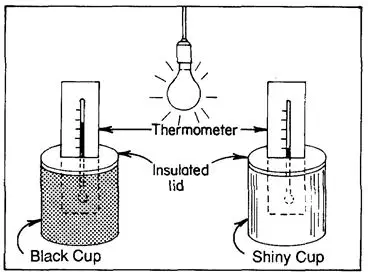
The diagram below shows a light source that has been heating two metal containers of air for 10 minutes. Both cups are made of the same material and are equal distances from the light source. Compared to the amount of energy reflected by the shiny cup during the 10 minutes of heating, the amount of energy reflected by the black cup is
less
greater
the same
What does duration of insolation mean?
how long the sun is above the horizon
how high the sun is above the horizon
cloud cover
Which type of land surface would probably reflect the most incoming solar radiation?
light colored and smooth
dark colored and smooth
light colored and rough
dark colored and rough
Which of the following Earth surfaces usually reflects the most incoming solar radiation?
snow cover
dark soil
green grass
lake water
During some winters in the Finger Lakes region of New York State, the lake water remains unfrozen even though the land around the lakes is frozen and covered with snow. The primary cause of this difference is that water
gains heat during evaporation
is at a lower elevation
has a higher specific heat
reflects more radiation

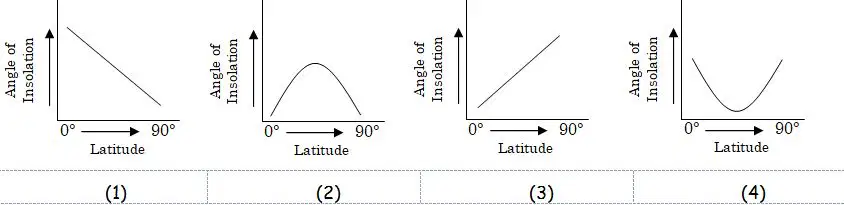
Which graph best represents the relationship between the angle of insolation and the intensity of insolation?
1
2
3
4
The average temperature at Earth’s North Pole is colder than the average temperature at the Equator because the Equator
receives less ultraviolet radiation
has more cloud cover
receives more intense insolation
has a thicker atmosphere


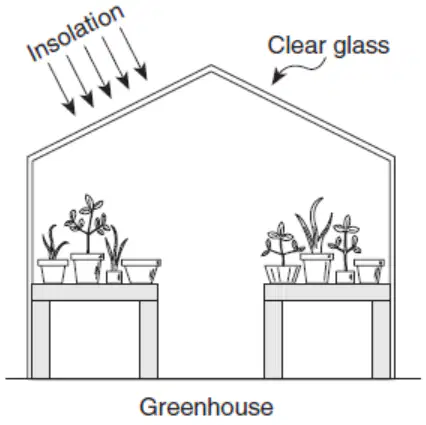
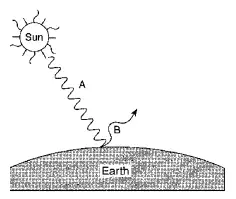
The diagram represents Solar Radiation from the sun and terrestrial radiation given off by earth. Which letter referes to insolation?
A
B
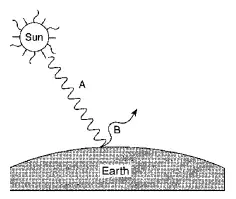
The diagram represents Solar Radiation from the sun and terrestrial radiation given off by earth. Which letter referes to Terrestrial Radiation?
A
B
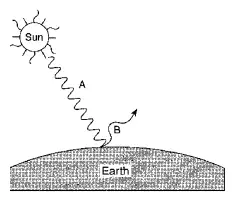
Which type of radiation is considered short wave radiation?
A
B
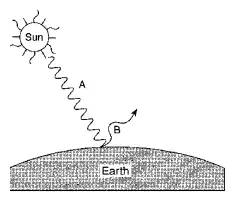
Which type of ratiation is considered long wave radiation?
A
B

Which diagram represents the wavelength of infrared energy radiated by the roof on a summer day?
A
B
C
D
Most of the energy radiated by Earth's surface at night is in the form of...
Infrared Rays
Ultraviolet Rays
Radiation
Insolation

Which diagram represents visible light rays after striking a dark, rough surface?
A
B
C
D

Which surface temperature of which sample increased at the slowest rate when placed in the Sun?
Water
Copper Pennies
Basaltic Sand
Iron Fragments
As water vapor changes phase from a gas to a liquid, each gram of water vapor
Releases 2260 Joules of heat energy
Releases 334 Joules of heat energy
Gains 2260 Joules of heat energy
Gains 334 Joules of heat energy

