
 Worksheets
Weather SOL 6.4, 6.7 SOL Review
Total questions: 80
Worksheet time: 1hrs 22mins
When solar energy hits the earth
it can be reflected by light colored surfaces like ice
it can be absorbed by light colored surfaces by ice
it can be reflected by dark colored surfaces like asphalt
it cannot affect processes that occur on earth

According to the diagram, what can happen when solar energy hits clouds in Earth's atmosphere?
it can be reflected or absorbed
it can only be absorbed
it can only be reflected
it is neither reflected nor absorbed

The sun transfers energy to Earth by radiation
True
False
Infrared Light is
the light you can see from the sun
this is where most of the warmth that you feel from the sun comes from
higher-energy radiation that can harm life
Ultraviolet light is
the light you can see from the sun
this is where most of the warmth that you feel from the sun comes from
higher-energy radiation that can harm life
True or False:
An unbalanced energy budget can increase or decrease global temperatures and disrupt the balance of energy in Earth's system.
True
False
What 2 things can disturb the Earth's energy budget?
decrease in greenhouse gases
increase in polar ice caps
increase in greenhouse gases
decrease in polar ice caps

How much solar energy is radiated directly to space from Earth? (Hint! look at RED arrows)
64%
6%
4%

What amount of incoming solar energy is absorbed by Earth's surface?
23%
51%
49%
15%

Earth's energy budget tracks how much energy flows in and out of Earth's climate.
True
False

Earth's energy budget is like an equation. Choose the correct equation.
energy in = energy out
energy in is less than energy out
energy in is more than energy out

This fair weather cloud is
Stratus
Cirrus
Altostratus
Stratocumulus

What type of cloud is this?
Cumulus
Cirrus
Nimbostratus
Cumulonimbus

This rain cloud fills the entire sky
Nimbostratus
Stratocumulus
Altostratus
Cumulus

This low lying cloud blankets the sky like a quilt
Cumulus
Altocumulus
Stratocumulus
Nimbostratus

These clouds are puffy and white and sometimes appear to have a flat bottom.
cumulus
cumulonimbus
cirrus
stratus

What are the four main types of clouds based on altitude?
cirrus, nimbus, stratus, cumulus
hot, warm, cold, frozen
troposphere, stratosphere, mesosphere , thermosphere
classes of clouds are not based on altitude

What process is this diagram showing?
convection
conduction
water cycle

In the diagram what do the red arrows represent?
Cold Air
Rain
Warm Air
Snow

Which one of these terms happens when a cloud forms?
evaporation
condensation
precipitation
run -off

Clouds form when __________ join with water vapor in the air .
gas particles
light particles
air particles
dust particles
The stratosphere is the top layer of Earth's atmosphere.
True
False
A jet stream is a wide band of low-speed winds that flow in the middle of the atmosphere.
True
False
The curving of the path of a moving object as a result of Earth's rotation is called the Coriolis effect.
True
False

The picture shows all three methods of energy transfer.
Which of these correctly identifies the three methods of energy transfer?
convection 2. radiation 3. conduction
radiation 2. conduction 3. convection
conduction 2. convection 3. radiation
radiation 2. convection 3. conduction

Refer to the diagram of the winds and currents to answer the question.
Which of the following best explains the curvature of the arrows for the westerlies and the trade winds?
The ocean currents create winds flowing in a similar direction to the current.
The Coriolis effect causes the winds to curve that way because the Earth rotates from left to right.
The Coriolis effect causes the winds to curve that way because the Earth rotates from right to left.
The sun is shining and warming the air from the right side of this diagram.
An astronomer studying planets outside our solar system has analyzed the atmosphere of four planets. Which of these planets' atmospheres would be most able to support a colony of humans?
Planet A: 76% Nitrogen, 23% Oxygen, 1% Other
Planet B: 82% Nitrogen, 11% Oxygen, 7% Other
Planet C: 78% Nitrogen, 1% Oxygen, 21% Other
Planet D: 27% Nitrogen, 3% Oxygen, 70% Other

Refer to the picture to answer the question.
Which of the following is most responsible for the moving bands of air around Earth that are shown in the picture?
conduction
convection
Coriolis effect
greenhouse effect
Put the atmospheric layers in order from closest to farthest from earth's surface.
Temperature & air pressure decrease rapidly while moving up
Troposhere
Temperature rises while air pressure decreases
Stratosphere
Temperature & air pressure decrease while moving up
Mesosphere
Temperature rises again while air pressure still decreases
Thermosphere
Your pilots today, Bentley and Braxton are landing the plane you are on. They need to pay attention to wind speed and direction on the run way. They will most likely read a (a)
Abby and Ansleigh have entered gardening contest. They want to know how much rain fell last night. They should read their (a)
Hayes and Murray are shadowing a meteorologist this week. They are asked to gather information on temperature, wind speed and air pressure. They wisely chose to use a (a)
Alice and Megan are studying in the Arctic. They are interested in climate change. They gather a lot of their information from a (a)
Grey and Jake are going sailing with their families this summer. They will want to be safe so they make sure that they check their (a) before they set out on the water.
Avery always checks a (a) before she leaves for school to know if she should grab her hoodie or not.
Scarletta and Drew are planning an outdoor party. They are really worried that it a low pressure storm is on its way. They make sure to watch their (a) to see if the pressure is falling.



Match the following front to its description
Warm Front
When warm, less dense air replaces cold, more dense air.
Cold Front
When cold, more dense air replaces warm, less dense air.
Stationary Front
When neither cold or warm air are strong enough to replace the other
Occluded Front
When two cold air masses converge on a warm air mass forcing it to quickly rise.

Match the following front symbol to its name.

Stationary Front

Cold Front

Occluded Front

Warm Front
Which of the following is true?
Warm air is MORE dense than cold air
Warm air is LESS dense than cold air
Warm air has the SAME density as cold air
Cold air is LESS dense than warm air.
Tool that measure atmospheric pressure in millibars.
Barometer
Tool that measures wind speed in MPH.
Anemometer
Helps determine wind direction when reading a weather map.
Compass Rose
Carries instruments to high altitudes to measure pressure, temperature, humidity, and wind speed
Weather Balloon
Tool that measures temperature in Celcius and Fahrenheit
Thermometer

What type of weather could be expected where the H's are located?
Clear
rainy
stormy

Look at the map and explain what front is located in Texas.
warm front
cold front
occluded front
stationary front


Which front is in this picture?
Warm front
Cold front
stationary front
occluded front
An air mass has similar
temperature and moisture
cold and wind
rain and temperature
warm and dry
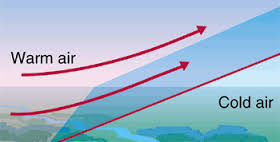

What type of front is shown?
Warm Front
Cold Front
Occluded Front
Stationary Front

A _____________ weather front occurs when a cold air mass moves forward, pushing the warm air mass up.
Cold
Warm
Stationary
Occluded

A _____________ weather front occurs two cold air masses meet and push/force the warm air in the middle upwards.
Cold
Warm
Stationary
Occluded

Which type of weather front can produce precipitation (rain or snow)?
Cold
Warm
Stationary
Occluded
All of the above
Thermal expansion is the increase in volume that results from an increase in temperature.
True
False

78% of the Earth's atmosphere is ___________ and 21% of the Earth's atmosphere is _____________.
Oxygen, Nitrogen
Nitrogen, Oxygen
Nitrogen, Carbon Dioxide
Oxygen, Carbon Dioxide
Why is the ozone layer vital to life on Earth?
Planes fly in the ozone layer
It is made up of oxygen (O2)
It shields the Earth from ultraviolet (UV) rays from the sun
It causes clouds to be created
In what layer of the atmosphere do all weather events occur?
Stratosphere
Exosphere
Mesosphere
Troposphere
In which layer of the atmosphere do meteors burn up?
Troposphere
Mesosphere
Thermosphere
Exosphere
This layer is the hottest layer of the atmosphere?
Troposphere
Stratosphere
Mesosphere
Thermosphere
This layer is the outermost layer of the atmosphere. Satellites orbit the atmosphere in this layer.
Exosphere
Mesosphere
Thermosphere
Ozone Layer
What layer of the atmosphere has the lowest air pressure?
Troposphere
Stratosphere
Exosphere
Mesosphere
What layer of the atmosphere has the highest air pressure?
Troposphere
Stratosphere
Exosphere
Mesosphere
As altitude increases, density.....
Increases
Decreases
Stays the same
Goes up and down

