wayground logo

Free Printable Worksheets

Font size

S
M
L
XL
Worksheets

Ecology and Biogeochemical Cycles

Total questions: 110

Worksheet time: 1hrs 23mins

Name
Class
Date
1.
All living things get their energy from which of the following sources?
a)
food
b)
water
c)
sun
2.
Which of the following is another word for a plant?
a)
autotroph
b)
heterotroph
c)
consumer
3.
Which of the following is an organism that eats only meat?
a)
herbivore
b)
carnivore
c)
omnivore
4.
Which of the following terms describes an area where an organism lives?
a)
community
b)
habitat
c)
area
5.
Which is represented by all of the bullfrogs living around a pond?
a)
community
b)
habitat
c)
population
6.
What would most likely happen if the rabbit population was removed from the food chain grass —› rabbit —› fox?
a)
their would be more grass
b)
there would be less rabbits
c)
there would be more fox
7.
What would most likely happen if the rabbit population was removed from the food chain grass —› rabbit —› fox?
a)
their would be more grass
b)
there would be less rabbits
c)
there would be more fox
8.
Which is an example of a parasitic relationship?
a)
a bee pollinates a flower
b)
a tapeworm takes nutrients from a dog
c)
an orchid lives in a tree but does not harm the tree
9.
In which type of relationship do both species benefit?
a)
parasitism
b)
mutualism
c)
commensalism
10.
Barnacles grow on whales.  Whales give the barnacles a place to live but the barnacles do not help or harm the whale.  Which type of relationship is this?
a)
commensalism
b)
mutualism
c)
parasitiesm
11.
An oxpecker bird eats ticks off of a zebra.  The bird gets food from eating the ticks and the zebra has harmful parasites removed.  Which type of symbiosis is this?
a)
mutualism
b)
parasitism
c)
commensalism
12.

A chimpanzee eats fruits, nuts, leaves, and small mammals. What kind of organism is a chimpanzee?

a)

carnivore

b)

decomposer

c)

producer

d)

omnivore

13.

Which of the following is NOT an example of a predator with its prey?

a)

a fox and a rabbit

b)

a bear and a fish

c)

a honeybee and flower

d)

a spider and a fly

14.

Which statement is true about predators?

a)

a predator is an organism that eats other organisms

b)

a predator is an organism that is eaten by other organisms

c)

a predator can never be eaten by other organisms

d)

a predator is an organism that eats decaying organisms

15.

What is a niche?

a)

the range of tolerance an organism has

b)

the location where an organism lives

c)

the first trophic level of a food chain

d)

the role an organism plays in its environment

16.

Which of the following refers to a community of living organisms and the way they interact with nonliving parts of their environment?

a)

trophic

b)

biome

c)

habitat

d)

ecosystem

17.

If a prey species becomes extinct, what else is most likely to happen?

a)

The climate the species lived in will change.

b)

The plants the species ate will also go extinct.

c)

The predators that eat the prey may be threatened.

d)

The habitats that the species lived in will be threatened.

18.
Which example shows a relationship between a living thing and a non-living thing?
a)
An insect is food for salmon.
b)
Water carries a rock downstream.
c)
A tree gets nutrients from the soil.
d)
A flower makes food for a butterfly.
19.
In an Energy Pyramid, the most energy is located...
a)
at the top
b)
at the bottom
c)
in the middle
d)
in the center
20.
A food web is composed of many...
a)
food webs
b)
food chains
c)
fast-food chains
d)
bike chains
21.
A series of events in which one organism eats another and obtains energy is called a
a)
ecosystem
b)
food web
c)
food chain
d)
Pokemon (Gotta Catch 'Em All!)
22.
An organism that can make its own food is called a 
a)
consumer
b)
producer
c)
decomposer
d)
composer
23.
An organism that obtains energy by feeding on other organisms is called a
a)
consumer
b)
producer
c)
decomposer
d)
brujeria
24.
A consumer that eats only other organisms is called a
a)
herbivore
b)
carnivore
c)
omnivore
d)
scavenger
25.
Nonliving parts of an ecosystem are called
a)
abiotic factors
b)
biotic factors
c)
rocks and dirt
d)
funiture
26.
Living parts of an ecosystem are called
a)
biotic factors
b)
abiotic factors
c)
crazy critters
d)
animals and plants
27.
A group of organisms of the same species living in the same area are called a/an ________.
a)
community
b)
habitat
c)
population
d)
ecosystem
28.

Which of these is the main source of energy on Earth?

a)

The Sun

b)

Producers/Plants

c)

Consumers/Animals

d)

Decomposers/Fungi

29.

Which organisms have the ability to use the sun's energy to PRODUCE glucose?

a)

Snakes/Mice

b)

Grass/ Trees

c)

Hawks/Eagles

d)

Fungi/Bacteria

30.

Which organisms convert Nitrogen in the atmosphere to a usable for for plants and animals?

a)

Plants

b)

Animals

c)

Bacteria

d)

Converters

31.

Photosynthesis will most likely appear in which of these cycles?

a)

Nitrogen

b)

Carbon

c)

Water

32.

Evaporation and Transpiration will most likely appear in which of these cycles?

a)

Nitrogen

b)

Carbon

c)

Water

33.

Which species will have the largest population?

a)

Hawks

b)

Snakes

c)

Rabbits

d)

Grass

34.

Which species is the 2nd level consumer?

a)

Sharks

b)

Mackerel

c)

Herring

d)

Crustaceans

35.

When members of a population work together it is called...

a)

Competition

b)

Cooperation

c)

Mutualism

36.

An ecosystem is...

a)

All of the members of a species in the same area.

b)

All of the different species in the same area.

c)

All of the Biotic and Abiotic factors in an area.

37.

Which of these are ways that animals will use to conserve energy during the winter?

a)

Grow more fur

b)

Hibernate

c)

Take a long trip to find food (migrate)

d)

Find a cabin with a fire place

38.

Increased Carbon Dioxide in the atmosphere has formed a blanket around the planet and contributed to an ...

a)

increase in the temperature of the planet.

b)

increase in noise

c)

increase in ice around the planet.

d)

increase in parasites looking for hosts.

39.

Limiting factors ...

a)

are resources that are in short supply and limit the size of a population.

b)

are a cause of too much nitrogen in the water.

c)

are hosts for parasites.

d)

only found in the jungle.

40.

An ocean bay food web is pictured.


Imagine a sea otter moves to the area. The sea otter eats crabs. What would happen to the ecosystem?

a)

The ecosystem would stay the same

b)

The sea duck population will decrease (go down)

c)

The crab population will increase (go up)

d)

The sea duck population would increase (go up)

41.

Pictured is a food web.


Which organism is an omnivore?

a)

Deer

b)

Berries

c)

Black bear

d)

Red Fox

42.

Pictured is a food web.


Which organism is a producer?

a)

Deer

b)

Berries

c)

Black bear

d)

Red fox

43.

Pictured is a food web.


Which organism is a herbivore?

a)

Deer

b)

Berries

c)

Black bear

d)

Red fox

44.

Pictured is a food web.


Which organism is a carnivore?

a)

Deer

b)

Berries

c)

Black bear

d)

Red fox

45.

Pictured is a food web.


Which of the following animals might compete with the coyote for food?

a)

A deer that eats grass

b)

A snake that eats mice

c)

A tree that uses the sun to produce energy

d)

A bird that eats worms

46.

Decomposers are important in the food web because they

a)

Produce their own food using light from the sun

b)

Stop the flow of energy from one organism to another

c)

Break down dead organisms and recycle nutrients into the soil

d)

Are microscopic and other organisms eat them

47.

Evaporation is when _________________________________________________________

a)

water freezes

b)

water changes 

from a gas to a 

liquid   

c)

water changes 

from liquid to a 

gas

d)

 plants use the 

water from the rain

48.

Constant movement of water is called________

a)

water runoff 

b)

     precipitation

c)

condensation

d)

the water cycle

49.

The water that falls from the clouds is_____

a)

evaporation

b)

  condensation 

c)

transpiration

d)

precipitation 

50.

What happens when the sun heats the earth's water?

a)

it turns to a solid

b)

it turns to a gas

c)

it turns into a liquid

d)

nothing

51.

The stages of the water cycle are...

(think of the first stage)

a)

evaporation

condensation

precipitation

b)

condensation

water vapor

precipitation

c)

wind

transpiration

sun

d)

clouds

precipitation

evaporation

52.

Puddles that disappear on a hot day is an example of......

a)

transpiration

b)

condensation

c)

evaporation

d)

precipitation

53.

What happens when warm air with water droplets meet cold air and become visible?

a)

precipitation

b)

evaporation

c)

transpiration

d)

condensation

54.

These are examples of what?

a)

precipitation

b)

evaporation

c)

transpiration

d)

condensation

55.

The process by which water changes from a liquid to a gas.

a)

evaporation

b)

condensation

c)

sublimation

d)

precipitation

56.

Plants return groundwater to the atmosphere through which process?

a)

evaporation

b)

sublimation

c)

transpiration

d)

condensation

57.

The step of the nitrogen cycle that is in red is called...

a)

Denitrification

b)

Nitrification

c)

Nitrogen Fixation

d)

Ammonification

58.

The step of the nitrogen cycle that is in red is called...

a)

Denitrification

b)

Nitrification

c)

Nitrogen Fixation

d)

Ammonification

59.

The step of the nitrogen cycle that is in red is called...

a)

Denitrification

b)

Nitrification

c)

Nitrogen Fixation

d)

Ammonification

60.
How animals get the nitrogen they need
a)
from the air they breathe
b)
from the water they drink
c)
from the food they eat
d)
from the Sun
61.
Organisms that need nitrogen to survive
a)
only plants
b)
only animals
c)
only bacteria
d)
all living organisms
62.
Organisms that play a role in the nitrogen cycle
a)
only plants
b)
only animals
c)
only bacteria
d)
plants, animals, & bacteria
63.
All plants have nitrogen fixing nodules on their roots.
a)
True
b)
False
64.
How nitrogen is "fixed" into useable form for plants
a)
only through action of bacteria
b)
only through lightning
c)
through action of bacteria & lightning
d)
through photosynthesis
65.
Organism that breaks down dead plants & animals and releases nitrogen back into atmosphere
a)
bacteria
b)
plants
c)
animals
d)
producers
66.
How plants get the nitrogen they need
a)
from the air
b)
from the soil or water in which they live
c)
from the Sun
d)
from broken down rocks
67.
Gas that makes up almost 80% of Earth's atmosphere
a)
oxygen
b)
carbon dioxide
c)
nitrogen
d)
hydrogen
68.
During which phase of the nitrogen cycle do decomposers break down nitrates into ammonium?
a)
Ammonification
b)
Nitrification
c)
Denitrification
d)
Assimilation
69.
Which of the following organisms plays a major role in all phases of the nitrogen cycle?
a)
Bacteria
b)
Fungi
c)
Plants
d)
Animals
70.
During which phase of the nitrogen cycle do bacteria and lightning strikes convert  atmospheric nitrogen into a usable form?
a)
Ammonification
b)
Assimilation
c)
Nitrogen Fixation
d)
Nitrification
71.
During which phase of the nitrogen cycle is nitrogen gas returned to the atmosphere?
a)
Ammonification
b)
Nitrogen fixation
c)
Nitrification
d)
Denitrification
72.
During which phase of the nitrogen cycle are nitrates taken up into plant roots?
a)
Ammonification
b)
Assimilation
c)
Nitrificaiton
d)
Denitrification
73.
Which phase of the water cycle occurs through the stomata of plant leaves?
a)
Precipitation
b)
Evaporation
c)
Condensation
d)
Transpiration
74.
Which of the following events occurs immediately prior to rain or snow fall?
a)
Evaporation
b)
Condenstation
c)
Infiltration
d)
Transpiration
75.
Which of the following events removes water from the atmosphere?
a)
Precipitation
b)
Evaporation
c)
Infiltration
d)
Run off
76.
Which two biological processes play a role in cycling carbon and oxygen?
a)
Photosynthesis and Transpiration
b)
Cellular Respiration and Evaporation
c)
Photosynthesis and Cellular Respiration
d)
Transpiration and Evaporation
77.
By which of the following processes is carbon dioxide removed from the atmosphere?
a)
Cellular respiration
b)
Decomposition
c)
Combustion
d)
Photosynthesis
78.
By what process do toxins increase in concentration as you move up the trophic levels in a food chain?
a)
Energy transfer
b)
Biomagnification
c)
Bioremediation
d)
Pollutant transfer
79.
The process of plants losing water through their leaves is called ____.
a)
condensation
b)
evaporation
c)
transpiration
d)
exhaling
80.
Identify the cycle pictured.
a)
The Water cycle
b)
The Carbon cycle
c)
The Nitrogen cycle
d)
The Phosphorus cycle
81.
Identify the cycle pictured.
a)
The Water cycle
b)
The Carbon cycle
c)
The Nitrogen cycle
d)
The Phosphorus cycle.
82.

the max amount of life that an ecosystem can support

a)

Climax Community

b)

Levels of Ecology

c)

Energy Pyramids

d)

Carrying Capacity

83.

End product of a succession until disturbed by environmental

change

a)

Climax Community

b)

Levels of Ecology

c)

Energy Pyramids

d)

Carrying Capacity

84.

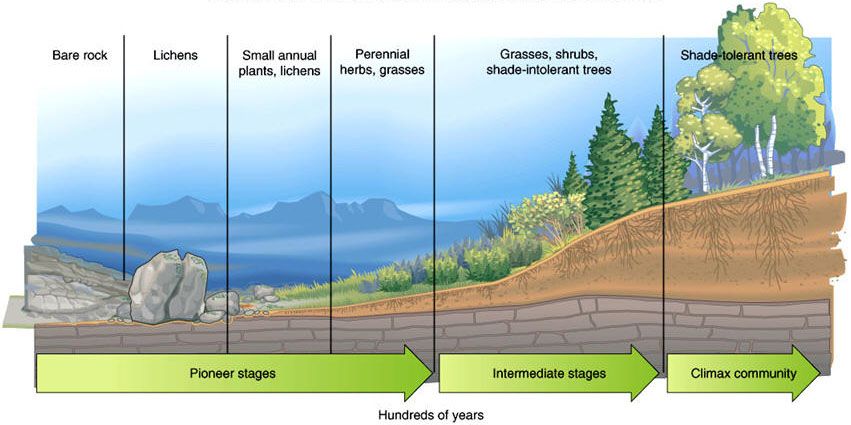
Gradual changes from one community to another. Happens when starting community is barren

(usually just bare rock).

a)

Primary Succession

b)

Secondary Succession

c)

Levels of Ecology

d)

Catastrophic Events

85.

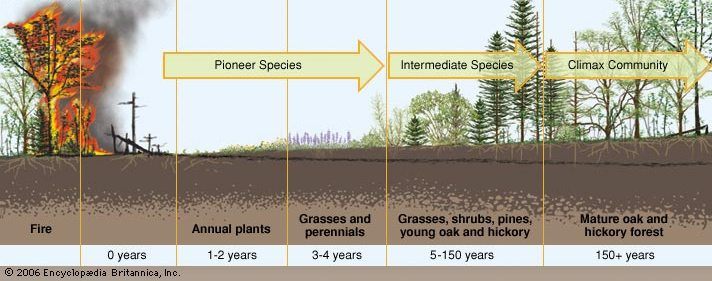
When a community evolves from a previously

disturbed community. (faster version)

a)

Primary Succession

b)

Secondary Succession

c)

Levels of Ecology

d)

Catastrophic Events

86.

FASTER VERSION!

a)

Primary Succession

b)

Secondary Succession

c)

None

87.

SLOOOW VERSION

a)

Primary Succession

b)

Secondary Succession

c)

None

88.

Starts an area following the destruction or partial destruction of an

area (fire, windstorm, volcano, etc.) but soil is still there.

a)

Primary Succession

b)

Secondary Succession

c)

None

89.

begins w/ area ready to support life, soil already exists

a)

Primary Succession

b)

Secondary Succession

c)

None

90.

no soil, bare empty environment

a)

Primary Succession

b)

Secondary Succession

c)

None

91.

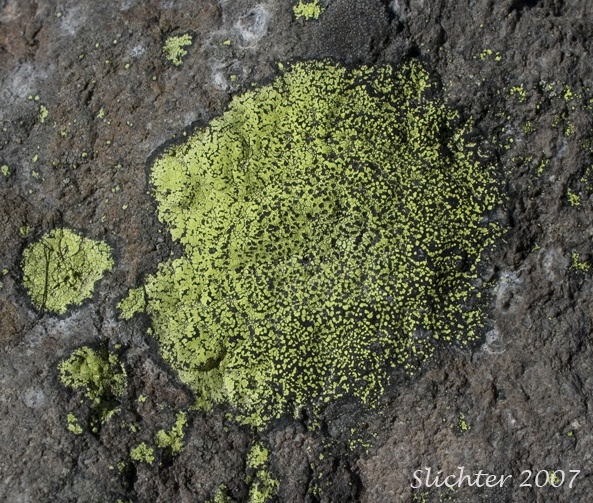
first species arrive (lichens and algae) - they chemically break

down soil for seeds, can take hundreds of years for soil to develop

a)

Primary Succession

b)

Secondary Succession

c)

None

92.

The picture display which type of succession?

a)

primary

b)

secondary

c)

tertiary

d)

all of the above

93.

The picture displays which type of succession?

a)

primary

b)

secondary

c)

tertiary

d)

all of the above

94.

What is the name given to lichen/algae during primary succession?

a)

pioneer species

b)

volunteer species

c)

founder species

d)

conqueror species

95.

After a volcanic eruption, volcanic rock is present (but no soil). Which of the following states the most likely order of succession that would be seen?

a)

Lichens → Shrubs → Grasses → Trees

b)

Lichens → tree → shrubs→Grasses

c)

Grasses → Lichens → Shrubs → Trees

d)

Lichens → Grasses → Shrubs → Trees

96.
Water temperature would be an example of ...
a)
a biotic factor.
b)
an abiotic factor.
97.
A collection of organisms that belong to different populations but all live in the same area and interact with one another.
a)
Population
b)
Ecosystem
c)
Community
d)
Ecosphere
98.
A collection of organisms that make up a community as well as all of the nonliving aspects of the environment.
a)
Population
b)
Community
c)
Habitat
d)
Ecosystem
99.
Which of the following best describes a community?
a)
sharks, groupers, anemones and shrimp on a coral reef
b)
decorator crabs on the seafloor
c)
loggerhead sea turtles in Atlantic
d)
prairie grassland in Wyoming
100.
An ecosystem contains living and nonliving things.
a)
True
b)
False
101.
The smallest unit of life that can sustain itself is called...
a)
an organism.
b)
the biosphere.
c)
a population.
d)
a community.
102.
When all the ecosystems on Earth are combined it is called...
a)
a community.
b)
a biome.
c)
a biosphere.
d)
an Earthsphere.
103.
Andrea is on the grils cross country tream. She is heading out for a run when she comes across 20 Canadian geese.  What level of organization is this group of Canadian geese?
a)
organism
b)
population
c)
community
d)
biome
104.
The correct order of ecological organization from the smallest to the largest is _______________.
a)
organism, community, population, ecosystem, biosphere, biome
b)
biosphere, biome, ecosystem, community, population, organism
c)
organism, population, community, ecosystem, biome, biosphere
d)
population, organism, biosphere, community, ecosystem, biome
105.
What are the abiotic factors in this image? 
a)
water, sunlight, dirt, air
b)
birds and plants
c)
water, plants, and birds 
106.

What level of organization can be seen here?

a)

Species

b)

Population

c)

Community

d)

Ecosystem

107.

What are three examples of a biotic factors?

a)

skunk

b)

rocks

c)

bacteria

d)

water

e)

coral

108.

What is Ecology?

a)

It is the study of the Earth.

b)

It is the study of how organisms interact with each other and their environment.

c)

It is the study of recycling.

d)

It is the study of plants.

109.

The tropical rain forest, the desert, and the tundra are all examples of ...

a)

the biopshere.

b)

biomes.

c)

ecosystems.

d)

communities.

110.

What level of ecological organization does the bird represent?

a)

Organism

b)

Population

c)

Community

d)

Ecosystem