
 Worksheets
AIR TEST REVIEW PART 4
Total questions: 71
Worksheet time: 36mins
Which statement about the effects of natural events and human activities is true?
The environment is not usually affected by natural events.
All human activities change the environment in a negative way.
Natural events always have a positive impact on the environment.
Human activities and natural events can damage the environment.
Pollution can enter the hydrosphere in many different ways. Which statement describes a type of point-source pollution?
Oil being transported on a ship spills into the ocean.
Grease from cars washes into a stream along the roadway.
Litter along beaches gets pulled into the ocean by the tide.
Rainwater carries chemical fertilizer from land into a stream.
There are many sources of air pollution in the United States and around the world. Some are natural sources, and others come from human activities. Which example is a natural source of air pollution?
car exhaust fumes
dust from construction sites
methane gas from cow manure
smoke from the burning of fossil fuels
Which example best describes how human activity can directly impact the geosphere?
Poor farming practices can degrade the soil and cause erosion.
Dumping waste from a factory into a river can pollute the water supply.
Construction activities can release harmful dust and chemicals into the air.
Removing too many fish from the ocean can cause a fish species to go extinct.
The burning of coal releases sulfur dioxide gas. How might the burning of coal lead to damaged plant life?
Sulfur dioxide can combine with drops of water to form acid rain.
Sulfur dioxide causes the remains of animals to decompose at a faster rate.
Sulfur dioxide gives off heat that raises the temperature of bodies of water.
Sulfur dioxide is a radioactive material that is dangerous for many years.
Which government organization helps regulate superfund sites?
The Water Department
The Sanitation Department
The Environmental Protection Agency
The Department of Health and Welfare
What greenhouse gasses contribute to Global Warming (Select all that apply)
Water Vapor
Carbon Dioxide
Methane
Other Pollutants
What evidence is there to support that Global Warming is occurring?
Rising ocean temperatures
Declining arctic sea glacers
Sea levels rising
Increase in carbon dioxide in the atmosphere
What is the best way for us to protect endangered species?
Feed them
Put them all in a zoo
Protect their habitat
divide their habitats into fragments
The Anthropocene is the era of
animals
humans
plants
bacteria
The lionfish is native to the Red Sea but was accidentally released in the Caribbean Sea in the 1990's. It has outcompeted the local fish for resources. This is an example of a(n)
pesticide
zoonotic disease
invasive species
eutrophication
Groundwater is a type of
salt water
pollutant
fresh water
smog
These areas are especially rich ecosystems that face urgent threats.
anthromes
groundwaters
monocultures
biodiversity hotspots

This graph provided some of the earliest clear evidence of
respiration
weather
climate change
Carbon capture
If your activities take as much carbon out of the atmosphere as they put in you are
infrared
Carbon-neutral
respiring
renewable
This takes place on a scale of minutes to days and can be highly variable
climate change
weather
fossil fuel production
all of these
A solution to habitat fragmentation is
building ecosystem ladders
building more zoos
building more islands
building wildlife corridors
Secondary succession begins
on bare, exposed rock.
after a disturbance like a wildfire.
What is a keystone species?
A keystone isn't a living thing, it's just a stone
Keys and stones have nothing to do with ecology
A species that lives in or around rocks
A species that helps to hold an ecosystem together

Based on the graph shown, what is the effect of removing a keystone species on an ecosystem?
richness oscillates between extremes
richness stabilizes
richness increases
richness decreases

According to this image, which two domains of life are most related?
Bacteria & Archaea
Archaea & Eukarya
Eukarya & Bacteria
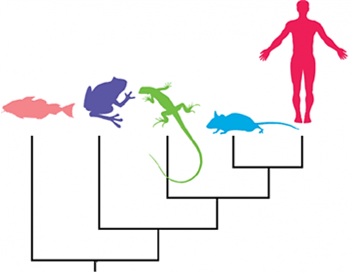
What is the human most closely related to?
Fish
mouse
Salamander
Human

Which group of animals on this tree are most closely related to birds?
Saurischian dinosaurs
Ornithischian dinosaurs
Crocodiles
None of these are related to birds

Where is the alligator and T. rex's common ancestor?
Point A
Point B
Point C
Point D
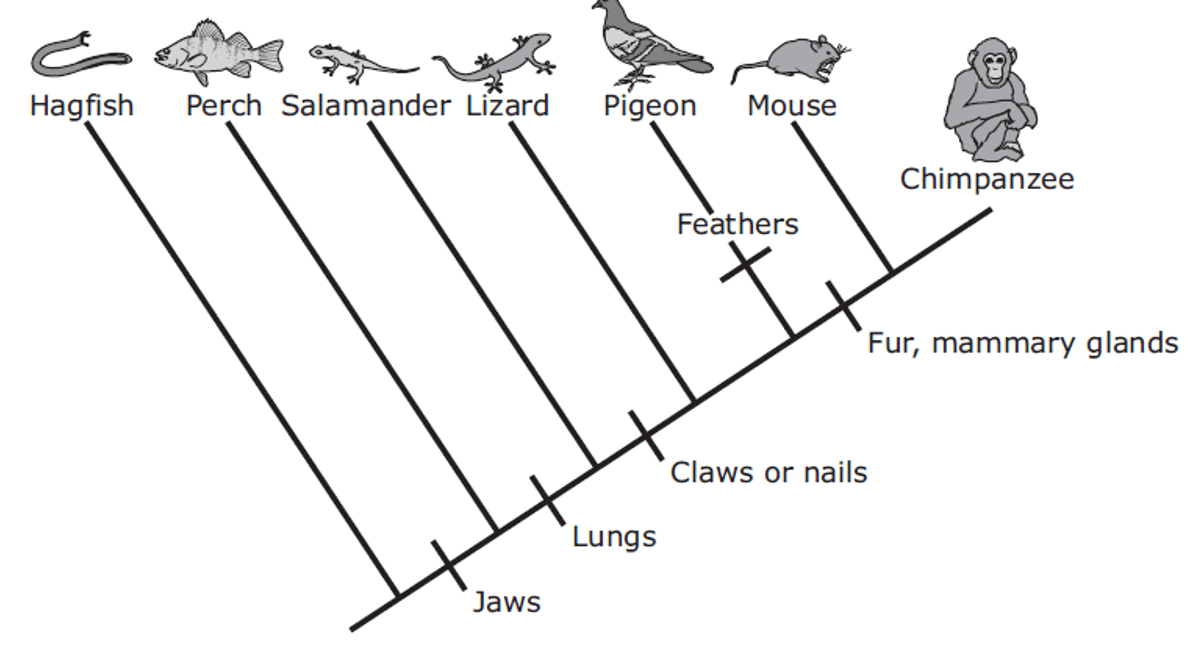
What is the purpose of a cladogram?
To map the ancestral relationships and shared traits of different organisms.
To trace the inherited traits of a single species over time.
To check the likelihood of an offspring having a particular trait.
To monitor mutations that arise among different populations.

What is the common ancestor of Letters A, B, C, D, E?
1
2
3
4

Bacteria are an example of a ____ cell.
prokaryotic
eukaryotic
plant
animal
Which of the following is evidence to support the endosymbiotic theory?
Mitochondria and chloroplasts have their own DNA, which is similar to prokaryotic DNA.
Fossil evidence shows that the first forms of life were prokaryotic cells.
All eukaryotic cells have a double-layered membrane composed of phosplipids and proteins.
Prokaryotes have the same number and types of enzymes as eukaryotes.
Which of the following is evidence to support the endosymbiotic theory?
Mitochondria and chloroplasts have their own DNA, which is similar to prokaryotic DNA.
Fossil evidence shows that the first forms of life were prokaryotic cells.
All eukaryotic cells have a double-layered membrane composed of phosplipids and proteins.
Prokaryotes have the same number and types of enzymes as eukaryotes.
Which type of cell? (It has a nucleus, membrane-bound organelles). Check all that apply.
prokaryotic cell
eukaryotic cell
plant cell
bacteria
The theory of Endosymbiosis explains
The origin of eukaryotes
How bacteria live
How species develop
Why cells rely on one another
Both eukaryotic and prokaryotic cells have:
ribosomes
cell membranes
false
true
Chemosynthesis:
converts carbon dioxide or methane and nutrients into organic matter without sunlight
Converts carbon dioxide into organic matter using sunlight
Converts water into oxygen without sunlight
Converts water into oxygen using sunlight
Substances directly involved in chemosynthesis include:
nucleotides, amino acids,
carbon dioxide, water, glucose, fructose
carbon dioxide, hydrogen sulfide, ammonia
nucleic acids, lipids, carbs, proteins
H2S + 6CO2 + 3O2 → C6H12O6 (carbohydrate) + 12H2O + 18S is the equation for:
Calvin cycle
cellular respiration
chemosynthesis
photosynthesis

Which statement best describes the predator-prey relationship displayed on this graph?
There is no relationship between the predator and prey.
When the prey population increases, the predator population decreases.
When the prey population increases, the predator population increases.
when the predator population increases, the prey population increases.
What is carrying capacity?
A condition that occurs when two or more organisms compete for the same resources within an ecological community
A relationship in which two organisms are mutually dependent on each other for survivial
All the biotic and abiotic factors and the interactions among them in a given area
The maximum number of organisms an ecosystem can support
What is interdependent relationship?
A condition that occurs when two or more organisms compete for the same resources within an ecological community
All the biotic and abiotic factors and the interactions among them in a given area
The maximum number of organisms an ecosystem can support
A relationship in which two organisms are mutually dependent on each other for survival
A condition that occurs when two or more organisms compete for the same resources within an ecological community
Interdependent Relationship
Carrying Capacity
Competition
Ecosystem
Which statement best describes the term limiting factors?
All the biotic and abiotic factors and the interactions among them in a given area
A finite resource organisms in an ecosystem require
The biotic and abiotic factors in an ecosystem
The maximum number of organisms an ecosystem can support
The ecological role an organism performs in their specific environment is considered the organism's...
Habitat
Population
Biome
Niche

Genetic drift is more likely to happen in...
aquatic populations
small populations
terrestrial populations
older populations

Which of the following is an example of the founder effect?
Humans choose two dogs they like the characteristics of and breed them together.
Affected individuals with blue skin can trace their ancestry back to one of the first settlers in the region.
The environment of a fox population changes and over time foxes who are white survive and pass on their genes to their offspring.
Cheetah populations reach their lowest levels with reduced diversity and as they rebound are so genetically similar they appear to be inbred.

Which of the following is an example of the bottleneck effect?
Cheetah populations reach their lowest levels with reduced diversity and as they rebound are so genetically similar they appear to be inbred.
Affected individuals with blue skin can trace their ancestry back to one of the first settlers in the region.
The environment of a fox population changes and over time foxes who are white survive and pass on their genes to their offspring.
Humans choose two dogs they like the characteristics of and breed them together.
This occurs when a large population is drastically reduced by an event such as a natural disaster; the population's new gene pool only contains alleles from the survivors
Founder effect
Bottleneck effect
Meteor effect
Natural selection

The current extinction event is being caused by
a meteor strike.
an alien invasion.
the increasing amount of hydrogen sulfide gas.
human activities.
"It is better to light one candle than to curse _________"
the problem.
the darkness.
extinction.
foolishness.

Which of the following genotypes is homozygous dominant?
Yy
yY
yy
YY

B=Brown fur
b=tan fur
What percent of the offspring would be tan when you cross BbxBb?
75%
25%
50%
100%


This laboratory procedure is known as
CLONING
gel electrophoresis
chromatography
use of a dichotomous key



