
 Worksheets
HBS II (Nerve/Muscle/Bone/Skin)
Total questions: 101
Worksheet time: 1hrs 11mins
The soft connective tissue that fills the internal spaces in bone.
marrow
cartilage
joints
ligaments
connects bone to bone
marrow
skeletal system
cartilage
ligaments
a place where two or more bones meet
joint
cartilage
marrow
tendon
A connective tissue that is more flexible than bone and that protects the ends of bones and keeps them from rubbing together.
marrow
cartilage
joint
ligament
Protects and supports body organs and provides a framework the muscles use to support movement.
cartilage
marrow
skeletal system
joint
involuntary muscle found in internal organs
cardiac muscle
smooth muscle
tendon
marrow
muscles only found in the heart
smooth
cardiac
marrow
cartilage
A muscle that is attached to the bones of the skeleton and provides the force that moves the bones.
smooth
cardiac
skeletal
involuntary
muscle that can be consciously controlled
voluntary
involuntary
smooth
cardiac
muscle that works without conscious control
voluntary
involuntary
smooth
cardiac
connects muscle to bone
ligaments
cartilage
tendon
smooth muscle
enables movement of the body and internal organs through contraction
skeletal system
muscular system
smooth muscle
cardiac muscle
examples of involuntary muscles are...
heart beating
eyes blinking
digestive system digesting
all of the above
the type of skeleton humans have
exoskeleton
striated skeleton
endoskeleton
no skeleton
joint inflammation, pain and stiffness from regular wear and tear
arthritis
tendonitis
polio
meningitis
which tissues are inelastic
ligaments only
tendons
cartilage only
cartilage and ligaments
fills bone cavities and the spaces in spongy bone
cartilage
tendon
ligaments
marrow
yellow marrow is made of
fat
material that produced red blood cells
red marrow is made of
fat
material that produces blood cells
which muscles are striated
skeletal only
cardiac and skeletal
cardiac only
smooth only
smooth and cardiac
injury to a tendon as a result of extreme exertion; symptoms include inflammation and pain
arthritis
tendonitis
polio
meningitis
which tissues are elastic
ligaments only
tendons
cartilage only
cartilage and ligaments
which muscles are smooth
muscles attached to bone only
heart only
muscles lining internal organs like blood vessels
which tissue type includes bones, ligaments, tendons, cartilage, and marrow?
connective
muscular
nervous
epithelial
which tissue type includes biceps, heart and diaphragm?
connective
muscular
nervous
epithelial
Which life function is most closely related to both the muscular and skeletal systems?
transport
locomotion
respiration
excretion
The contractile unit of a muscle:
sarcomere
motor unit
fascicle
myofibril
Thick filaments within a myofibril are:
ATPase
Sarcoplasmic reticulum
Actin
Myosin
Thin filaments in a myofibril are
Sarcomeres
Sarcoplasm
Actin
Myosin
The energy needed to perform a muscle contraction comes directly from
ATP
Oxygen
Glucose
Calcium
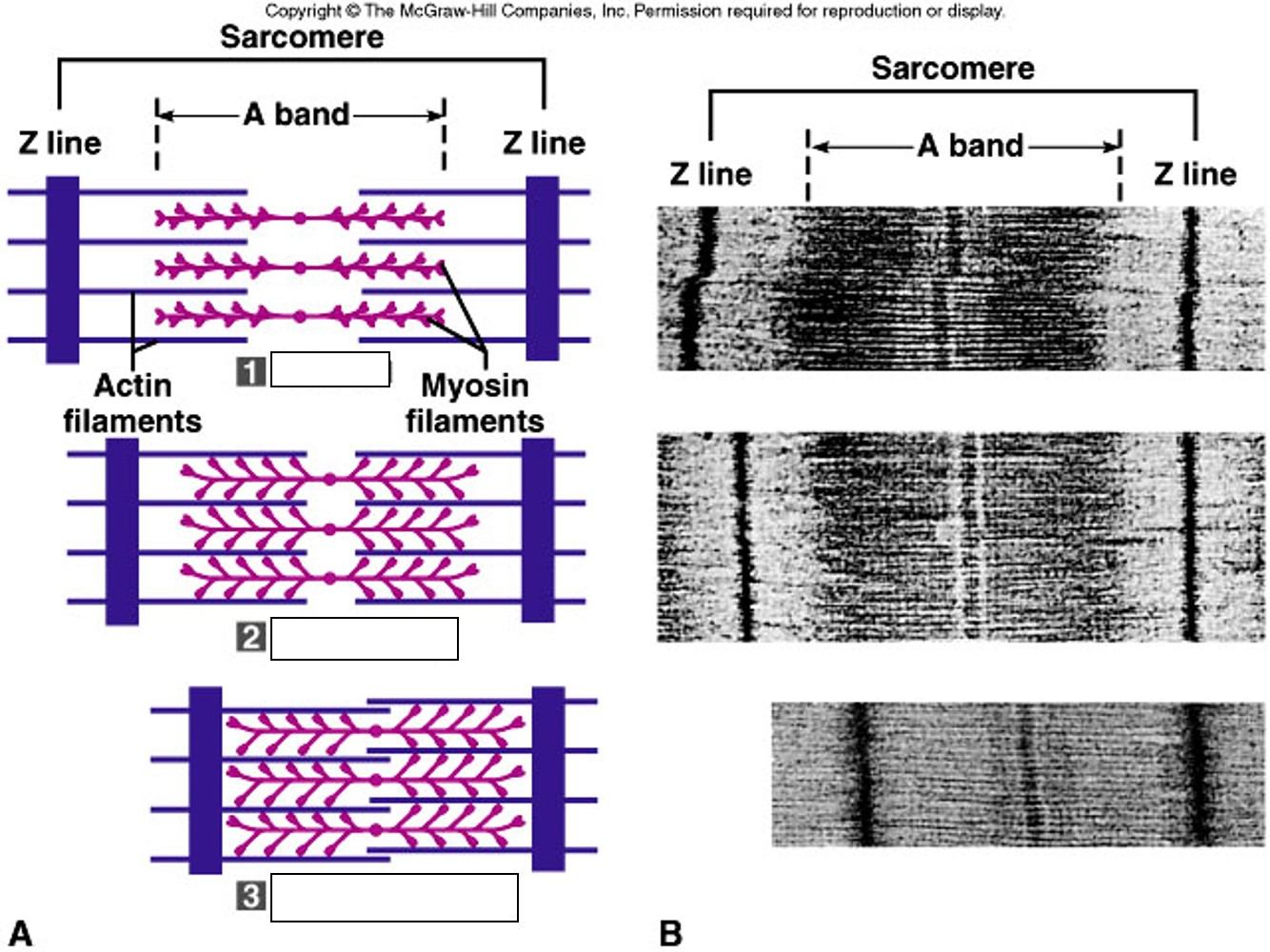
A ___extends from one Z disc to another Z disc.
Sarcolemma
Neuromuscular junction
Sarcomere
Motor end plate
___slides inward during muscle contraction.
actin
myosin
Which "osteo" cell is responsible for bone reabsorption?
osteoblasts
osteocytes
osteogenic
osteoclasts
Which "osteo" cell is responsible for bone formation?
osteoblasts
osteocytes
osteogenic
osteoclasts
Which "osteo" cell is entrapped in matrix?
osteoblasts
osteocytes
osteogenic
osteoclasts


The distal biceps tendon connects to the radius and _____________.
wrist
ring finger
Ulna
Which muscle is this? It is the muscle responsible for extension of the elbow joint (straightening of the arm).
Bicep
Tricep
Brachioradialis
Radialis
What type of joint is the elbow?
Saddle
pivot
Ball and socket
Hinge


What part of the brain is responsible for conscious thought, judgement, memory, reasoning and will power?
Cerebellum
Hypothalamus
Cerebrum
Thalamus
Medulla
Symptoms include: Double vision, Balance problems, caused by immune system eating away at protective nerve covering
Multiple Sclerosis
Concussion
Meningitis
Polio
Alzheimer's


Where would the nerve impulse start in this reflex arc?
A
C
D
E

_____ neurons carry messages away from the central nervous system and out to muscles or glands. The RED neuron in diagram.
sensory
motor
inter
central
Which way does an impulse travel
From dendrite to axon and out axon terminal
From axon to axon and out dendrite terminal
From axon to dendrite and out axon terminal
From cell body to dendrite and out axon terminal
__________ carry messages between sensory neurons and motor neurons.
Active Neurons
Interneurons
Refraction Neurons
Flower Neurons
An electrical impulse within a single neuron is called a
synapse
membrane potential
action potential
cell body
Which ion is pumped into the axon of a neuron to help maintain the resting potential?
calcium
hydrogen
potassium
sodium
What is the specific neurotransmitter that stimulates the movement of skeletal muscles?
GABA
Acetylcholine
Serotonin
Dopamine
What is the name of the component that houses the neurotransmitters?
Synaptic cleft
Acetylcholine
Receptors
Synaptic vesicles
When at rest, calcium and sodium ion channels
are closed and prevent the ion from entering the cells.
are open and allow the ions to flow into the cells
are closed and keep the ions trapped inside the cells
are opening and closing a regular intervals
What causes the sodium channels on the muscle to open?
Acetylcholine binds to the Na+ channel
Acetylcholine binds to the synaptic vesicles
the Ca2+ channels open
The action potential is generated in the muscle cell
What is the role of acetylcholinesterase? (two answers)
It allows acetylcholine to leave the synaptic cleft
It creates acetylcholine out of acetic acid and choline
It breaks acetylcholine down into choline and acetic acid
It helps acetylcholine re-enter the neuron
What happens at the neuromuscular junction?
A sensory neuron communicates with a motor neuron
An action potential jumps from the muscle to the neuron
A nerve signal traveling down a motor neuron can jump over to the muscle cell
Muscle cells contract in response to a sensory neuron

Name an effector in this diagram.
A
B
D
E
F
In a reflex arc, the sensory neuron leads to the ___________ and the motor neuron leads to the __________
Spinal cord, CNS
CNS, muscle
Spinal cord, muscle
Muscle, CNS
Interprets and processes information and delivers commands to PNS
Stimulus
Effector
Sensory Neuron
Motor Neuron
Interneuron
In which order is a signal sent from stimulus to response?
Sensory Organ, Sensory Neuron, Interneuron, Motor Neuron, Effector
Sensory Neuron, Sensory Organ, Interneuron, Motor Neuron, Effector
Interneuron, Sensory Neuron, Sensory Organ, Motor Neuron, Effector
Motor Neuron, Effector, Interneuron, Sensory Neuron, Sensory Organ
Effector, Motor Neuron, Interneuron, Sensory Neuron, Sensory Organ
The receptors that sense light
thermoreceptor
chemoreceptor
mechanoreceptor
photoreceptor

