
 Worksheets
UNIT 3: GENETIC
Total questions: 121
Worksheet time: 1hrs 6mins
1. Meiosis was discovered by
Strasburger
Hofmeister
Amici
Sutton
In which of the following meiosis takes place
Pollen grains
Pollen tube
Pollen mother cells
Generative cells
The significance of meiosis lies in
Reduction of the diploid number of chromosomes to haploid
Maintaining constancy in the number of diploid chromosomes during sexual reproduction
Production of genetic variability in the population of a species
All of the above
Which of these scientists designed an experiment to show that DNA replication was semi-conservative?
Matthew Meselson and Franklin Stahl
James Watson
Linus Pauling
All of the above
Proposed the one gene-one enzyme hypothesis
Maurice Wilkins & Rosalind Franklin
Alfred Hershey & Martha Chase
Oswald Avery, Maclyn McCarty and Colin MacLeod
George Beadle và Edward Tatum
Archibald Garrod
Determined DNA as a transforming principle
Maurice Wilkins & Rosalind Franklin
Oswald Avery, Maclyn McCarty and Colin MacLeod
George Beadle và Edward Tatum
Archibald Garrod
Alfred Hershey & Martha Chase
Demonstrated DNA as a hereditary material of virus
Archibald Garrod
George Beadle và Edward Tatum
Oswald Avery, Maclyn McCarty and Colin MacLeod
Alfred Hershey & Martha Chase
Maurice Wilkins & Rosalind Franklin
Used X-ray crystallography to determine the structure of DNA.
Maurice Wilkins & Rosalind Franklin
Archibald Garrod
George Beadle và Edward Tatum
Oswald Avery, Maclyn McCarty and Colin MacLeod
Alfred Hershey & Martha Chase
Postulated that Alcaptonuria disease was due to a defective enzyme
Maurice Wilkins & Rosalind Franklin
George Beadle và Edward Tatum
Oswald Avery, Maclyn McCarty and Colin MacLeod
Alfred Hershey & Martha Chase
Archibald Garrod
In a eukaryotic cell, a molecule of pre-mRNA is found to have four exons and three introns. Which of the following are possible combinations of the exons, if the order in which they are written is the order in which they will be translated?
A. Exon 1, Exon 2, Exon 3, Exon 4
B. Exon 1, Exon 3, Exon 4
C. Exon 4, Exon 1, Exon 2, Exon 3
All of the above
A and B
The sequence of part of an mRNA is 5’-AUGGGGAACAGCAAGAGUG-3’
The sequence of the coding (+, sense) strand is
5’- ATGGGGAACAGCAAGAGTG-3’
3’-ATGGGGAACAGCAAGAGTG-5’
3’- CACTCTTGCTGTTCCCCAT-5’
5’-CACTCTTGCTGTTCCCCAT-3’
The sequence of part of an mRNA is 5’-AUGGGGAACAGCAAGAGUG-3’
The sequence of the template (-, antisense) strand is
5’-CACTCTTGCTGTTCCCCAT-3’
3’- CACTCTTGCTGTTCCCCAT-5’
3’-ATGGGGAACAGCAAGAGTG-5
5’- ATGGGGAACAGCAAGAGTG-3
Suggest a means by which you could separate mRNA from the other types of RNA in a eukaryotic cell.
Attach an oligo dA sequence to an inert support to create an affinity column.
Attach an oligo dG or oligo U sequence to an inert support to create an affinity column.
Attach an oligo dC or oligo U sequence to an inert support to create an affinity column.
Attach an oligo dT sequence to an inert support to create an affinity column.
__________ are parts of __________ molecules that do not contain information about a protein's primary structure.
Exons . . . mRNA
Introns . . . mRNA
Introns . . . pre-mRNA
Exons . . . pre-mRNA
The primary transcript is much longer than the mRNA that will eventually be translated. This can be explained by which of the following?
Exons have not yet been added to the transcript
The 5' cap has not yet been added to the transcript
Introns have not yet been removed from the transcript
The poly-A tail is still on the primary transcript
In most cases, introns are spliced out of mature messenger RNA (mRNA) and are not a part of the final translated protein product of a gene. Even though they are not included in the final protein, why are introns important?
Introns can generate non coding RNAs that influence gene expression
None of these
All of these
Introns are involved in some special regulatory functions like mRNA export and non-sense mediated decay
Introns allow for alternative splicing of exons to create multiple proteins from one gene sequence
In eukaryotes, which of the following is true about introns and exons?
Intronic regions typically code for transcription factors.
The primary RNA transcript contains both intronic and exonic regions.
Exons are repeating sequences that are typically found at the distal ends of a gene.
The mature mRNA transcript contains a mix of introns and exons.
The mature mRNA transcript only contains the introns because the exons have been spliced out.
If a gene produces a pre-RNA that is 1200 basepairs long and has the following intron-exon structure:
Exon 1 - 200 bp
Intron 1 - 100 bp
Exon 2 - 50 bp
Intron 2 - 150 bp
Exon 3 - 700 bp
How many basepairs long would we expect the mRNA to be?
1150 basepairs
500 basepairs
1150 basepairs
950 basepairs
1000 basepairs
950 basepairs
500 basepairs
900 basepairs
950 basepairs
900 basepairs
In the Meselson-Stahl DNA replication experiment, what percent of the DNA was composed of one light strand and one heavy strand after one generation of growth in 14N containing growth media?
0
25
50
75
100
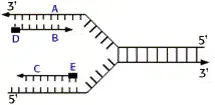
In this diagram of the process of DNA replication at a replication fork, the strand labeled B is the:
template strand
RNA primer
Okazaki fragment
leading strand
lagging strand

In this diagram of the process of DNA replication at a replication fork, the newly synthesized DNA strand labeled C is the:
coding strand
lagging strand
leading strand
parental DNA
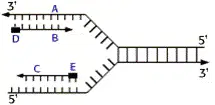
In this diagram of the process of DNA replication at a replication fork, the black boxes labeled D and E are:
RNA primers
Newly synthesized DNA strand
DNA polymerase
Okazaki fragments
DNA template strands
In the Meselson-Stahl DNA replication experiment, if the cells were first grown for many generations in 15N containing media, and then switched to 14N containing media, what percent of the DNA had 1 light strand and 1 heavy strand after 2 generations of growth in 15N growth media?
0
25
50
75
100
Frederick Griffith accidentally discovered transformation when attempting to develop a vaccine for pneumonia. He injected mice with samples from S-strain (virulent) and/or R-strain (nonvirulent) pneumococci bacteria (Streptococcus pneumoniae). Which of the following results is NOT consistent with Griffith's experiments?
injected S-strain; mouse dies.
injected mixture of heat-killed R-strain and live S-strain; mouse dies.
injected mixture of heat-killed S-strain and live R-strain; mouse lives.
injected heat-killed S-strain; mouse lives.
injected R-strain; mouse lives.
For the DNA strand 5'-TACGATCATAT-3' the correct complementary DNA strand is:
3'-TACGATCATAT-5'
3'-TATACTAGCAT-5'
3'-GCATATACGCG-5'
3'-AUGCUAGUAUA-5'
3'-ATGCTAGTATA-5'
Three types of RNA involved in comprising the structural and functional core for protein synthesis, serving as a template for translation, and transporting amino acid, respectively, are:
mRNA, tRNA, rRNA
rRNA, mRNA ,tRNA
tRNA, rRNA, mRNA
tRNA, mRNA, rRNA
rRNA, tRNA, mRNA
A synthetic mRNA of repeating sequence 5'-CACACACACACACACAC... is used for a cell-free protein synthesizing system like the one used by Nirenberg. If we assume that protein synthesis can begin without the need for an initiator codon, what product or products would you expect to occur after protein synthesis?
one protein, consisting of a single amino acid
one protein, with an alternating sequence of two different amino acids
one protein, with an alternating sequence of three different amino acids
two proteins, each with an alternating sequence of two different amino acids
three proteins, each consisting of a different, single amino acid

With what mRNA codon would the tRNA in the diagram be able to form a codon-anticodon base pairing interaction?
3'-AUG-5'
3'-GUA-5'
3'-CAU-5'
3'-UAG-5'
3'-UAC-5'
During their experiments, Alfred Hershey and Martha Chase helped confirm that DNA was the hereditary material. Which method did they use to discover this?
Radio-labelling DNA and protein
Transformation of DNA in Streptococcus pneumoniae
DNA linkage mapping
X-ray crystallography of DNA molecules
DNA replication in E. coli begins at a site in the DNA called the (a) .
At the replication fork the (b) ___________ strand is synthesized continuously while the (c) _________ strand is synthesized discontinuously.
(a)
On the strand synthesized discontinuously, the short pieces are called (d) (a) fragments.
An RNA primer for each of the fragments is synthesized by an enzyme called (e) __________, and this RNA primer is removed after the fragment is synthesized by the enzyme (f) ___________, using its (g) _____________ activity.
(a)
The nicks left behind in this process are sealed by the enzyme (h) (a) .

You have obtained a sample of DNA, and you transcribe mRNA from this DNA and purify it. You then separate the two strands of the DNA and analyze the base composition of each strand and of the mRNA. You obtain the data shown in the table to the right. Which strand of the DNA is the coding strand, serving as a template for mRNA synthesis?
Strand 1
Too little information to tell
Neither strand 1 nor 2
Both strands 1 and 2
Strand 2
The Meselson-Stahl experiment established that:
DNA polymerase has a crucial role in DNA synthesis.
newly synthesized DNA in E. coli has a different base composition than the preexisting DNA.
DNA synthesis requires dATP, dCTP, dGTP, and dTTP.
DNA synthesis in E. coli proceeds by a conservative mechanism.
preexisting DNA.
DNA synthesis in E. coli proceeds by a semiconservative mechanism.
When a DNA molecule is described as replicating bidirectionally, that means that it has two:
chains.
replication forks.
termination points.
origins.
independently replicating segment.
An Okazaki fragment is a:
fragment of DNA resulting from endonuclease action.
segment of mRNA synthesized by RNA polymerase
segment of DNA that is an intermediate in the synthesis of the lagging strand.
piece of DNA that is synthesized in the 3' ® 5' direction.
fragment of RNA that is a subunit of the 30S ribosome.
Which one of the following statements about enzymes that interact with DNA is true?
E. coli DNA polymerase I is unusual in that it possesses only a 5' ® 3' exonucleolytic activity.
Primases synthesize a short stretch of DNA to prime further synthesis.
Many DNA polymerases have a proofreading 5' ® 3' exonuclease.
Exonucleases degrade DNA at a free end.
Endonucleases degrade circular but not linear DNA molecules.
E. coli DNA polymerase III:
represents over 90% of the DNA polymerase activity in E. coli cells.
requires a free 5'-hydroxyl group as a primer.
is the principal DNA polymerase in chromosomal DNA replication.
is efficient at nick translation.
can initiate replication without a primer.
The 5' -> 3' exonuclease activity of E. coli DNA polymerase I is involved in:
formation of a nick at the DNA replication origin.
sealing of nicks by ligase action.
removal of RNA primers.
proofreading of the replication process.
formation of Okazaki fragments.
At replication forks in E. coli:
DNA helicases make endonucleolytic cuts in DNA.
RNA primers are synthesized by primase.
RNA primers are removed by primase.
DNA topoisomerases make endonucleolytic cuts in DNA.
DNA primers are degraded by exonucleases.
Which of the following is true about DNA polymerase?
It can synthesize DNA in the 5' to 3' direction
It can synthesize mRNA in the 5' to 3' direction
It can synthesize mRNA in the 3' to 5' direction
It can synthesize DNA in the 3' to 5' direction
The reaction in DNA replication catalyzed by DNA ligase is
Addition of new nucleotides to the leading strand
Base pairing of the template and the newly formed DNA strand
Formation of a bond between one Okazaki fragment and the next one
Addition of new nucleotide to the lagging strand
Which of the following enzymes remove supercoiling in replicating DNA ahead of the replication fork?
DNA polymerases
Helicases
Primases
Topoisomerases
DNA opening and unwinding is done by
Ligase
Hexonuclease
Topoisomerase
Helicase
The enzyme used to replace RNA primer with DNA is
DNA polymerase I
DNA Polymerase III
Primase
Endonuclease
DNA ligase
ecause DNA polymerase III can only act from 5' to 3', continuous strand growth can be achieved only along one of the template strands (Leading strand) and strand growth along the other strand must occur discontinuously resulting in the production of a series of short sections of new DNA called:
Replicon fragments
Klenow fragments
Okazaki fragments
None of the above
Since the first nucleotides cannot be linked in a newly synthesized strand in DNA replication, ___________ is required.
a DNA primer
DNA polymerase
ligase
an RNA primer
helicase
In DNA, thymine always pairs with
adenine
cytosine
guanine
thymine
uracil
DNA replication is called semiconservative because _______________ of the original DNA molecule appears in the DNA formed in replication.
none
most
half
hardly any
all
Each unit of a nucleic acid consisting of a sugar, attached phosphate group, and base is a
nucleolus
nucleotide
nucleosome
histone
genetisome
In replication of DNA, the helix is opened and untwisted by
polymerase
helicase
deoxase
ligase
ribase
In a nucleic acid, the bases are always attached to the _______________ carbon of the sugar.
5'
4'
3'
2'
1'
In nucleic acids, the phosphate group is attached to the _______________ carbon of the sugar.
5'
4'
3'
2'
1'
_______________ join DNA fragments on the lagging strand.
Telomeres
Centromeres
Helicases
Ligases
Antiparallel strands
DNA polymerase catalyzes the elongation of a DNA strand in the 5'-->3' direction.
True
False
A DNA molecule has the same amount of adenine and thymine.
True
False
During semiconservative replication, the original double helix remains intact and a new double helix forms.
True
False
The elongation of Okazaki fragments during DNA synthesis progresses away from the replication fork.
True
False
DNA is made up of a phosphate group, an organic base, and:
none of the above
A fat
a molecule of ATP
a protein
a sugar
In the DNA molecule:
adenine pairs with guanine
All of the above are possible.
None of the above are possible
cytosine pairs with thymine
guanine pairs with thymine
If one side of a DNA molecule contains the following sequence of nucleotides, AGTCCG, the complementary sequence on the other side would be:
GCCTGA
TCAGGC
AGTCCG
CTGAAT
none of the above
You isolate a previously unknown virus. Analysis of its genome reveals that it is composed of a double stranded DNA molecule containing 14% T (thymine). Based on this information, what would you predict the %C (cytosine) to be?
14%
28%
36%
72%
The two sides of the double helix structure of DNA are held together with hydrogen bonds.
True
False
DNA replication is called semiconservative because half of each of the two new strands of DNA is "old" DNA from the original DNA molecule and half is "new"
True
False
The lactose operon is likely to be transcribed when
the cyclic AMP level is high and and lactose is absent within the cell
the lactose and glucose levels are both high within the cell
the cyclic AMP and lactose levels are both low within the cell
the cyclic AMP and lactose levels are both high within the cell
In E. coli, adenylate cyclase is activated when
The ATP and glucose levels are high in the cell.
The cAMP and glucose levels are high in the cell
Phosphate accumulates on proteins in presence of glucose
Phosphate accumulates on proteins in absence of glucose
In E. coli, tryptophan switches off the trp operon by
binding to the repressor and increasing the latter's affinity for the operator
inactivating the gene for the first enzyme in the pathway (feedback inhibition)
binding to the operator
inactivating the repressor protein
A mutation that renders nonfunctional the product of a regulatory gene for a repressible operon would result in
continuous transcription of the genes of the operon
none of the above
blocking the operator of operon.
stopping transcription of the genes of the operon
Inducible enzymes are
usually involved in anabolic pathways
produced when a small molecule inactivates the repressor protein
produced when an activator molecule enhances the attachment of RNA polymerase to the operator
regulated by inherently inactive repressor molecules
In E. coli, tryptophan switches off the trp operon by
inactivating the repressor protein
inactivating the gene for the first enzyme in the pathway
binding to the repressor and increasing the latter's affinity for the operator
binding to the operator
certain mutations of the lac operon E. coli involve a change to the operator region. this modified operator is unable to bind the repressor protein, whether or not the repressor is bound to allolactose. In such cells
enzymes for the utilization of lactose would always be produced, even in the absence of lactose
RNA polymerase would be unable to bind to the operator region to initiate RNA synthesis
RNA polymerase would be unable to bind to the promoter region to initiate RNA synthesis
enzymes for the utilization of lactose would never be produced, even in the presence of lactose
Proinsulin is a polypeptide created directly by translating a mRNA molecule. to become insulin, it is cleaved and the pieces joined covalently. This is an example of
post transcriptional regulation
eterochromatin regulation
alternative splicing
post translational regulation
The results of the human genome project have indicated that a euk cell can produce more different proteins than it has genes. Given that most genes code for proteins, how is this possible?
some transcripts can be spliced in more than one way, producing messages for multiple proteins from the same gene
some proteins can be produced on the cell without info from genes
some proteins are the result of transcription from the genes of viruses that have infected the cell
darwinian theory requires extra proteins as the raw material for natural selection and evolution
which of the following would you expect to find as a part of a receptor protein that binds with a steriod hormone?
a domain that binds to DNA and protein binding domains
a binding domain that enables it to bend the DNA to bring bound activators closer to the promoter
an activated promoter region that allows attachment of RNA polymerase
In snails, sell coiling can either be right handed or left handed. The pattern of coiling in a snail is related to the genotype of its mother and not to the genotype of the individual. This curious observation suggests that shell coiling is controlled by
a maternal effect gene (Orgenelle genetic)
an oncogene
a piRNA
a morphogen
Which of the following might a proto-oncogene code for
DNA polymerase
RNA polymerase
receptor protein for growth factors
an enhancer
a tumor suppressor gene could cause the onset of cancer if
a-both alleles have mutations that decrease the activity of the gene product
both a and c are correct
c- a proto oncogene has also become an oncogene
b- it ins inherited from a parent in mutated form
Apoptosis is
a cell suicide program that may be initiated by p53 protein in response to DNA damage
metastasis, or the spread of cancer cells to a new location in the body
the mutation of a G protein into a hyperactive form
the transformation of a proto-oncogene to an oncogene by a point mutation
All of the following are made up of nucleic acid except a
repressor
structural gene
promotor
regulatory gene
operator
Why was the rediscovery of Mendel’s experiments important for the development of molecular biology?
Mendel’s experiments suggested that DNA was the hereditary material
All of the above
Mendel’s experiments with pea plants gave molecular biologists a useful model organism
Mendel’s laws of inheritance suggested that there were discrete biochemical pa
Where are Barr bodies typically found?
Male gametes
Female somatic cells
Male and female somatic cells
Male somatic cells
If a female’s cells contain three X chromosomes, how many Barr bodies will each cell have?
One
Two
Three
None
Which of the following applies to the Xist gene?
It activates genes on X chromosomes
It prevents the inactivation of genes
It inactivates genes on X chromosomes
It contains the XIC
A cell is going through meiosis. The sister chromatids are lined up on the metaphase plate. What phase of meiosis is this?
Metaphase I
Metaphase II
Prophase II
An adult organism has 60 chromosomes or 30 homologous chromosomes. 30 are maternally derived, 30 are paternally derived. How many chromosomes are in each cell after mitosis?
60 chromosomes, 30 homologs.
120 chromosomes, 60 homologs
30 chromosomes, no homologs.
An adult organism has 60 chromosomes or 30 homologous pairs of chromosomes. 30 are maternally derived, 30 are paternally derived. How many chromosomes are in each cell after meiosis?
30 chromosomes, no homologous chromosomes.
120 chromosomes, 60 homologous chromosomes.
60 chromosomes, 30 homologous chromosomes
A cell duplicates its DNA, divides into two cells, then divides into two cells again. Effectively, the cell reduces its DNA in half. Did this cell go through mitosis?
Yes, but only one
Yes
No
During mitosis, the chromosomes have condensed, lined up on the metaphase plate, and the chromatids are being separated by an enzyme? Which phase of mitosis is this?
Prophase
Metaphase
Anaphase
Yeast, the asexually reproducing organism used to create alcohol, eats sugar to create energy and reproduce. To make beer or wine, yeast is placed in sugar water of different flavors, and the yeast go to work creating alcohol. Typically, large amounts of yeast are added to the sugar water. However, if only a few yeast are added, the mixture will still produce the same amount of alcohol and deplete the sugar, in a similar amount of time. What process allows this?
Cytokinesis
Mitosis
Meiosis
Meiosis I creates ___________________.
two dissimilar daughter cells from one cell
four same daughter cells from two cells
four dissimilar daughter cells from one cell
two same daughter cells from one cell
In which phase does the tetrad first make its appearance?
S phase of the natural cell cycle
Anaphase I
Anaphase B
Prophase I
Why is it important that cells have the ability to signal one another?
It is not important
Communication between cells always necessary for individual cellular processes
Communication allows coordination, allowing the organism to survive
The DNA has been replicated in a cell containing 4 chromosomes. The cell is going through mitosis, and sister chromatids are being separated in anaphase. Before the cell divides, chromosomes will exist in the same cell. How many chromosomes will exist in the cell between anaphase of mitosis and cytokinesis, or cell division?
4 chromosomes
8 chromosomes
2 chromosomes
Crossing over occurs during which stage of meiosis
Prophase I
Prophase II
Anaphase I
Metaphase I
What is the evolutionary purpose of cells that undergo crossing over?
To produce two cells instead of one
To increase genetic diversity
To keep mutations from forming
To keep the redundancy of the cell high
To produce gametes that are genetically identical
What structures exchange genetic material during crossing over?
Nonsister chromatids
Egg and sperm chromosomes
Sister chromatids
Non-homologous chromosomes
During crossing over, two homologous chromosomes pair to form which of the following choices?
Chromatid
Tetrad
None of these
Base Pair
Mitotic Bond
Crossing over is a phenomenon that happens during Meiosis I in the attempt to create genetic diversity. Crossing over typically occurs between which of the following structures?
Tetrads
Homologous chromosomes
Chromatin
Sister chromatids
Which of the following is the cause of complete monosomy? A. Partial deletions B. Partial monosomy C. Translocations D. Nondisjunction
Partial deletions
Nondisjunction
Translocations
Partial monosomy
What do most monosomies lead to in humans?
Infertility
Most aren’t dangerous and lead to no problems
Death
Small feet
In humans, Turner’s and Down’s syndromes are examples of: A. Monosomy B. A monsomy and a trisomy, respectively C. A trisomy and a monosomy, respectively D. An aneuploidy and a monosomy, respectively
An aneuploidy and a monosomy, respectively
A trisomy and a monosomy, respectively
A monsomy and a trisomy, respectively
Monosomy
Which of the following is a missense mutation?
Serine is substituted for Serine
Arginine is substituted for Glutamine
A STOP signal is substituted for Cysteine
Molecules of mature mRNA are short, single-stranded and contain the following components:
adenine, cytosine, guanine and uracil, exons, 5’-cap and 3’-poly-tail
adenine, cytosine, guanine and uracil, introns, exons, 5’-cap and 3’-poly-tail
adenine, cytosine, guanine and uracil, introns
introns, 5’-cap and 3’-poly-tail
Which of the following statements are true about the differences between eukaryotic and prokaryotic mRNA?
In contrast to eukaryotes that transcribe in the nucleus and translate in the cytoplasm, prokaryotes, transcribe and translate the mRNA simultaneously in the cytoplasm
Prokaryote mRNA is primarily polycistronic and eukaryotic mRNA is primarily monocistronic.
Bacterial mRNAs are short-lived to allow for flexibility in rapidly changing environments, while eukaryotic mRNAs are stable up to a few days.
All of the above are correct.
What happens during the important pre-mRNA to mRNA processing step?
Non-coding introns are removed or “spliced out”.
The mRNA is translated into protein.
The pre-mRNA is exported out of the nucleus
All of the above.
Mutations are sometimes carried on the sex chromosomes, X and Y. Why might a male inherit a mutation carried by his mother, even though his mother does not have the mutation, herself?
The male inherited the recessive mutation on his X chromosome, while his mother inherited the recessive mutation on one X chromosome and a dominant form of the gene on her other X chromosome.
The male inherited the dominant mutation on his Y chromosome, because his mother carried the recessive mutation on her Y chromosome.
The male inherited the dominant mutation on his Y chromosome, because his mother carried the dominant mutation on her Y chromosome.
The male inherited the dominant mutation on his X chromosome, because his mother carried the dominant mutation on both of her X chromosomes.
Male calico cats are rare because:
The gene for fur color is carried on the X chromosome, and is inherited exclusively from the mother. The mother would have to carry both the gene for orange fur and the gene for black fur for her male offspring to be a calico
The gene for fur color is carried on the X chromosome, and male cats only have one X chromosome. A male cat would have to have two X chromosomes, or the Klinefelter’s syndrome mutation, to inherit both orange and black fur.
The gene for fur color is carried on the X chromosome, and male cats do not always inherit the X chromosome. This is why there are so many albino male cats.
The gene for fur color is carried on the Y chromosome, and male cats do not usually inherit two Y chromosomes. A male cat must therefore have an XYY genotype to be a calico.
One of the following examples includes a silent mutation. Which one?
A sunbather forgets to put sunscreen on. The DNA within many skin cells is damaged, and several mutations happen when it is repaired.
the third spot of the codon, a C mutates to a G. Both codons call for threonine amino acid
Due to a mutation, a changed amino acid within an enzyme cause it to slow down.
What is the difference between a nonsense mutation and a silent mutation?
Nothing, they both change protein function
A nonsense mutation does not create a change in the protein
A silent mutation does nothing, while a nonsense mutation can be significantly disruptive
On the inside of a protein, a mutation causes the swap of one amino acid with another. This change does not affect the internal structure of the protein, and both proteins act similarly in their roles. Which of the following represents this situation?
Silent mutation
Point mutation
Missense mutation
Frameshift mutation
A complex protein has thousands of amino acids, but only a few of them exist in the active site. The active site requires a specific sequence of amino acids, to bind to a substrate. If a deletion mutation of 3 nucleotides removes one of these amino acids, will the protein still function?
No
Yes, just not as well
Maybe, it depends on the protein.
While replicating a gene, polymerase accidently slips on the template strand, and skips a nucleotide. The resulting DNA produced is missing that nucleotide counterpart, and forms a mismatch in the DNA. Exonuclease senses the lump in the DNA, and cuts the strand open, allowing polymerase to insert the proper nucleotide and reseal the DNA. What just happened?
Frameshift mutation
A deletion mutation, and an insertion mutation
Normal DNA replication
A deletion mutation
What does the Svedberg unit measure?
Volume
Time taken for sedimentation
Molecular weight
Density
What nitrogenous bases do pyrimidines always pair with?
(a)
How many backbones does DNA have?
(a)
How many backbones does RNA have?
(a)
What is the backbone of DNA and RNA made of?
(a)
What are at the ends of a DNA strand?
(a)

