
 Worksheets
Review - Central Dogma
Total questions: 79
Worksheet time: 1hrs 3mins
Which Nucleotide matches to Cytosine?
Guanine
Adenine
Uracil
Thymine
A codon consists of ___ nucleotides?
2
3
4
5
This is the process by which double stranded DNA produces single stranded RNA:
Photosynthesis
Translation
Pollination
Transcription
Proteins aren't made in the nucleus because they are too big to escape the ______________:
Nuclear Membrane
Cell Membrane
This organelle is crucial for the translation process:
Mitochondria
Ribosome
Gogli Apparatus
Vacuole
The start codon is _______:
AUG
GGG
UCG
AAU
The DNA sequence UAGCGAUUACGU is part of a gene. How many amino acids are coded for by this sequence?
20
4
8
12
T-G-A-C-C-A
T-G-A-G-C-A
Building the first accurate model of DNA
Isolating strains of pneumonia causing bacteria
Determining base pairing rules
Discovering the process of genetic transformation

Francis Crick
James Watson
Rosalind Franklin
Watson and Crick
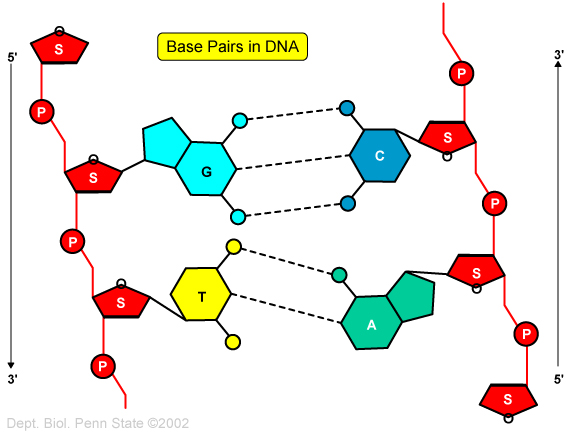
Which of these are the correct way for "bases" to pair in DNA?
A-T and C-G
A-C and T-G
A-G and T-C
A-A, T-T, C-C, G-G
In a DNA molecule, 31% of the bases are Adenine. What % would be Thymine?
38%
19%
31%
68%
Which of the following units are repeatedly joined together to form a strand of DNA?
Amino Acids
Nucleotides
Fatty Acids
Polysaccharides
The process of DNA replication is called semi conservative because it results in
none of these
Two DNA molecules. One original molecule and one with two new strands
two exact copies with new strands
two DNA molecules, each with 1 original strand and one new.
The enzyme used to separate the double helix into 2 single strands is:
Nuclease
Primase
Helicase
DNA polymerase III
In a molecule of double-stranded DNA, the amount of Adenine present is always equal to the amount of
Cytosine
Guanine
Thymine
Uracil
Which enzyme joins together Okazaki fragments?
DNA pol I
Helicase
Ligase
Primase
The DNA sequence of the parent strand is 5'-ATGCTCAGCT-3'. What is the sequence of the daughter strand?
3'-UACGAGUCGA-5'
5'-UACGAGUCGA-3'
3'-TACGAGTCGA-5'
5'-TACGAGTCGA-3'
Why would it be important to replicate DNA before a cell divides in mitosis or meiosis?
In order for the DNA to be contained in the nucleus.
In order for the cell to re-order the DNA sequencing in the new cells.
In order for the cell to be able to increase in size.
In order for genetic information to be transferred into daughter cells.

GCUAUA
CGATAT
CGAUAU
GCUTUT

translation
transcription
transformation
replication
RNA has what base that is instead of thymine?
guanine
adenine
thymine
uracil
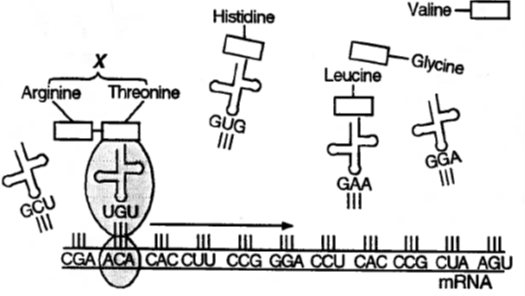
Transcription
Translation
Replication
All the above
mRNA is created in the Nucleus
mRNA is decoded to form a protein
glucose molecules are made
is where lipids are synthesised
carry a message that, when translated, forms proteins
form a portion of ribosomes
string together complementary RNA and DNA strands
bring amino acids from the cytoplasm to the ribosomes
How many nucleotides code for 1 amino acid?
1
2
3
4
Match the following to where they occur
nucleus
transcription
cytoplasm
translation
nuclear pore
mRNA leaves through
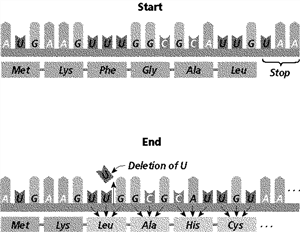
When an extra base is inserted into the DNA sequence of a gene, the protein doesn't work. Which explains why?
the base increases rate of translation
the base causes DNA to be transcribed in opposite direction
the inserted base causes the codons in the sequence to be shifted and read differently
the base signals enzymes to translate DNA rather than RNA
In RNA, Uracil pairs with ______.
cytosine
adenine
guanine
thymine
DNA holds the code for
lipids
carbohydrates
proteins
sugars

What process is going on in this photo?
Transcription
Translation
Replication
All the above
What is the job of messenger RNA?
to transfer amino acids
to assemble the protein
to carry genetic information

Which amino acid is coded C G G ?
Arginine
Proline
Leucine
Glycine
Which amino acid is coded G A U ?
Glutamic acid
Proline
Aspartic acid
Glycine
Which of the following is NOT a codon for serine?
A G C
U C U
G U G
A G U
What is Chargaff's Rule?
In DNA, there is always an equal quantity of the bases A and T and bases G and C.
There are always a greater number of A's and T's in a strand of DNA compared to the number of G's and C's.
In DNA, there is an equal quantity of C's and G's and the same number of A's and U's
What is the function of the helicase enzyme?
to join nucleotides to an open strand of DNA
to add RNA nucleotides to a strand of RNA
to unzip the original DNA along it's weak bonds
to remove nucleotides from a strand of DNA
Which of the following is the tRNA anticodon for the mRNA codon U G G?
A G G
G G U
T C C
A C C
A codon is located on
DNA
mRNA
tRNA
When does DNA replication take place?
During prophase
During interphase
During metaphase
During anaphase
What do you call a section of DNA that codes for a specific protein?
Gene
Enzyme
Splice
Triplet
Which of the following is NOT a role of DNA?
store information
copy information
transmit information
delete information
DNA nucleotides consist of three parts. Which of the following is NOT part of a DNA nucleotide?
phosphate group
5-carbon sugar
nitrogenous base
amino acids
Match the following DNA nucleotides to their complimentary nucleotide:
cytosine
guanine
adenine
thymine
guanine
cytosine
thymine
adenine
Given the mRNA sequence - 3' AUG CAU GGU.5'. What is the original DNA template strand?
5' TAC GTA CCA 3'
5' UAC GUA CGA 3'
3' UAC GUA CGA 5''
3' TAC GTA CGA 5'

Given the DNA strand: 3' TAC-TGT-GGT-TAA 5'. What is the amino acid sequence?
Met-Thr-Pro-Ile
Met-Pro-Thr-Ile
Ile-Pro-Thr-Met
Ile-Thr-Pro-Met

What is this structure called
Double Helix
Double Felix
Two Cats
Single Strand

Name this structure.
Base
Nucleotide
Sugar
DNA
Name the bases of DNA.
Guanine and Cytosine
Adenine
Adenine, Thymine, Guanine, Cytosine
Adenine, Uracil, Guanine, Cytosine
Name the bases of RNA.
Guanine and Cytosine
Adenine
Adenine, Thymine, Guanine, Cytosine
Adenine, Uracil, Guanine, Cytosine

What protein is UCC
Ser
STOP
Thr
Tyr


A polypeptide is a sequence of:
proteins
base nucleotides
amino acids
monosaccharides
Which organelle is the site where translation occurs?
ribosomes
tRNA
mRNA
lysosomes

