
 Worksheets
AQA AS Biology
Total questions: 176
Worksheet time: 2hrs 56mins
What type of bond that is formed when two amino acids combine?
DNA and ATP
Ester
RNA and ATP
Peptide
Glycosidic
Maltose is a disaccharide formed of glucose and which other monosaccharide?
fructose
lactose
glucose
galactose
Which of the following statements about the polysaccharide glycogen is not true?
Glycogen is made up of many α-glucose monomers.
Glycogen is found in animal cells.
Glycogen is formed of unbranched chains of glucose.
Glycogen is a compound used for storage.
Calculate the pH of a solution that has the hydrogen ion concentration of
2.75 × 10⁻⁴ M. Use the formula pH = −log10[H+].
pH 2.56
pH 4.44
pH 3.5
pH 3.56
Which of these is a feature of all monounsaturated fatty acids?
contain no hydrogen atoms
a double bond between all of the carbon atoms
are hydrophillic, so attract water
one double bond between carbon atoms
a phosphate group at the end of the fatty acid chain

An unknown food substance was tested using a variety of techniques, the results are in the table below. Which substances does the food sample contain?
starch and protein
reducing sugar and fat
non-reducing sugar and protein
fat and starch
Which property of a triglyceride fat makes it unsuitable to form a bilayer?
It has a low mass to volume ratio.
It has a high ratio of C–H bonds and carbon atoms.
It has a high ratio of hydrogen to oxygen atoms.
It is a non-polar molecule.
When searching for life on other planets, which two substances should you look for?
air and carbon
water and carbon
nitrogen and air
carbon and nitrogen

The graph below shows a reaction controlled by the digestive enzyme pepsin. The temperature is set at 30 °C and the pH at 6. What change would increase the rate of this reaction from point A.
decrease the temperature
decreasing the enzyme concentration
decreasing the pH
decreasing the substrate concentration
Changes in the sequence of amino acids in haemoglobin can result in sickle cell anaemia. Which of the following statements about sickle cell anaemia is not true?
Sickle cell is an infectious disease.
The change in amino acid sequence causes a change in the tertiary structure of haemoglobin.
Symptoms of sickle cell anaemia include lethargy, joint pain, and shortness of breath.
Haemoglobin is a complex globular protein with an associated iron containing haem group.
Potassium cyanide is non-competitive enzyme inhibitor. It inhibits an enzyme which is involved in respiration resulting in cells being unable to utilise oxygen. What would the effect of potassium cyanide have on the rate of respiration?
Water can leave the root hair cells.
aerobic respiration stops
aerobic respiration is reduced


Maltose is a disaccharide and is made up of which two monosaccharides ...
glucose + glucose
glucose + fructose
glucose + galactose
fructose + sucrose
Sucrose is a disaccharide and is made up of which two monosaccharides ...
glucose + glucose
glucose + fructose
glucose + galactose
fructose + sucrose
Lactose is a disaccharide and is made up of which two monosaccharides ...
glucose + glucose
glucose + fructose
glucose + galactose
fructose + sucrose
Polysaccharides form by which reaction ...
Hydrolysis
Condensation
Starch is an example of a polysaccharide, where is it found?
Plants
Animals
Glycogen is an example of a polysaccharide, where is it found?
Plants
Animals
Which monomer makes up cellulose?
alpha glucose
beta glucose
Role of lipids includes ...
source of energy
waterproofing
insulation
protection
Triglycerides are so called because ...
they have three fatty acids combined with glucose
they have two fatty acids combined with glycerol
they have three fatty acids combined with glycerol
because they are three
Phospholipids are similar to lipids except that one of the fatty acids is replaced with a phosphate molecule. Which of the following is true?
Hydrophilic head and Hydrophilic tail
Hydrophilic head and Hydrophobic tail
Hydrophilic tail and Hydrophilic tail
Hydrophilic head and Hydrophilic Head
An amino acids has which of the following attached to the central carbon ...
amino group
carboxyl group
hydrogen atom
R (side) group
The bond between amino acids are called ...
peptide
ester
glycosidic
phosphodiester
hydrogen
The bond between glucose molecules are called ...
peptide
ester
glycosidic
phosphodiester
hydrogen
The bond between DNA bases are called ...
peptide
ester
glycosidic
phosphodiester
hydrogen
The bond found in lipids are called ...
peptide
ester
glycosidic
phosphodiester
hydrogen
The bond found between a sugar and a base in a nucleotide is called ...
peptide
ester
glycosidic
phosphodiester
hydrogen
In the tertiary structure of a protein, which of the following bonds could be found ...
ionic
disulphide
hydrogen
glyosidic
The base pair rule in DNA is
A-G and C-T
A-T and C-G
A-A and T-T
A-C and G-T
If the % of Thymine in a cell is 34%, what is the % of Guanine?
34
68
16
0
The site of cellular respiration is?
rER
Golgi Body/aparatus
Vesicle
Nucleus
Mitochondria
The organelle responsible for packaging and processing proteins is known as?
rER
Golgi Body/aparatus
Vesicle
Nucleus
Mitochondria
The organelle responsible folding the protein is?
rER
Golgi Body/aparatus
Vesicle
Nucleus
Mitochondria


What is the chemical symbol of the iron containing haem group?
Fe+
Fe2+
Fe3+
Fe
How many polypeptide chains is a haemoglobin molecule made of?
1
2
3
4
Haemoglobin has a high affinity for oxygen in areas with a...
High partial pressure of carbon dioxide
High partial pressure of oxygen
Low partial pressure of oxygen
Low partial pressure of carbon dioxide
Dissociation of haemoglobin is its ability to...
Unload its oxygen to tissues
Become saturated with oxygen
Keep hold of its oxygen
All of the above...
What kind of protein structure does haemoglobin have?
Primary
Secondary
Tertiary
Quaternary
Foetal haemoglobin has a dissociation curve...
The same as the normal curve
To the left of the normal curve
To the right of the normal curve
Plateaus lower than the normal curve
An organism with a high metabolic rate has a dissociation curve...
At a lower partial pressure than the normal curve
The same as the normal curve
To the left of the normal curve
To the right of the normal curve
The Bohr effect is caused by...
An increase in carbon dioxide, increasing the concentration of H+ ions, increasing acidity
An decrease in carbon dioxide, increasing the concentration of H+ ions, increasing acidity
An increase in carbon dioxide, increasing the concentration of H+ ions, decreasing acidity
An decrease in carbon dioxide, decreasing the concentration of H+ ions, decreasing acidity
After the first molecule of oxygen binds to haemoglobin...
The tertiary structure changes, revealing less oxygen binding sites
The tertiary structure changes, revealing more oxygen binding sites
The tertiary structure stays the same
The tertiary structure changes, the protein is denatured
What is the advantage of the Bohr effect during intense exercise?
Haemoglobin dissociates its oxygen more readily, as its affinity for oxygen decreases, providing more oxygen for an increase in aerobic respiration in muscle cells
Haemoglobin dissociates its oxygen less readily, as its affinity for oxygen increases, providing less oxygen for an decrease in aerobic respiration in muscle cells
Haemoglobin dissociates its oxygen more readily, as its affinity for oxygen increases , providing more oxygen for an increase in aerobic respiration in muscle cells
Haemoglobin dissociates its oxygen less readily, as its affinity for oxygen decreases, providing more oxygen for an increase in aerobic respiration in muscle cells
Which do BOTH prokaryotes and eukaryotes contain?
nucleus
mitochondria
ribosomes
cell wall
Which does only eukaryotic cells contain?
nucleus
DNA
cell membrane
ribosomes
Which cell type tends to be smaller?
Prokaryote
Eukaryote
there is not a size difference
Which cellular process takes place in the RIBOSOMES that are bound to the ER?
Breakdown of waste material
Production of ATP
Synthesis of new proteins
Replication of nucleic acids
What am I?
mRNA leaves through me (I am a small hole/gap) on its way to the ribosome?
nucleus
nuclear pore
nucleolus
ribosome
What am I?
I act as a control centre for the cell by producing mRNA and therefore control protein synthesis?
Nucleus
Nuclear Pore
Nucleolus
ribosome
What am I?
I have ribosomes on my outer surfaces of my membrane. I provide a large surface area for the synthesis of proteins and glycoproteins.
sER
ER
rER
RER
What am I?
I come in two varieties. 70S and 80S. I am made of two subunits - one large and one small. I contain ribosomal RNA and protein. I am the site of protein synthesis in eukaryote cells.
80S Ribosomes
70S Ribosomes
What am I?
I am formed when a vesicle is pinched off from the Golgi apparatus. I contain enzymes such as proteases and lipases. These enzymes can hydrolyse cell walls.
Lysosome
Ribosome
Cytoplasm
Organelle
What am I?
I package and process new lipids and proteins which have been made in the endoplasmic reticulum.
Golgi apparatus
Rough Endoplasmic Reticulum
Smooth Endoplasmic Reticulum
Ribosomes


What do glycoproteins do?
act as recognition sites
help cells to attach to one another and so form tissues
allow cells to recognise one another
none of the above
What do glycolipids do?
act as recognition sites
help maintain stability in the membrane
help cells attach to one another and so form tissues
all of the above
Which transport processes require protein channels/carriers?
Diffusion
Facilitated diffusion
Osmosis
Active transport
Which transport processes require move substances along a concentration gradient?
Diffusion
Facilitated diffusion
Osmosis
Active transport
Which transport processes require move substances against a concentration gradient?
Diffusion
Facilitated diffusion
Osmosis
Active transport
Which of the following is not a protein?
collagen
antibody
enzyme
phospholipid
A plant cell wall is made of ...
starch
gylcogen
cellulose
peptidoglycan
The element _______is found in all of the organic compounds.
Iron
Carbon
Nitrogen
Oxygen
Which of the following is a main function of a lipid?
source of quick energy
stores energy, insulates us, and makes up the cell membrane
transport substances in and out of the cell
stores genetic information

The visible features of this blood cell suggest that it is a
polymorph
monocyte
lymphocyte
red blood cell
Which word describes red blood cells ?
anucleate
multinucleate
polymorphic
spherical

The diagram shows the results of separating blood components in a centrifuge. Which are the most dense components of this sample?
plasma
leukocytes (white blood cells)
platelets
erythrocytes (red blood cells)
Which statement supports the fact that mature plant cells can carry out the same role as lysosomes?
A range of hydrolytic enzymes can be found within mature plant vacuoles.
Glycogen, found within vesicles, can be hydrolysed to glucose molecules.
Single membrane-bound vesicles are formed from plant Golgi bodies
Vesicles, formed from smooth endoplasmic reticulum, contain enzymes.
Which of these processes allow movement in both directions across cell surface membranes?
1 - active transport
2 - diffusion
3 - facilitated diffusion
4 - osmosis
1, 2, 3 and 4
1 and 4 only
2 and 3 only
2 only
What describes a telomere?
a cell structure composed mainly of protein and involved in cell division
a protein that associates with DNA to help condense it
a region of DNA that links two sister chromatids together
a region of repetitive nucleotide sequences at the end of a chromatid
Uncontrolled cell division can form tumours. Which statement is correct for tumour cells only?
Metaphase does not take place
Cytokinesis does not occur
Interphase takes less time.
They have mutated DNA.
Which of these events are part of mitosis?
1 - interphase
2 - anaphase
3 - cytokinesis
1, 2 and 3
1 and 3 only
1 only
2 only
In what mode of transport are protein carriers involved in?
Active transport
Diffusion
Facilitated diffusion
Osmosis
What is the role of bile in digestion?
It breaks up fats
It emulsifies lipids, creating a larger surface area
It creates a slightly alkali condition for enzymes to work in once digested food has left the stomach
It catalyses the breakdown of proteins
Which of the following does not act as a defence mechanism of the body?
Antibodies
Phagocytes
Lymphocytes
Antigens
Which enzyme do phagocytes use during phagocytosis?
Lysozyme
DNA helicase
ATP synthase
Amylase
Which of the following is an example of passive immunity?
Previous exposure to the pathogen
Vaccination by injection
Breastfeeding
Oral vaccination
Which of the following structure is for cellular respiration occurs in a cell?
vacuoles
mitochondria
cytoplasm
nucleus

A
B
C
D

A
B
C
D

A
B
C
D

A
B
C
D

A
B
C
D

A
B
C
D

A
B
C
D

A
B
C
D

A
B
C
D

A
B
C
D
The element _______is found in all of the organic compounds.
Iron
Carbon
Nitrogen
Oxygen
The main function of a carbohydrate is
long term energy storage
stores genetic information
short term energy storage
regulates and controls all body proccesses
Carbohydrates are made of what elements?
CHO
CHON
CHONP
CHONS

Which of these are examples of Lipids?
simple sugars
complex carbohydrates
fats, oils, & waxes
hair, skin, & nails
Monomers of Lipids include
amino acids
monosaccharides
nucleotides
glycerol and fatty acids
Which of the following is a main function of a lipid?
source of quick energy
stores energy, insulates us, and makes up the cell membrane
transport substances in and out of the cell
stores genetic information

A
B
C
D

A
B
C
D

A
B
C
D

A
B
C
D

A
B
C
D
A
B
C
D

A
B
C
D

A
B
C
D

A
B
C
D

A
B
C
D

A
B
C
D

Not C
A
B
C
D
The monomer making up a polypeptide chain.
glucose
amino acid
protein
DNA

In this image what does R represent
an element
a carbon atom
a functional group
a carboxyl group

Which level of protein structure is shown here?
tertiary structure
secondary structure
quaternary structure
primary structure

How would you describe the bonds shown in this diagram?
strong covalent bonds
ionic bonds
non-polar interactions
hydrogen bonds

Which level of protein structure is shown here?
tertiary structure
secondary structure
quaternary structure
primary structure

How would you describe the bonds indicated in this diagram?
strong covalent bonds
ionic bonds
non-polar interactions
hydrogen bonds

Which levels of protein structure are shown here?
primary structure
tertiary structure
primary and secondary structure
quaternary structure
Which side groups can form hydrogen bonds?
-COOH
-CH
-HS
-CH3

Which statement is NOT true of this collagen molecule?
it is insoluble
it contains just a few types of amino acid
it is a globular protein
it is a strong molecule

Which statement is NOT true of this haemoglobin molecule?
it has tertiary structure
it is a fibrous protein
it is soluble
it has quaternary structure
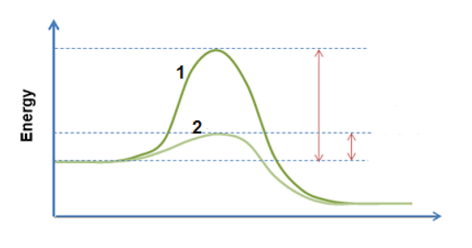
Enzymes are proteins. Which phrase best describes the function of enzymes?
They take part in biochemical reactions
They make reactions happen in the body
They speed up biochemical reactions by lowering the activation energy
They are catalysts

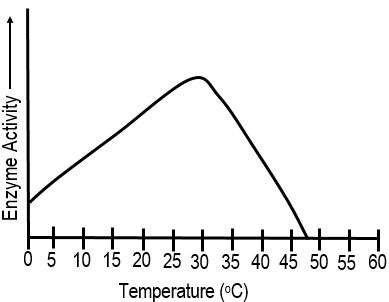
Which phrase best explains the increase in rate between 10oC and 30oC?
Enzymes and substrates collide more often
The enzyme is working faster
The temperature is increasing
The rate of reaction is increasing

Which phrase best explains the low rate at 50oC?
The enzyme is not at its optimum temperature
The substrate has melted
The enzyme has denatured
The temperature is too high
All enzymes have an optimum temperature of 37oC.
True
False
All enzymes are most effective at pH 7
True
False

