wayground logo

Free Printable Worksheets

NEW

Font size

S
M
L
XL
Worksheets

ORB PS/CR/BC

Total questions: 78

Worksheet time: 1hrs 15mins

Name
Class
Date
1.
Which of the following are products of the light reactions of photosynthesis that are utilized in the Calvin cycle?
a)
CO2 and glucose
b)
H2O and O2
c)
electrons and H+
d)
ATP and NADPH
2.
Where does the Calvin cycle take place?
a)
stroma of the chloroplast
b)
thylakoid membrane
c)
outer membrane of the chloroplast
d)
interior of the thylakoid membrane
3.
When oxygen is released as a result of photosynthesis, it is a direct by-product of
a)
reducing NADP+
b)
splitting water molecules
c)
chemiosmosis
d)
electron transfer in photosystem II and I
4.
Which of the following events occurs in the light reactions of photosynthesis?
a)
NADP+ is produced
b)
ATP is consumed to yield ADP
c)
carbon dioxide is fixed in organic molecules
d)
light is absorbed and funneled to reaction-center chlorophyll a
5.
Which of the following is directly associated with Photosystem I?
a)
harvesting light energy to make ATP
b)
receiving electrons from the thylakoid membrane ETC
c)
generation of molecular oxygen
d)
extraction of hydrogen electrons from the splitting of water
6.
What is the primary function of cyclic electron flow?
a)
to produce additional NADPH
b)
to produce additional ATP
c)
to produce additional oxygen
d)
to produce additional carbon dioxide
7.
In a plant cell, where are ATP synthase complexes located?
a)
thylakoid membranes only
b)
inner mitochondrial membranes only
c)
thylakoid membrane and inner mitochondrial membranes
d)
thylakoid membrane and plasma membranes
8.
Which of the following statements about the relationship between photosynthesis and cellular respiration is true?
a)
In cellular respiration the biochemical pathways of photosynthesis run in reverse.
b)
In photosynthesis the biochemical pathways of cellular respiration run in reverse.
c)
Cellular respiration occurs only in animals and photosynthesis occurs only in plants.
d)
Cellular respiration is catabolic and photosynthesis is anabolic.
9.
Where are the molecules of the electron transport chain associated with photophosphorylation located in plant cells?
a)
thylakoid membanes of chloroplasts
b)
stroma of chloroplasts
c)
matrix of mitochondria
d)
outer membrane of chloroplasts
10.
In photosynthetic cells, synthesis of ATP by chemiosmosis occurs during
a)
photosynthesis only
b)
cellular respiration only
c)
both photosynthesis and cellular respiration
d)
photophosphorylation only
11.
What is the relationship between wavelength of light and the quantity of energy per photon?
a)
they have a direct, linear relationship
b)
they are inversely related
c)
they are logarithmically related
d)
they are only related in certain parts of the spectrum
12.
What is the primary function of the Calvin cycle?
a)
regenerate ATP for use in the light reactions of photosynthesis
b)
produce carbon dioxide for use in the light reactions of photosynthesis
c)
produce oxygen by oxidizing water
d)
produce simple sugars from carbon dioxide
13.
Where do the enzymatic reactions of the Calvin cycle take place?
a)
stroma of the chloroplast
b)
thylakoid membranes
c)
matrix of the mitochondria
d)
thylakoid space
14.
In C3 photosynthesis, the reactions that require ATP take place in
a)
the light reactions alone
b)
the calvin cycle only
c)
both the light reactions and the calvin cycle
d)
the citric acid cycle
15.
Reactions that consume CO2 take place in
a)
the light reactions of photosynthesis only
b)
the calvin cycle only
c)
the light reactions and the calvin cycle
d)
the calvin cycle and the citric acid cycle
16.
Which of the following statements best represents the relationships between the light reactions and the Calvin cycle?
a)
The light reactions provide ATP and NADPH to the Calvin cycle, and the Calvin cycle returns ADP, ℗i, and NADP+ to the light reactions.
b)
The light reactions provide ATP and NADPH to the carbon fixation step of the Calvin cycle, and the Calvin cycle provides water and electrons to the light reactions.
c)
The light reactions supply the Calvin cycle with CO2 to produce sugars, and the Calvin cycle supplies the light reactions with sugars to produce ATP.
d)
The light reactions provide the Calvin cycle with oxygen for carbon fixation, and the Calvin cycle provides the light reactions with sugars to produce ATP.
17.
CAM plants keep stomata closed in daytime, thus reducing loss of water. They can do this because they
a)
fix CO2 into organic acids during the night when temperatures are cooler.
b)
fix CO2 into by combining it with RuBP in the Calvin cycle.
c)
obtain CO2 through their roots during the day.
d)
fix CO2 into organic acids in the mesophyll cells, which do not rely on stomata.
18.
Compared to C3 plants, C4 plants
a)
) have higher rates of photorespiration.
b)
can continue to fix CO2 even at relatively low CO2 concentrations and high oxygen concentrations.
c)
do not use rubisco for carbon fixation.
d)
grow better under cool, moist conditions.
19.
In chemiosmosis in mitochondria, protons flow from the intermembrane space into the matrix, whereas in chemiosmosis in chloroplasts, protons flow from
a)
stroma into the cytosol
b)
stroma to the thylakoid space
c)
thylakoid space to the stroma
d)
intermembrane space to the stroma
20.
In mitochondria, the electron transport chain pumps protons from the matrix into the intermembrane space, whereas in chloroplasts, the electron transport chain pumps protons from
a)
matrix to stroma
b)
stroma to thylakoid space
c)
intermembrane space to stroma
d)
thylakoid space to stroma
21.

Electrons are an important part of cellular respiration, what role do they play?

a)

They jump-start cellular respiration

b)

They carry/transfer potential/chemical energy

c)

They co-transport oxygen

d)

They lower the pH of the mitochondria

22.

How are electrons transferred through the process of cellular respiration?

a)

NADH & FADH2

b)

NADPH

c)

Oxygen

d)

ATP

23.

Substrate level phosphorylation is the process of producing ATP by

a)

breaking a bond

b)

chemiosmosis (using ATP synthase)

c)

a kinase

d)

phosphatase

24.

If Kreb's Cycle only produces 2 ATP, why is it a step in Cellular Respiration?

a)

It produces oxygen

b)

It produces citric acid

c)

It produces carbon dioxide

d)

It produces NADH & FADH2

25.

As NADH & FADH2 donate their electron(s) to their respective proteins embedded in the inner membrane, what is transported across?

a)

oxygen

b)

protons

c)

electrons

d)

water

26.

What is pulling the electrons down the ETC?

a)

oxygen

b)

water

c)

carbon dioxide

d)

protons

27.

List the proper order of energy transfer.

a)

mechanical, chemical, oxidative

b)

chemical, mechanical, kinetic

c)

kinetic, chemical, kinetic

d)

chemical, mechanical, chemical

28.

Which letter points to where the Kreb's Cycle takes place?

a)

A

b)

B

c)

C

d)

D

29.

Where is ATP synthase located?

a)

A

b)

B

c)

C

d)

D

30.

Where is the proton concentration built up/the highest?

a)

A

b)

B

c)

C

d)

D

31.

Where do the protons end up after going through ATP synthase?

a)

A

b)

B

c)

C

d)

D

32.

Which location is the site of the step universal to all organisms?

a)

A

b)

B

c)

C

d)

E

33.
What is a peptide bond?
a)
Bond that holds two amino acids together.
b)
A bond that holds hydrogen and oxygen molecules together.
c)
A bond that holds the phosphate group of one nucleotide and a sugar of a neighboring nucleotide.
d)
A bond that is formed by the sharing of electrons.
34.
Each amino acid is different from the other due to....
a)
The R group
b)
The amino group
c)
The carboxyl group
d)
The central carbon
35.
Where does transcription occur in eukaryotic cells?
a)
Nucleus
b)
Ribosome
c)
Cytoplasm
d)
Rough E.R.
36.
A certain gene codes for a polypeptide that is 120 amino acids long. Approximately how many nucleotides long is the mRNA that codes for this polypeptide likely to be?
a)
360
b)
480
c)
40
d)
30
37.
The anticodon of a particular tRNA molecule is 
a)
complementary to the corresponding mRNA codon.
b)
complementary to the corresponding triplet in rRNA.
c)
the part of tRNA that bonds with a specific amino acid.
d)
catalytic, making the tRNA a ribozyme.
38.
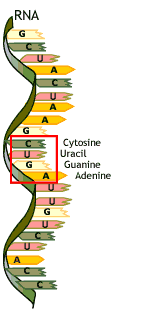
In RNA, Uracil pairs with ______. 
a)
cytosine
b)
adenine
c)
guanine
d)
thymine
39.
The process to go from DNA to mRNA is _______
a)
translation
b)
transcription
c)
replication
40.
Choose the nucleotide sequence of the RNA strand that would be complementary to the following strand: 
GTAGTCA
a)
UATUAGA
b)
ACGACTG
c)
CAUCAGU
d)
CATCAGT
41.
The main function of tRNA is to...
a)
carry a message that, when translated, forms proteins
b)
form a portion of ribosomes
c)
string together complementary RNA and DNA strands
d)
bring amino acids from the cytoplasm to the ribosomes
42.
This is the triplet of bases on the end of a tRNA molecule
a)
Anticodon
b)
Codon
c)
Protein
43.
The process where mRNA is read and made into an amino acid chain.
a)
Transcription
b)
Translation
c)
Transportation
d)
Transient
44.
What process is going on in this photo? 
a)
Transcription 
b)
Translation 
c)
Replication 
d)
All the above 
45.

Which organelle is the location where protein is made?

a)

Ribosome

b)

Nucleus

c)

Cytoplasm

d)

Nucleotide

46.
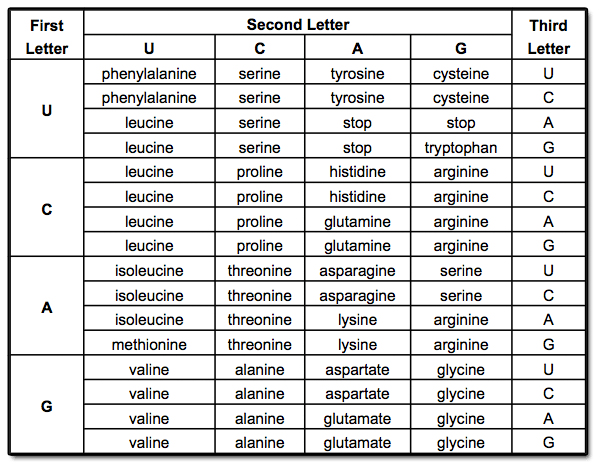
What amino acid is represented by the codon UUA?
a)
Phenylalanine
b)
Tyrosine
c)
Leucine
d)
Stop codon
47.

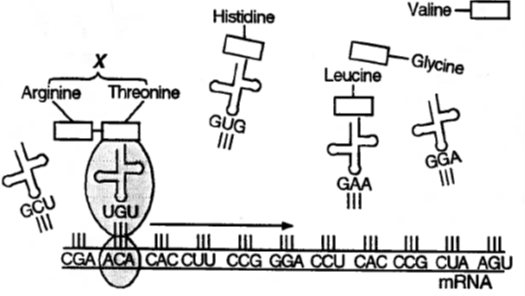
What process is happening in the diagram?

a)

transcription

b)

translation

c)

dna replication

d)

mitosis

48.

How many amino acids will FIFTEEN codons code for?

a)

three

b)

five

c)

fifteen

d)

thrity

49.
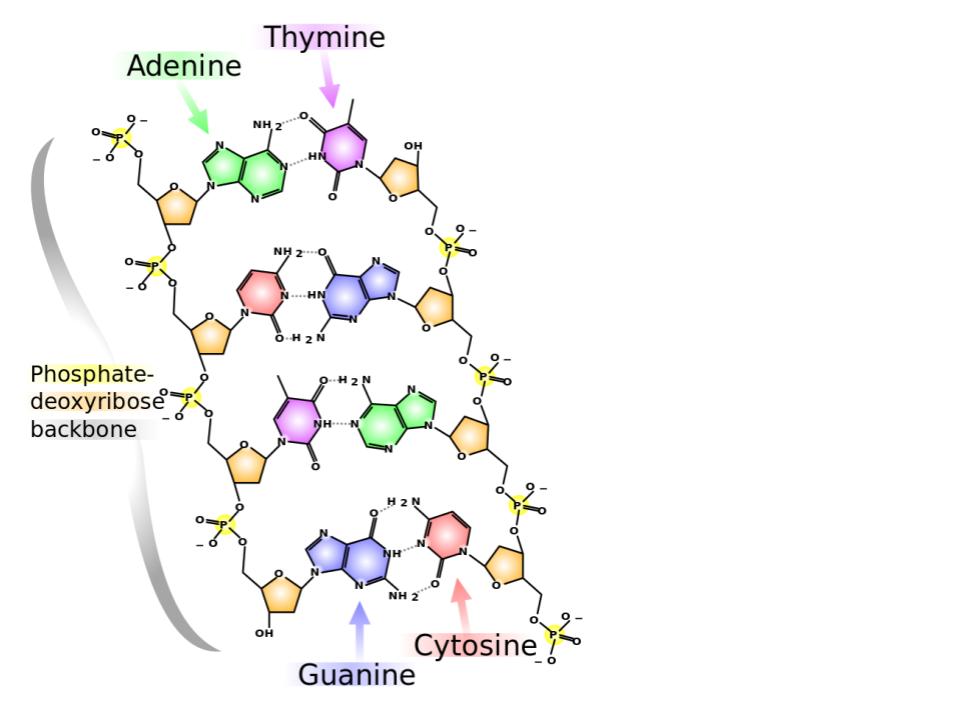
The two strands of DNA are held together by:
a)
Hydrogen Bonds
b)
Phosphodiester Bonds
c)
Glycolsyl Bonds
d)
Glycosidic Linkages
50.

Which of the following is a codon?

a)
b)

ATG

c)

AUG

d)

AUT

51.
What is the relationship between a protein, the cell, and DNA?
a)
DNA is produced by protein which is produced in the cell
b)
Protein is composed of DNA which is produced in the cell
c)
DNA controls the production of protein in the cell
d)
A cell is composed of DNA and protein
52.

When mRNA processing occurs, _____________ are removed and ________________ are spliced together to form the final mRNA molecule

a)

introns; exons

b)

exons; introns

53.

Which of the following shows the steps of translation in proper order from start to finish?

a)

Initiation to Elongation to Termination

b)

Elongation to Initiation to Termination

c)

Termination to Initiation to Elongation

54.

Which of the following is the start codon?

a)

UGA

b)

AUG

c)

GUA

d)

GAU

55.

Which of the following describes the direction the template strand is read?

a)

5' to 3'

b)

3' to 5'

c)

N terminus to C terminus

d)

C terminus to N terminus

56.

Which of the following describes the process of alternative RNA splicing?

a)

Different mRNA molecules are made from different sections of DNA

b)

Different mRNA molecules are made by splicing together different exons from same pre-mRNA

c)

Different mRNA molecules are absorbed from the environment for recombination

d)

Different mRNA molecules are made by splicing together different introns from same pre-mRNA

57.

Which of the following is the function of the poly-A tail?

a)

To protect mRNA from hydrolytic enzymes

b)

To allow for exit from nucleus

c)

To signal for termination of translation

d)

To decrease the length of mRNA molecules

58.

Which of the following describes the difference between a prokaryote mRNA and eukaryote mRNA?

a)

Prokaryotes have longer mRNA strands due to presence of introns

b)

Eukaryotes have longer mRNA strands due to the presence of introns

c)

Prokaryotes modify the mRNA due to the presence of a nuclear envelope

d)

Eukaryotes modify the mRNA due to the absence of a nuclear envelope

59.
The image below shows a polymer of glucose molecules. What type of macromolecule is this?
a)
carbohydrate
b)
protein
c)
lipid
d)
nucleic acid
60.
What type of macromolecule is shown in the image below?
a)
Carbohydrate
b)
Nucleic Acid
c)
Fatty Acid
d)
Protein
61.
An unknown molecule contains a sugar and a phosphate group. It is likely what?
a)
carbohydrate
b)
protein
c)
lipid
d)
nucleic acid
62.
Larger polymers are formed when monomers are joined together by a _______ reaction.
a)
dehydration synthesis
b)
digestion
c)
hydrolysis
d)
redox
63.
What is the monomer of proteins?
a)
monosaccharides
b)
amino acids
c)
phospholipids
d)
nucleotide
64.
What is the ratio carbon:hydrogen:oxygen in carbohydrates?
a)
1:1:1
b)
1:2:1
c)
2:1:1
d)
2:1:2
65.
Which of the macromolecules contain nitrogen?
a)
proteins only
b)
nucleic acids only
c)
proteins and lipids
d)
nucleic acids and proteins
66.
What is the function of fats for living organisms?
a)
short term energy storage
b)
store hereditary information
c)
long term energy storage
d)
catalyze metabolic reactions
67.
Identify the macromolecule in the image below.
a)
carbohydrate
b)
nucleic acid
c)
protein
d)
lipid
68.
How are the subunits of proteins linked together?
a)
ionic bonds
b)
amino acids
c)
monomers
d)
peptide bonds
69.
Which statement about polymers is not true?
a)
polymers consist of more than one type of monomer
b)
polymers are broken down through hydrolysis
c)
polymers are synthesized through dehydration synthesis
d)
All are untrue
70.
The image depicts which level of structure in proteins?
a)
primary
b)
secondary
c)
tertiary
d)
quaternary
71.
Which 4 elements make up most of all living matter?
a)
Carbon, Hydrogen, Nitrogen, Oxygen
b)
Carbon, Oxygen, Sodium, Potassium
c)
Carbon, Hydrogen, Calcium, Nitrogen
d)
Carbon, Oxygen, Nitrogen, Sulfur
72.
Which of the following is NOT involved in capillary action in plants?
a)
Capillary ActXylem (transport tissue)ion
b)
Adhesion
c)
Cohesion
d)
pH
73.
Which kingdoms contain Eukaryotes?
a)
Bacteria and Archaea
b)
Bacteria and Animalia
c)
Fungi and Protista
d)
Archaea and Plantae
74.
When atoms share electrons unequally...
a)
a nonpolar covalent bond is formed.
b)
an ionic bond is formed.
c)
a polar covalent bond is formed.
d)
a hydrogen bond is formed.
75.
Which type of lipid forms the primary structure of the cell membrane?
a)
triglycerides
b)
wax
c)
cholesterol
d)
phospholipid
76.
When water freezes the molecules form a matrix by forming hydrogen bonds and
a)
sinking in water
b)
becomes more dense than water
c)
becomes less dense than water
d)
becoming more tightly packed
77.
If a hydroxyl functional group is present, which of the following is likely to be true?
a)
The compound will dissolve in water.
b)
The compound is hydrophobic.
c)
The compound will not form hydrogen bonds.
d)
The compound is nonpolar.
78.
What is the difference between carbon-12 and carbon-14? (Hint: 12 and 14 are mass #)
a)
The number of protons in the nucleus.
b)
The number of protons and neutrons in the nucleus.
c)
The number of neutrons in the nucleus.
d)
The number of electrons in the orbitals.