
 Worksheets
Unit 2 GMA Review
Total questions: 104
Worksheet time: 2hrs 54mins
What characteristic of phospholipids causes semipermeability of the cell membrane?
They have hydrophobic tails and hydrophilic heads
They are fully hydrophobic
They are polar molecules
They are fully hydrophillic
What is the cell membrane made of?
Carbohydrates and Lipids only
Lipids only
Lipids, Proteins, and Carbohydrates
Lipids and Proteins only
What best describes the head end of a phospholipid?
Hydrophilic
Hydrophobic
Nonpolar
Amphipathic
What term best describes the tail end of a phospholipid?
Amphipathic
Hydrophobic
Polar
Hydrophilic

In the phospholipid bilayer, which region is hydrophilic?
A Only
B Only
Both A and B
Neither A or B
Part A of the cell membrane is composed of which of the following?
Both the heads and the tails of the phospholipid molecules, arranged randomly
Proteins attached to the heads of the phospholipid molecules
The hydrophilic heads of the phospholipid molecules
The hydrophobic tails of the phospholipid molecules
What best describes region B in the pictured phospholipid bilayer?
Nonpolar
Hydrophobic
Amphipathic
Hydrophilic

Which of the following is true of the structures labeled A in the Cell Membrane?
They are membrane proteins
They are phospholipids
They are carbohydrates
They are entirely hydrophobic
Which of the following is true of the structures labeled D in the Cell Membrane?
They are membrane proteins
They are hydrophilic
They are carbohydrates
They are hydrophobic
Which of the following is true of the structures labeled C in the Cell Membrane?
They are nonpolar
They are hydrophilic
They are carbohydrates
They are hydrophobic

In passive transport, substances move across the cell membrane ________ the concentration gradient.
Ahead of
Down
Against
Before
A(n) (a) solution is one with equal concentrations of water inside and outside the cell.
Passive transport requires ATP.
True
False

What are the two types of cell transport?
Passive and Fast
Slow and Active
Fast and Slow
Passive and Active

Which example describes diffusion?
Baking cookies and smelling them throughout the house
Water moving across a semi-permeable membrane
Iodine molecules moving through a plastic bag
All of the above
Which macromolecule is embedded in the cell membrane and aids in facilitated diffusion?
Carbohydrate
Lipid
Protein
Nucleic Acid
What is needed in order for Active transport to happen?
Catalase
Glucose
ATP
Fructose
A(n) (a) solution is a solution in which water leaves the cell and leaves it plasmolyzed.
In active transport, substances cross the cell membrane ______ the concentration gradient.
Ahead of
Along
Against
Before
When a cell forms a vesicle around unwanted particles and expels it OUT of the cell.
Pinocytosis
Receptor-mediated transport
Endocytosis
Exocytosis
A(n) (a) solution is a solution in which water rushes into the cell and makes it cytolyzed.
Osmosis is the movement of _____ across a membrane.
food
oxygen
energy
water
A process in which cells surround and engulf substances that are TOO BIG to enter the cell is known as...
Pinocytosis
Receptor-mediated transport
Endocytosis
Exocytosis
When material passes into and out of a cell at equal rates and there is no difference in concentration between the inside and outside of the cell, the cell is in a state of...
Static equilibrium
Dynamic equilibrium
Absolute equilibrium
Overall equilibrium
__________ "pick up" molecules in low concentration areas and "carry" them to areas of high concentration.
Protein pumps
Endocytosis
Exocytosis
Pinocytosis
Water is attracted to salt.
True
False
The cell membrane can be described as a ______ model.
wave mosaic
fluid mosaic
static mosaic
dynamic mosaic
Something is ___________ ____________when some molecules can cross the membrane while others cannot.
semi regulated
selectively permeable
totally transparent
heavily regulated
How does water move through aquaporins?
It moves with its cohesive properties
The water and the aquaporins share similar pH levels
Water and aquaporins are both non-polar and are attracted to each other
Water and aquaporins are both polar and are attracted to each other
What is it called when molecules move across the cell membrane from an area of high concentration to an area of low concentration through a carrier protein?
Simple diffusion
Facilitated diffusion
osmosis
active transport
Which type of solution makes a cell shrink?
Hypotonic
Hypertonic
Isotonic

What type of transport is shown in the diagram?
Ion pump
Facilitated diffusion
Endocytosis
Exocytosis

What type of transport is shown in the diagram?
Protein pump
Facilitated diffusion
Endocytosis
Exocytosis

What type of transport is shown in the diagram?
diffusion
facilitated diffusion
endocytosis
exocytosis
Which of the following are examples of passive transport? Select multiple answers.
Diffusion
Facilitated diffusion
Endocytosis
Exocytosis
Osmosis

phospholipids
main component of the cell membrane
membrane proteins
allows large molecules to pass through membrane
semipermeable
some substances can go through the cell membrane and some can't
passive transport
does not require ATP; molecules move high to low
active transport
requires ATP; molecules move low to high


Which correctly points to the part of the image that is hydrophobic?
A
B
You are alone on an island in the middle of the Atlantic Ocean. You are hot and thirsty, so you want to drink water from the ocean. You think about biology class and you decide:
to drink the ocean water because the extra salt will quench your thirst.
not to drink the ocean water because the extra salt will cause you to dehydrate.
to drink the ocean water because your cells will burn more fat due to the salt intake.
not to drink the ocean water because the extra salt will cause your cells to burst.

Why has water moved into the cell in the hypotonic solution?
The cell was deflated and needed to be inflated.
The concentration of solvent was higher inside than outside the cell.
The concentration of solute (salt) was higher outside the cell than inside.
The concentration of solute (salt) was higher inside the cell than outside.
Transport of water molecules across a cell membrane allows cells to maintain stable internal conditions in an ever-changing environment. This stable internal condition is called _____.
homeostasis
energy transfer
osmosis
carrying capacity

A red blood cell is placed into a solution. The red blood cell has a lower concentration of protein and sugar than the solution, as shown in the diagram. What is most likely to occur?
Water from the solution will move into the red blood cell.
Water from the red blood cell will move into the solution.
Protein and sugar will move from the solution into the red blood cell.
Protein and sugar will move from the red blood cell into the solution.
Hypertonic
The solution contains a high concentration of solute an and low concentration of water
Hypotonic
The solution contains a low concentration of solute an and high concentration of water
Isotonic
The solution has an equal concentration of solute and water compared to the inside of the cell
Simple Diffusion
When molecules passively cross the plasma membrane through the phospholipid bilayer
Facilitated Diffusion
When molecules passively cross the plasma membrane through a channel protein
Osmosis
The movement of water across the cell membrane
Endocytosis
Bringing in large materials through the cell membrane into a vacuole.
Exocytosis
Moving larger amounts or large quantities of materials through the cell membrane

What is the name of 'D' found on the structure below
Lipid hydrophobic tails
Protein
Lipid bi layer
Phosphate hydrophilic heads

What is the name of 'C' found on the structure below
Phosphate hydrophilic heads
Lipid hydrophobic tails
Lipid bilayer
protein

In which organelle does cellular respiration occur?
nucleus
mitochondria
ribosomes
lysosomes
True/False: Plants do not carry out cellular respiration.
True
False
After cellular respiration is complete, what energy molecule is produced?
ATP
ADP
Glucose
Lactose
What's the chemical formula for glucose?
6C6H12O6
C12H6O12
C6H12O6
CHO

What are the reactants (taken into) of cellular respiration? (Mark all of them!)
oxygen
glucose
carbon dioxide
water
energy

What is the correct equation for cellular respiration?
6O2 + C6H12O6 -> 6CO2 + 6H2O + Energy
6O2 + C6H12O6 + Energy -> 6CO2 + 6H2O
6CO2 + 6H2O -> 6O2 + C6H12O6 + Energy
6CO2 + 6H2O + Energy -> 6O2 + C6H12O6
Which of the following is the correct equation for PHOTOSYNTHESIS?
6CO2 + light + 6H2O --> 6O2 + glucose
6CO2 + sugar + 6H2O --> 6O2 + light
6O2+ light + 6H2O --> 6CO2 + Sugar
6CO2 + 6O2 + 6H2O --> Light + Sugar
What three things are required for photosynthesis?
carbon dioxide, oxygen, water
oxygen, water, sunlight
water, sunlight, glucose
carbon dioxide, water, sunlight
What are the products in photosynthesis?
carbon dioxide
water
glucose
oxygen
Where do plants get their energy for photosynthesis?
Inorganic chemicals in the soil
Carbon DIoxide
Sunlight
Water

What is the name of the green pigment that traps light energy for photosynthesis?
Chlorophyll
Green pigment
Chloroplasts
Mucus
Why do plants appear green?
Chlorophyll absorbs green light
Because they are green
Chlorophyll reflects green light
Because of the water
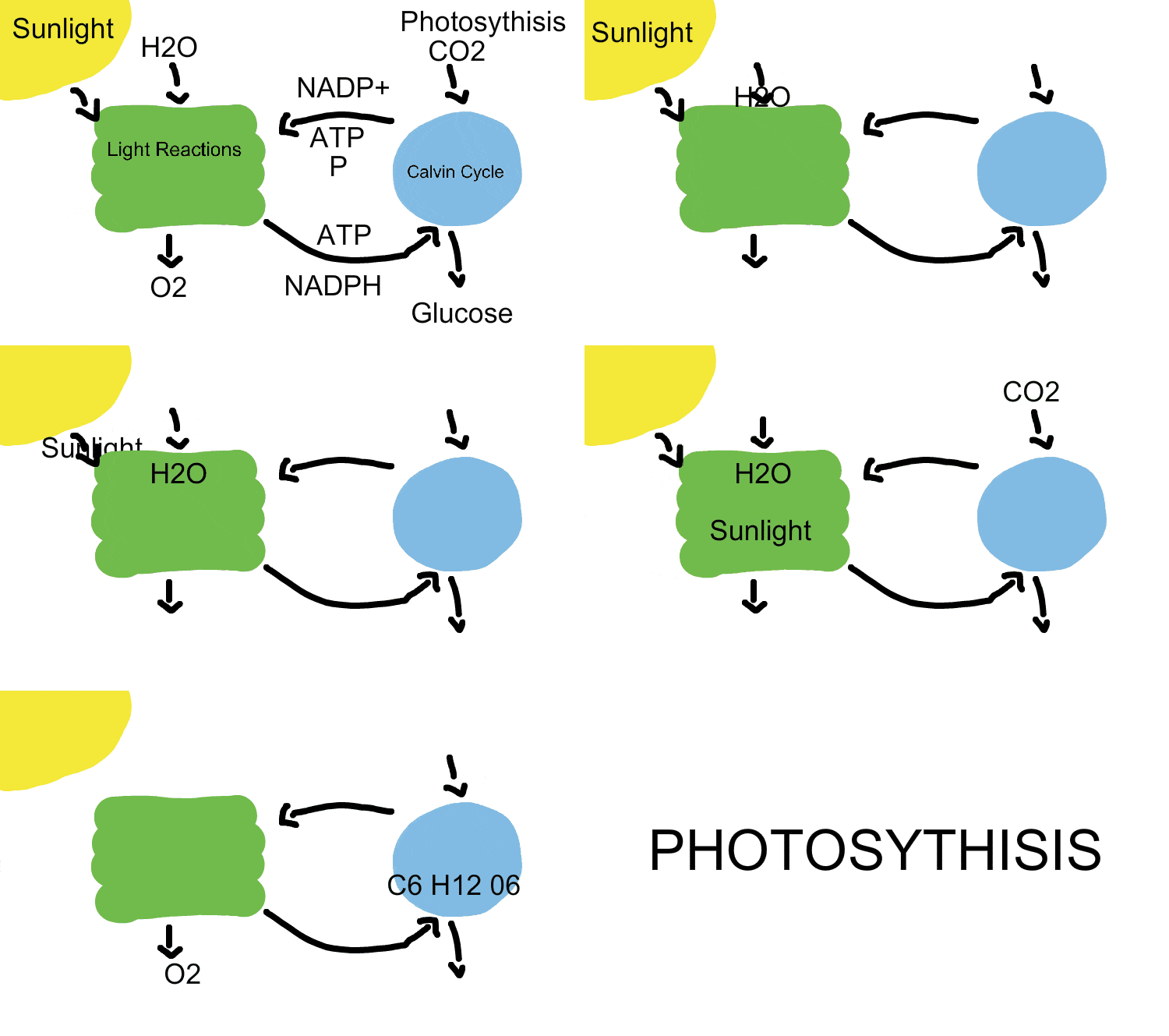

Carbon dioxide enters a plant through the leaves' _____________.
stomata
xylem
phylem
roots
chlorophyll
In what organelle does photosynthesis take place?
Mitochondria
Lysosome
Chloroplast
Chlorophyll

ATP and NADPH are made in the _______________ and used in the _________________
Stroma, Chlorophyll
Calvin cycle, Krebs cycle
dark reactions, light reactions
light dependent reactions, light independent reactions
Where in the chloroplast does the dark reaction/ light-independent reaction/ Calvin Cycle take place?
thylakoids
matrix
stroma
nucleus
In the overall photosynthetic reaction, there are two reactants. Which one is used in the dark reaction/ light-independent reaction/ Calvin Cycle?
water
carbon dioxide
oxygen
glucose
What happens to NADPH and ATP after they are used in the dark reaction/ light-independent reaction/ Calvin Cycle?
They recycle back to the light reactions
They are used up
They diffuse out of the chloroplast
What substance is the source of carbon in photosynthesis?
H20
CO2
C6H12O6
Sunlight
How many glucose molecules are made at a time through the process of photosynthesis?
1
3
6
12
How many carbon dioxide molecules do you need to start the process of photosynthesis?
1
3
6
12



