
 Worksheets
HBS III (Endo/Repro/Immune)
Total questions: 112
Worksheet time: 1hrs 10mins
Cells that ingest pathogens are
antigens
white blood cells
red blood cells
antibodies
White blood cells involved in humoral immunity mature in the___________
bone marrow
spleen
thymus
tonsiles
blood plasma
Something that triggers an immune response is a/n
antibiotic
antigen
antibody
receptor
diseases
vaccines
antibodies
pathogens
antigens

What do antibodies attach to on the pathogen?
Antibiotics
Antigens
Neurotransmitters
Antibodies


Antigens
Antibodies
Histamines
DNA
Allergens

You are a doctor and Little Billy is in your office with the flu. His mother wants you to prescribe an antibiotic. Which would be the best response?
"Absolutely, get that kid an antibiotic!"
"Actually, he just needs to take a painkiller."
"Unfortunately, antibiotics do not work against viruses like the flu."
"Give him a vaccine and he will feel better right away!"
A/an ________ is an injection of a weakened form of a pathogen to help the individual gain immunity from a disease.
Virus
Vacuum
Vaccine
Antibiotic

Which of the following statements are TRUE about vaccinations?
Allow B cells to make antibodies for any type of antigen the body comes in contact with.
Triggers the body to make memory cells for specific pathogens.
They are substances prepared from killed or weakened pathogens.
Always allows the body to resist an infectious disease any time it comes into contact with it.

Which of the following statements is TRUE about someone's immune system that has allergies?
Body cells are dividing at an uncontrolled rate.
The body is reacting to foreign antigens that are not dangerous to most people.
T cells and B cells in the body cannot be activated.
The body is mistaking its own cells for foreign antigens.
What is the term for a strong response to a harmless antigen in the environment?
An allergy
Cell-mediated immunity
An autoimmune disease
Inflammatory response

The proteins found on the surface of RBCs that allow us to type blood as A, B, O or AB are called
antigens
antibodies
aggluntates
Rh factors
Which blood types have Type A antibodies?
Type AB
Type A
Type B
Type O
Destiny has blood type B, what antigens are present?
None
A
B
O
Someone who has Type O blood has what for antibodies?
No antibodies
A antibodies
B antibodies
O antibodies
What causes your body to have an allergic response?
antibody
allergens
wbc
macrophages
__________ immunity is when the body makes its own antibodies.
passive
active
lucid
auto
Which immunity is present at birth and passed from the mother to the baby through milk and the placenta?
Artificial Active Immunity
Natural Active immunity
Natural passive immunity
Artificial passive immunity
immunity in which antibodies are given to a person rather than produced within the person's own body
Artificial Passive Immunity
Natural Passive Immunity
Artificial Active Immunity
Natural Active Immunity
The reproductive system
The respiratory system
The endocrine system
The immune system
The circulatory system
Causes an overproduction of white blood cells that crowd the blood.
leukemia
heart disease
hemophilia
sickle-cell anemia
White blood cells primarily involved in cell-mediated immunity are called...
B-Cells
T-Cells
Macrophages
Phagocytes
Antibodies
Transplant recipients must take ___________ to avoid rejection.
immune system boosters
Antibodies
Antibiotics
Immunosuppressants
Antigens
Which of the following are part of a non-specific, physical, first line of defense
Skin
Cilia
Oil and Sweat Gland Secretions
Antigens
Lysozyme
Which of the following are part of a non-specific, second line of defense?
Inflammatory Response
Interferons
Fever
Antibodies
Antigens
Which of the following are part of a specific defense?
Immune Response
Interferons
Antibiotics
Antibody Production
Antigen Production
What do you take to inhibit the inflammatory response when the trigger is nonpathogenic?
Histamines
Antihistamines
Antibiotics
Immunosuppressants
Tylenol
Why is it important to finish ALL of an antibiotic, even if you feel better?
If all of the infectious bacteria are not killed, the bacteria may continue to multiply. Some of these bacteria may have a mutation that makes them resistant to the antibiotic. This could cause resistant bacteria to spread.
If all of the antibiotic is not used, the surviving bacteria may learn how to fight off the antibiotic, causing the sickness to get even worse.
If all of the antibiotic is not used, the bacteria may begin ingesting your skin cells, causing a new sickness to arise.
If all of the antibiotic is not used, the surviving bacteria may cooperate with other infectious bacteria, resulting in two separate infections at the same time.
Which option correctly outlines the sequence of events once bacteria are exposed to antibiotics?
1. Non-resistant bacteria die.
2. Resistant bacteria exist due to variation.
3. Resistant bacteria survive, replicate and pass resistance to next generation.
1. Resistant bacteria die.
2.Non-resistant bacteria exist due to variation.
3. Non-resistant bacteria survive, replicate and pass resistance to next generation.
1. All bacteria die.
2. The person taking the antibiotic develops resistance to the antibiotic if used again.
Which of the following are issues associated with the use of antibiotics and antibiotic resistance?
Overuse of antibiotics can contribute to antibiotic resistance.
Resistant bacteria can pass 'their resistance' to other bacteria.
There are some bacteria which are resistant to antibiotics currently available.
People themselves can develop resistance to antibiotics
Select the example of something which does not cause antibiotic resistance.
Not finishing a course of antibiotics.
Giving antibiotics to live stock (animals we eat).
Using antibiotics when we don't need them.
Finishing a course of antibiotics.
Endocrine glands secrete __________.
Hormones
Neurotransmitters
A wide range of chemical substances
Glucose
Antibodies
What is the endocrine system?
A system of vessels that circulates blood around the body.
A group of bones and tissue that provides support and structure for the body.
A group of glands that work together with the nervous system to coordinate all body functions
A group of organs that is responsible for eliminating wastes.
What is the main function of the endocrine system?
It creates chemicals, or hormones, that are sent around the body to maintain homeostasis.
It creates electrical messages that are sent around the body to maintain homeostasis.
It maintains the correct level of oxygen in the body to maintain homeostasis.
It releases waste from the body to maintain homeostasis.
The "master gland" is known as the __________________.
thyroid gland.
adrenal gland.
pancreas.
pituitary gland.
hypothalmus
thyroid
testes
ovary
adrenal
parathyroids
The adrenal glands release adrenaline to help the body regulate _________________.
diseases
body temperature.
stress.
hormones.
sexual development
Which of the following are chemicals that travel in the blood and cause changes in different parts of the body?
Hormones
Glands
Parathyroid
Adrenal Gland
Neurotransmitters
The response to stress is called
Stay or Stray Response
Fight or Stay Response
Flee or Stray Response
Fight or Flight Response
Which term refers to the body's use of energy for energy and growth?
Excretion
Metabolism
Digestion
Respiration
Reproduction
Hormone regulation operates mostly under which type of feedback mechanism?
positive feedback
negative feedback
zero feedback
Hormones are not regulated
feedback inhibition
Which hormone lowers blood sugar?
insulin
glucagon
glycogen
liver
thyroxine
Which hormone raises blood sugar?
insulin
glucagon
glycogen
glucose
parathormone
The liver stores excess glucose as ___________
starch
glucagon
glycogen
insulin
Insulin and glucagon are produced by the _______
liver
pancreas
pituitary
thyroid
parathyroids
Insulin and glucagon target the _______
liver
pancreas
pituitary
thyroid
adrenal cortex
The part of the brain that coordinates with the endocrine system is the...
pituitary
hypothalamus
thyroid
pancreas
cerebellum
thyroxine production is inhibited by...
hypocalcemia
hypercalcemia
low iodine levels
high iodine levels
hyperglycemia
When you are hypocalcemic, the _______ will secret _______.
parathyroid; PTH
thyroid; PTH
thyroid; Calcitonin
parathyroid; Calcitonin
thyroid; thyroxine
When you are hypercalcemic, the _______ will secret _______.
parathyroid; PTH
thyroid; PTH
thyroid; Calcitonin
parathyroid; Calcitonin
pancreas; insulin
Calcitonin and PTH target which of the following tissues...
Bones
Kidneys
Small intestine
Parathyroids
Liver
Calcitonin causes the bones to...
Release stored calcium into the blood
Reabsorb calcium from the blood and store it
TSH target which of the following tissues...
Bones
Kidneys
Small intestine
Parathyroids
Thyroid
PTH causes the bones to...
Release stored calcium into the blood
Reabsorb calcium from the blood and store in
PTH causes the small intestine to...
Absorb less calcium
Absorb more calcium
Calcitonin causes the small intestine to...
Absorb less calcium
Absorb more calcium
Calcitonin causes the kidneys to...
Reabsorb less calcium
Reabsorb more calcium
PTH causes the kidneys to...
Reabsorb less calcium
Reabsorb more calcium
Which of the following is a sign of a thyroid disorder?
goiter
tetany
adenoma
hypoglycemia
kidney stones
Which of the following is a potential complication of hyperparathyroidism?
goiter
tetany
adenoma
osteoporosis
kidney stones


Letter J is pointing to
Ovaries
Pineal Gland
Adrenal
Testes

The gland labeled 4 in the diagram is?
the thymus gland
the thyroid gland
the parathyroid glands
the adrenal glands
Cells that have receptors for a particular hormone.
gland cells
neurons
hormones
target cells

This structure releases what hormones?
insulin and glucagon
calcitonin and estrogen
Parathyroid hormone and antidiuretic hormone
epinephrine and testosterone
Which of the following does NOT refer to the product of meiosis?
zygote
gamete
egg cell
sperm cell
Which of the following does NOT refer to a purpose for mitosis?
growth
repair
asexual reproduction
sexual reproduction

cervix
vagina
ovaries
uterus
fallopian tubes
Uterus
Womb
Vaginal opening
Fallopian Tubes
Ovaries
The two hormones that maintain the lining of the uterus are:
FSH and estrogen
LH and estrogen
estrogen
Progesterone and estrogen
Day 4
Day 8
Day 14
Day 28
Day 1
The human male reproductive system is adapted for the production of
sperm and the delivery of these cells for internal fertilization
gametes that transport food to the egg
zygotes and the development of these cells into a fetus
hormones that stimulate placenta formation in the male

A diagram of the human male reproductive system is given. Which structure produces cells that become sperm?
A
B
C
D

Base your answers to questions 10 on
the picture given which represents systems in a
human male and on your knowledge of biology.
Which structure has both reproductive and
excretory functions?
A
G
C
D

The diagram GIVEN represents a human reproductive system. Meiosis occurs within structure
A
B
C
D

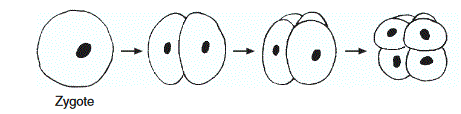
The diagram below represents some stages of early embryonic development. Which process is represented by the arrows in the diagram?
meiosis
Mitosis
Fertilization
Evolution
LH and FSH are produced in the ____ and target the ____.
ovaries, pituitary
pituitary, ovaries
hypothalamus, pituitary
testes, pitutary
pituitary, mammary glands
What is the periodic shedding of tissues and blood from the inner lining of the
uterus?
menopause
ovulation
pregnancy
menstruation
What is considered as the ovulation day for regular menstrual cycle?
1st day
7th day
14th day
28th day
In males, which is the correct pathway of sperms release?
Seminiferous tubules - Vas deferens - Epididymis - Urethra
Vas deferens - Seminiferous tubules - Epididymis - Urethra
Epididymis - Vas deferens - Seminiferous tubules - Urethra
Seminiferous tubules - Epididymis - Vas deferens - Urethra

Identify the structure labeled "B".
Fallopian Tubes
Ovaries
Uterus
Placenta
The entire nervous system arises from the:
Endoderm
Mesoderm
Ectoderm
On what day of the cycle is menstruation?
Day 4
Day 8
Day 14
Day 18
Day 1
Which phase follows ovulation?
menstruation
follicular
luteal
gastrulation
neurulation
Which phase follows menstruation?
menstruation
follicular
luteal
gastrulation
neurulation
Which hormones most directly influence the uterus during pregnancy?
testosterone and insulin
progesterone and testosterone
estrogen and insulin
progesterone and estrogen
The hormones estrogen and progesterone are produced within this structure.
Ovaries
Testes
Uterus
Pituitary
Fallopian Tubes
Which phase most immediately follows implantation?
menstruation
follicular
luteal
gastrulation
neurulation
Which phase includes the development of the brain and spinal cord?
ovulation
follicular
luteal
gastrulation
neurulation
From which embryonic layer do muscle and bone develop?
mesoderm
endoderm
ectoderm
epidermis

