
 Worksheets
Quiz
Total questions: 116
Worksheet time: 8hrs 0mins
Movement across the cell membrane that does not require energy from the cell is called
active transport
passive transport
mass transport
A difference in the concentration of a substance across a space or between two solutions is called
concentration gradient
potential
equilibrium
balance
It is a type of passive transport which involves the movement of substances from a high concentration area to a low concentration area.
effusion
diffusion
concentration gradient
Diffusion is the movement of a substance from an area of low concentration to an area of higher concentration.
True
False
Osmosis is a process that requires energy to transport substances in and out of the cell.
True
False
When molecules are evenly distributed throughout the cell, they are said to be in
concentration gradient
equilibrium
homeostasis
In osmosis, free water molecules move from a higher concentration of solutes to a lower concentration of solutes.
True
False
In a solution, solvent is the substance that does the dissolving and the one present in greater quantity.
True
False
In a solution, the solute is the substance that does the dissolving and the one present in greater quantity.
True
False
This prefix means "higher" than normal.
hypo
hyper
iso
This prefix means "lower" than normal.
hypo
hyper
iso
A solution in which the concentration of dissolved substances is lower than the
concentration inside a cell is
hypotonic
hypertonic
isotonic
A solution in which the concentration of dissolved substances is higher than the
concentration inside a cell is
hypotonic
hypertonic
isotonic
A solution in which the concentration of dissolved substances is equal to that of the
concentration inside a cell is
hypotonic
hypertonic
isotonic

Which side has the higher concentration of glucose?
cell
blood

What kind of solution is shown in the diagram?
hypotonic
hypertonic
isotonic

Which way will water molecules move towards?
into the cell
out of the cell
Neither in or out of the cell.

What will be happen to the size of the cell considering the diagram?
It will shrink.
It will swell.
It will remain the same.
The part of the cell that regulates what enters and exits it.
cell membrane
golgi apparatus
nucleus
mitochondria

Osmosis is specifically.....
diffusion of water molecules through a semi-permeable mebrane from an area of low concentration to an area of high concentration
the diffusion of particles from an area of high concentration to an area of low concentration
diffusion of water molecules through a semi-permeable membrane from an area of high concentration to an area of low concentration
the diffusion of particles from an area of low concentration to an area of high concentration



Nemo and other ocean dwelling fish cannot survive in freshwater because......
freshwater is hypertonic to Nemo's cells and will result in water leaving them causing the cells to shrink
freshwater is hypotonic to Nemo's cells and will result in water leaving them causing the cells to shrink
freshwater is hypertonic to Nemo's cells and will result in water entering them causing the cells to swell and burst
freshwater is hypotonic to Nemo's cells and will result in water enter them causing the cells to swell and burst

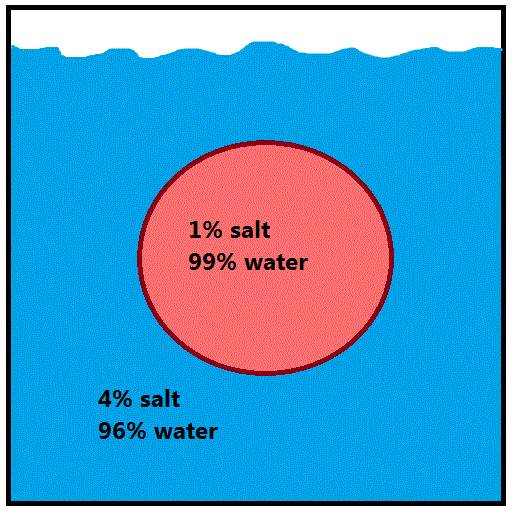
In the cell pictured, which way would water move?
Into the cell, causing the cell to swell
Out of the cell, causing the cell to shrink
In and out of the cell equally, keeping the shape the same

What is the basic structural and functional unit of all living things?
atom
cell
bacteria
animalcules


The 3 parts of the Cell Theory are...?
All living things are composed of cells
Cells are the basic units of structure and function in living things
All cells are produced from other cells
All living things are composed of cells
Cells are the basic units of dance and vibes in living things
All cells are destroyed from other aliens
All living things are composed of Jell-O
Cells are the basic units of structure and function in living things
All cells are produced from factories in Canada
All living things are composed of cells
Cells do karate and practice eating whole pies in their free time
All cells are produced from other cells
What does it mean to say that a cell membrane is semipermeable?
it allows some materials to pass through
it allows nothing to enter the cell, only to leave
It only allows things into the cell and not out
it allows all materials to pass through
What is the function of an organelle?
to take up space
to carry out a specific function in the cell
to carry out all the functions of a cell
to create new cells
What organelle do many ribosomes connect themselves to?
lysosome
mitochondria
endoplasmic reticulum
golgi apparatus
Which organelle uses enzymes to break down waste in a cell?
Lysosome
Ribosome
Chloroplast
Golgi Apparatus
What is the function of the mitochondria?
to capture energy from the sun and turn it to sugar
to release usable energy for the cell
to store energy for when the cell needs it
to remove waste from the cell
What organelle allows plants to create their glucose?
Mitochondira
Lysosome
Ribosome
Chloroplast
Which of the following is not one of the 5 things all cells have?
cell membrane
cytoplasm
DNA
nucleus
What is the difference the key difference between prokaryotic and eukaryotic cells?
Prokaryotes have a nucleus, Eukaryotes do not
Eukaryotes have a nucleus, Prokaryotes do not
Prokaryotes have a cell membrane, Eukaryotes do not
Eukaryotes have ribosomes, Prokaryotes do not
Which of the following organelles do plants have that animals to not? (Select all that apply)
Cell wall
Golgi Apparatus
Endoplasmic Reticulum
Chloroplasts
Ribosomes
Which organelle provides structure and protection to plant cells?
cell membrane
ribosome
golgi apparatus
cell wall
What is the name of the "packages" the golgi body creates?
Vacuoles
Lysosomes
Vesicles
Ribosomes
Which of the following is not part of the nucleus?
Chromatin
Centrioles
Nuclear Envelope
Nuclear Pores
Nucleolus

What type of cell is this?
Plant
Animal
Prokaryote

What type of cell is this?
Plant
Animal
Prokaryote

What type of cell is this?
Plant
Animal
Prokaryote

Name the type of tooth labelled A
(a)

Where in the jaw would you find tooth C?
Very front of the mouth
Back of the jaw
Top row of teeth only
Bottom row of teeth only

What is organ R?
(a)

What is organ L?
(a)

What is organ J?
(a)
Define the term ingestion
The movement of nutrients from the digestive system into the blood
The removal of undigested food from the body
The breaking down of large insoluble molecules into small soluble molecules
The taking in of nutrients.
Define the term digestion
The movement of nutrients from the digestive system into the blood
The removal of undigested food from the body
The breaking down of large insoluble molecules into small soluble molecules
The taking in of nutrients.
What gland produces amylase?
Liver
Gall bladder
Salivary gland
stomach
Define the term mechanical digestion
The breaking down of large food molecules by the use of enzymes.
The physical break down of food done by the teeth or the muscles in the stomach.
What word is used to describe food which has been mixed with saliva.
Chyme
Bolus
Churning
Mucus
What is the pH in the stomach?
pH 1-2
pH 3-4
pH 11-12
ph 13-14
What part of the small intestine does the digestion of nutrients finish?
Ilium
Duodenum
Gall Bladder
Liver
What is absorbed into the blood from the large intestine?
Digested nutrients
Fibre
Water
Chyme
What is the role of bile in digestion?
Emulsifies fat
Kills bacteria
Acidifies stomach acid
Turns food into a bolus
What is the job of pre molars?
help you bite off and chew pieces of food
These teeth are used for tearing and ripping food
These help you crush and grind food
What is the job of the pancreas in digestion?
Produces acid
Produces bile
Produces digestive enzymes
Produces chyme
Where does absorption occur?
Stomach
Duodenum
Ilium
Liver
Which organ releases digestive enzymes into the small intestine?
pancreas
small intestine
esophagus
salivary glands
What organ is responsible for the majority of the absoption that occurs in the digestive system?
large intestine
small intestine
stomach
oral cavity
Which of the following is an accessory organ of the digestive system?
stomach
small intestine
esophagus
liver
Which organ stores and releases bile?
liver
gallbladder
pancreas
Which organ makes bile?
liver
gallbladder
pancreas
What organ is responsible for the absorption of water and movement of waste?
large intestine
small intestine
stomach
oral cavity
What carries food from the pharynx to the stomach?
larynx
trachea
esophagus
bronchioles
What enzyme is found in saliva that starts digesting carbohydrates?
amylase
chyme
pepsin
bile
What are the rhythmic muscular contractions of your esophagus called to help food move along?
swallowing
peristalsis
inertia contractions
paralysis
What does the pancreas do?
produces digestive enzymes to break down proteins and fats
produces sodium bicarbonate to neutralize stomach acid
regulates our blood sugar levels
all answers are correct
1. The term that is used for the mode of nutrition in yeast, mushroom and bread-mould is
(a) autotrophic
(b) insectivorous
(c) saprophytic
(d) parasitic
Which of the following statements is/are correct?
(i) All green plants can prepare their own food.
(ii) Most animals are autotrophs.
(iii) Carbon dioxide is not required for photosynthesis.
(iv) Oxygen is liberated during photosynthesis.
Choose the correct answer from the options below:
(a) (i) and (iv)
(b) (ii) only
(c) (ii) and (iii)
(d) (i) and (ii)
Pitcher plant traps insects because it
(a) is a heterotroph.
(b) grows in soils which lack in nitrogen.
(c) does not have chlorophyll.
(d) has a digestive system like human beings.
Rhizobium is an example of
(a) Symbiosis
(b) Parasites
(c) Insectivorous
(d) none of these
Iodine used to detect presence of starch. It gives starch
(a) red colour
(b) green colour
(c) blue-black colour
(d) colourless appearance

Identify the plant
dodder
venus fly trap
mushroom
pitcher plant
Where in a plant cell does photosynthesis take place
Palisade cells
Chlorophyll
Chloroplasts
Vacuole
Which of these are limiting factors for photosynthesis? Choose 3 answers.
Light intensity
CO2 concentration
Temperature
Light
CO2 levels
Which of these is the correct equation for photosynthesis?
6O2 + C6H12O6 --> 6CO2 + 6H2O
6O2 + 6CO2 --> C6H12O6 + 6H2O
6CO2 + 6H2O --> 6O2 + C6H12O6
6CO2 + 6H2O --> O2 + C6H12O6
A student wanted to see if covering a leaf in foil would stop it from producing starch. Why should the student put the plant in a dark cupboard for 48 hours before returning it to the light and starting the experiment?
To make the results reliable
So that the plant would photosynthesise faster when returned to the light
So that any starch already in the leaf was used up by the plant

Which of the following is not a micro-nutrient used by plants?
Zinc
Copper
Manganese
Potassium

Two organisms are good friends and live together. One provides shelter, water, and nutrients while the other prepares and provides food. Such an association of organisms is termed as
saprophyte
parasite
autotrophs
symbiosis
Which of the following is an enzyme?
lactose
adenosine
protease
phosphate
How do enzymes speed up chemical reactions? Enzymes
lower the activation energy of chemical reactions.
raise the temperature of the cell, speeding chemical reactions.
store ATP, allowing more energy to be used in chemical reactions.
act as miniature "transfer trucks", gathering materials for chemical reactions, and placing them together.

What is the optimum temperature for this enzyme?
20 degrees Celsius
45 degrees Celsius
52 degrees Celsius
64 degrees Celsius
Which suffix (word ending) is used in the names of most enzymes?
-ase
-in
-ine
-ose

What can be inferred using the graph?
Cells can function equally as well at all pH values.
Cells do not function well at pH values that are too high or too low.
Cells function best at high pH values.
Cells function best at low pH values.

In the enzymatic reaction, the __________ is on the left of the arrow, while the products are to the right of the arrow.
enzyme
filtrate
pre-product
reactant
Each enzyme produced by the body is
open - meaning it is able to catalyze a reaction with any molecule.
immature - meaning it cannot catalyze a reaction until many years later.
incomplete - meaning it requires other parts before it is able to bind to a molecule.
specific - meaning it is only able to catalyze a rection with a certain molecule.
Which of the following two factors affect an enzyme's operation the most?
amount of light and temperature
blood glucose and pH
temperature and pH
amount of light and pressure

What substances are formed as a result of this reaction?
hydrogen peroxide and water
water and oxygen
hydrogen peroxide and oxygen
water and ozone

What is the optimum pH for the enzyme salivary amylase?
2
5
6.2
9.1
Enzymes are a type of which macromolecule?
carbohydrate
lipid
protein
nucleic acid
Why are enzymes needed for life?
They speed up all the chemical reactions in living things.
They are the main proteins that make up our body structure.
The provide energy to all living things.
They provide genetic information.
Which would be the enzyme that breaks down the starch amylose?
amylase
maltase
lactase
amylose
What is activation energy?
the energy from the sun
the energy produced by an enzyme
the energy needed to get a reaction going
none of these
What does it mean when an enzyme is denatured?
that there is an acid around
that the enzyme works faster
that it is providing energy for the cell
that the shape is changed of the active site & it no longer works

Which labeled part is the substrate?
letter A
letter B
letter D
letter E

Which labeled part is the enzyme?
letter A
letter B and D
letter D
letter E
Which model describes the active site of the enzyme changing shape slightly to fit the substrate?
'twisted ladder' model
'estimation' model
'induced fit' model
'lock and key' model
Which of the following describes the role that enzymes play in the process of metabolism?
Enzymes carry the genetic instructions required for a cell to initiate metabolism.
Enzymes increase the rate of the chemical reactions carried out during metabolism.
Enzymes provide the chemical energy that is broken down and released during metabolism.
Enzymes store the chemical energy that is used to construct nucleic acids during metabolism.
In the lock-and-key model of enzyme action, the __________ fits into the __________ of the enzyme.
product; substrate
active site; product
substrate; active site
active site; substrate
catalyst =
enzyme used to break down nucleic acids
substance that speeds up the rate of a chemical reaction
minerals that assist in the normal functioning of enzymes
the part of an enzyme where the substrate binds to the enzyme and where the chemical reaction occurs
Where does the substrate bind on an enzyme?
active site
allosteric site
binding site
product site

