wayground logo

Free Printable Worksheets

Font size

S
M
L
XL
Worksheets

Year 10 Revision

Total questions: 107

Worksheet time: 3hrs 1mins

Name
Class
Date
1.

By what process does the water move in to or out of the potato cells?

a)

Active transport

b)

Osmosis

c)

Diffusion

d)

Transpiration

2.

Which of these has the highest water concentration?

a)

0.1M sugar

b)

0.2M sugar

c)

0.3M sugar

d)

0.4M sugar

3.

Why would a potato gain mass?

a)

Water leaves the potato because the concentration of water is higher outside

b)

Water enters the potato because the concentration of water is lower outside

c)

Water leaves the potato because the concentration of water is lower outside

d)

Water enters the potato because the concentration of water is higher outside

4.

Why would a potato lose mass?

a)

Water leaves the potato because the concentration of water is higher outside

b)

Water enters the potato because the concentration of water is lower outside

c)

Water leaves the potato because the concentration of water is lower outside

d)

Water enters the potato because the concentration of water is higher outside

5.

Why do we dab the potatos with a dry paper towel when taking them out of the solution? Choose the best answer.

a)

To remove mass

b)

To remove excess mass

c)

To remove excess water

d)

To dry them

6.

What is the independent variable of this required practical?

a)

Concentration of the solution

b)

Percentage change in mass

c)

Volume of the solution

d)

Time the potato is left in the solution

7.

What is the dependent variable of this required practical?

a)

Concentration of the solution

b)

Percentage change in mass

c)

Volume of the solution

d)

Time the potato is left in the solution

8.

What are the control variables of this required practical?

a)

Concentration of the solution

b)

Percentage change in mass

c)

Volume of the solution

d)

Time the potato is left in the solution

9.

Why do we calculate percentage change instead of just change in mass?

a)

It is quicker

b)

It is more accurate

c)

It takes into account differences in starting mass

10.

How do we describe the cell membrane that the water molecules travel through?

a)

Permeable

b)

Non-permeable

c)

Partially permeable

11.
What is a substance called if it speeds up a chemical reaction?
a)
reusable
b)
catalyst
c)
specific
d)
fragile
12.
Each enzyme only has 1 substrate that will fit its active site.  What is this called?
a)
reusablility
b)
denaturation
c)
specificity
d)
fragility
13.
With what 3 letters do enzymes typically end?
a)
-ose
b)
-ase
c)
-ese
d)
-tic
14.
Any substance that is acted upon by an enzyme is called a(n)?
a)
Coenzyme
b)
Substrate
c)
Vitamin
d)
Polypeptide
15.
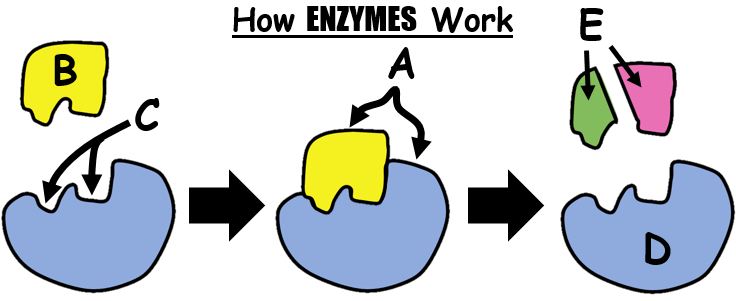
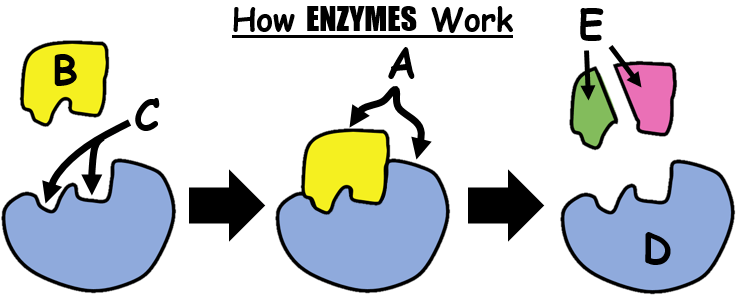
In the diagram, what is letter A? 
a)
product
b)
substrate
c)
enzyme-substrate complex
d)
active site
16.
Enzymes are...
a)
nucleic acids
b)
proteins
c)
lipids
d)
carbohydrates
17.
An enzyme speeds up a chemical reaction in the cell but can only be used once.  True or False? 
a)
true
b)
false
18.
What happens when enzymes are heated to a high temperature?
a)
The enzymes die.
b)
The shapes of the enzyme are altered denature
c)
The enzymes' amino acid sequence changes.
d)
The enzymes remain the same
19.
What is another name for enzymes?
a)
chemical catalysts
b)
microorganisms
c)
biological catalysts
d)
inorganic catalysts
20.
Letter D...
a)
active site
b)
enzyme
c)
substrate
d)
products
21.
Where do substrates bind on an enzyme?
a)
voltage-gated channels
b)
surface receptor
c)
calcium channels
d)
active site
22.
What is structure A?
a)
Substrate
b)
Active site
c)
Enzyme
d)
Products
23.
What is structure D?
a)
Substrate
b)
Active site
c)
Enzyme
d)
Products
24.
Which of the following conclusions can be drawn from this graph?
a)
The optimum pH of the enzyme is 6.6.
b)
The optimum pH of the enzyme is 5.8
c)
The enzyme’s activity increases as pH increases 5.0 to 9.0
d)
The enzyme’s activity is greater around pH of 8.0 .
25.

Which 2 factors can affect the rate of enzyme activity?

a)

Light intensity

b)

Temperature

c)

pH

d)

Oxygen concentration

26.
What is structure E, F, G?
a)
Substrate
b)
Active site
c)
Enzyme
d)
Products
27.

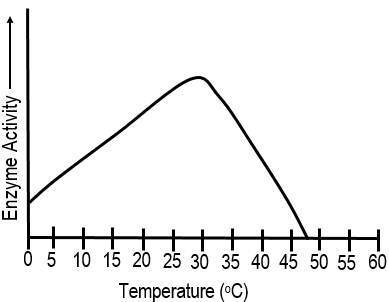
Based on the graph, what temperature does this enzyme work best?

a)

15 C

b)

40 C

c)

30 C

d)

50 C

28.

What happens when enzymes are heated to a high temperature?

a)

The enzymes die

b)

The shape of the enzyme changes as it denatures

c)

The enzymes become more active

d)

The enzymes remain the same

29.

Which of the following denatures an enzyme?

a)

High Temperatures

b)

Incorrect pH

c)

Both

30.
Each enzyme only has 1 substrate that will fit its active site.  What is this called?
a)
reusable
b)
catalyst
c)
specificity 
d)
fragile
31.

Hydrocarbons, the simplest family of carbon compounds, are made from these two elements:

a)

Hydrogen and Copper

b)

Helium and Carbon

c)

Hydrogen and Carbon

32.
How many carbon atoms are in methane?
a)
1
b)
2
c)
3
d)
4
33.
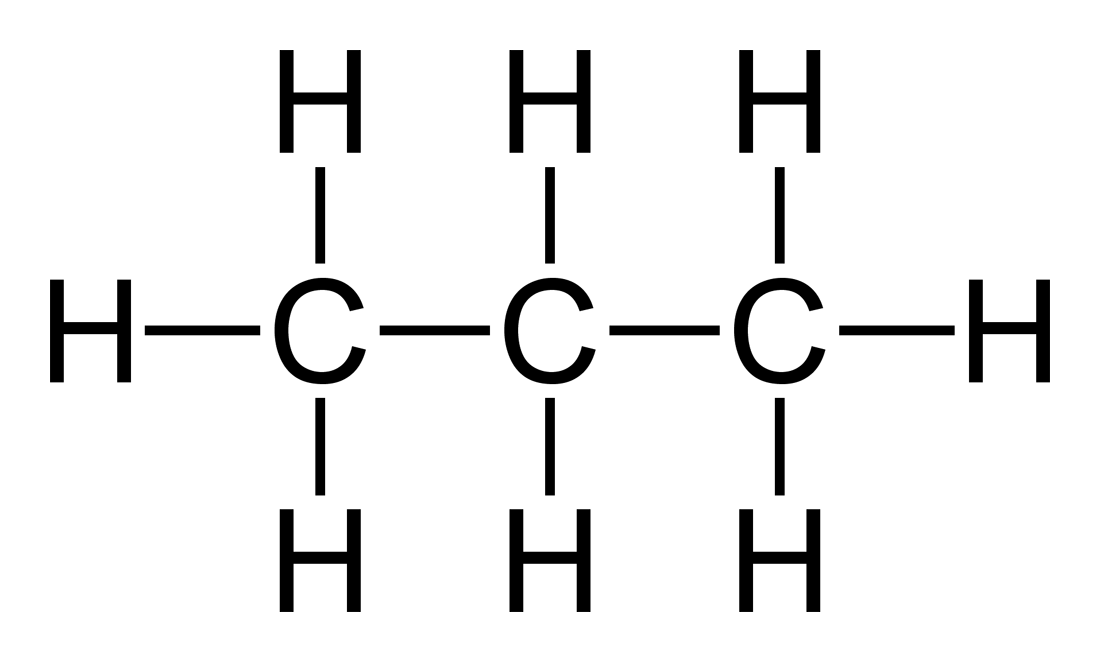
Name this alkane
a)
Methane
b)
Ethane
c)
Propane
d)
Butane
34.
Name this alkane
a)
Methane
b)
Ethane
c)
Propane
d)
Butane
35.
What is electrolysis?
a)
breaking down of a compound using a current
b)
making a compound using a current
36.
What kind of Electrical Current does Electroysis require?
a)
Direct
b)
Indirect
c)
Anternative
d)
A alternating
37.
Which statement correctly describes the 2 electrodes?
a)
The anode is negative and the cathode is positive
b)
The anode and cathode are both positive
c)
The anode is positive and the cathode is negative
d)
The anode and cathode are both negative.
38.
What is the name given to the solution that is being electrolysed?
a)
Salt solution
b)
Electric solution
c)
Mineral solution
d)
Electrolyte
39.
Explain why the electrolyte has to be a liquid.
a)
So the ions can move
b)
So the electrons can move
c)
So that it doesn't get too hot
d)
So the fish are ok
40.
What happens at the positive electrode?
a)
Positive non-metal ions are attracted
b)
Positive metal ions are attracted
c)
Negative non-metal ions are attracted
d)
Negative metal ions are attracted
41.
Positive ions (cations) will move towards the cathode (-) where they will discharge by....
a)
Breaking apart
b)
Losing electrons
c)
Clumping together.
d)
Gaining electrons
42.
What does the Cathode (-) do to ions?
a)
Give electrons to the Positive ions to turn them back into atoms
b)
Take electrons from the positive ions?
c)
Turn ions back into atoms by removing electrons
d)
Turn atoms into ions by adding electrons
43.
Describe oxidation in terms of electrons
a)
oxidation is gain of electrons
b)
oxidation is loss of electrons
44.
Describe reduction in terms of electrons
a)
reduction is gain of electrons
b)
reduction is loss of electrons
45.

Using your periodic Table, calculate the formula mass of N2.

Answer:

(a)  

46.

Using your periodic Table, calculate the formula mass of CH4.

Answer:

(a)  

47.

Using your periodic Table, calculate the formula mass of CaCO3.

Answer:

(a)  

48.

Using your periodic Table, calculate the formula mass of NH3.

Answer:

(a)  

49.

Using your periodic Table, calculate the formula mass of Fe2O3.

Answer:

(a)  
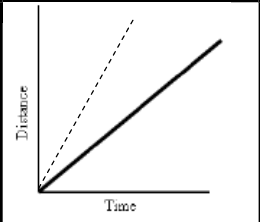
50.
What does this graph represent?
a)
Constant Speed
b)
Acceleration
c)
Not moving
51.
What does this graph represent?
a)
Constant speed
b)
Acceleration
c)
Not moving
52.

Match the description to the graph:

"The car is stopped."

a)
b)
c)
53.

Match the description to the graph:

"The car is traveling at a constant speed."

a)
b)
c)
54.

Match the description to the graph:

"The car is coming back."

a)
b)
c)
d)
55.

Segment A-B The bus is _________________.

a)

at rest

b)

returning (to original position)

c)

moving forward

56.

Segment C-D The bus is _________________.

a)

at rest

b)

returning (to original position)

c)

moving forward

57.

Which of the graphs shows that one of runners started in the same place?

a)
b)
58.

In which of the following graphs below did one runner overtake (run past) the other?

a)
b)
c)
d)
59.

Match the description to the graph:

"The car is slowing down."

a)
b)
c)
d)
60.
What two measurements are necessary for calculating speed?
a)
Mass and time
b)
Temperature and mass
c)
Mass and distance
d)
Distance and time
61.
A measurement of how fast an object is moving
a)
Velocity
b)
Speed
c)
Vector
d)
Acceleration
62.
Can be measured in meters (m)
a)
Distance
b)
Time
c)
Speed
d)
Acceleration
63.

Describe the motion in the graph:

a)

Constant Speed (positive slope)

b)

Stopped (at rest)

c)

Acceleration (increasing speed)

d)

Return Home (negative slope)

64.

Describe the motion in the graph:

a)

Constant Speed (positive slope)

b)

Stopped (at rest)

c)

Acceleration (increasing speed)

d)

Return Home (negative slope)

65.

A measurement of how fast an object is moving with direction

a)

Velocity

b)

Speed

c)

Vector

d)

Acceleration

66.
The graph shows Ashley riding her bike to Maria's house. 
What was occurring from point B to point C?
a)
She was increasing her speed.
b)
She stopped for 4 minutes
c)
She was decreasing in speed
67.

Which of these graphs do not show the object staying still?

a)
b)
c)
d)
68.

Which is faster?

a)

walking

b)

skating

c)

biking

69.

Which scene matches the graph?

a)

Jonathon walked to his girlfriends house - stayed a while then walked home

b)

Justice rode her bike to the mall

c)

Yeshua walked home from school

70.
A series circuit has ____ path(s) that the electric current can take. 
a)
One
b)
Two 
c)
Three 
d)
Four
71.
this is the symbol for a _____?
a)
switch
b)
light 
c)
battery
d)
wires
72.
In a parallel circuit, if one connection is broken, all of the connections stop working.
a)
True
b)
False
73.

What is this symbol?

a)

Ammeter

b)

Wire

c)

Bulb

d)

Voltmeter

74.
What kind of circuit is this?
a)
Series
b)
Consecutive
c)
Parallel
d)
Training
75.
When you flip a light switch on and off you are closing and opening a circuit.
a)
true
b)
false
76.
What is a Parallel circuit? 
a)
Has only one path 
b)
Has more than one path 
c)
Allows energy to travel through easily 
d)
Has only one light bulb
77.

What is this symbol?

a)

Closed Switch

b)

Resistor

c)

Cell

d)

Battery

78.

1. Which switch or switches must be closed to make the lamps light?

a)

Only switch a

b)

Only switch b

c)

Switches a and b

d)

Switches a , b and c

79.

What is this symbol?

a)

Wire

b)

Bulb

c)

Buzzer

d)

Ammeter

80.

If L2 is unscrewed from its holder, what will happen to L1?

a)

It will stay lit

b)

It will go out

c)

It will get dimmer

d)

It will disappear

81.

What is this Symbol?

a)

Motor

b)

Voltmeter

c)

Ammeter

d)

Buzzer

82.

Is this a Series or Parallel Circuit?

a)

Series

b)

Parallel

83.

Current is...

a)

how fast the electrons are moving

b)

the flow of electrical charge

c)

the power source

d)

the amount of energy gained/lost across two points

84.

Voltage is...

a)

the power

b)

the flow of electrical charge

c)

the amount of energy gained or lost across two points

d)

what opposes the flow of current

85.

Every circuit MUST have...

a)

A Power Source, Energy User and a Switch

b)

An Energy User, Switch and a Conducting Pathway

c)

A Power Source, Conducting Pathway and a Bulb

d)

A Power Source, Conducting Pathway and an Energy User

86.

In a Series Circuit the Current...

a)

is the same at every point

b)

is shared between the energy users

87.

In a Series circuit the Voltage is...

a)

the same at every point

b)

split between the energy users

88.

In a Parallel circuit the current is

a)

the same at every point

b)

split between the branches

89.

In a parallel circuit the voltage...

a)

remains the same

b)

is shared between the branches

90.
A magnet will pick up a nail, but not a penny because the nail
a)
has rust on it.
b)
is lighter than the penny.
c)
has a sharp point.
d)
contains iron.
91.
Which is NOT a use of magnets?
a)
Generating electricity
b)
Holding cabinet doors closed
c)
Sorting paper from plastic
d)
Storing information on computer hard drives.
92.
The magnet's shown will
a)
not move
b)
attract
c)
repel
d)
all of the above
93.
The magnet's shown will
a)
not move
b)
attract
c)
repel
d)
all of the above
94.
Magnets attract things made of
a)
copper
b)
iron
c)
wood
d)
plastic
95.
All magnets have 2
a)
fields
b)
colors
c)
poles
d)
all of the above
96.
The two poles on a magnet are
a)
north and east
b)
north and west
c)
south and north
d)
south and west
97.
What do the lines around this magnet represent?
a)
North Pole
b)
South Pole
c)
Magnetic Declination
d)
Magnetic Field
98.

The Earth has a magnetic field.

a)

True

b)

False

99.
Earth acts like a giant magnet because its center is made up MOSTLY of
a)
granite
b)
limestone
c)
iron
d)
nickel
100.
Why does a compass needle point north?
a)
The compass is a bar magnet
b)
Because north is up
c)
Because it's magic
d)
It lines up with the Earth's magnetic field
101.
The force of magnetism is stronger when magnets are ________________
a)
cold
b)
round
c)
closer together
d)
farther apart
102.
Magnetism is generated by moving
a)
protons.
b)
electrons.
c)
neutrons.
d)
elements.
103.
What kind of magnet can be turned on and off?
a)
refridgerator magnet
b)
electromagnet
c)
magnetite
d)
iron
104.
The strongest part of a magnet is...
a)
the bars.
b)
the force field.
c)
the poles. 
d)
the middle.
105.
Iron and steel can become _____.
a)
magnetized
b)
transformed into plastics
c)
lined up to the poles
d)
part of the equator
106.
A simple electromagnet can be made with which of the following?
a)
an electric current
b)
a turbine and nail
c)
a nail, a wire, and a battery
d)
a compass and a battery
107.
What will happen when these magnets are brought close together?
a)
They will attract each other.
b)
They will repel each other.
c)
Both magnets will turn to the left
d)
Both magnets will turn to the right