
NEW
Font size
 Worksheets
3T Biology Final Review 3rd Tri
Total questions: 60
Worksheet time: 30mins
Which of the following is a nucleotide found in DNA?
adenine + phosphate group + thymine
cytosine + phosphate group + guanine
deoxyribose + phosphate group + polymerase
deoxyribose + phosphate group + cytosine
Which of the following best describes Rosalind Franklin’s contribution to our understanding of the structure of DNA?
She created many models of DNA based on what was known about its properties, and eventually figured out that the structure of DNA is a double helix.
She purified large amounts of DNA, stretched the fibers so the strands were parallel, stretched the fibers so the strands were parallel, and used an X-ray beam to produce an image of the molecule.
She isolated DNA from many different organisms, and discovered that in every sample, the amount of guanine was almost exactly equal to the amount of cytosine.
She used radioactive phosphorus and sulfur to produce radioactive viruses, then allowed these viruses to infect bacteria. She found that DNA was the transforming material.
Rosalind Franklin contributed to the understanding of DNA by
producing images of DNA molecules using X-rays.
figuring out that DNA strands form a double helix.
conducting experiments that showed which nucleotides are complementary.
finding that DNA was nucleic acid made up of a long chain of individual nucleotides.
Which of the following statements correctly describes Chargaff’s contribution to the study of DNA?
Chargaff hypothesized that DNA was a double helix,, but he did not produce the image that proved this fact.
Chargaff’s experiments conclusively proved that DNA was made of nucleotides, but he could not show that there are four types of nitrogenous bases.
Chargaff showed that adenine and thymine were found in equal percentages in DNA, but he did not know this was because of base-pairing.
Chargaff’s work proved that DNA could be made using radioactive nucleotides, but he did not show that DNA could be transferred from one organism to another.
Which scientist(s) figured out that the shape of a DNA molecule is a double helix?
Hershey and Chase
Griffith
Watson and Crick
Franklin
Which of the following forms a base pair with thymine?
Deoxyribose
Adenine
Guanine
Cytosine
Watson and Crick discovered the two strands in DNA
run in perpendicular directions.
run in the same direction.
run in opposite directions.
run in random directions.
DNA replication results in two DNA molecules,
each with two new strands..
one with two new strands and the other with two original strands.
each with one new strand and one original strand.
each with two original strands.
During DNA replication, a DNA strand that has the bases CTAGGT produces a strand with the bases
TCGAAC.
GATCCA.
AGCTTG.
GAUCCA.
In eukaryotes, DNA
is located in the nucleus.
floats freely in the cytoplasm.
is located in the ribosomes.
is circular.
In both prokaryotes and eukaryotes, how many copies of the chromosome are left after replication?
1
2
3
4
RNA contains the sugar
ribose
deoxyribose
glucose
lactose
Unlike DNA, RNA contains
adenine.
uracil
phosphate groups
thymine
Which of the following is true?
RNA is usually single stranded.
DNA is usually single stranded.
DNA contains uracil.
RNA contains thymine.
From which molecules are mRNA molecules transcribed?
tRNA
rRNA
DNA
proteins
What is produced during transcription?
RNA molecules
DNA molecules
RNA polymerase
Proteins
How many nucleotides are needed to specify three amino acids?
3
6
9
12
What happens during translation?
Messenger RNA is made from a DNA code.
The cell uses a messenger RNA code to make proteins.
Transfer RNA is made from a messenger RNA code.
Copies of DNA molecules are made.
A protein is being assembled when
DNA is being translated.
RNA is being transcribed.
RNA is being translated.
DNA is being transcribed.
Which is the correct sequence of the transfer of information in most organisms?
protein to DNA to RNA
RNA to DNA to protein
DNA to RNA to protein
RNA to protein to DNA
When a chromosome undergoes a deletion mutation, information is
repeated
lost
reversed
transferred
Most mutations
have no effect on an organism.
are fatal to an organism.
are helpful to an organism.
are harmful to an organism.
Human females produce egg cells that have
one X chromosome.
two X chromosomes.
one X or one Y chromosome.
one X and one Y chromosome.
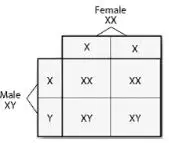
According to Figure 14-1, what is the approximate probability that a human offspring will be female?
10%
25%
50%
75%
What percentage of human sperm cells carry an X chromosome?
0%
25%
50%
100%
A human female inherits
two copies of every gene located on the X chromosome.
twice as many sex chromosomes as a human male inherits.
one copy of every gene located on the Y chromosome.
all of the same genes that a human male inherits.
How many chromosomes are shown in a normal human karyotype?
2
23
44
46
Sex-linked genes are located on
the autosomal chromosomes.
the X chromosome only.
the Y chromosome only.
both the X chromosome and the Y chromosome.
Human males have
one X chromosome ONLY.
two X chromosomes.
one X and one Y chromosome.
two Y chromosomes.
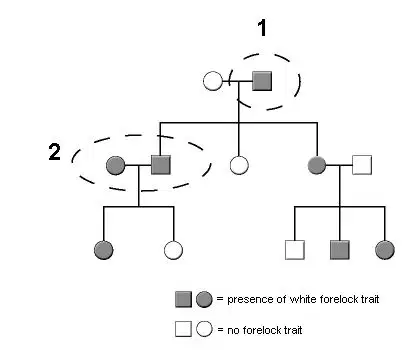
Examine the pedigree in Figure 14-3. The allele for the presence of a white forelock is dominant. What is the probability of the couple labeled 2 of having offspring with a white forelock?
25%
50%
75%
100%
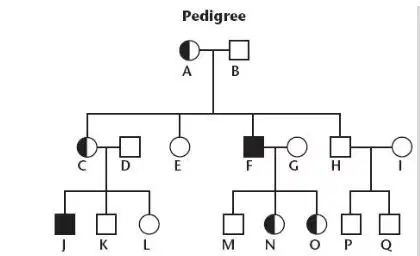
In a pedigree, such as the one in Figure 14-4, a circle represents a (an)
male
female
child
adult
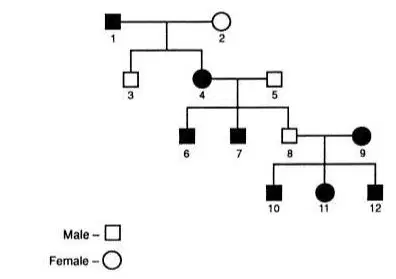
The trait in pedigree in Figure 14-5 has two alleles: P (dominant) and p (recessive). The black symbols show the dominant phenotype, and the white symbols show the recessive phenotype. What is the genotype of individual #1?
PP
Pp
P
p
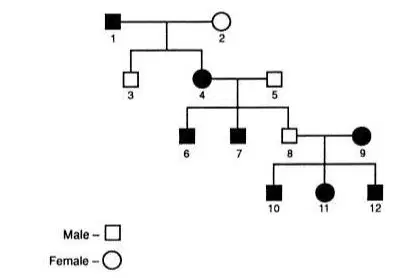
How many generations are shown in the pedigree in Figure 14-5?
2
4
6
8
If the allele for having a white forelock is dominant, family members WITHOUT a white forelock are
homozygous recessive.
heterozygous.
homozygous dominant
trisomal.
The failure of chromosomes to separate during meiosis is called
nondisjunction.
X-chromosome inactivation.
Turner’s syndrome.
Down syndrome.
Because the X chromosome contains genes that are vital for normal development, no baby has been born
with one X chromosome.
with three X chromosomes
without an X chromosome.
with four X chromosomes.
Darwin noticed that many organisms seemed well suited to
being preserved as fossils.
providing humans with food.
surviving in the environments in which they lived.
swimming from South America to the Galapagos Islands.
The species of finches that Charles Darwin found on different Galapagos Islands varied in certain structural adaptations. One of the most significant adaptations that Darwin noted was the
similarities of the birds’ embryos.
birds’ different-shaped beaks.
length of the birds’ necks.
number of eggs in each bird’s nest.
Based on the adaptations Charles Darwin observed in finches and tortoises in the Galapagos, he wondered
if species living on different islands had once been members of the same species.
if finches and tortoises had originated from the same ancestral species.
if all birds on the different islands were finches.
why all tortoises on the different islands were identical.
Biologists in Darwin’s time had already begun to understand that living things change over time. How did Darwin contribute to these ideas?
He found many fossils that showed that these changes could not possibly happen on islands.
He figured out and explained how these changes happened and supported his ideas with evidence
He made guesses about how these changes happened, and wrote experiments that could be used to test these guesses.
He was the first person to truly believe that these changes happened, and he worked very hard to convince others.
Charles Darwin’s observation that finches of different species on the Galapagos Islands have many similar physical characteristics supports the hypothesis that these finches
have the ability to interbreed.
acquired traits through use and disuse.
all eat the same type of food.
descended from a common ancestor.
On the Galapagos Islands, Charles Darwin observed
completely unrelated species on each of the islands.
species exactly like those found in South America.
species similar to mainland South American species.
species completely unrelated to those found in South America.
Which of the following ideas is supported by Darwin’s observation of local variation among tortoises in the Galapagos Islands?
artificial selection
adaptation
acquired characteristics
tendency towards perfection.
James Hutton’s and Charles Lyell’s work suggests that
Earth is several million years old.
Earth is several thousand years old.
all fossils were formed in the last 1000 years.
Artificial selection is the basis for evolution.
Which is a major concept included in Lamark’s evolutionary hypothesis?
Change is the result of survival of the fittest.
Body structures can change according to the actions of the organism.
A small population size decreases the rate of evolution.
Artificial selection is the basis for evolution.
Darwin realized that the economist Malthus’s theory of population control
applied only to humans.
could be generalized to any population of organisms.
could be generalized only when populations lived in crowded conditions.
explained why the number of deaths exceeded that of births.
When a dairy farmer chooses to breed the cows that give the most milk in the herd, the farmers are following the principle of
acquired characteristics.
descent with modification.
artificial selection.
natural selection.
When a farmer breeds only his or her best livestock, the process involved is
natural selection
artificial selection
artificial variation
survival of the fittest.
According to Darwin’s theory of natural selection, individuals who survive are the ones best adapted for their environment. Their survival is due to the
possession of adaptations developed through use.
possession of inherited adaptations that maximize fitness.
lack of competition within the species.
choices made by plant and animal breeders.
Charles Darwin called the ability of an organism to survive and reproduce in its specific environment
diversity
fitness
adaptation
evolution
According to Darwin’s theory of natural selection, the individuals that tend to survive are those that have
characteristics their parents acquired through use and disuse.
characteristics that plants and animal breeders value.
the greatest number of offspring.
variations best suited to environmental conditions.
Which of the following phrases best describes the results of natural selection?
The natural variation found in all populations.
Unrelated species living in different locations.
Changes in the inherited characteristics of a population over time.
The struggle for existence is undergone by all living things.
Which statement is part of Darwin’s theory of evolution by natural selection?
More offspring are produced than can possibly survive.
The organisms that are the fittest are always largest and strongest.
The number of offspring is not related to fitness.
Acquired characteristics that are inherited are the cause of evolution.
The principle of common descent helps explain why
well-adapted species have many offspring.
conditions in an organism’s environment ensures the organism’s survival.
birds and reptiles share a number of inherited characteristics.
tigers are so different from cheetahs.
The hypothesis that all species are descended from common ancestors was proposed by
James Hutton.
Jean-Baptiste Lamark.
Thomas Malthus.
Charles Darwin.
The number and location of bones of many fossil vertebrates are similar to those in living vertebrates. This is evidence in support of which of the following concepts?
Lamark’s tendency toward perfection
Common descent
Analogous structures
The inheritance of acquired traits.
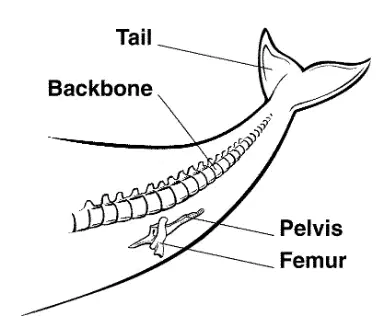
In humans, the pelvis and femur, or thigh bone, are involved in walking. In whales, the pelvis and femur shown in Figure 16-1 are
examples of fossils.
vestigial structures.
acquired traits.
examples of natural variation.
What type of bond holds the base pairs together?
hydrogen
ionic
covalent
polar covalent
According to the base pair rules, which answer shows the correct pairings of the nitrogen bases?
adenine = guanine, thymine = cytosine (A=G, T=C)
thymine = guanine, adenine = cytosine (T=G, A=C)
phosphorus = adenine, cytosine = guanine (P=A, C=G)
adenine = thymine, cytosine = guanine (A=T, C= G)
What are the tips of the DNA molecule called?
telomeres
chromosomes
chromatin
histones

