
 Worksheets
Quarter 4 Exam Review
Total questions: 107
Worksheet time: 1hrs 2mins
Some Antelope are faster then others. When lions prey on a herd of antelopes, slower antelope are most likely to be killed. Which part of Darwin’s concept of natural selection might best be used to describe this situation?
Species have variations in their traits
Species struggle to survive
Some Individuals have an advantage to survive because of their traits
Individuals that survive have the ability to reproduce
All light grey moths will survive
Which statement is true about evolution?
Individual organisms can evolve during a single lifespan.
Darwin proposed the idea that populations can change over time and branch into new species
Humans evolved from chimpanzees
Traits acquired within ones lifetime can be genetically passed to the next generations
For natural selection to impact evolution, which condition is not required?
Struggle to survive
Reproduction and inheritance of traits
genetic variation within a population
each population occupies its own niche
What was the change in the environment for the finches?
Drought
Fire
Pollution
Diseases
What was the change in the environment for the moths?
Drought
Fire
Pollution
Diseases
Carrying Capacity is
The number of individuals that a habitat can support
The number of individuals that die from natural selection
The number of individuals that are born from natural selection
The about of weight you can carry
Which statement is true about variation?
Environmental variation is what trait you can see
Genetic variation is advantageous
Environmental variation is acquired during your life
Traits are either fully genetic or fully environmental
Which statement would Darwin and Lamarck Agree on?
Traits are developed
Natural variation exists
There is a struggle to survive
everyone ends up with the advantageous trait
What was the struggle for the bacteria to survive?
Viruses
Medicine
Predators
Starvation
People who get their wisdom teeth removed have a better chance of avoiding deadly tooth infections. Why is it that having no wisdom teeth is not being affected by natural selection?
It is not genetic
There is no struggle to survive
the trait does not give an advantage
There is not reproduction
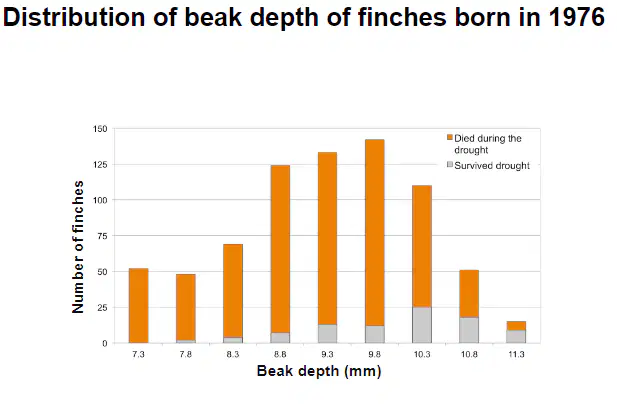
What is the main take-away of this graph?
all small beaked finches died during the drought
Many birds died during the drought
Large beaked finches were more likely to survive
Distribution of beak depth of finches
When the trees in England were covered in soot...
Speckled moths had an advantage to survive
Dark moths had an advantage survive
Dark moths had an advantage to reproduce
Speckled moths had an advantage to reproduce
Why is it important to always complete an antibiotic medication? What happens if you stop early?
It can cause new mutations to appear
the infection will not go away
only the strongest bacteria are left to reproduce again
It can make the bacteria become stronger
What happens before mitosis begins/during interphase
DNA is replicated
Chromosomes line up in the middle
Sister chromatids separate
The nucleus dissolves away
Chromosomes line up in the center of the cell during
Phophase
Metaphase
Anaphase
Telophase
Chromosomes separate to opposite sides of the cell during
Phophase
Metaphase
Anaphase
Telophase
Homologous chromosomes have genes for the same traits (hair color) but are not identical
True
False
What is the end result of Meiosis
2 identical daughter cells
4 identical daughter cells
4 unique haploid cells
4 unique diploid cells
How does Mitosis differ from Meiosis
Mitosis makes gametes, while meiosis makes identical cells
Meiosis makes haploid cells, mitosis makes diploid cells
Mitosis requires DNA replication while Meiosis does not
Mitosis makes gametes and meiosis makes Zygotes
What is it called when genes exchange between homologues chromosomes during meiosis?
fertilization
cytokinesis
crossing over
nondisjunction
Nondisjunction is when you have an abnormal number of chromosomes
True
False
If a diploid cell has 62 chromosomes, how many chromosomes will be in the gamete cell?
62
1
124
31
What is the purpose of crossing over
to fix chromosomes
to duplicate chromosomes
to make chromosomes pretty colors
to increase genetic diversity
Nondisjunction is when
An extra chromosome develops in a zygote
Chromosomes fail to separate during meiosis
a cell rapidly divides in mitosis
two sperm cells fertilize one egg cell
The process of a sperm and egg cell fusing is
Mitosis
Meiosis
Fertilization
Nondisjunction
Which of these is NOT a purpose of Mitosis?
Sexual Reproduction
Growth
Repair
Replacement
Has two cell divisions
Mitosis
Meiosis
Both
Neither
Homologous Chromosomes...
Are identical
are connected
are the same length
come from the same parent
makes diploid cells
Mitosis
Meiosis
Both
Neither
Sister Chromatids...
Are connected
are different lengths
come from different parents
do crossing over
Which chromosomes do crossing over?
Homologous Chromosomes
Sister Chromatids
X and Y chromosomes
Any chromosome in the same cell
Meiosis produces
Haploid Cells
Gametes
Zygotes
Diploid cells

Genotype refers to the ...
physical expression of the genes
the combination of alleles in a gene
whether an allele is dominant or recessive
how an organism will appear

An organism that has the same alleles for a trait(TT or tt)
An organism that has different alleles for a trait (Tt)
If a trait Cannot skip generations, then it must be
dominant
recessive
X-linked
Homozygous
If a trait primarily effects males, then the gene must be on a
Sister chromosome
X chromosome
chromosome 11
mitochondria
A Heterozygous and a Homozygous recessive person have kids, what percent % of their offspring will be Heterozygous?
0%
25%
50%
75%
If two heterozygous people have kids, what percent % of their offspring will be Homozygous Dominant?
0%
25%
50%
75%
If you cross a Heterozygote with a Homozygote recessive, what genotypes will you get?
50% 11
50% 12
50% 12
50% 22
100% 12
25% 11
50% 12
25% 22
If type AA and type AB have kids, what could their kids genotypes be?
AA
AB
AO
BO
OO
A gene for a disease is X-linked recessive. If a son had the disease, which parent gave him the allele with the disease?
Mom
Dad
Both Mom and Dad

What pedigree pattern is shown here?
Complete Dominant
Complete Recessive
X-Linked Recessive
Co Dominant
Incomplete Dominant

What pedigree pattern is shown here?
Complete Dominant
Complete Recessive
X-Linked Recessive
Co Dominant
Incomplete Dominant
A typical biological female cell will have which sex chromosomes
XX
XY
YY
YX
When drawing a pedigree what should you NOT do
have children below parents
draw females as circles
Shade in affected individuals
Connect siblings with horizontal lines
B Antibodies attack
A Antigens
B Antigens
Rh Antigens
A Antibodies
An albino (recessive trait) women has kids with a Homozygous dominant man, what is the probability of an albino child?
100%
50%
25%
0%
ATG TGA CAG
Which organelle is the location where protein is made?
Ribosome
Nucleus
Cytoplasm
Nucleotide
Where are chromosomes located inside the cell?
The ribosome
The nucleus
The nuclear membrane
The cell wall
What is the nucleic acid that stores and transmits the genetic information from one generation to another?
DNA
RNA
mRNA
tRNA
What is a monomer of nucleic acids made of 3 parts, a 5-carbon sugar, a phosphate group and a nitogenous base
DNA
Nucleotide
Deoxyribose
RNA
What are the "messengers" from DNA to the rest of the cell?
Nucleotides
Ribose
DNA
mRNA
What RNA would bond to the following RNA sequence:
AUG GCG UCA
URC CGC RGU
CAC CGC AUA
TAC CGC AGT
UAC CGC AGU
This molecule reads the messenger RNA and adds corresponding amino acids
DNA
Protein
tRNA
rRNA
If a mutation causes a stop codon, then it is a _______ Mutation
Frameshift
Missense
Nonsense
Silent
If a mutation causes a single amino acid to change, then it is a _______ Mutation
Frameshift
Missense
Nonsense
Silent
If a codon changes from CGG to CGA, what type of mutation is that?
Frameshift
Missense
Nonsense
Silent
If a mutation happens and all amino acids after are changed, then it is most likely a _________ mutation
Frameshift
Missense
Nonsense
Silent
DNA is directly involved in the process of
Transcription
Translation
Both
Neither
mRNA is directly involved in the process of
Transcription
Translation
Both
Neither
tRNA is directly involved in the process of
Transcription
Translation
Both
Neither
rRNA is directly involved in the process of
Transcription
Translation
Both
Neither
If my mRNA strand is AGG-CUA-CGG, what would my tRNA strand be?
AGG-CUA-CGG
TCC-GAT-GCC
UCC-GAU-GCC
AGG-CTA-GCC
What amino acid would I get from the codon
TTA
Leu
Phe
Asn
Stop
What amino acid would I get from the DNA codon
AGG
Stop
Arg
Thr
Tyr

The picture below shows an enzyme unwinding and unzipping DNA.
What is the name of this enzyme?
Helicase
Ligase
DNA polyermase
Exonuclease
Which enzyme is responsible for adding the new nucleotides
Helicase
Ligase
DNA polyermase
Exonuclease
Which is the first step of DNA Replication?
Helicase unwinds original DNA strand
Primase lays down RNA primer
DNA polymerase builds new strands of DNA
Ligase knits together fragments
Which is the second step of DNA Replication?
Helicase unwinds original DNA strand
Primase lays down RNA primer f
DNA polymerase builds new strands of DNA
Ligase knits together fragments
Which is the third step of DNA Replication?
Exonuclease removes RNA primers and DNA polymerase fills the spaces with DNA
RNA Primase lays down RNA primer
DNA polymerase builds new strands of DNA
Ligase knits together fragments
Which is the fourth step of DNA Replication?
Exonuclease removes RNA primers and DNA polymerase fills the spaces with DNA, and Ligase fills the gaps
Enzymes proofread the DNA of base errors
DNA polymerase builds new strands by bring in new nucleotide bases.
Primase Builds RNA primers
What is the purpose of DNA replication?
To make identical copies of DNA for new cells
To make new genetic variation in the DNA
To make proteins
To replace old DNA in the cell
What is the job of the Ribosome?
To help make DNA
To help make RNA
To help make protein
to help replicate DNA
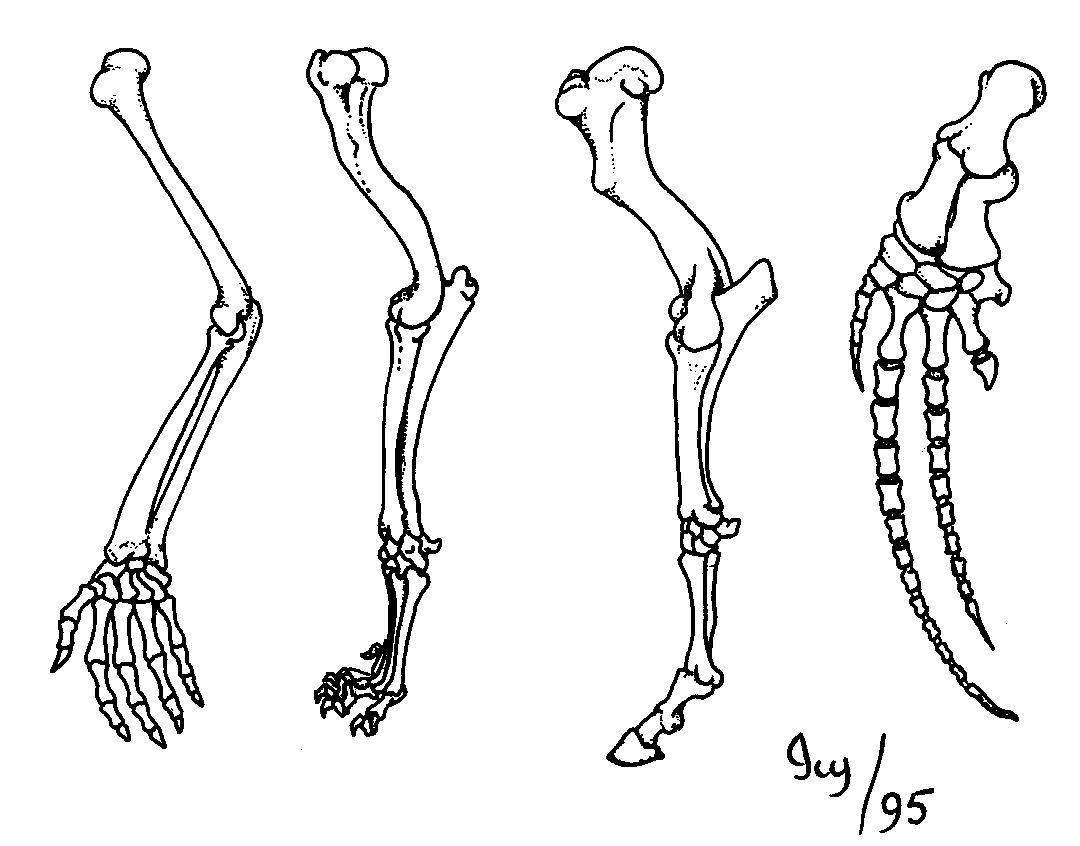

Vestigial structures
structures that perform a similar function but are not similar in origin
remnants of once-important structures that have slowly lost all or most of their function
features found in different organisms that share structural similarities but may have very different functions
preserved remains of an organism

A species is...
a group of organisms that look alike
a group that you can breed together
a group that can reproduce and have fertile offspring
a group that lives in the same location
Marine life and invertebrates dominated the planet during the
Paleozoic
Mesozoic
Cenozoic
Triazoic
Dinosaurs dominated the planet during the
Paleozoic
Mesozoic
Cenozoic
Triazoic
Mammals and birds dominated the planet during the
Paleozoic
Mesozoic
Cenozoic
Triazoic
What is LUCA?
The first living thing
The ancestor of humans
the most recent ancestor to all living things
the process of evolution
Which of these is NOT a potential cause of speciation
Breeding a hybrid
Different locations
Different mating styles
Gamete DNA/Protein too different

Which group of animals on this tree are most closely related to birds?
Saurischian dinosaurs
Ornithischian dinosaurs
Crocodiles
None of these are related to birds
Carbon has a half life of about 5700 years. If I have a sample that only have 25% of the carbon left, how old is it?
5700
11,400
17,100
22,800
If there are only 3 males left in a species, we would consider them to be
Complete Extinct
Extinct in the Wild
Functionally Extinct
Subspecies Extinction
If the only individuals of a species are in a zoo, we would consider that to be
Complete Extinct
Extinct in the Wild
Functionally Extinct
Subspecies Extinction
The T-rex would be considered
Complete Extinct
Extinct in the Wild
Functionally Extinct
Subspecies Extinction
If the West African elephants were to go extinct, but the South African elephants still existed, we would consider that to be
Complete Extinct
Extinct in the Wild
Functionally Extinct
Subspecies Extinction
What is a Mass Extinction?
When all life dies on earth
when about 20% of life goes extinct in a given time
When about 5% of life goes extinct in a give time
When an environment gets destroyed and all the species there die out

What number is the common ancestor of C and D
1
2
3
4

From the picture above, What do The salamander, lizard, pigeon, mouse, and chimp share in common?
Jaws
Claws/nails
Lungs
Feathers

