
 Worksheets
Review DNA structure
Total questions: 110
Worksheet time: 1hrs 3mins

DNA is an acronym for _____
Diphosphorus Nucleic Acid
Ribose Nucleic Acid
Deoxyribonucleic Acid
Deoxyribonucleic Acetate

A nucleotide is composed of
A phosphate, sugar and nitrogenous base
A protein, protein and Guanine
A phosphate, Adenine, and nitrogenous base
A protein, Adenine and nitrogenous base

Which of the following is a base pair?
Adenine - Cytosine
Cytosine - Thymine
Deoxyribose - Cytosine
Cytosine - Guanine
Adenine pairs with
Thymine
Thyme
Guanine
Glutamine
The backbone of DNA is made of
base pairs
sugars and phosphates
only sugars
only phosphates
The two strands of DNA are held together with
covalent bonds
hydrogen bonds
nothing
One function of DNA is to
code for proteins
code for lipids
code for carbohydrates

The building blocks of DNA are called ______________?
Nuclei
Nucleotides
Proteins
Carbohydrates

DNA is found within the _____________ of a cell.
mitochondria
nucleus
endoplasmic reticulum
vacuole
DNA is arranged into a ________- _________ shape.
double-helix
single-helix
diamond
circular
True or False: DNA contains the genetic blueprint for life.
True
False

Primary functions of DNA are (mark all that apply)
Transmit information on heredity from one generation to the next
Control cellular respiration
Regulate homeostasis
Provide a blueprint for making proteins
DNA is an acronym for _____
Diphosphorus Nucleic Acid
Ribose Nucleic Acid
Deoxyribonucleic Acid
Deoxyribonucleic Acetate
A nucleotide is composed of
A phosphate, sugar and nitrogenous base
A protein, protein and Guanine
A phosphate, Adenine, and nitrogenous base
A protein, Adenine and nitrogenous base
Which of the following is a base pair?
Adenine - Cytosine
Cytosine - Thymine
Deoxyribose - Cytosine
Cytosine - Guanine
Adenine pairs with
Thymine
Thyme
Guanine
Glutamine
The backbone of DNA is made of
base pairs
sugars and phosphates
only sugars
only phosphates
The two strands of DNA are held together with
covalent bonds
hydrogen bonds
nothing
One function of DNA is to
code for proteins
code for lipids
code for carbohydrates
The building blocks of DNA are called ______________?
Nuclei
Nucleotides
Proteins
Carbohydrates
DNA is found within the _____________ of a cell.
mitochondria
nucleus
endoplasmic reticulum
vacuole
DNA is arranged into a ________- _________ shape.
double-helix
single-helix
diamond
circular
True or False: DNA contains the genetic blueprint for life.
True
False
Primary functions of DNA are (mark all that apply)
Transmit information on heredity from one generation to the next
Control cellular respiration
Regulate homeostasis
Provide a blueprint for making proteins
DNA is an acronym for _____
Diphosphorus Nucleic Acid
Ribose Nucleic Acid
Deoxyribonucleic Acid
Deoxyribonucleic Acetate
A nucleotide is composed of
A phosphate, sugar and nitrogenous base
A protein, protein and Guanine
A phosphate, Adenine, and nitrogenous base
A protein, Adenine and nitrogenous base
Which of the following is a base pair?
Adenine - Cytosine
Cytosine - Thymine
Deoxyribose - Cytosine
Cytosine - Guanine
Adenine pairs with
Thymine
Thyme
Guanine
Glutamine
The backbone of DNA is made of
base pairs
sugars and phosphates
only sugars
only phosphates
The two strands of DNA are held together with
covalent bonds
hydrogen bonds
nothing
One function of DNA is to
code for proteins
code for lipids
code for carbohydrates
The building blocks of DNA are called ______________?
Nuclei
Nucleotides
Proteins
Carbohydrates
DNA is found within the _____________ of a cell.
mitochondria
nucleus
endoplasmic reticulum
vacuole
DNA is arranged into a ________- _________ shape.
double-helix
single-helix
diamond
circular
True or False: DNA contains the genetic blueprint for life.
True
False
Primary functions of DNA are (mark all that apply)
Transmit information on heredity from one generation to the next
Control cellular respiration
Regulate homeostasis
Provide a blueprint for making proteins
DNA is an acronym for _____
Diphosphorus Nucleic Acid
Ribose Nucleic Acid
Deoxyribonucleic Acid
Deoxyribonucleic Acetate
A nucleotide is composed of
A phosphate, sugar and nitrogenous base
A protein, protein and Guanine
A phosphate, Adenine, and nitrogenous base
A protein, Adenine and nitrogenous base
Which of the following is a base pair?
Adenine - Cytosine
Cytosine - Thymine
Deoxyribose - Cytosine
Cytosine - Guanine
Adenine pairs with
Thymine
Thyme
Guanine
Glutamine
The backbone of DNA is made of
base pairs
sugars and phosphates
only sugars
only phosphates
The two strands of DNA are held together with
covalent bonds
hydrogen bonds
nothing
One function of DNA is to
code for proteins
code for lipids
code for carbohydrates
The building blocks of DNA are called ______________?
Nuclei
Nucleotides
Proteins
Carbohydrates
DNA is found within the _____________ of a cell.
mitochondria
nucleus
endoplasmic reticulum
vacuole
DNA is arranged into a ________- _________ shape.
double-helix
single-helix
diamond
circular
True or False: DNA contains the genetic blueprint for life.
True
False
Primary functions of DNA are (mark all that apply)
Transmit information on heredity from one generation to the next
Control cellular respiration
Regulate homeostasis
Provide a blueprint for making proteins
DNA is an acronym for _____
Diphosphorus Nucleic Acid
Ribose Nucleic Acid
Deoxyribonucleic Acid
Deoxyribonucleic Acetate
A nucleotide is composed of
A phosphate, sugar and nitrogenous base
A protein, protein and Guanine
A phosphate, Adenine, and nitrogenous base
A protein, Adenine and nitrogenous base
Which of the following is a base pair?
Adenine - Cytosine
Cytosine - Thymine
Deoxyribose - Cytosine
Cytosine - Guanine
Adenine pairs with
Thymine
Thyme
Guanine
Glutamine
The backbone of DNA is made of
base pairs
sugars and phosphates
only sugars
only phosphates
The two strands of DNA are held together with
covalent bonds
hydrogen bonds
nothing
One function of DNA is to
code for proteins
code for lipids
code for carbohydrates
The building blocks of DNA are called ______________?
Nuclei
Nucleotides
Proteins
Carbohydrates
DNA is found within the _____________ of a cell.
mitochondria
nucleus
endoplasmic reticulum
vacuole
DNA is arranged into a ________- _________ shape.
double-helix
single-helix
diamond
circular
True or False: DNA contains the genetic blueprint for life.
True
False
Primary functions of DNA are (mark all that apply)
Transmit information on heredity from one generation to the next
Control cellular respiration
Regulate homeostasis
Provide a blueprint for making proteins
What does DNA stand for?
Deoxyribonucleic acid
Doublenucleic acid
Do Not Assess
Deribonucleic acid
What is the importance of DNA?
It does nothing
It looks cool
It is the genetic code for life
It does some stuff
How many different nucleotides are found in our DNA?
3
4
5
6
When the two strands of our DNA combine, only certain nucleotides/nitrogenous bases can combine. Adenine pairs with (a) , and Guanine pairs with (b)
What is the name of the rule that tells which nucleotides/nitrogenous bases can pair up?
Avery's Rule
Griffith's Rule
Franklin's Rule
Chargaff's Rule
Which famous scientist used x-rays to capture the first photograph of DNA?
Erwin Chargaff
Rosalind Franklin
Watson and Crick
Charles Avery
If we were to pick apart a piece of DNA, what type of chemical bond would be found WITHIN a strand of that DNA?
Covalent bond
Hydrogen Bond
Ionic Bond
van der Waals forces
If we were able to zoom in on a piece of DNA, what type of chemical bond would be seen BETWEEN the strands of DNA?
Covalent bond
Hydrogen bond
Ionic bond
van der Waals forces
What TWO parts of the nucleotide make up the backbone of the DNA strand?
Phosphate
Nitrogenous base
Hydrogen bonds
5-Carbon Sugar
Who are the two scientists that created the first accepted model of DNA?
Watson and Crick
Holmes and Watson
Rosalind Franklin
Avery and McCleod

What is "A"?
Nucleotide
Deoxyribose Sugar
Nitrogenous base
Phosphate
What is "B"?
Nucleotide
Deoxyribose Sugar
Nitrogenous base
Phosphate
What is "C"?
Nucleotide
Deoxyribose Sugar
Nitrogenous base
Phosphate
What is the molecule in the image?
Nucleotide
Deoxyribose Sugar
Nitrogenous base
Phosphate
What is the complimentary sequence of the following sequence:
GATCAG
TGACAT
GACATG
CTAGTC
CGACTA

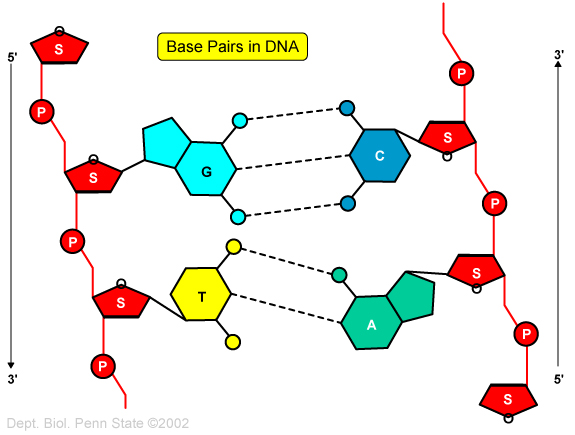
What do the dotted lines between the nitrogenous bases (A,T,C,G) represent in the image provided?
Covalent bonds
Ionic bonds
Peptide bonds
Hydrogen bonds
What determines the specific traits in an organism?
The number of carbons in the DNA molecule.
The number of hydrogen bonds that hold the strands of DNA together.
The sequence of nucleotide bases in the DNA molecule.
The sequence of phosphates along each DNA strand.
DNA is an acronym for _____
Diphosphorus Nucleic Acid
Ribose Nucleic Acid
Deoxyribonucleic Acid
Deoxyribonucleic Acetate
Which of the following is a base pair?
Adenine - Cytosine
Cytosine - Thymine
Deoxyribose - Cytosine
Cytosine - Guanine


What makes up the SIDES of a DNA ladder?
nitrogen bases
sugars & phosphates
genes & chromosomes
RNA

What makes up the rungs (steps) of a DNA ladder?
sugars & phosphates
nitrogen bases
sugars
genes & chromosomes
What three parts make up 1 nucleotide?
Phosphate
Sugar
Nitrogen containing base
Lipid
If the left side of DNA contains the following bases: ATCGATCG, what would the right side contain?
CGATCGAT
TAGGTAGG
TAGCTAGC
ATCGATCG
What is the end result of DNA replication?
2 semi-conservative strands of DNA
1 semi-conservative strand of DNA
Half of a semi-conservative strand.
Nothing is created

Look at the image of DNA, what do the circles represent?
Sugars
Phosphates
Bases
Covalent Bonds

Look at the image of DNA, what do the pentagons represent?
Sugar
Phosphate
Nitrogen Containing Base
Covalent bond
A always pairs with _____ and C always pairs with _____
T, G
G, T
C, A
A, C
ATG TGA CAG
Which enzyme is responsible for unzipping or the DNA molecule when replication begins?
Helicase
DNA breakase
Primase
DNA polymerase
Which enzyme is responsible for gluing together the Okasaki fragment on the lagging strand during DNA replication?
Ligase
Helicase
Amaylase
DNA polymerase
Where does the DNA molecule unzip at during DNA replication?
Between the sugar and phosphate
Between the sugar and nitrogen bases
Between the nitrogen bases


AATCATGGA

