wayground logo

Free Printable Worksheets

Font size

S
M
L
XL
Worksheets

Biology final exam- practice

Total questions: 108

Worksheet time: 2hrs 26mins

Name
Class
Date
1.

Cells that contain a nucleus and other membrane bound organelles are called:

a)

Prokaryotic

b)

Eukaryotic

c)

Simple

d)

Bacteria

2.

Eukaryotic cells all have MITOCHONDRIA. What is the function?

a)

To create proteins for the cell

b)

To clean out cell waste

c)

To generate energy from glucose

d)

To store DNA

3.

What cell part is responsible for the conversion of sunlight and water into glucose (photosynthesis)?

a)

Lysosome

b)

Central Vacuole

c)

Endoplasmic Reticulum

d)

Chloroplast

4.

Select all cell organelles that are found ONLY in plant cells.

a)

Cell Wall

b)

Central Vacuole

c)

Cell Membrane

d)

Chloroplast

e)

Golgi Apparatus

5.

What makes up a nucleotide?

a)

Sugar

b)

Polymer

c)

Nitrogen Base

d)

Polypeptide

e)

Phosphate

6.

Which nitrogen base pairs up with Thymine in a DNA molecule?

a)

Guanine

b)

Adenine

c)

Cytosine

d)

Adrenaline

7.

What is the complementary strand of the DNA sequence ATA GCC AGC AAG? (Include spaces)

(a)  

8.

Which nitrogen base in found only in mRNA?

a)

Thymine

b)

Lysine

c)

Uracil

d)

Cytosine

9.

RNA and DNA are both made up of building blocks called...

a)

Cells

b)

Proteins

c)

Nucleotides

d)

Atoms

10.

All organism in a food chain will eventually return to environment by the action of ____?

a)

top carnivores

b)

producers

c)

decomposers

d)

secondary consumers

11.

The amount of energy expected to be transferred from one trophic level to another is ___?

a)

1%

b)

10%

c)

90%

d)

100%

12.

When organ systems work together, they form another level of organization called a/an _____?

a)

cell

b)

tissue

c)

organ

d)

organism

13.

The process by which RNA is made from DNA

a)

transcription

b)

translation

c)

replication

d)

synthesis

14.

The process by which DNA makes a copy of itself is called

a)

transcription

b)

translation

c)

replication

d)

synthesis

15.

A trait is____________.

a)

a characteristic that is recessive

b)

a characteristic that is always visible

c)

a characteristic that is inherited

d)

a characteristic that is dominant

16.

A gene is_______________________.

a)

located only in sex cells

b)

a whole chromosome

c)

a section of DNA that codes for a trai

d)

not expressed in the dominant form

17.

To be useful in science, a hypothesis must be

a)

proven true

b)

testable

c)

observable

d)

correct

18.
Which type of variable is chosen and controlled by the scientists?
a)
dependent
b)
independent
19.
Which word below properly describes cell membranes?
a)
impermeable
b)
permeable
c)
semi-permeable
20.
Where does mitosis begin?
a)
nucleus
b)
ribosomes
c)
cytoplasm
d)
cell membrane
21.
Scientifically, what causes cancer?
a)
exposure to chemicals
b)
poor diet
c)
genetics
d)
uncontrollable cell growth
22.
Which subunits make up the structure of all proteins?
a)
glucose
b)
amino acids
c)
carbohydrates
d)
fatty acids
23.
What is the function of nucleic acids?
a)
store genetic information
b)
store energy (long-term)
c)
store energy (short-term)
d)
build skin, hair, nails, muscles
24.
Unlike eukaryotes, prokaryotes do not have:
a)
DNA
b)
cytoplasm
c)
cell walls
d)
a membrane bound nucleus
25.
During what phase of the cell cycle is DNA replicated?
a)
G1 phase
b)
S phase
c)
G2 phase
d)
M phase
26.
Put the following stages of mitosis in order: anaphase, prophase, metaphase, and telophase. 
a)
prophase, metaphase, telophase, anaphase
b)
prophase, anaphase, metaphase, telophase
c)
prophase, metaphase, anaphase, telophase
d)
prophase, telophase, metaphase, anaphase
27.
Put the following stages of the cell cycle in order: G2, S, G1, M. 
a)
G1, S, G2, M
b)
S, G1, G2, M
c)
G1, M, G2, S
d)
M, G1, S, G2
28.
a)

Cytokinesis

b)

Interphase

c)

Anaphase

d)

Metaphase

29.

The process where the better adapted organisms survive to pass traits along to offspring.

a)

Evolution

b)

Natural Selection

c)

Extinction

d)

Artifical Selection

30.

Why are advantageous traits more likely to be passed onto offspring?

a)

Because they are more likely to survive and reproduce.

b)

Because they come from dominant genes.

c)

Because they come from recessive genes.

d)

Because the trait is an acquired trait.

31.
When every organism of a species has died.
a)
Evolution
b)
Natural Selection
c)
Extinction
d)
Artificial Selection
32.
The differences among a species, like different bird beaks, are called
a)
genes.
b)
variations.
c)
traits.
d)
theories.
33.
Which of the following is the correct equation for PHOTOSYNTHESIS?
a)
CO+ light + H2O --> O+ Sugar
b)
CO+ sugar + H2O --> O+ light
c)
O2 + light + H2O --> CO+ Sugar
d)
CO+ O2 + H2O --> Light+ Sugar
34.
What is the ultimate ORIGINAL source of energy for living things
a)
Sugar
b)
Sun
c)
Moon
d)
Carbon Dioxide
35.
What is the correct equation for cellular respiration?
a)
6O2 + C6H12O6 -> 6CO2 + 6H2O + Energy
b)
6O2 + C6H12O6 + Energy -> 6CO2 + 6H2O
c)
6CO2 + 6H2O -> 6O2 + C6H12O6 + Energy
d)
6CO2 + 6H2O + Energy -> 6O2 + C6H12O6
36.
Cellular Respiration's goal is to
a)
make water
b)
make ATP
c)
make glucose
d)
make  oxygen
37.

Organisms that rely on other organisms for food are called

a)

producers

b)

autotrophs

c)

consumers

d)

saprophytes

38.
What is the functions of lipids?
a)
Quick source of energy
b)
Builds muscles, skin, enzymes
c)
Stores genetic information
d)
Stores energy, insulation, protection
39.
The maintenance of an organism’s internal environment is called:
a)
compensating
b)
homeostasis
c)
balancing
d)
routine
40.
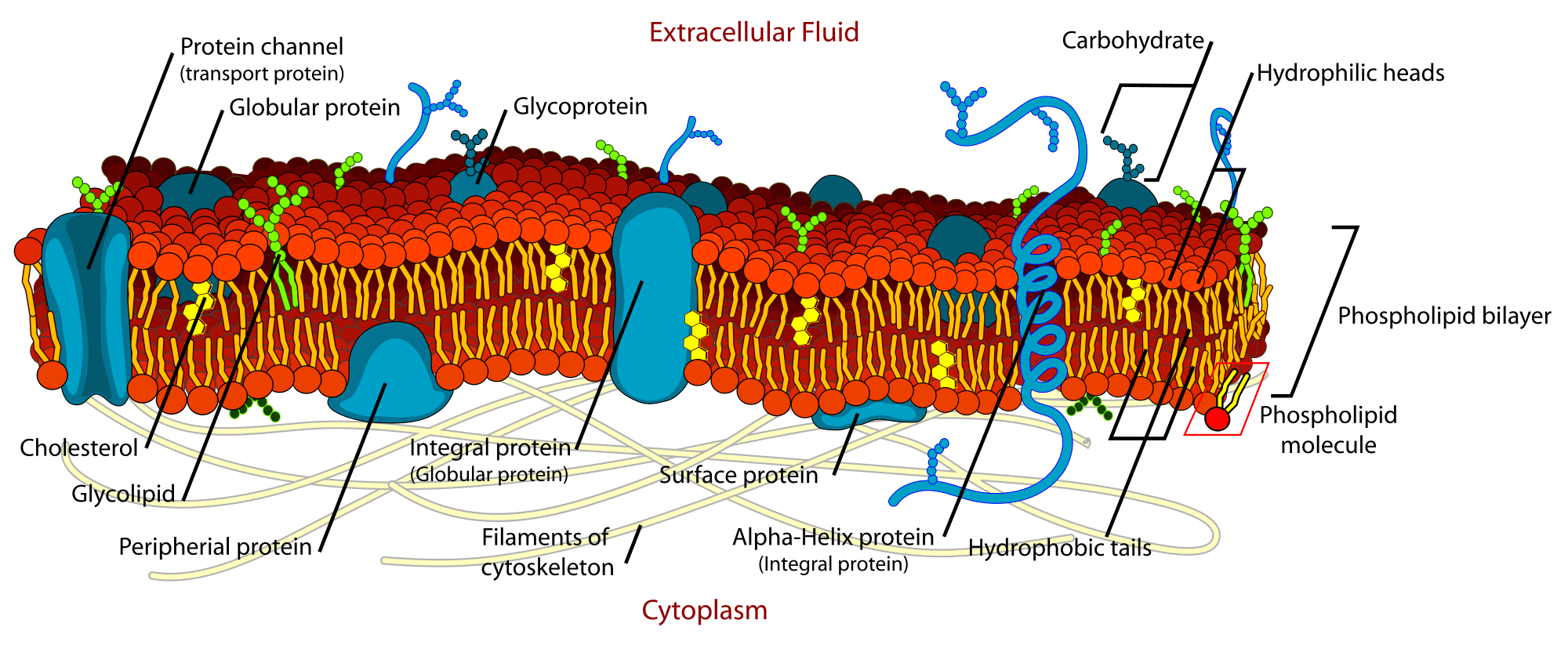
What is this image?
a)
cell membrane
b)
proteins
c)
carbohydrates
d)
lipids
41.
Reestablishing a damaged ecosystem where even the soil was destroyed...
a)
Secondary succession
b)
Primary succession
c)
Carrying capacity
d)
Homeostasis
42.
All of the living and nonliving things in an area that interact with each other are called a/an ______.
a)
community
b)
habitat
c)
population
d)
ecosystem
43.
The final stable community of plants and animals is called:
a)
pioneer community
b)
farmland
c)
climax community
d)
old field
44.

What are the pioneer species in a climax community?

a)

larger plants and trees

b)

shrubs and grasses

c)

rocks and soil

d)

lichens and mosses

45.
Over time, adaptions can lead populations to experience 
a)
environmental changes
b)
genetic changes
c)
geological changes
d)
extinction
46.
Lightning bugs using different blinking patterns to attract a mate is an example of
a)
reproductive isolation.
b)
behavioral isolation.
c)
geographic isolation.
47.
Which trait do only humans have, according to the cladogram?
a)
jaws
b)
mammary glands & hair
c)
terrestrial during all life stages
d)
bipedal & opposable thumbs
48.

How does DNA replicate/copy itself?

a)

Carefully

b)

Semiconservatively

c)

Mitosis

d)

Xerox

49.

What is the central dogma of biology

a)

RNA --> DNA --> PROTEIN

b)

Protein --> RNA --> DNA

c)

DNA--> RNA --> Protein

d)

DNA --> Protein --> RNA

50.

A man sues his wife for infidelity. She has type A blood and her child has type O blood. What would his blood type have to be for him to win his court case?

a)

AB

b)

heterozygous B

c)

heterozygous A

d)

o

51.
The primary purpose the body uses monosaccharides for is?
a)
Building muscles
b)
Helping the Immune System
c)
Immediate Energy
d)
Generating Heat
52.
The property where water molecules are attracted to other water molecules.
a)
adhesion
b)
capillary action
c)
cohesion
d)
universal solvent
53.
Cellular energy is produced in the membrane of this organelle.
a)
endoplasmic reticulum
b)
chloroplast
c)
mitochondria
d)
lysosome
54.
Which class of biomolecules include fats, oils, and steroids?
a)
carbohydrates
b)
lipids
c)
proteins
d)
nucleic acids
55.
Which class of biomolecules is considered the main structural molecule?  This same class also makes up enzymes..
a)
carbohydrates
b)
lipids
c)
proteins
d)
nucleic acids
56.
Which class of biomolecules includes DNA and RNA?
a)
carbohydrates
b)
lipids
c)
proteins
d)
nucleic acids
57.
Which class of biomolecules include monosaccharides, disaccharides, and polysaccharides?
a)
carbohydrates
b)
lipids
c)
proteins
d)
nucleic acids
58.
Which biomolecule's monomer (or building block) is glycerol and fatty acid?
a)
Lipids
b)
Proteins
c)
Carbohydrate
d)
Nucleic Acid
59.
The phases of the cell cycle in correct order are _______________.
a)
Interphase, Prophase, Metaphase, Anaphase, Telophase, Cytokinesis
b)
Interphase, Prophase, Anaphase, Metaphase, Cytokinesis, Telophase
c)
Prophase, Metaphase, Anaphase, Telophase, Cytokinesis, Interphase
d)
Prophase, Metaphase, Telophase, Anaphase, Interphase, Cytokinesis
60.
Which identifies an individuals genotype? 
a)
Tt
b)
tall
c)
short
d)
type A
61.
What is the main function of a selectively permeable membrane?
a)
storage of water
b)
storage of chemicals
c)
breaks down molecules within the cell
d)
regulates what enters and leaves the cell
62.
What phase of mitosis is shown in the picture?
a)
Prophase
b)
Metaphase
c)
Anaphase
d)
Telophase
63.
What does a flagellum do?
a)
It helps the cell move.
b)
It helps the cell make protein.
c)
It stores water and energy for the cell to use later.
d)
I don't know, but it looks cool.  
64.
Another name for a sex cell is a:
a)
gamete
b)
embryo
c)
bone cell
d)
muscle cell
65.

Which phase of mitosis is being represented in the image?

a)

prophase

b)

metaphase

c)

anaphase

d)

telophase

66.

Which letter represents interphase

a)

A

b)

B

c)

C

d)

D

e)

E

67.

Which is the correct order of mitosis in the above image?

a)

1, 2, 3, 4, 5

b)

2, 4, 3, 1, 5

c)

2, 4, 3, 5, 1

d)

4, 2, 3,1,5

68.

What sex is the individual in the above Karyotype

a)

male

b)

female

69.

In DNA, cytosine will always pair with

a)

thimine

b)

guanine

c)

cytosine

d)

adenine

70.

What type of selection is take place in the graph

a)

stabilizing

b)

disruptive

c)

directional

d)

none

71.

This is the combined alleles of all of the individuals in a population

a)

gene pool

b)

allele frequency

c)

mutations

d)

allele recombination

72.

This is any change in the sequence of DNA

a)

mutation

b)

gene error

c)

translation

d)

transcription

73.
A heterozygous yellow pea plant's genotype would be:
a)
YY
b)
yy
c)
Yy
d)
Yg
74.
Who was the naturalist that traveled the world to study plants and animals?
a)
Albert Einstein
b)
Charles Darwin
c)
Charles Barkley
d)
Isaac Newton
75.
which of the folllowing is an exammple of a vestigial structure?
a)
the wings of a red-tailed hawk
b)
the hind limbs of a house cat
c)
the fins of sharks
d)
the wings of an ostrich
76.
Two organisms that are closely related would have
a)
very similar DNA sequence
b)
exactly the same DNA sequences
c)
no proteins in common
d)
completely different DNA sequence
77.
The scientific name for an organism is made from the:
a)
class and family name
b)
genus and species name
c)
domain and kingdom name
d)
kingdom and phylum name
78.
When experimenting with the growth of a plant, a scientist uses three (of the same type of) plants, two different fertilizers, equal light, and equal water. What type of variable is the fertilizer?
a)
Dependent
b)
Independent
c)
Control
d)
Compound
79.
When experimenting with the growth of a plant, a scientist uses three (of the same type of) plants, two different fertilizers, equal light, and equal water. What type of variable is the fertilizer?
a)
Dependent
b)
Independent
c)
Control
d)
Compound
80.
What part of the water cycle does this picture show?
a)
condensation
b)
precipitation
c)
evaporation
81.
Biogeochemical cycles:
a)
only include processes conducted by or within living organisms
b)
Pertain only to the abiotic environment
c)
describe the movement of water and other materials through the abiotic and biotic environment. 
d)
Only pertain to exchanges and interactions that occur within the atmosphere 
82.

Organisms that have two identical alleles for a particular trait are said to be?

a)

Hybrid

b)

Heterozygous

c)

Homozygous

d)

Dominant

83.

A Punnett square is used to determine the?

a)

Probable outcome of a cross

b)

Actual outcome of a cross

c)

Result of incomplete dominance

d)

Result of meiosis

84.

When two species reproduce at different times, the situation is called?

a)

Genetic drift

b)

Temporal selection

c)

Temporal isolation

d)

Lateral gene transfer

85.
Rosalind Franklin's "Photo 51" allowed Watson and Crick to determine the _______ of DNA.
a)
Shape
b)
Backbone
c)
Nitrogen bases
d)
Hydrogen bonds
86.
What is the cell cycle?
a)
The gradual development of something, especially from a simple to a more complex form.
b)
The study of heredity and the variation of inherited characteristics.
c)
The branch of biology that deals with the relations of organisms to one another and to their physical surroundings.
d)
The series of events that take place in a cell leading to its division and duplication of its DNA to produce two daughter cells.
87.
Put the following actions in order: DNA replicates, cell grows, cell divides, cell prepares for mitosis. 
a)
DNA replicates, cell grows, cell prepares for mitosis, cell divides
b)
cell grows, cell prepares for mitosis, DNA replicates, cell divides
c)
cell grows, DNA replicates, cell prepares for mitosis, cell divides
d)
DNA replicates, cell prepares for mitosis, cell grows, cell divides
88.
Which sex chromosomes would indicate a typical human male?
a)
XX
b)
X
c)
XY
d)
XXY
89.

a photograph or picture of chromosomes grouped in ordered pairs is a ______________

a)

pedigree

b)

Punnett Square

c)

Venn Diagram

d)

Karyotype

90.

The scientist(s) responsible for the discovery of the bacterial transformation is (are)?

a)

Watson and Crick

b)

Avery

c)

Griffith

d)

Franklin

91.

A farmer's use of the best livestock for breeding is an example of?

a)

Natural selection

b)

Artificial selection

c)

Extinction

d)

Adaptation

92.

Body parts of unrelated organisms that serve the same function are examples of?

a)

Homologous structures

b)

Vestigial structures

c)

Analogous structures

d)

Fossil structures

93.

Which of the following is an important concept in Darwin's theory of evolution by natural selection?

a)

Descent with modification

b)

Homologous molecules

c)

Processes that change the surface of the earth

d)

The tendency toward perfection

94.

A human body (somatic) cell usually has how many chromosomes?

a)

6

b)

22

c)

4

d)

46

95.
The exact genetic makeup of an organism, such as RR, Tt, PP is its?
a)
phenotype
b)
dominance
c)
genotype
d)
trait
96.
How many alleles (letters) do each person carry for a trait?
a)
1
b)
2
c)
3
d)
4
97.
Which of the following is homozygous recessive?
a)
rr
b)
AA
c)
TT
d)
Ff
98.

The macromolecule that is composed of P, C, H, O, & N is:

a)

protein

b)

nucleic acid

c)

carbohydrate

d)

lipid

99.

What are the building blocks of matter?

a)

Elements

b)

Atoms

c)

Compounds

d)

Chemical Bonds

100.

Which type of solution makes a cell shrink?

a)

Hypotonic

b)

Hypertonic

c)

Isotonic

101.
Which of the following terms means water-loving?
a)
Hypotonic
b)
Hypertonic
c)
Hydrophobic
d)
Hydrophilic
102.
Which type of solution causes a cell to swell?
a)
Hypotonic
b)
Hypertonic
c)
Isotonic
103.

What type of transport is shown in the diagram?

a)

diffusion

b)

facilitated diffusion

c)

endocytosis

d)

exocytosis

104.

What organelle makes protein?

a)

Cell Wall

b)

Cell Membrane

c)

Cytoplasm

d)

Ribosomes

105.

Which organelle digests and gets rid of waste and worn-out cellular components?

a)

Nucleus

b)

Ribosome

c)

Cytoplasm

d)

Lysosome

106.

Which pH reading would indicate a solution is basic?

a)

5

b)

11

c)

7

d)

2

107.

What is it called when our body is a stable constant environment?

a)

covalent

b)

homeostasis

c)

catalyst

d)

enzyme

108.

Cancer that is not harmful & does not spread to other areas of the body is called...

a)

malignant

b)

gametiosis

c)

benign

d)

all of the above