
 Worksheets
Economics Final Exam Review
Total questions: 128
Worksheet time: 2hrs 36mins


What is the relationship between the Price and Quantity Demanded?
Positive Relationship
Direct Relationship
Inverse Relationship
Mixed Relationship
The desire to have some good or service and the ability to pay for it
supply
equilibrium
demand
quantity demanded
Which of these best describes the law of demand?
if prices go up, quantity demanded will fall and if prices go down, quantity demanded will go up
if prices go up, quantity demanded will also go up and if prices go down, quantity demanded will also go down
there is no law of demand, each situation is unique and demand and prices cannot be predicted
prices will go up for certain goods when quantity demanded goes up and vice versa
A change in the price of a good causes people to buy more or less of an item. This best describes the concept of
the demand curve
change in quantity demanded
change in demand
elasticity
The quantity demanded of a good or service changes at all price levels best describes the concept of
change in quantity demanded
elasticity
change in demand
demand curve
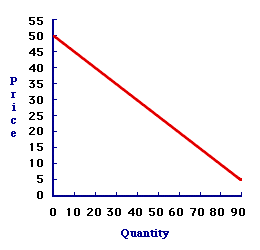
Which of these shows a decrease in the quantity demanded?


Which of these shows an increase in the quantity demanded?


When the price of good A rises, people start to drink good B. In this case, what is good B considered?
luxury good
complementary good
substitute good
normal good
How is a decrease in the price of a good illustrated on a demand graph?
The demand curve shifts to the right.
The demand curve shifts to the left
There is upward movement along the demand curve
There is downward movement along the demand curve.




When producers offer more of a good as its price increases and less as its price falls, this defines the
law of demand
law of supply
change in demand
change in supply
The willingness and ability of a producer to make a product is referred to as
quantity supplied
quantity demanded
supply
demand
Movement along a supply curve demonstrates
a change in quantity supplied
a change in quantity demanded
a change in supply
a change in demand
A shift in a supply curve demonstrates
a change in quantity supplied
a change in quantity demanded
a change in supply
a change in demand
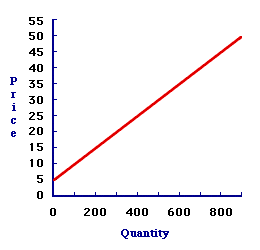
Which of these demonstrates an example of a supply curve? (More than one answer)


Which of the following supply curves demonstrates a decrease in the quantity supplied?
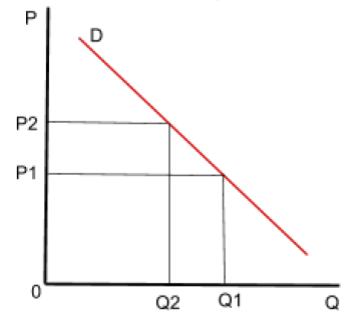


A decrease in supply is demonstrated by which of the following?


A hurricane wipes out an orange crop in Florida, sharply affecting the supply of oranges. Which chart demonstrates this concept?


The prices for houses steadily increase, causing more people to want to sell their homes. Which of these demonstrates this concept?


A popular musical act announces a concert at a 10,000 seat venue. Prices for tickets skyrocket so the venue announces that there will be 500 standing room only tickets offered. What concept does this demonstrate?
elastic supply
inelastic supply
change in supply
change in quantity supplied
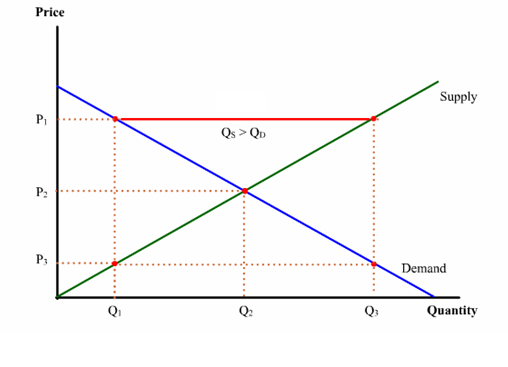

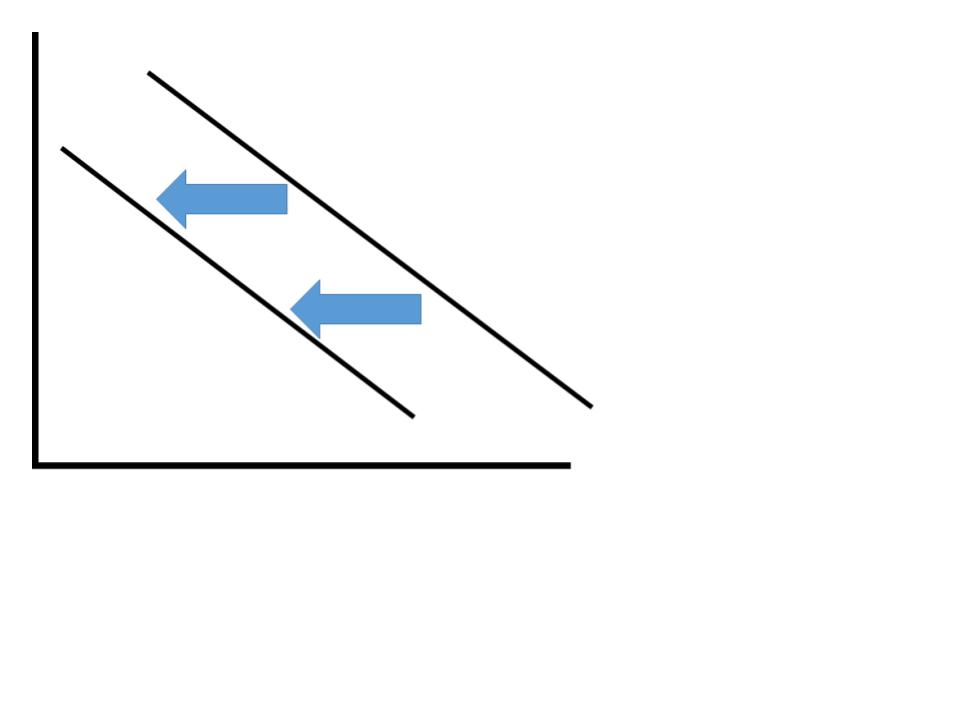
What does this curve represent?
Change in Demand
Change in supply
Change in Quantity Demanded
Change in Quantity Supplied

Change in Quantity Supplied
Decrease in Supply
Increase in Supply
Decrease in Supply and Decrease in Demand
Auto Union Workers Agree to Wage Cuts
Change in Resources/Inputs
Change in Subsides or Taxes Government Policy
Change in Income
Change in Number of Producers
Auto Union Workers Agree to Wage Cuts


New robot increase efficiency for Autos
Cost of Steel decreases
Major Auto producer goes out of business
Government gives Car producers Subsidies
Price of Autos increase
increase in supply
increase in quantity supplied
decrease in supply
decrease in quantity supplied
Cost of Steel decreases and effects autos
increase in supply
increase in quantity supplied
decrease in supply
decrease in quantity supplied
Nationwide Auto workers strike
Change in supply
Change in quantity supplied
Auto workers strike
increase in supply
increase in quantity supplied
decrease in supply
decrease in quantity supplied
What is one reason that firefighter services are considered a public good?
Everyone in the community benefits from it.
Nobody in the community has to pay for it.
Private firms make a profit from producing it
Individual citizens pay directly for it.
Public goods are examples of market failure, because producing these goods in the free market
shows that the free enterprise system cannot distribute resources.
helps entrepreneurs learn how to distribute public resources.
does not allow for the efficient distribution of resources.
encourages private businesses to distribute resources efficiently.
Which of the following is an example of a negative externality resulting from an outdoor concert in the park?
College students near by get to enjoy free entertainment
An elderly woman in her apartment hears a song that she liked as a child.
A pizza parlor stays open later and makes a bigger profit than most nights
A traffic jam occurs as drivers hunt for parking spots near the concert.
Which of the following explains why a city fireworks display on the Fourth of July is provided as a public good?
Fireworks displays usually take place in a public area.
Fireworks are a scarce resource.
Nonpayers cannot be prevented from seeing the fireworks.
Each consumer pays a fee to see the fireworks.
What is critical in determining whether something is produced as a public good?
whether the market has the resources to provide it
whether the benefits to society are greater than the total cost
whether the government needs to use tax money to provide it
whether the benefits are limited to the poor
What might be the economic benefit of the government providing a public good rather than the private sector?
decreased prices for the good
decreased cost for the good
increased taxes needed to provide the good
greater efficiency in providing the good
Market failure occurs whenever
free markets fail to distribute resources efficiently.
goods fail to arrive at a market in a timely fashion.
government builds infrastructure.
voluntary exchange in a market fails to result in a sale.

Use the image to answer the question:
What two qualities that work together to regulate the marketplace are present in this photo of two cellphone service providers?
innovation and specialization
efficiency and underutilization
competition and self-interest
opportunity and efficiency
The goal of government welfare programs is to
maintain a poverty threshold that matches the median income.
eliminate the dependence of people on the welfare system.
eliminate the income gap between the richest Americans and the poorest.
raise the standard of living of certain less-fortunate members of society.
What statement best explains why the government provides goods and services to its citizens?
To provide benefits to small groups of people in certain areas of the country.
To provide goods and services that would not be available if individuals had to provide them.
To compete with businesses in the private sector.
To make a large profit by providing certain goods and services to it's citizens.
The government pays for public goods and services through —
donations from wealthy politicians
donations from foreign nations
revenue from sales and income taxes
revenue from the lottery
What is one reason that local law enforcement is considered a public good?
Everyone in the community benefits from it.
Nobody in the community has to pay for it.
Private firms make a profit from producing it.
Individual citizens pay directly for it.
What is the free rider problem?
scarcity even when you pay for a good
Reaping all the benefits without contributing
Common goods that don't have a price
none of the above
If a student volunteers at a food pantry on Fridays after school, which of the following might be a negative externality?
The student might learn a new skill.
The student might make some new friends.
The student's parents have to drive him or her to the food pantry.
The student might decide to volunteer two days a week.

Refer to the image. Given the position of the marginal social cost curve, one can conclude that
production of good X creates a negative externality.
private cost of producing good X exceeds the social cost of production at all levels of output.
market quantity, Q3, is the socially optimal quantity.
free market will produce too little of good X.
Markets exhibiting negative externalities will
under produce.
over produce.
be optimal.

Driving a car on crowded highway produces
a negative externality.
a positive externality.

Apartment dwellers who buy fire alarms or fire extinguishers generate a
negative externality.
positive externality.
The market should produce the quantity where
marginal social cost equals marginal social benefit.
marginal private cost equals marginal social benefit.
external cost equals external benefit.
private cost is greater than social cost.
Marginal Social Cost minus Marginal Private Cost equals
internal cost.
external cost.
marginal cost.
marginal revenue.
A negative externality results due to firms
being very, very , bad.
not paying the full cost of production.
firms internalizing production costs.
firms not realizing they are polluting.
In which of the following situations is market failure least likely to occur? A situation where;
externalities exist
many producers compete in the market
there is a sole producer in market
there is a very uneven distribution of income and wealth
Which of the following statements is true about externalities?
When externalities exist, resources are allocated efficiently
When positive externalities exist, efficiency is improved by taxing the product
From society's point of view, the output of goods for which a positive externality exists is too low
The price system overproduces goods with positive externalities
When social costs are greater than private costs, there is a;
positive externality
negative externality
less than socially optimal output
socially optimal output
The amount of stuff that is produced by firms and offered for sale.
Supply
Demand
Equalibrium
Disequalibrium
The person or business that provides a good or service.
Supplier
Consumer
High prices give businesses an incentive to produce. Low prices give producers a reason to reduce production.
Law of Supply
Equilibrium
Disequalibrium
Supply Curve
Government increases rules which reduces supply.
Technology
Regulation
Number of Sellers
Supply Shock
Education
If suppliers believe a market will be strong they will make more products.
ex: smartphones and virtual reality.
Technology
Change in Producer Expectations
Number of Sellers
Supply Shock
Education
An increase or decrease in _______ can cause an increase or decrease in the supply of goods/services.
ex: fast food, apps
Technology
Change in Producer Expectations
Number of Sellers
Supply Shock
Education
Increases in human capital will increase the ability to produce.
ex: colleges, tech schools
Technology
Change in Producer Expectations
Number of Sellers
Supply Shock
Education
A sudden and unexpected shortage due to natural disaster or human mistake.
ex: earthquakes, fire, hurricane.
Technology
Change in Producer Expectations
Number of Sellers
Supply Shock
Education
The point of balance where demand and supply come together.
Equilibrium
Supply
Demand
Prices
Disequalibrium
When the quantity supplied is not equal to the quantity demanded.
Equilibrium
Supply
Prices
Disequalibrium
What is an example of excess demand?
Toilet Paper in 2020
Christmas ornaments on sale in January.
What is an example of QD<QS, or excess demand?
Toilet Paper in 2020
Christmas ornaments on sale in January.
The price of any good adjusts to equilibrium is known as ___.
Supply
Demand
Disequalibrium
Law of Supply and Demand
A binding maximum legal price in a market
Price ceiling
Price floor
Who are price ceilings intended to benefit?
Consumers
Producers
Government
Employees
Shortages, lower quality goods, and increased search costs, are all associated with
Price ceilings
Price floors
Rent control, an attempt to make housing more attainable when prices rise too high is an example of a
Price ceiling
Price floor
Which of the following is an argument in support of rent control?
Lower rent prices discourage incentives to build additional housing.
Housing prices in certain areas are rising faster than wages.
Rent control can cause a shortage of housing.
Quality of existing apartments will decrease.
A binding legal minimum price in a market
Price ceiling
Price floor
Price floors are intended to protect
Sellers of a good or service
Consumers of a good or service
Binding price floors often result in a market
Surplus
Shortage
When a price ceiling is in place keeping the price below the market price, which is true of the quantity demanded & quantity supplied?
Quantity Demanded is greater
Quantity Supplied is greater
Quantity Demanded equals Quantity supplied


If the Market price is $50,, which of the following is True of Quantity Supplied and Quantity Demanded
quantity demanded = 120
quantity supplied = 120
quantity demanded = 120 & quantity supplied =120
quantity demanded = quantity supplied
What prevents firms from entering a monopoly?
Barriers to Entry
Technology
Price
Barriers to Travel
Which of the following industries is an example of a monopoly?
utilities/water
department stores
auto industry
commercial airlines
A market that has a few sellers of basically the same goods.
Perfect Competition
Pure Monopoly
Monopolistic Competition
Oligopoly
Public utilities are an example.
Perfect Competition
Natural Monopoly
Monopolistic Competition
Oligopoly
In this market, the producer is the least responsive to buyers' needs and wants.
Perfect Competition
Pure Monopoly
Monopolistic Competition
Oligopoly
Which type of market structures has many producers (companies) and sell similar but different products from each other? These companies have a little control over the price and there are relatively low barriers to entry.
perfect competition
monopolistic competition
oligopoly
monopoly

