
NEW
Font size
 Worksheets
Biology 20 final exam review
Total questions: 70
Worksheet time: 40mins


Most plants appear green because chlorophyll
does not absorb green light.
reflects violet light.
absorbs green light.
none of the above
If carbon dioxide is removed from a plant’s environment, what would you expect to happen to its production
of high-energy sugars?
More sugars will be produced.
No sugars will be produced.
The same number of sugars will be produced but without carbon dioxide.
Carbon dioxide does not affect the production of high-energy sugars in plants.
Photosynthesis uses sunlight to convert water and carbon dioxide into
oxygen.
high-energy sugars.
ATP and oxygen.
oxygen and high-energy sugars.
Photosynthesis is to chloroplasts as cellular respiration is to
chloroplasts.
cytoplasm.
mitochondria.
nucleus.
aerobic cellular respiration occurs only in the presence of
carbon dioxide
water
sunlight
oxygen

What is the organelle pictured?
mitochondria
chloroplast
ribosome
vacuole
4. Which biomolecules transport oxygen and other substances and also form part of most organelles?
Lipids
Carbohydrates
Proteins
Nucleic Acids
5. Which biomolecules provide quick energy for the cell and also provide materials to build the cell membrane/wall?
Carbohydrates
Proteins
Lipids
Nucleic Acids
2. Which biomolecules contains your genetic information?
Proteins
Lipids
Carbohydrates
Nucleic Acids
9. Amino Acids are the monomers of __________.
Nucleic Acids
Proteins
Carbohydrates
Lipids
6. The monomer of carbohydrates is known as _______.
Amino Acid
Fatty Acid
Nucleotide
Saccharide
Just under an orca's skin lies a thick layer of blubber. Blubber helps insulate a whale from heat loss. Based on this information, which biomolecule is blubber primarily made of?
Lipids
Nucleic Acids
Proteins
Carbohydrates
3. Which biomolecules act as energy storage for the cell and also cushions and insulates organs?
Carbohyrdates
Lipids
Proteins
Nucleic Acids
8. The monomer of Nucleic Acids is known as _________.
Amino Acid
Fatty Acid
Nucleotide
Saccharide
11. People with albinism do not produce the melanin protein. Melanin allows for people to be protected from the sun and thus people with albinism are prone to severe sunburns. Which biomolecule would you infer is responsible for albinism?
Carbohydrate
Protein
Lipid
Nucleic Acid
1. The four most common elements found in biomolecules are __________.
Sulfur, Phosphorus, Carbon, Oxygen
Carbon, Oxygen, Nitrogen, Hydrogen
Sulfur, Nitrogen, Carbon, Iron
Carbon, Nitrogen, Hydrogen, Sulfur
What are the fingerlike structures located in the small intestine that absorbs nutrients?
Duodenum
Villi
Bile
Pancreas
Which of the following answers correctly sequences the pathway food takes from the beginning to end?
mouth, esophagus, stomach, small intestine, large intestine
mouth, esophagus, stomach, large intestine, small intestine
mouth, stomach, esophagus, small intestine, large intestine
mouth, stomach, esophagus, large intestine, small intestine
The teeth and tongue of the oral cavity break foodstuff down physically. This is an example of
mechanical digestion
chemical digestion
absorption
peristalsis
Which organ makes bile to help break down fats?
liver
gallbladder
pancreas
What organ is responsible for the absorption of water and movement of waste?
large intestine
small intestine
stomach
oral cavity
Why doesn't the stomach digest itself with hydrochloric acid?
It is lined with villi to protect the lining of the stomach
the lining is covered with mucus to protect itself
the stomach wall becomes immune to the strong acid over time
the stomach walls are made of very thick skeletal muscle.
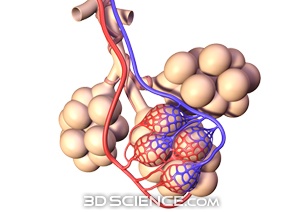
1. larynx
2. nasal cavity
3. pharynx
4. trachea
Which of the following is the correct order that air would flow during inhalation.
The process of exchanging oxygen and carbon dioxide in the lungs.
inspiration
expiration
internal respiration
external respiration
A capillary is a form of...
Gas exchange
Respiration
Blood vessel
Alveoli
Gaseous exchange happens because of...
Osmosis
Respiration
Diffusion
Semi-permeable membranes
The job of the heart is to . . .
pump blood around the body.
send food to the small intestines.
break down food.
give energy to the body.
The FREQUENCY of heart contractions is...
heart rate
blood pressure
respiratory rate
voluntary muscle contraction
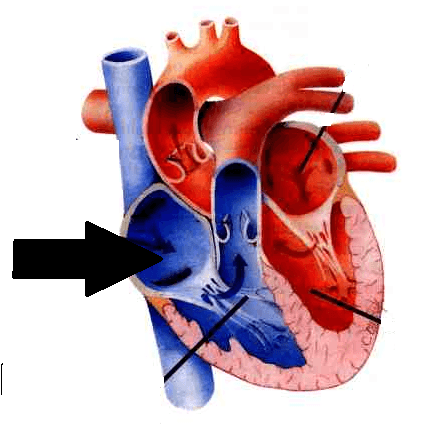
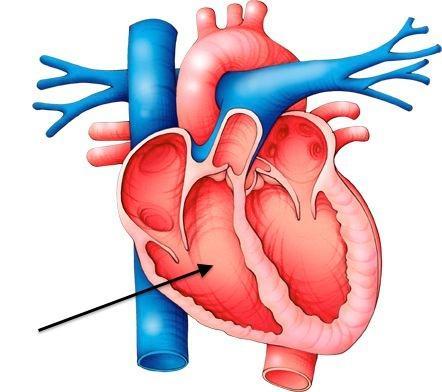
This chamber of the heart RECEIVES oxygen rich blood back from the lungs
Right Atrium
Left Atrium
Right Ventricle
Left Ventricle
This chamber of the heart pumps the blood from the heart to the lungs through the pulmonary artery
Right Atrium
Left Atrium
Right Ventricle
Left Ventricle

What is blood pressure?
Pressure of the blood against the walls of the veins.
Pressure of the heart pushing the blood out.
Pressure of the heart receiving blood.
Pressure of the blood against the walls of the arteries.

As the diameter of a blood vessel DECREASES...
resistance INCREASES.
resistance DECREASES.
resistance is NOT affected.
What type blood vessel exchanges nutrients and oxygen in the tissues?
Arteries
Veins
Capillaries
Venules

Which type of blood vessel carries blood TO the heart?
Arteries
Capillaries
Veins
Venules
This sticky fluid traps any pathogens that try and get in our body
Mucous Lining
Blood
Stomach Acid
Skin
What is the first line of defense of the immune system?
Mucos
White Blood Cells
Skin
Red Blood Cells
Whats another name for White Blood Cells?
Lymphocytes
Leukocytes
Plasma Cells
Memory Cells
Which cells engulf the pathogens?
Macrophages
B Cells
White Blood Cells
Plasma Cells
A protein that attacks antigens is called:
Antibody
Immune response
Inflammatory Response
Vector
What is a vaccine?
A weakened pathogen injected in the body to produce immunity
Temporary immunity that develops as natural exposure
An overreaction of the immune system
Medicine that helps after you're infected
What are memory T Cells?
The kills infected body cells
They help the immune system respond quicker if the same pathogen enters the body again
They signal B Cells
They cause Inflammation

