
 Worksheets
SS Final Exam
Total questions: 71
Worksheet time: 1hrs 16mins

How long is the paper clip?
3 cm
4cm
5cm


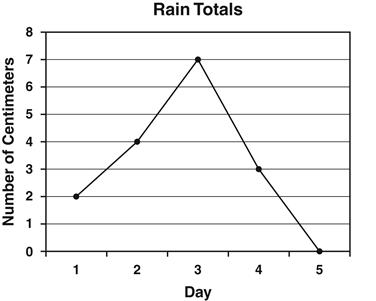
Annie recorded the amount of rain that fell each day. The results are shown in the line graph below. How many centimeters of rain fell on the third day?
2
3
4
7

What type of graph is this?
line plot
line graph
bar graph
frequency table
The X axis represents the _________ variable.
Independent
Dependent
The Y axis represents the ____________ variable.
Independent
Dependent
What is a claim?
Answers a question or problem
long and detailed paragraph
Explains why something happened
What is evidence ?
Answers a question
Anything you see, hear or read or experience that causes you to believe something is true.
Long and detailed paragraph
What is an example of reasoning?
Honey is stored in hives.
Honeybees store their honey in hives.
Honeybees use hexagons to store the honey and pollen they bring to the hive.
What is an example of evidence?
Football players are 33% more likely to get injured than baseball players.
Football is more dangerous than baseball.
Baseball is a fun sport.

50 ml of water was added to the graduated cylinder. After we drop in the object, the new water level goes up to 60 ml. What is the volume of the blocks?
8 ml
10 ml
60 ml
5 ml

What do we put at the top of a graph?
X axis
data table
title
nothing
The variable that is measured throughout the experiment is the ________________
Hint: What you are testing and change as a result of your testing.
Controlled Variable
Responsive Variable
Dependent Variable
Independent Variable
What is an independent variable?
the variable that changes because another variable changes
independent variables are only found on pie charts.
a variable most often found on the y-axis
the variable the experimenter manipulates or has control over
We can infer that…

Which of the following is an observation about this picture?
The boy has fallen off his bike.
The boy is in a lot of pain.
The boy has injuries to his knees
The boy learned his lesson about wheelies

Which of the following statements is an inference about the picture
The vase is broken.
The girls' bow is blue and purple.
The girl broke the vase.
The girl has blonde hair.
Scenario: You walk into the science classroom and see an unfamiliar adult at the front of the room. You also see that Ms. Rodriguez is not in the room. You wonder where she could be. Which one(s) are observations?
You walk into science.
You see an unfamiliar adult.
You wonder where Ms. Rodriguez could be.
None of these are observations
Scenario: You walk into the science classroom and see an unfamiliar adult at the front of the room. You also see that Ms. Rodriguez is not in the room. You wonder where she could be. "Maybe she's home sick today" you think to yourself. Which of these is an inference?
You walk into science.
You see an unfamiliar adult.
You do not see Ms. Rodriguez
"Maybe she's home sick today"
Scenario: You are shopping at Kroger. You hear glass breaking, a person cursing, and the sharp smell of pickle juice coming from the next aisle. Which of these is/are observations?
You hear glass breaking
You hear a person cursing
You smell pickle juice
All of these are observations
Scenario: You are shopping at Kroger. You hear glass breaking, a person cursing, and the sharp smell of pickle juice coming from the next aisle. Based on the scenario, what do you infer (inference)?
The pickle jar was slippery.
Someone dropped a jar of pickles.
All of these are inferences.
That person is having a bad day.
Observations like measurements are ____________ observations
quantitiative
qualitative
operational
scientific
Observations like the color or texture of an object are ________________ observations.
quantitative
qualitative
operational
scientific

Observation or Inference: I notice the tree by the pond has no leaves on it.
Observation
Inference
Observation or Inference: The boy fell off the branch.
Observation
Inference

Qualitative or Quantitative: There is 300 mL of liquid in this beaker.
Qualitative Observation
Quantitative Observation

Qualitative or Quantitative: I feel rough sand and a strong heat on the back of my neck.
Qualitative Observation
Quantitative Observation
Suppose your friends went to the beach at noon on a warm day. They saw some black and white birds. As you are talking to you friend you think "This happen during summertime". Is this an observation or an inference?
observation
inference
Suppose your friends went to the beach at noon on a warm day. They saw some black and white birds. As you are talking to you friend you think "It was during the day". Is this an observation or an inference?
observation
inference
Suppose your friends went to the beach at noon on a warm day. They saw some black and white birds. As you are talking to you friend you think "They saw a bird". Is this an observation or an inference?
observation
inference
Suppose your friends went to the beach at noon on a warm day. They saw some black and white birds. As you are talking to you friend you think "They saw seagulls". Is this an observation or an inference?
observation
inference
Suppose your friends went to the beach at noon on a warm day. They saw some black and white birds. As you are talking to you friend you think "They went swimming.". Is this an observation or an inference?
observation
inference
Suppose your friends went to the beach at noon on a warm day. They saw some black and white birds. As you are talking to you friend you think "One friend’s name was Bob.". Is this an observation or an inference?
observation
inference
Suppose your friends went to the beach at noon on a warm day. They saw some black and white birds. As you are talking to you friend you think "One friend’s name was Bob.". Is this an observation or an inference?
observation
inference
Suppose your friends went to the beach at noon on a warm day. They saw some black and white birds. As you are talking to you friend you think " It was a warm day.". Is this an observation or an inference?
observation
inference
Suppose your friends went to the beach at noon on a warm day. They saw some black and white birds. As you are talking to you friend you think " The birds were black and white". Is this an observation or an inference?
observation
inference
Suppose your friends went to the beach at noon on a warm day. They saw some black and white birds. As you are talking to you friend you think " They ate lunch and drank Coke.". Is this an observation or an inference?
observation
inference
Suppose your friends went to the beach at noon on a warm day. They saw some black and white birds. As you are talking to you friend you think "They are friends.". Is this an observation or an inference?
observation
inference


Which of the following is NOT a characteristics of a hypothesis?
Must be made with background knowledge
Must be testable
Must organizes the IV and DV
Must always be correct
The control group , or the normal group, is needed for:
Keeping aspects of experiment constant
Comparison
Hypothesis formation
Application of the manipulated variable
Experiments include many trials, since:
It's fun
Scientists like to stay busy
More trials ensure the hypothesis is ALWAYS correct
More trials increase accuracy of results
If I add sliced garlic to my aquarium water, then my fish will eat a lot. The IV in this hypothesis is:
Adding garlic to the aquarium
The fish eating a lot
If I feed Puff Puff McGuff mole crabs, then his teeth will wear down. The responding variable in this hypothesis is:
Mole crabs as food
Wearing down puffs teeth
On our water density lab, the IV was:
Applying heat to the water
Measuring salinity
Applying freshwater
The use of the graduated cylinder
On our density doughnuts lab, the DV was:
Mass measurements
Volume measurements
How well the doughnuts stayed together
Having 3 trials

