wayground logo

Free Printable Worksheets

Font size

S
M
L
XL
Worksheets

Chemistry Pretest 2023

Total questions: 101

Worksheet time: 2hrs 52mins

Name
Class
Date
1.

The number of Sodium (Na) atoms in Na₂CO₃

a)

1

b)

2

c)

3

d)

6

2.

How many elements are in the compound C2H8O ?

a)

2

b)

1

c)

3

d)

0

3.

How many total atoms are in the compound C2H8O ?

a)

11

b)

2

c)

8

d)

1

4.
How many Sodium (Na) are in 6NaCl?
a)
1
b)
12
c)
6
5.
How many Hydrogen are in 4H2O?
a)
6
b)
8
c)
2
d)
4
6.

The substances at the beginning (left) of a chemical equation are called the ____

a)

product

b)

yield

c)

chemical symbol

d)

reactants

7.

What is the right part of a chemical equation called...

H2 + O2 --> H2O

a)

Reactants

b)

Products

c)

Yields

d)

Chemical Equation

8.

How do you Balance This Equation?

__Al + __O2--> __Al2O3

a)
4,1 --> 2
b)
4,3 --> 4
c)
3,4 --> 1
d)
4,3 --> 2
9.

How do you Balance This Equation?

__H2SO3 + __KOH--> __H2O+ __K2SO3

a)
2,1 --> 2,1
b)
1,2 --> 1,1
c)
1,2 --> 1,2
d)
1,2 --> 2,1
10.

How do you Balance This Equation?

__H2 + __S --> __H2S

a)
1,1 --> 1
b)
2,2 --> 2
c)
1,2 --> 1
d)
1,2 --> 2
11.

How do you Balance This Equation?

__CH4 + __O2 --> __CO2+ __H2O

a)
2,1 --> 2,1
b)
1,2 --> 1,1
c)
1,2 --> 1,2
d)
1,2 --> 2,1
12.

Identify the reaction type:

C2H6 + O2 --> CO2 + H2O

a)

Double replacement

b)

Synthesis

c)

Acid base

d)

Combustion

13.

Identify the type of reaction:

ZnCl2 + Mg --> Zn + MgCl2

a)

Precipitate

b)

Single Replacement

c)

Double Replacement

d)

Decomposition

14.

Identify the reaction type:

NaCl + KOH --> KCl + NaOH

a)

Double replacement

b)

Combustion

c)

Synthesis

d)

Decomposition

15.

Identify the reaction type:

H2O2 --> H2O + O2

a)

Decomposition

b)

Synthesis

c)

Combustion

d)

Acid Base

16.

Define nuclear fusion.

a)

Combining lighter atoms to make heavier ones

b)

Splitting lighter atoms to make heavier ones

c)

Combining heavier atoms to make lighter ones

d)

Splitting heavier atoms to make lighter ones

17.

The time it takes for half of a sample to decay into products.

a)

Half-Life

b)

Radioisotope

c)

Radiation

d)

Carbon-14

18.

Beta, gamma, and alpha are all examples of

a)

Half-Life

b)

Radioisotope

c)

Radiation

d)

Carbon-14

19.

The most dangerous type of radiation to be exposed to.

a)

Alpha

b)

Beta

c)

Gamma

20.

When released during radioactive decay, the product's mass number would have changed by 4 and the atomic number by 2.

a)

Alpha

b)

Beta

c)

Gamma

21.

Is really an electron.

a)

Alpha

b)

Beta

c)

Gamma

22.
The splitting of a nucleus into smaller nuclei is
a)
fusion
b)
fission
c)
decay
d)
gamma radiation
23.

What is Avogadro's number?

a)

6.02 x 10²³

b)

1 mole

c)

600 million

d)

6.02

24.

A mole is:

a)

The unit for mass

b)

The unit for the amount of a substance

c)

The unit for volume

d)

The unit for area

25.

How is moles abbreviated?

a)

M

b)

m

c)

mol

d)

ml

26.

What is the octet rule?

a)

Elements will have 8 valence in the outermost electron shell

b)

Elements will have 8 protons in the nucleus

c)

Elements will have 8 neutrons on average

d)

Elements must form an octopus like structure

27.

Group 18 of the periodic table are:

a)

Noble Gases

b)

Alkaline earth metals

c)

Halogens

d)

Alkali Metals

28.

Elements in the same family have similar ___________ and ___________ properties.

a)

Chemical/ Reaction

b)

Physical/ Mental

c)

Chemical/ Physical

d)

Reactions/ Chemical

29.

Which of the following is a true statement about Bromine?

a)

Bromine would be a cation and wants to gain electrons

b)

Bromine would be an anion and wants to lose electrons

c)

Bromine would be a cation and wants to lose electrons

d)

Bromine would be an anion and wants to gain electrons

30.

Which of the following elements has a full valence electron shell?

a)

Neon

b)

Iron

c)

Oxygen

d)

Hydrogen

31.

The atomic mass of an element is _______

a)

The average mass of all isotopes of an element

b)

A measure of the density of that element

c)

The mass of the most common isotope of the element

d)

The number of protons and neutrons in the element

32.

An electron __________

a)

Is larger than a proton and has a positive charge

b)

Has less mass than a proton and has a negative charge

c)

Is smaller than a proton and has no charge

d)

Is larger than a proton and has a negative charge

33.

What is a compound?

a)

substance with 2 or more different elements chemically combined

b)

mixture which is evenly distributed throughout

c)

substance with 2 or more elements physically combined

d)

substance containing only one type of element

34.

Mixtures are divided into two classes. What are they?

a)

compounds and substances

b)

heterogeneous and compounds

c)

homogeneous and heterogeneous

d)

homogenous and elements

35.

What is the difference between a chemical change and a physical change?

a)

chemical changes create new substances

b)

physical changes create new substances

c)

chemical changes break apart atoms

d)

physical changes break apart atoms

36.
The red numbers in the image below represent ________
a)
subscripts
b)
coefficients
c)
I don't know, and don't want to try
d)
None of the answers are correct
37.
The blue numbers in the image below represent ________
a)
I don't know, and don't want to try
b)
coefficients
c)
subscripts
d)
none of the answers are correct
38.

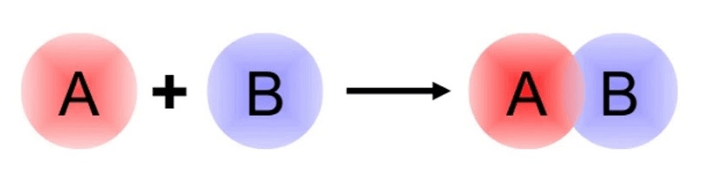
What is the type of reaction shown above?

a)

Synthesis

b)

Decomposition

c)

Single Replacement

d)

Double Replacement

39.
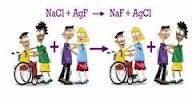
This pictures simulates what type of reaction?
a)
Synthesis
b)
Decomposition
c)
Single Replacement
d)
Double Replacement
40.

Why is the mole used in chemistry?

a)

The mass of atoms is in AMUs which is too hard to convert to grams.

b)

A dozen is not a scientific amount.

c)

Chemists needed to make chemistry easier to understand.

d)

It makes counting large numbers of small particles easier.

41.

What is a quantum?

a)

A packet of energy

b)

A light wave

c)

A proton

d)

A neutron

42.

The line spectrum of hydrogen is caused by when electrons release energy by

a)

Moving to a lower energy level

b)

Moving to a higher energy level

c)

Moving to an excited state

d)

Absorbing energy

43.
The major difference between a 1s orbital and a 2 s orbital is that
a)
the 2 s orbital is at a higher energy level.
b)
the 2s orbital has a slightly different shape.
c)
the 1 s orbital can have only one electron.
d)
the 2s orbital can hold more electrons.
44.
The part of the atom where the electrons CANNOT be fond is the 
a)
orbitals.
b)
nucleus.
c)
electron cloud.
d)
area surrounding the nucleus
45.
The statement that an electron occupies the lowest available energy orbital is 
a)
the Pauli exclusion principle.
b)
Hund's rule.
c)
the Aufbau principle.
d)
Bohr's law.
46.
For the f sublevel, the number of orbitals is
a)
18.
b)
9.
c)
5.
d)
7.
47.
Which of the following rules requires that each of the p orbitals at a particular energy level receive one electron before any of them can have two electrons?
a)
the Pauli exclusion principle
b)
Hund's rule.
c)
the Aufbau principle.
d)
the quantum rule.
48.
The main energy levels of an atom are indicated by the 
a)
magnetic quantum numbers.
b)
principal quantum numbers.
c)
orbital quantum numbers.
d)
spin quantum numbers.
49.
The total number of orbitals that can exist in a p sublevel is 
a)
5
b)
3
c)
1
d)
7
50.
A 3-D region around a nucleus where electrons may be found is called a(n)
a)
spectral line.
b)
electron path.
c)
orbital
d)
Pauli exclusion.
51.

Which of these describes the lowest total energy of an electron?

a)

ground state

b)

excited state

c)

neutral state

d)

negative state

52.

How many total electrons can go in an f orbital?

a)

2

b)

6

c)

10

d)

14

53.

How many total orbitals are possible in a d sublevel?

a)

2

b)

3

c)

5

d)

10

54.

Who's atomic theory said that electrons travel in fixed circular paths around the nucleus

a)
Bohr
b)
Dalton
c)
Rutherford
d)
Thomson
55.

Which model of the atom said that electrons live in 3D orbitals and do not travel in circular orbits around the nucleus?

a)
Bohr model
b)
Quantum mechanical model
c)
Dalton's model
d)
Photoelectric effect
56.

What atom matches this electron configuration? 1s22s22p63s23p64s23d8

a)
Zinc
b)
Copper
c)
Nickel
d)
Germanium
57.

The electron configuration of an atom is 1s22s22p6.  The number of valence electrons in the atom is 

a)
3
b)
6
c)
8
d)
10
58.

Light and electrons have properties of....(select all that apply)

a)

Waves

b)

Particles

c)

neutrons

d)

protons

59.

What things does the Heisenberg Uncertainty Principle say that you CAN NOT know at the same time? (select all that apply)

a)

position

b)

momentum

c)

mass

d)

energy

60.

The Pauli exclusion principle states that no two electrons in the same orbital can

a)

have the same set of quantum numbers.

b)

be at the same main energy level.

c)

have the same spin.

d)

occupy the same orbital.

61.

A wavelength is measured from ______ to ______.

a)

trough to through

b)

origin to crest

c)

crest to crest

d)

frequency to energy

62.

What happens when an electron moves from n=1 to n=2?

a)

Absorbs energy

b)

Releases energy

c)

nothing

d)

releases a photon

63.
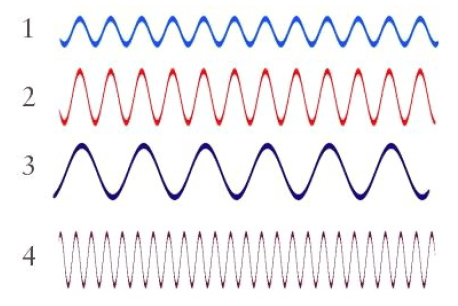
Which wave in the diagram has the greatest frequency?
a)
1
b)
2
c)
3
d)
4
64.

Which color has the highest energy?

a)

red

b)

orange

c)

green

d)

violet

65.
Which color of visible light has the lowest frequency?
a)
Red
b)
Orange
c)
Blue
d)
Violet
66.
Which group of METALS is the most reactive?
a)
Group 2- Alkaline Earth
b)
Group 17- Halogens
c)
Group 18- Noble Gases
d)
Group 1- Alkali metals
67.
Which element has properties that do not fit with any one group?
a)
Hydrogen
b)
Helium
c)
Nitrogen
d)
Oxygen
68.
What happens to the atomic mass as you move down a group of elements?
a)
It increases.
b)
It decreases.
c)
It stays the same.
d)
Nothing
69.
What happens to the reactivity of METALS as you move from left to right across the periodic table? 
a)
Reactivity increases
b)
Reactivity decreases
c)
It does not change.
d)
It stays the same.
70.
Which two groups are the most reactive?
a)
1 and 2
b)
1 and 17
c)
3 and 18
d)
4 and 5
71.
What direction are groups on the periodic table?
a)
Vertical
b)
horizontal
c)
sideways
d)
left to right
72.
The major difference between a 1s orbital and a 2 s orbital is that
a)
the 2 s orbital is at a higher energy level.
b)
the 2s orbital has a slightly different shape.
c)
the 1 s orbital can have only one electron.
d)
the 2s orbital can hold more electrons.
73.
The p orbitals are shaped like
a)
circles.
b)
dumbbells.
c)
spheres.
d)
electrons.
74.
The element with electron configuration 1s22s22p63s23p2
a)
Si
b)
Mg
c)
S
d)
C
75.
The atomic sublevel with the next hightest energy after 4p is
a)
5s
b)
4f
c)
5p
d)
4d
76.
The part of the atom where the electrons CANNOT be fond is the 
a)
orbitals.
b)
nucleus.
c)
electron cloud.
d)
area surrounding the nucleus
77.
The statement that an electron occupies the lowest available energy orbital is 
a)
the Pauli exclusion principle.
b)
Hund's rule.
c)
the Aufbau principle.
d)
Bohr's law.
78.
What is the electron configuration for nitrogen?
a)
1s22s22p23s1
b)
1s22s32p1
c)
1s22s32p2
d)
1s22s22p3
79.
For the f sublevel, the number of orbitals is
a)
18.
b)
9.
c)
5.
d)
7.
80.
The main energy levels of an atom are indicated by the 
a)
magnetic quantum numbers.
b)
principal quantum numbers.
c)
orbital quantum numbers.
d)
spin quantum numbers.
81.
Which of the following rules requires that each of the p orbitals at a particular energy level receive one electron before any of them can have two electrons?
a)
the Pauli exclusion principle
b)
Hund's rule.
c)
the Aufbau principle.
d)
the quantum rule.
82.
What element's orbital diagram is shown in the figure?
a)
stontium
b)
chromium
c)
antimony
d)
fluorine
83.
Which has the greater EN: 
Cl or Al?
a)
Cl
b)
Al
84.
Which of the following will have a larger radius than Zinc?
a)
Gallium
b)
Aluminum
c)
Magnesium
d)
Strontium
85.
Which of the following will have a higher electronegativity than arsenic (As)?
a)
Carbon (C)
b)
Neon (Ne)
c)
Antimony (Sb)
d)
Germanium (Ge)
86.
How many moles are in 32 grams of Oxygen (O)? 
a)
3
b)
2
c)
1
d)
4
87.
How many atoms are in 1 mole of NaCl? 
a)
6.02 x 10²³
b)
58 
c)
11
d)
17
88.
What is the molar mass of H2O?
a)
6.02 x 10²³
b)
16 grams
c)

18.02 grams

d)
15.99999 grams
89.
What is the mole used for? 
a)
To measure the amount of grams in a substance
b)
To measure the amount of atoms or molecules in a substance
c)
To measure the amount of energy in a substance
d)
To measure the amount of bonding in a substance 
90.

What is the difference between the atomic mass of an element and the molar mass of a compound?

a)

The atomic mass is the added sum of ALL of the elements

b)

The molar mass can be either the added sum of ALL the masses or the mass of a particular element

c)

The molar mass and the atomic mass are always the same

d)

The atomic mass of a compound is the average of H2O

91.
Nonmetals tend to 
a)
gain electrons
b)
lose electrons
92.
Metals tend to 
a)
gain electrons
b)
lose electrons
93.
How do the following two elements bond together?
Na1+  F1-         
a)
NaF
b)
NaF3
c)
Na3F
d)
Na1F2
94.
In most cases, when naming you change the ending of the second element to ________.
a)
-ate.
b)
-ite.
c)
-ide.
d)
-ine.
95.
What is the formula for calcium phosphide?
a)
CaP
b)
Ca2P3
c)
Ca3P2
d)
Ca2P
96.

Is the following compound ionic or covalent?

LiBr

a)

Ionic

b)

Covalent

97.

Is the following compound ionic or covalent?

PBr5

a)

Ionic

b)

Covalent

98.

Is the following compound ionic or covalent?

Cl2

a)

Ionic

b)

Covalent

99.

Is the following compound ionic or covalent?

Cu(NO3)2

a)

Ionic

b)

Covalent

100.

Is the following compound ionic or covalent?

A material that forms a crystal lattice

a)

Ionic

b)

Covalent

101.

Classify the following molecule.

a)

polar

b)

nonpolar