wayground logo

Free Printable Worksheets

Font size

S
M
L
XL
Worksheets

linear motion unit review

Total questions: 102

Worksheet time: 4hrs 46mins

Name
Class
Date
1.
Find the speed of a person who covers 20 km in 5 hours. 
a)
4 km/hr
b)
100 km/hr
c)
0.25 km/hr
d)
5 km/hr
2.
meters per second (m/s) is a unit of:
a)
speed
b)
distance
c)
acceleration
d)
gravity
3.

Which of the following is a possible unit for speed? Select all that apply.

a)

meters

b)

meters per second

c)

meters per second squared

d)

miles per hour

4.

Which of the following lines shows the object is moving backwards?

a)

A

b)

B

c)

C

d)

D

5.
Which object is traveling faster? 
a)
B
b)
D
6.
What is the best way to describe the speed of object C?
a)
Fast
b)
Moving backwards
c)
Not Moving
d)
Slow
7.

Calculate the speed of the object using this graph.

a)

Speed = 5 m/min

b)

Speed = 50 m/min

c)

Speed = 2 m/min

d)

Speed = 3 m/min

8.
Calculate the speed of object A.
a)
2 m/s
b)
.5 m/s
c)
3 m/s
d)
6 m/s
9.
In this position vs time graph, describe the object's motion between 3 and 4 seconds.
a)
Stopped
b)
Slowing down
c)
Constant speed
d)
Speeding up
10.
In this position vs time graph, describe the object's motion between 1 and 3 seconds.
a)
Stopped
b)
Slowing down
c)
Constant speed
d)
Speeding up
11.
What does the speed 10 m/s mean?
a)
The object moves at 10 m for every 1 second it is in motion.
b)
The object moves 1 m for every 10 seconds it is in motion.
c)
The object moves 0.10 m for every 1 second it is in motion.
d)
The object moves 100 m for every 1 second it is in motion.
12.

A car moves a distance of 100 m with an average speed of 20 m/s. Calculate the time.

a)

5 seconds

b)

2000 seconds

c)

0.2 seconds

d)

100 seconds

13.

A cheetah runs with an average speed of 30 m/s for 10 seconds. How far did the cheetah run?

a)

300 m

b)

1.0 m

c)

3.0 m

d)

0.33 m

14.

1) You want to challenge Hein’s dog, Charlie in a race. You don’t want to lose, however, so you want to calculate how fast you’ll have to run. If Charlie can run 30 meters in 25 seconds, what is her speed?

a)

0.83 m/s; scalar

b)

0.83 m/s; vector

c)

1.2 m/s; scalar

d)

1.2 m/s; vector

15.

2) A motorcyclist rides his bike 147 miles northeast during a road trip. If he spent 2.30 hours on his bike, what was his velocity?

a)

63.91 mph northeast; vector

b)

63.91 mph; scalar

c)

0.016 mph; scalar

d)

0.016 mph northeast; vector

16.

3) You and your cousin jog 1600 m in 434 seconds. What is the average speed for your run?

a)

3.69 m/s; vector

b)

3.69 m/s; scalar

c)

0.27 m/s; vector

d)

0.27 m/s; scalar

17.

6) A runner sprints 400 m west in a time of 58.0 s. What was the runner’s average velocity?

a)

6.90 m/s west; vector

b)

6.90 m/s; scalar

c)

0.15 m/s; scalar

d)

0.15 m/s west; vector

18.
30 m/sec, East. Scalar or Vector
a)
Scalar
b)
Vector
c)
Neither
19.
Distance and direction of an object's change in position from a starting point
a)
displacement
b)
distance
c)
motion
d)
reference point
20.
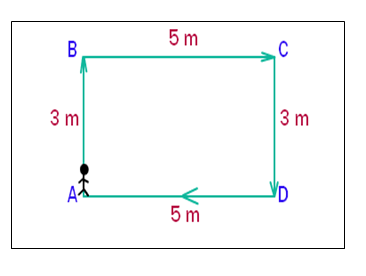
Find the distance Sara walks from A to B,  B to C then C to D?
a)
11m
b)
3m
c)
5m
21.
A quantity that has both magnitude and direction is called a scalar quantity.
a)
True
b)
False
22.

Another word for "size" is...

a)

magnification

b)

magnetism

c)

magnitude

d)

magnanimity

23.

An example of scalar magnitude:

a)

velocity

b)

mass

c)

acceleration

d)

force

24.
This is speed in a specific direction.
a)
Velocity
b)
Motion
c)
Position
25.
Scott travels north 5 miles and then goes west 3 miles before coming straight back south 2 miles. What is his distance?
a)
10
b)
7
c)
8
d)
6
26.
 Jermaine runs exactly 2 laps around a 400 meter track. What is the displacement?
a)
800
b)
400
c)
0
d)
200
27.

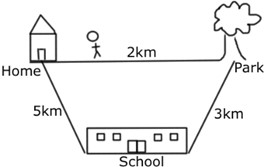
Jerry walked from home to school, then from the school to the park. What is his total distance?

a)

2 km

b)

5 km

c)

8 km

d)

10 km

28.

Jerry walked from home to school, then from the school to the park. What is his total displacement?

a)

2 km

b)

5 km

c)

8 km

d)

10 km

29.
A person walks 50 meters directly north, stops, and then travels 32 meters directly south.  What is their displacement?
a)
82 meters
b)
18 meters
c)
28 meters
30.

A person walks 50 meters directly north, stops, and then travels 32 meters directly south.  What is their distance?
a)
82 meters
b)
18 meters
c)
28 meters
31.
Sara walks from Point A to Point B. Which is true?
a)
Distance and displacement are EQUAL
b)
Distance is less than displacement
32.

A swimmer swims 3 back and forth laps in a 50 m Olympic size swimming pool.

Distance = ____________________

Displacement =______________________

a)

300 m; 0 m

b)

150 m; 0 m

c)

0 m; 150 m

d)

0 m; 300 m

33.

What is the total displacement at the end of 16 seconds?

a)

0 meters

b)

16 m

c)

8 m

d)

24 m

34.

What is the total distance traveled at the end of 16 seconds?

a)

0 meters

b)

16 m

c)

8 m

d)

24 m

35.
Which runner won the race?
a)
Albert
b)
Bob
c)
Charlie
36.
What is the velocity?
a)
positive
b)
negative
c)
decreasing
d)
increasing
37.
What is the velocity?
a)
not moving
b)
increasing
c)
positive
d)
negative
38.
What kind of acceleration is shown here?
a)
none
b)
positive
c)
negative
d)
varies
39.
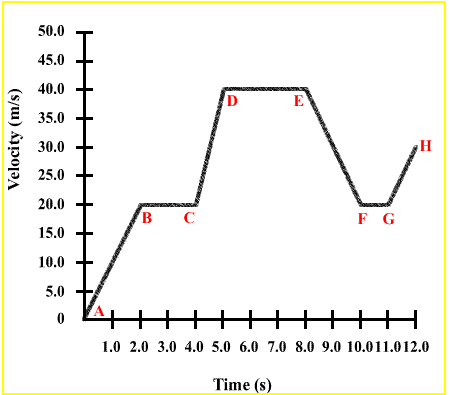
Which section of the graph shows constant velocity?
a)
AB
b)
BC
c)
EF
d)
GH
40.

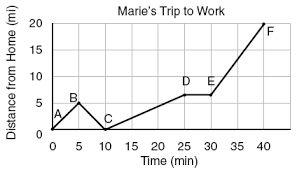
When was Marie driving the fastest?

a)

C to D

b)

D to E

c)

E to F

41.
What is the standard unit force is measured in?
a)
Newtons
b)
pounds
c)
grams
d)
meters
42.
What is Newton's First Law known as? The Law of
a)
Friction
b)
Mass
c)
Inertia
d)
Gravity
43.
What is the formula for force?
a)
F=M/A
b)
F=MA
c)
F=AX
d)
what is force?
44.
What is Newton's Third Law?
a)
Object in motion stays in motion and an object at rest stays at rest unless acted on by a outside force
b)
Force = mass x acceleration
c)
For every action there is an equal and opposite reaction
45.
Slamming on the brakes in a moving car makes a passenger move forward against his or her seat belt because
a)
the passenger has the inertia to keep moving forward
b)
the passenger is being pushed by the seats of the car
c)
the passenger is better able to stop themselves in this manner
d)
the passenger has an equal and opposite force supporting their weight
46.

A push or pull acting on an object.

a)

Gravity

b)

Force

c)

Friction

d)

Acceleration

47.

An object’s motion won’t change unless acted upon by a force.

a)

Newton’s 1st Law

b)

Newton’s 2nd Law

c)

Newton’s 3rd Law

d)

Gravity

48.

Heavier objects need a larger force to make them move.

a)

Newton’s 1st Law

b)

Newton’s 2nd Law

c)

Newton’s 3rd Law

d)

Force

49.

A force that pulls objects down towards the Earth.

a)

Gravity

b)

Force

c)

Newtons 1st Law

d)

Newtons 2nd Law

50.

A force resulting from two objects rubbing against each other.

a)

Gravity

b)

Friction

c)

Force

d)

Air Resistance

51.

A force caused by air, acting in the opposite direction of a moving object.

a)

Air Resistance

b)

Friction

c)

Gravity

d)

Force

52.

A force caused by air, acting in the opposite direction of a moving object.

a)

Air Resistance

b)

Friction

c)

Gravity

d)

Force

53.

The speeding up of an object.

a)

Friction

b)

Acceleration

c)

Force

d)

Gravity

54.

When two forces on an object cancel each other out, they do not affect the motion of the object.

a)

Unbalanced Force

b)

Balanced Force

c)

Friction

d)

Gravity

55.

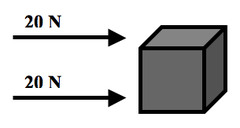
These forces are...

a)

Balanced

b)

Unbalanced

56.

These forces are...

a)

Balanced

b)

Unbalanced

57.
As mass increases, what happens to gravitational force?
a)
increases
b)
decreases
c)
stays the same
d)
i don't know
58.
You and your dad are moving the couch from one side to another. Your dad pushes with a force of 35 N to the right and you push with a force of 25 N right. What is the net force on the couch?
a)
60 N right
b)
10 N left
c)
60 n right
d)
50 N left
59.
What is the net force?
a)
40 N left
b)
0 N Balalnced
c)
400 N right
d)
40 N right
60.
What is the net force?
a)
400 N Up
b)
400 N Down
c)
- 400 N Down
d)
800 N Down
61.
How will this object move? 
a)
It won't move. 
b)
It will move to the right. 
c)
It will move to the left. 
d)
It will move up. 
62.
When the resulting force is greater than zero what type of force is acting on the objects? 
a)
balanced force
b)
unbalanced force
63.

The sum of all forces acting on an object is

a)

balanced.

b)

unbalanced.

c)

friction.

d)

the net force.

64.
You push on a tree with 20 N of Force. If the tree doesn't move, the tree is pushing back on you with _____of Force.
a)
20 N 
b)
40 N 
c)
10 N 
d)
0 N
65.
What are balanced forces?
a)
forces of the same size, in opposite directions
b)
the same size in the same direction
c)
forces in opposite directions
d)
forces at right angles to each other
66.
What is the net force?
a)
17 N Right
b)
3 N Right
c)
3 N Left
d)
17 N Left
67.
If a 10 kilogram object accelerates suddenly at 15 m/s^2, how much force was applied to the object?
a)
150 Newtons
b)
15 Newtons
c)
150 kilograms
d)
100 kilograms
68.

If a force of 50 Newton's was applied to an object with a mass of 500 grams, what will the object's acceleration be? (HINT - UNITS!)

a)

10 m/s^2

b)

.1 m/s^2

c)

100 m/s^2

d)

1 m/s^2

69.
If an object was accelerating at 10 m/s^2, and a force of 10 newtons was required to accelerate it, what was the object's mass?
a)
1 kilogram
b)
10 kilograms
c)
2 kilograms
d)
5 kilograms
70.
If a force of 26 N is exerted on two balls, one with a mass of 0.52 kg and the other with a mass of 0.78 kg, which ball will have the greater acceleration?  (F=ma)
a)
The one with a mass of .78 kg will have the greatest acceleration.
b)
The one with a mass of .52 kg will have the greatest acceleration.
c)
They will both accelerate at the same rate.
71.
Acceleration is caused by a force acting on a mass.
a)
Newton’s first law of motion
b)
Newton’s second law of motion
c)
Newton’s third law of motion
72.
Forces always act in equal and opposite pairs.
a)
Newton's 1st Law
b)
Newton's 3rd Law
c)
Newton's second law
73.

Which of these is the correct equation to relate impulse to force in a collision?

a)

J=FΔvJ=F\Delta v  

b)

J=pfp0J=p_f-p_0  

c)

J=FΔtJ=F\Delta t  

d)

F=JΔtF=J\Delta t  

74.

What must be true for momentum to be conserved in a collision?

a)

total initial momentum is greater than total final momentum

b)

momentum of object 1 is equal to momentum of object 2

c)

total initial momentum is equal to total final momentum

d)

momentum of object 1 is less than momentum of object 2

75.

F=ma. If force is kept the same but the mass is doubled, then the acceleration will....

a)

stay the same

b)

be halved

c)

be doubled

d)

be zero

76.

What is the Equation for Weight?

a)

Weight = Mass x Gravitational Field Strength

b)

Weight = Mass / Gravitational Field Strength

c)

Weight = Gravitational Field Strength / Mass

77.

An object has a weight of 230N on the moon where the acceleration of gravity is 1.6m/s/s. What is the mass of the object?

a)

299kg

b)

0.007kg

c)

141.9 kg

d)

233 kg

78.

An object of 30kg has a weight of 830N on an unknown planet. What is the gravitational acceleration of this planet?

a)

27.6 m/s2

b)

24900 m/s2

c)

0.04 m/s2

d)

Nobody cares!

79.

This object would be moving (pick all that are correct):

a)

up

b)

down

c)

left

d)

right

80.

A roller coaster is moving at 25 m/s at the bottom of a hill. Three seconds later it reaches the top of the hill moving at 10 m/s. What was the acceleration of the coaster?

a)

-5 m/s2

b)

5 m/s2

c)

9.33 m/s2

d)

-9.33 m/s2

81.

Mark slams on the brakes after traveling 25 m/s. It takes him 3 seconds to come to a complete stop. What is his acceleration?

a)

8.33 m/s2

b)

-8.33 m/s2

c)

75 m/s2

d)

-75 m/s2

82.

The elevators in the Landmark Tower, in Yokohama, Japan are among the fastest in the world. They accelerate upward at 3.125 m/s2 for 4.0 s to reach their final speed. If these elevators start from rest, what is their final speed?

a)

0.781 m/s

b)

7.125 m/s

c)

1.28 m/s

d)

12.5 m/s

83.

Saki is ice-skating to the left with a velocity of 5 m/s, . A steady breeze starts blowing, causing Saki to accelerate leftward at a constant rate of 1.5 m/s2

After 6 s what is Saki's velocity?
Answer using a coordinate system where rightward is positive.

a)

-1.25m/s

b)

-14m/s

c)

14m/s

d)

1.25m/s

84.

A speedy rabbit is hopping to the right with a velocity of 4.0 m/s when it sees a carrot in the distance. The rabbit speeds up to its maximum velocity of 13 m/s with a constant acceleration of 2.0 m/s2

How many seconds does it take the rabbit to speed up from 4.0 m/s to 13 m/s?

a)

0.0s

b)

9.0 s

c)

4.5 s

d)

2.0 s

85.

A bicyclist is riding to the left with a velocity of 14 m/s After a steady gust of wind that lasts 3.5 s the bicyclist is moving to the left with a velocity of 21 m/s

Assuming the acceleration is constant, what is the acceleration of the bicyclist?
Answer using a coordinate system where rightward is positive.

a)

-2m/s2

b)

0m/s2

c)

2 m/s2

d)

4m/s2

86.
A runner has a momentum of 670 kg m/s and is traveling at a velocity of 9 m/s. What is his mass?
a)
6030 kg
b)
0.0134 kg
c)
74.4 kg
d)
80 kg
87.

A 5 N force is applied to a 3 kg ball to slow it down from 9 m/s to 3 m/s. What is the impulse on the ball?

a)

-2.5 N⋅s

b)

-10 N⋅s

c)

-18 N⋅s

d)

-45 N⋅s

88.

A boy kicks a football with a force of 20 N, the time the force acts for is 0.3 s. Calculate the impulse on the ball.

a)

1 N⋅s

b)

6 N⋅s

c)

33.3 N⋅s

89.
The impulse-momentum theorem states that
a)
the impulse on an object is equal to the change in momentum it causes 
b)
the force on a moving object is equal to the magnitude of the impulse.
c)
the impulse on an object is greater than the change in momentum it causes 
d)
the impulse on an object is less than the change in momentum it causes
90.
In this type of collision, objects tend to "stick" together.
a)
elastic
b)
inelastic 
c)
They "stick" together in both types of collisions
91.
Which object listed below has the greatest momentum?
a)
A 0.05 kg object rolling at 0.2 m/s.
b)
A 0.15 kg object rolling at 2 m/s.
c)
A 0.15 kg object rolling at 1 m/s
d)
A 0.4 kg object rolling at 2 m/s.
92.
In a physics experiment, two carts of mass 1.5 kg each are rolled towards each other.  The orange cart has a velocity of 2 m/s and the blue cart has a velocity of -1m/s.  The carts stick together when they collide.  Calculate their final speed.
a)
0.5 m/s
b)
1.0 m/s
c)
0.33 m/s
d)
0.67 m/s
93.

A 0.25kg ball strikes a 1.25kg ball at rest. After the collision the 0.25kg ball is moving with a velocity of 18m/s

and the second ball is moving with a velocity of 9m/s. What is the initial velocity of the first ball?

a)

63 m/s

b)

78 m/s

c)

103 m/s

d)

44 m/s

94.

When the speed of an object is doubled, its momentum...

a)

remains unchanged in accord with the conservation of momentum.

b)

doubles.

c)

quadruples.

d)

decreases.

95.
An 1 kg object moving to the right at 2 m/s collides inelastically with a 1 kg object moving to the left at 2 m/s. The final velocity of both objects will be 
a)
0 m/s
b)
1 m/s
c)
2 m/s
d)
4 m/s
96.
A dart with a mass of 0.5kg is thrown at 15m/s and sticks into a 1kg apple hanging on a string.  What is the velocity of the dart and apple just after the dart is embedded
a)
0 m/s
b)
5 m/s
c)
10 m/s
d)
15 m/s
97.
While playing pool, the white cue ball strikes the 8 ball. Before the collision, the cue ball's velocity was 10 m/s and the 8 ball was at rest. If both ball's have a mass of 0.15 kg and the cue ball's velocity after the collision is 2 m/s, what is the 8 ball's velocity?
a)

2 m/s

b)

8 m/s

c)

-2 m/s

d)

1.5 m/s

98.
A 2.2 kg ball travels at 4.5 m/s and strikes a stationary 5.0 kg ball. The 2.2 kg ball stops and transfers all momentum to the 5.0 kg ball. What is the new speed of the 5.0 kg ball?
a)

A. 25.0 kg

b)

B. 1.98 m/s

c)

C. 5 N*s

d)

D. 1.8 kg * m/s

99.

Julia jumps straight upward on Mars, where the acceleration due to gravity is 3.7 m/s After 3 s Julia is falling downward with a velocity of 3.1 m/s

Assuming air resistance is negligible, what was the initial vertical velocity of Julia's jump?
Answer using a coordinate system where upward is positive.

a)

-9.8 m/s

b)

-8 m/s

c)

9.8 m/s

d)

8m/s

100.

A canoe is drifting left toward a hungry hippo with a velocity of 7 m/s. The canoe rider starts paddling frantically, causing the canoe to travel to the right with a constant acceleration of 6 m/s2

After 4 s, what is the velocity of the canoe?
Answer using a coordinate system where rightward is positive.

a)

10.5 m/s

b)

17m/s

c)

0 m/s

d)

-17m/s

101.

Isabella drops a pen off her balcony by accident while celebrating the successful completion of a physics problem.

Assuming air resistance is negligible, how many seconds does it take the pen to reach a speed of 19.62 m/s?

a)

1 s

b)

2 s

c)

3 s

d)

4 s

102.

Isabella drops a pen off her balcony by accident while celebrating the successful completion of a physics problem.

Assuming air resistance is negligible, how many seconds does it take the pen to reach a speed of 19.62 m/s?

a)

1 s

b)

2 s

c)

3 s

d)

4 s