
 Worksheets
Unit 1 Part 1
Total questions: 86
Worksheet time: 2hrs 18mins

Molecules in cold things move more _________
than in hot things.
quickly
slowly
speedy
Rapidly

Which direction will the heat flow while this person holds a hot cup of tea?
from the cup to her hand
from her hand to the cup
no heat is transferred
Heat does not move

When two things are the same temperature:
They have the same number of molecules
Their molecules stop moving
Their molecules move at the same average speed
Heat transfer between the two things stops

Absolute zero is shown as 0 on which scale?
Fahrenheit
Celsius
Kelvin
Centigrade

Which of the following is true of the Celsius scale?
212o is the boiling point of water
0 degrees is absolute zero
0 degrees is the freezing point of water
32o is the freezing point of water
One common application of thermal energy is
a toaster oven
a microwave oven
a refrigerator
a thermometer
You have two identical stuffed animals in your room. One in the shade and one in the direct sunlight of the window. What happens to the thermal energy of the two stuffed animals.
The one in the shade will have less thermal energy and the one in the sunlight will obtain more thermal energy.
More thermal shade, less thermal in the sunlight.
Both will have the same because they are identical having the same amount of mass.
The both will raise temperature and thermal energy about 15 degrees, just the one in the shade will take less time to reach the top temperature.
Define Thermal Energy
The average kinetic energy of all particles in a substance.
The flow or exchange of thermal energy to another substance.
The total amount of kinetic energy contained in the atoms of a substance.
The amount of heat transfer from one system to another.
Which type of chemical reaction is found to create an ice pack for a sport injury.
Exothermic
Endothermic
Closed System
Thermal Energy
The measure of the average kinetic energy of all molecules in a sample of matter.
Heat
Thermal Energy
Radiation
Temperature
Which of the following would contain molecules with the greatest average kinetic energy?
Water vapor from your breath on a cold night.
A snow ball
Ice on a pond
A glass of hot coco
If the molecules in an object begin to move faster, their average kinetic energy will __________and the object's temp. will ___________.
Increase, rise.
Increase, fall.
decrease, rise.
decrease, fall.
Which of the following helps explain why salt dissolves more rapidly in hot water than in cold water?
The salt and hot water form bonds
The salt reacts best with water
The salt breaks down into smaller molecules in hot water instead of cold water.
The greater motion of hot water molecules causes the salt molecules to spread out more quickly.
Identify the system and the surroundings in our class lab with the two baggies of chemicals mixed together?
Outside the bag is the system, Surroundings are the chemicals inside.
Chemicals inside are the system, outside of the bag is the surroundings.
School Building is the system, State of Missouri is the surroundings.
USA is the system, and the World is the surroundings.
Heat is often measured in units called _____.
temperature
degrees
pounds
calories
In this state of matter the molecules are spaced very far apart from each other and move freely through space.
liquid
solid
plasma
gas
In this state of matter the molecules are in constant contact with one another, but they can move around freely.
liquid
solid
plasma
gas
In this state of matter the molecules vibrate in place, but they do not change positions relative to each other.
liquid
solid
plasma
gas
In this state of matter molecules move the fastest.
liquid
solid
plasma
gas
In this state of matter molecules move the slowest.
liquid
solid
plasma
gas
When molecules in an object move faster, they have more _______.
potential energy
kinetic energy
mass
volume
This potential energy of a molecule is stored ...
in the atoms of the molecule.
in the air around the molecule.
in a vacuum within the molecule.
in the bonds between atoms.
The total kinetic and potential energy of the molecules in an object is known as _______.
thermal energy
total energy
energy of the universe
its power to work
Energy is defined as
power
food
ability to produce heat
ability to do work or cause change

The diagram above represents a thermometer. Which of the following best explains how the thermometer works?
Liquid changes to a gas when heated.
Gas changes to a liquid when heated.
Liquids expand when heated and contract when cooled.
Liquids contract when heated and expand when cooled.
The three scales used to measure temperature are
metric, American and wrong
Celsius, Fahrenheit, and Calvin
Celsius, Fahrenheit, and Kelvin
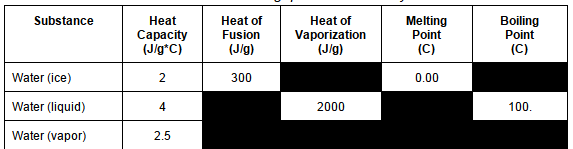
The heat absorbed while a solid is melting is known as....
heat of fusion
heat of solid
heat of liquid
heat of vaporization
Calculate the energy needed to completely boil away 30 g of water at 100 ⁰C .
67,800 J
2260 J
226,000 J
100 J
Which of the following best explains why the sand at the beach is hotter than the water?
Sand has a higher specific heat than water.
Sand has a lower specific heat than water.
There is more water than sand at the beach.
There is more sand than water at the beach.
Using the heat equation, what would the formula look like if we were solving for change in temperature?
Q m = ∆T C
Q / (m C) = ∆T
Q m / C = ∆T
m c Q = ∆T
20 g of water. specific heat of water is 4.18 J/g°C. temperature changes from 25° C to 20° C, what will the value of q be?
positive
negative
equilibrium
q does not exist
What letter do we use to represent mass?
Q
m
c
ΔT
The unit for mass is
g
J
J/gC
°C
What does ΔT represent?
tf −ti
ti −tf
t - celsius
celsius - t

Temperature when a substance changes from a liquid to a gas
Heat of Vaporization
Boiling point
Heat Energy
Phase change
What is the heat of vaporization (Qv)?
The heat required to make Vick's Vapor Rub.
The heat required to change 1 gram of a substance between a liquid and a solid.
The heat required to change 1 gram of a substance between a liquid and a gas.
The Law of Conservation of Energy states:
energy can be created and destroyed and changed
energy can be created but not destroyed and simply changes forms
energy cannot be created or destroyed it simply changes forms
What are the 2 things that determine whether something is a solid, liquid, or a gas?
the color of the matter
the motion of the particles in the matter
the forces between the particles of matter
the matter's ability to react with other matter
When particles in matter move faster, they move farther apart. What happens to the attractive forces holding the particles together?
the attractive forces get stronger
the attractive forces get weaker
the attractive forces do not change
there is not enough information to answer this question
Which of the following are properties of a solid? There is more than one correct answer.
definite shape
definite volume
particles are packed tightly together
attractive forces between particles are strong
What are the properties of a liquid? There is more than one correct answer.
definite shape
definite volume
attractive forces between particles are weaker than in a solid
take the shape of the container they are in
What are the properties of gasses? There is more than one correct answer.
definite shape
definite volume
particles are moving very quickly
particles are very far apart
In which state of matter are particles moving the fastest?
solid
liquid
gas
Evaporation is the change in state of a
gas to a liquid
gas to a solid
solid to a liquid
liquid to a gas

In which state are the distances between the particles greatest?
Both gas and liquid
Liquid
Gas
Solid

Particles of a liquid
are tightly packed together and stay in a fixed position.
are free to move around one another but still touch.
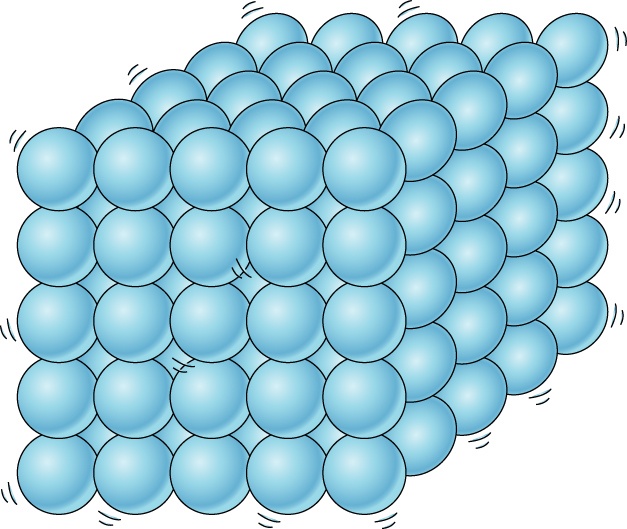
What state of matter?
Solid
Liquid
Gas
Plasma!!!
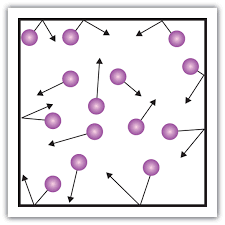
What state of matter?
Solid
Liquid
Gas

What is the definition of matter?
Anything that has mass and takes up space
A substance that is liquid, solid, or gas
Anything that is pure
Anything that you can see or hold
What term means "take up space"
Volume
Matter
Mass
Substance

Sophia combines a black liquid and a clear liquid. She observes that the two liquids do not mix. Sophia allows the mixture to settle for 30 minutes.
Which of the statements below best describes the properties of the two liquids?
The clear liquid is less dense than the black liquid.
The clear liquid is more dense than the black liquid.
The volume of the clear liquid is less than the black liquid.
The volume of the clear liquid is greater than the black liquid.

John fills a graduated cylinder with 50 mL of water. He then drops a 60g key into the graduated cylinder. The water level inside the graduated cylinder rose to 53 mL as shown below.
If Density = Mass / Volume, what is the density of the key ?
60 g/mL
20 g/mL
2.05 g/mL
0.05 g/mL

1. When ice melts. Its particles
gain energy and begin to move
lose energy and begin to move
move far apart and gain energy
close together and lose energy
Which of the following is the correct definition of density?
The amount of stuff in an object
The amount of space an object takes up
A measure of the force of gravity on an object
The amount of matter (mass) packed into a space (object)

Which object has the highest density in this picture?
A
B
C

Which object has the lowest density in this picture?
A
B
C

You calculated the density of an unknown substance to be 7.8g/cm3. According to the chart, which of the substances doe you most likely have?
Zinc
Copper
Tin
Iron
What is the density of an object with a mass of 3g and a volume of 1cm3? (Hint: Density = mass / volume)
1/3 g/cm3
3 g/cm
3 g/cm3

What is the formula for density?
density = mass / volume
density = volume / mass
density = mass x volume
density = mass + volume
What do substances less dense than water do?
Sink in water
Float on water
Dissolve in water
Freeze in water
Calculate the volume
Starting volume = 25mL
Final Volume = 30mL
55mL
5mL
15mL
10mL
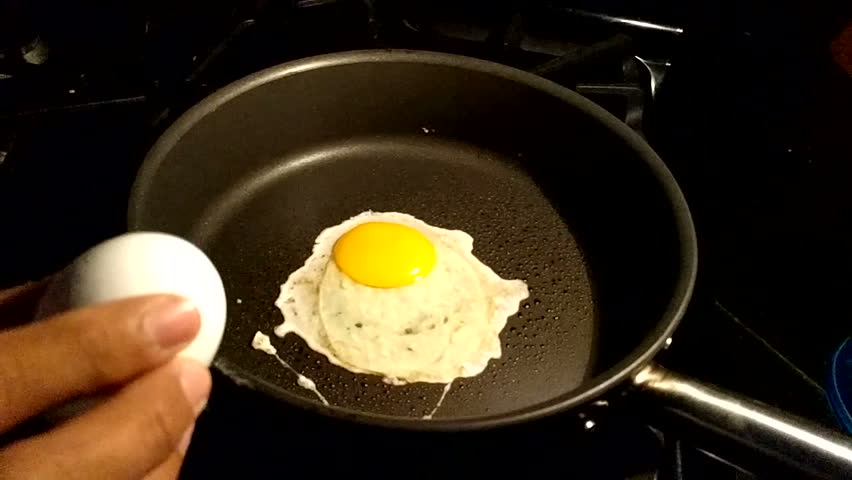
Baking bread and cooking an egg are examples of....?
Endothermic processes
Exothermic processess

