
Font size
 Worksheets
Q1 Midterm Review
Total questions: 94
Worksheet time: 1hrs 22mins
Which of these is NOT a metric unit?
Seconds
Grams
Meters
Ounces
The variable that you change in the experiment.
Independent
Dependent
Control
Control Group
The variable that you measure in the experiment.
Independent
Dependent
Control
Control Group
The variables that do not change in an experiment are called
Independent
Dependent
Controls
Control Group
The variable that changes because you changed the other variable. (This is the data you collect.)
Independent
Dependent
Control
Manipulated
Good experiments should have more that one tested variable.
True
False

Matias wanted to see if his dog would lose weight if he took the dog for a walk twice a day instead of just once a day. What is the independent variable in this situation?
The breed of dog
The dog's weight
How many times they go for a walk each day
How fast they walked
Matias wanted to see if his dog would lose weight if he took the dog for a walk twice a day instead of just once a day. What is the dependent variable in this situation?
The breed of dog
The dog's weight
How many times they go for a walk each day
How fast they walked

Independent variable is the one controlled by the experimenter ex: time, date, depth, temperature.... and is placed on the _____ axis of a graph
z
y
x
not on a graph
Dependent variable is the data resulting FROM the change made by the experimenter and is placed on the _____ axis
z
y
x
not on a graph
What type of graph would you make to show how many of your classmates were born in each month of the year?
line
bar
circle
scatter plot

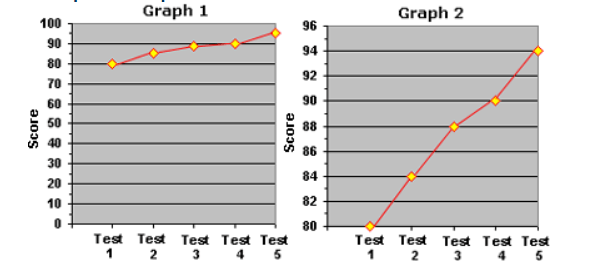
A sneaky student wants to impress his parents by showing them a graph of his performance progress on the last 5 science tests.
Which graph should he use to impress his parents?
Graph 1
Graph 2
Neither
Both
You want to make a graph for an experiment you did about plant growth over a two week period of time. What type of graph would you use?
Column graph
Line graph

What conclusions can you draw from this graph?
The deer population went down over time.
The deer population went up over time.
The dear population went up quickly, then down, but then stayed the same.
There are less dear because of hunters

Which of the following could be most helpful when you want to analyze your data?
Test your hypothesis over again
Stare at the numbers and hum until you see a pattern
Make your data into a graph
State the problem

How many meters in a kiloliter?
.001
10
100
1000
How many milligrams in a gram?
1
10
100
1000
1234 mL = _____ L
1.234
.1234
12.34
123.4
A ___ is a possible explanation for a set of observations or answer to a scientific question; must be testable.
hippopotomus
hypochondriac
hypothesis
hypothyroid
_________________ is shown in the form of tables, graphs, or scientific logs and records.
Materials
Variables
Data
CER

A gray elephant stampeding across the Savannah is an example of a observation.
Quantitative
Qualitative
Neither quantitative nor qualitative

Steve used a ruler to measure the length of a cube. He found the cube to be 3 cm. This is an example of a observation.
Quantitative
Qualitative
Neither qualitative nor quantitative

What kind of observation is in the picture?
Quantitative
Qualitative
Neither quantitative nor qualitative
"A spaghetti noodle can hold pennies" is an example of a observation
Quantitative
Qualitative
Neither quantitative nor qualitative
"A spaghetti noodle can hold 12 pennies" is an example of a observation
Quantitative
Qualitative
Neither quantitative nor qualitative
There were 17 boys and 12 girls on the yellow school bus.
Quantitative
Qualitative
Both
Neither

What are observations made using our five senses called?
Qualitative data
Quantitative data
The ocean water looked bluish green.
Qualitative
Quantitative

The bearded iris smells sweet.
Qualitative data
Quantitative data


The penguin got pushed in.
Qualitative Observation
Inference
Quantitative Observation
Hypothesis

The penguins are black and white.
Qualitative Observation
Inference
Hypothesis
Quantitative Observation

There are 29 students in the classroom.
quantitative observation
qualitative observation
inference
hypothesis

The boy is probably sad...
Qualitative Observation
Hypothesis
Inference
Quantitative Observation

Observation or Inference
observation
inference

Which statement is qualitative observation?
There are four glasses total in the picture.
The chicks are yellow.
There are 8 legs in the picture.
There are 4 beaks in the picture.

What kind of observation is this? A Phineas and Ferb episode is 45 minutes long.
qualitative observation
quantitive inference
Formatted in an "If...Then..." statement.
Results
Research
Hypothesis
Define the problem/Question
Group in the experiment that recieves the variable being tested.
Control Group
Controlling Group
Independent Group
Experimental Group
The group that DOES NOT receive the experimental treatment.
Control Group
Experimental Group
Party Group
Sad Group

What is wrong with this graph? Select all that apply.
X and Y axes are not labeled.
There are no units on the graph labels.
The title is irrelevant.
The scales are bad.
The graph is perfect.

What is the relationship?
Positive
Negative
Null
There is not enough data
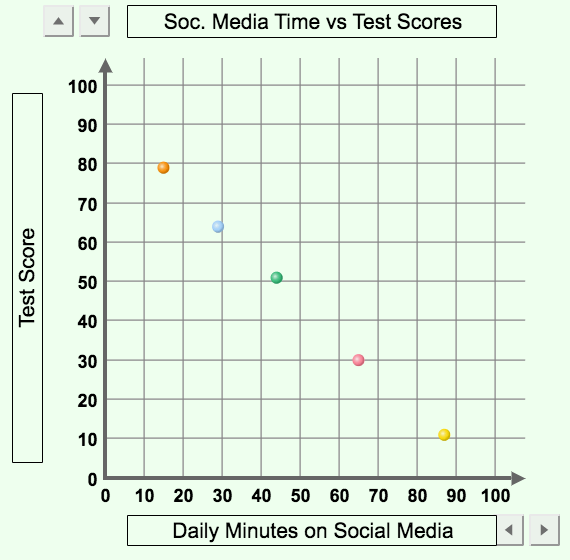
Look at the relationship between time spent on social media, and school test performance.
What type of relationship is being displayed?
Positive
Negative
Diagonal
Null
The formula used to calculate density is...
D= mv
D=m/v
D=v/m
D= m + v
A plastic dinosaur has a mass of 5g and a volume of 125 cm3 What is the dinosaur's density?
625 g/cm3
130 g/cm3
0.04 g/cm3
25 g/cm3
Explains WHY things behave the way they do - it is an explanation of a set of related observations or events based on a proven hypothesis and verified multiple times.
Scientific Question
Scientific Law
Scientific Theory
Scientific Supposition
Explains HOW things behave - description of what happens in nature. Often expressed as a mathematical formula.
Scientific Question
Scientific Law
Scientific Theory
Scientific Supposition

Which passenger has the most potential energy?
A
B
C
D
Conservation of energy means that
energy can be created but not destroyed
energy can be destroyed but not created
energy can both be created and destroyed
energy can neither be created nor destroyed
Which is the best example that something has kinetic energy?
a car parked on a steep hill
a tennis ball rolling across the court
a picture hanging on the wall
a piece of coal before it's burned
The ability to do work or cause change describes
A Job
Energy
Temperature
Heat
Complete the following sentence. The ________________ an object moves, the more ____________________ energy it has.
slower ... potential
faster .... kinetic
faster ... potential
slower ... kinetic
Thermal energy is the __________ _________ energy of moving particles
total potential
average potential
average kinetic
total kinetic
Temperature is the __________ _________ energy of moving particles
average potential
average kinetic
total potential
total kinetic
Law of Conservation of Mass says...
Energy is always created and destroyed
Energy is only in hot things
Energy can be destroyed easily
Energy cannot be created or destroyed
As temperature increases, molecules _____________
move slower
move the same
move faster
stop moving


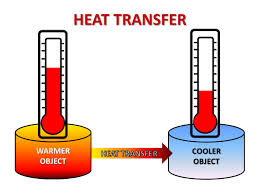
Which has more thermal energy?
teaspoon of boiling water
bowl of boiling water
bathtub of boiling water
All matter is made of _________.

The subatomic particles that make up an atom.
solid, liquid, gas
electrons, protons, nucleus
energy, protons, nucleus
electrons, protons, neutrons
A chemical change
changes matter from one form to another.
destroys matter.
creates matter
does not change matter in any way.
Which of the following is a physical change?
Iron is oxidized to iron oxide
Aluminum metal is pounded into thin sheets
Copper reacts with a strong acid
Sodium metal explodes on contact with water
Diane draws a picture on a piece of paper and then folds it into a paper airplane. She throws it at her little brother, and it hits him in the head. He responds by ripping up the paper. Which of the following is an example of a physical change?
ripping up the paper
folding the paper into an airplane
drawing on the paper
all of these
Removing energy (cooling) causes the atoms to
spread apart
move closer together
get larger
get smaller

What phase change occurs due to losing heat energy?
freezing

Three containers with the same amount of the same material are shown below. Which container has the substance with the highest amount of energy?
The container on the left
The middle container
The container on the right
All have an equal amount of energy
Three containers with the same amount of the same material are shown below. Which container has the substance with the lowest amount of energy?
The container on the left
The middle container
The container on the right
All have an equal amount of energy

Directions: The table below shows the temperatures of several different objects made of the same material. Use the table to answer the question below.
What will happen if the ball is placed inside the box, in a closed system?
Thermal energy will flow from the ball into the box until they come to the same temperature at 50°C.
Thermal energy will flow from the box into the ball until they come to the same temperature at 25°C.
Thermal energy will flow from the ball into the box until the box decreases in temperature to 20°C.
Thermal energy will flow from the box into the ball until the ball increases in temperature to 30°C.

