wayground logo

Free Printable Worksheets

Font size

S
M
L
XL
Worksheets

Unit 1 Review

Total questions: 156

Worksheet time: 7hrs 48mins

Name
Class
Date
1.

You know 1000 mg = 1 g. Convert 2.5 grams into milligrams.

a)

25 mg

b)

25,000 mg

c)

250 mg

d)

2500 mg

2.

Which unit of measurement is greatest?

a)

decimeters

b)

millimeters

c)

centimeters

d)

kilometers

3.
5000 millimeters = ____ meters
a)
5
b)
50
c)
500
d)
25
4.
1800 milligrams = ___ grams
a)
1.8
b)
18
c)
180
d)
.18
5.
1000 g= ______ kilogram(s)
a)
1
b)
10
c)
100
d)
1000
6.
1 L = _______ mL
a)
1
b)
10
c)
100
d)
1000
7.
convert 650 m to km
a)
6.5
b)
0.65
c)
65
d)
0.065
8.
1 cm = ________mm
a)
1
b)
100
c)
10
d)
1000
9.
71 km = ___ m
a)
71
b)
710
c)
7,100
d)
71,000
10.
Is 4,000 mg greater than, less than, or equal to 4 g?
a)
greater than
b)
less than
c)
equal to
11.
648 g = ____ mg
a)
6,480
b)
64,800
c)
648,000
d)
64.8
12.

Which is the largest unit measure listed

a)

Milligram

b)

Kilogram

c)

Hectogram

d)

Centigram

13.
Convert into kilometers.
452.159 meters.
Round to the nearest thousandth.
a)

0.452

b)

4.52

c)

45.2

d)

.4522

14.
Convert into grams.
763.1247 milligrams.
a)
7631.247
b)
76312.47
c)
0.7631247
d)
7631247
15.
Convert into centimeters.
25.12 meters.
a)
2512
b)
2.512
c)
0.2512
d)
0.2512
16.
Convert 0.085m to mm
a)
0.850
b)
8.50
c)
850
d)
85
17.
Convert 1.7 km to m
a)
1700
b)
17
c)
170
d)
0.17
18.
There are ___ meters in 25 kilometers (km)
a)
250 m
b)
2500 m
c)
25000 m
d)
.025 m
19.
Convert from meters to cm:  9 meters
a)
900 cm
b)
90 cm
c)
0.9 cm
d)
0.09 cm
20.
Convert 300 meters to centimeters:
a)
3000 cm
b)
0.3 cm
c)
30,000 cm
d)
3 cn
21.
How many cm's is in a meter?
a)
1000
b)
10
c)
100
d)
1
22.

What is 5m/s in km/h?

a)

18 km/h

b)

0.014 km/h

c)

3 600 km/h

d)

0.005 km/h

23.
Theory or Law???  Predicts what will happen in the natural world.
a)
Law
b)
Theory
24.
Theory or Law???  Explanation of a wide range of observations?
a)
Theory
b)
Law
25.
Theory or Law???  Makes NO attempt to explain an event.
a)
Theory
b)
Law
26.
Theory or Law???  How the universe was formed.
a)
Law
b)
Theory
27.
Theory or Law???  Newton's description on what causes things to move.
a)
Law
b)
Theory
28.
Theory or Law???  Explanation of how the dinosaurs disappeared.
a)
Law
b)
Theory
29.
Theory or Law???  Is a well-tested EXPLANATION for a wide range of observations and experimental results.
a)
Law
b)
Theory
30.
Theory or Law???  Is a DESCRIPTION of what a scientists expects to happen every time under a certain set of conditions.
a)
Law
b)
Theory
31.
True or False.  Theories change because new technology improves our ability to observe the natural world.
a)
True
b)
False
32.
True or False.  Theories describe things and laws explain things.
a)
False
b)
True
33.

A prediction that can only be supported or not supported by scientific experimentation.

a)

hypothesis

b)

theory

c)

law

34.

Explains something we see in the natural world that has been verified through repeated experiments or testing.

a)

hypothesis

b)

law

c)

theory

35.

A ___ is observed and describes in the natural world what appears to always be true.

a)

hypothesis

b)

theory

c)

law

36.

Explains HOW nature works.

a)

hypothesis

b)

theory

c)

law

37.

Based on many, many proven hypotheses.

a)

theory

b)

law

38.

Help us understand laws.

a)

hypothesis

b)

theory

c)

another law

39.

Describes how nature works.

a)

hypothesis

b)

theory

c)

law

40.
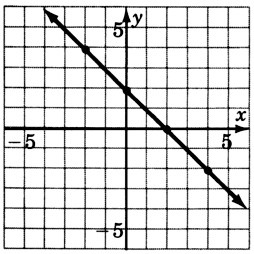
What is the y-intercept shown on the graph?
a)
(0, -2)
b)
(3, 0)
c)
(0, 3)
d)
None of these.
41.
What is the y-intercept?
a)
-2
b)
2
c)
-4
d)
4
42.
y -intercept is where the line ______________.
a)
begins
b)
crosses the x-axis 
c)
crosses the y-axis 
d)
crosses each other
43.
In the equation y=mx+b, what does the m represent?
a)
slope
b)
y-intercept
c)
linear
d)
point-slope
44.

What is the slope of the table?

a)

1/4

b)

4

c)

-6

d)

-4

45.

What is the y-intercept?

a)

-1/3

b)

3

c)

0

d)

8

46.

What is the y-intercept?

a)

-5

b)

24

c)

0

d)

3

47.
Determine the slope and y-intercept from the following equation:   y = 3/2x + 3
a)
slope: 5   y-intercept:  (0,3) 
b)
slope: 3/2   y-intercept:  (0,3) 
c)
slope:  4  y-intercept:  (0,3/2)
d)
slope: 1/5   y-intercept:  (0,5) 
48.

Which equation has the same slope and y-intercept as the graphed line?

a)
y = -1x + 2
b)
y = 1/2x + 2
c)
y = 3x -4
d)
y = -3x +2
49.
What is the slope of the line y= -4x + 10?
a)
10
b)
4
c)
-4
d)
-10
50.
What is the y-intercept of the line y = 4x - 10?
a)
4
b)
-4
c)
10
d)
-10
51.

What is the y-intercept of the line y = -3x + 12

a)

3

b)

-3

c)

-12

d)

12

52.

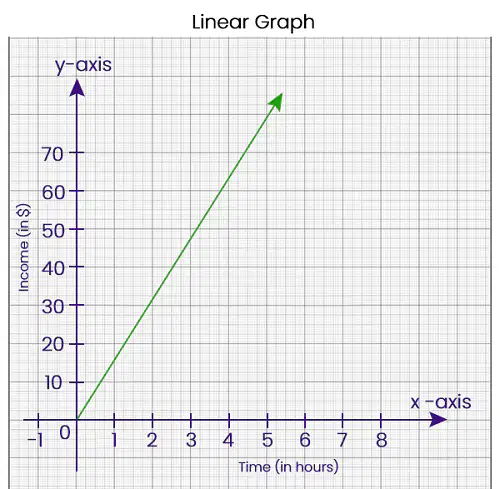
What is the slope of this graph?

a)

15

b)

15 $/hr

c)

$0

d)

10 $/hr

53.

What is the equation for this graph?

a)

y=mx+b

b)

y=15x+0

c)

I = (15 $/hr)t + 0

d)

I=mt+b

54.

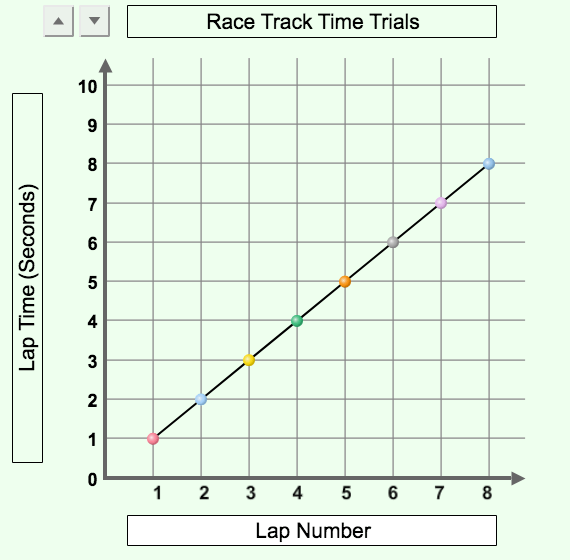
A car is timed around a race track for 8 laps. The laps are numbered in order. Look at the relationship between Lap Number and Lap Time (seconds).


What type of relationship is this?

a)

As laps increase, lap time decreases

b)

As laps increase, lap time increases

c)

There is no relationship

d)

As laps decrease, lap time increases

55.

A car is timed around a race track for 8 laps. The laps are numbered in order. Look at the relationship between Lap Number and Lap Time (seconds).


What is the slope of this graph?

a)

1

b)

1 s/#

c)

There is no slope

d)

0

56.

What is the equation for this graph?

a)

LT = (1 s/#)LN + 0

b)

y = mx + b

c)

Can't write the equation without variables

d)

y = 1x

57.
The x-axis shows
a)
time
b)
carbon dioxide concentration
c)
Mauna Loa volcano
d)
science
58.
The y-axis shows
a)
time
b)
carbon dioxide concentration
c)
Mauna Loa volcano
d)
science
59.
This data set shows that
a)
there is more CO2 in the atmosphere now than ever before
b)
Hawaii will be most affected by global warming
c)
global temperatures are rising
d)
there is more CO2 in Hawaii than anywhere else
60.

When should a line graph be used?

a)

When comparing parts of a whole

b)

When showing change over time

c)

When comparing data between different groups of categories

d)

Whenever you want

61.
The X axis is _______?
a)
vertical
b)
diagonal
c)
criss-cross
d)
horizontal
62.
The Y axis is _______?
a)
Vertical
b)
Horizontal
c)
criss-cross
d)
diagonal
63.

The independent variable is the ONE thing you _____

a)

change

b)

keep the same

c)

experiment with

d)

investigate

64.
Which of the following is a prediction based on a question?
a)
Inference
b)
Observation
c)
Hypothesis
d)
Prediction
65.
Theory or Law???  Predicts what will happen in the natural world.
a)
Law
b)
Theory
66.
Theory or Law???  Changes with new observations.
a)
Theory
b)
Law
67.
Theory or Law???  Explanation of a wide range of observations?
a)
Theory
b)
Law
68.
Theory or Law???  Is a well-tested EXPLANATION for a wide range of observations and experimental results.
a)
Law
b)
Theory
69.
Theory or Law???  Is a DESCRIPTION of what a scientists expects to happen every time under a certain set of conditions.
a)
Law
b)
Theory
70.
Another word for prediction or educated guess is: ________________
a)
hypothesis
b)
conclusion
c)
experiment
d)
data
71.
The information you record in an experiment is called your ____________.
a)
data
b)
conclusions
c)
notebook
d)
inquiry
72.
The final results and answers to your big question is shared in your ________________.
a)
conclusion
b)
hypothesis
c)
observation
d)
inquiry
73.
What observations might you make about a nearby cat?
a)
The cat is black and white.
b)
The cat is hungry.
c)
The cat is lost.
74.

What is science?

a)

Study of astrology and signs

b)

Sharing uncited opinions

c)

Asking questions and finding answers

d)

Study of essential oils

75.

What animal did the ameoba sisters feel like they needed to rescue? Hint: #team_____

a)

Mice

b)

Earthworms

c)

Cheetahs

d)

Cows

76.

A hypothesis is:

a)

a good idea

b)

always a correct explanation that can be tested

c)

a possible explanation that can be tested

d)

has been tried and tested multiple times that is correct

77.

A scientific theory is:

a)

supported by facts

b)

widely accepted

c)

tested over and over again

d)

a believable notion & 100% true

78.

A scientific theory usually graduates (turns into) a scientific law.

a)

True

b)

False

79.

A scientific law explains ____________________, and a scientific theory ___________.

a)

what/natural phenomena, why/explanation of scientific idea

b)

why/explanation of scientific idea, what/naturalphenomena

80.

You know 1000 mg = 1 g. Convert 2.5 grams into milligrams.

a)

25 mg

b)

25,000 mg

c)

250 mg

d)

2500 mg

81.

565,900 seconds into days

a)

3.5 days

b)

4 days

c)

6.5 days

d)

6 days

82.

17 years into minutes

a)

8,900,000 minutes

b)

625,000 minutes

c)

345,000 minutes

d)

476,000 minutes

83.

43 miles into feet

a)

142,086 feet

b)

325,006 feet

c)

278,090

d)

227,040 feet

84.

165 pounds into kilograms

a)

77 kilograms

b)

75 kilograms

c)

120 kilograms

d)

132 kilograms

85.

100 yards into meters

a)

91.46 meters

b)

92.54 meters

c)

87.34 meters

d)

86.23 meters

86.

2678 cm into feet

a)

84.67 feet

b)

87.86 feet

c)

92.54 feet

d)

90.67 feet

87.

60 miles per hour into meters per second

a)

28.6 meters per second

b)

28.6 meters per minute

c)

26.8 meters per second

d)

26.8 meters per minute

88.

130 meters per second into miles per hour

a)

291.56 miles per hour

b)

290.73 miles per hour

c)

290.53 miles per hour

d)

291.78 miles per hour

89.

Conversion Factors

a)

60 minutes = 1 hour; 24 hours = 1 day; 100 cm = 1 m; 12 in = 1ft; 16 oz = 1 lb

b)

Ex: Mass in grams (g), Volume in liters (L), Length in meters (m)

c)

A method used to convert units

90.
You know 1000 mg = 1 g.  Convert 2.5 grams into milligrams.
a)
25 mg
b)
25,000 mg
c)
250 mg
d)
2500 mg
91.

The Olympic record for the high jump is just over 2.6 yards. What is that distance in feet? (3 ft = 1 yd)

a)

0.867 ft

b)

7.8 ft

c)

8.07 ft

d)

8.27 ft

92.

Convert 62 miles/hour to feet/second. (5,280 ft = 1 mi)

a)

5,456 ft/s

b)

.003 ft/s

c)

91 ft/s

d)

909 ft/s

93.
Theory or Law???  Predicts what will happen in the natural world.
a)
Law
b)
Theory
94.
Theory or Law???  Changes with new observations.
a)
Theory
b)
Law
95.
Theory or Law???  Explanation of a wide range of observations?
a)
Theory
b)
Law
96.
Theory or Law???  Is a well-tested EXPLANATION for a wide range of observations and experimental results.
a)
Law
b)
Theory
97.
Theory or Law???  Is a DESCRIPTION of what a scientists expects to happen every time under a certain set of conditions.
a)
Law
b)
Theory
98.
Another word for prediction or educated guess is: ________________
a)
hypothesis
b)
conclusion
c)
experiment
d)
data
99.
The information you record in an experiment is called your ____________.
a)
data
b)
conclusions
c)
notebook
d)
inquiry
100.
The final results and answers to your big question is shared in your ________________.
a)
conclusion
b)
hypothesis
c)
observation
d)
inquiry
101.
What observations might you make about a nearby cat?
a)
The cat is black and white.
b)
The cat is hungry.
c)
The cat is lost.
102.

What is science?

a)

Study of astrology and signs

b)

Sharing uncited opinions

c)

Asking questions and finding answers

d)

Study of essential oils

103.

What animal did the ameoba sisters feel like they needed to rescue? Hint: #team_____

a)

Mice

b)

Earthworms

c)

Cheetahs

d)

Cows

104.

A hypothesis is:

a)

a good idea

b)

always a correct explanation that can be tested

c)

a possible explanation that can be tested

d)

has been tried and tested multiple times that is correct

105.

A scientific theory is:

a)

supported by facts

b)

widely accepted

c)

tested over and over again

d)

a believable notion & 100% true

106.

A scientific theory usually graduates (turns into) a scientific law.

a)

True

b)

False

107.

A scientific law explains ____________________, and a scientific theory ___________.

a)

what/natural phenomena, why/explanation of scientific idea

b)

why/explanation of scientific idea, what/naturalphenomena

108.
Why are approved eye protection devices (such as goggles) are worn in the lab?
a)
A. To improve your vision
b)
B. To make you look like a bug
c)
 C. To give you headaches
d)
 D. To protect eyes around chemicals, heat, or glassware
109.

You are in lab and your partner accidentally gets their hair stuck in a triple beam balance. What should have your partner done BEFORE beginning the lab?

a)

Worn a hat in class

b)

Skipped class

c)

Got a hair cut

d)

Tied/pulled their hair back

110.
What should you do when gathering materials for an experiment?
a)
 A. Read all directions carefully
b)
B. Check all materials for chips or cracks (or broken)
c)
Clean the materials if they seem dirty/used
d)
D. All of the above
111.
Horseplay or practical jokes in the laboratory are...
a)
always against the rules.
b)
okay.
c)
not dangerous.
d)
okay if you are working alone.
112.

When conducting an experiment in science class you shouls always follow this list of the steps anyone could follow to conduct an experiment.

a)

obervations

b)

question/problem

c)

materials

d)

procedures

113.
It is OK to start a lab before you read all the directions.
a)
True
b)
False
114.
Goggles are worn during science experiments--
a)
only if you don't have glasses
b)
to protect your eyes any time chemicals, heat or sediments are used
c)
to improve vision
d)
to avoid eye strain
115.
You have been injured in the lab (cut, burned, etc.) First you should -
a)
apply first aid yourself
b)
tell the teacher at once
c)
see a doctor after school
d)
visit the school nurse after class
116.
Cleaning up the science classroom is the job of -
a)
each student
b)
new students
c)
the teacher
d)
old students
117.
Which of the following is allowed during a Lab?
a)
Horseplay
b)
Running
c)
Gum
d)
Asking questions
118.
Always point the open end of a test tube
a)
toward yourself
b)
toward your lab partner
c)
toward another classmate
d)
away from people
119.
Never touch the eyewash or shower station unless it is a true emergency. 
a)
True
b)
False
120.
If you don't understand the directions, what should you do?
a)
Figure it out
b)
Try something until it works
c)
Ask the teacher for help
d)
Skip it
121.
Lab work should be started immediately upon entering the lab even if the teacher is not present.
a)
True
b)
False
122.

You know 1000 mg = 1 g. Convert 2.5 grams into milligrams.

a)

25 mg

b)

25,000 mg

c)

250 mg

d)

2500 mg

123.

565,900 seconds into days

a)

3.5 days

b)

4 days

c)

6.5 days

d)

6 days

124.

17 years into minutes

a)

8,900,000 minutes

b)

625,000 minutes

c)

345,000 minutes

d)

476,000 minutes

125.

43 miles into feet

a)

142,086 feet

b)

325,006 feet

c)

278,090

d)

227,040 feet

126.

165 pounds into kilograms

a)

77 kilograms

b)

75 kilograms

c)

120 kilograms

d)

132 kilograms

127.

100 yards into meters

a)

91.46 meters

b)

92.54 meters

c)

87.34 meters

d)

86.23 meters

128.

2678 cm into feet

a)

84.67 feet

b)

87.86 feet

c)

92.54 feet

d)

90.67 feet

129.

60 miles per hour into meters per second

a)

28.6 meters per second

b)

28.6 meters per minute

c)

26.8 meters per second

d)

26.8 meters per minute

130.

130 meters per second into miles per hour

a)

291.56 miles per hour

b)

290.73 miles per hour

c)

290.53 miles per hour

d)

291.78 miles per hour

131.

Conversion Factors

a)

60 minutes = 1 hour; 24 hours = 1 day; 100 cm = 1 m; 12 in = 1ft; 16 oz = 1 lb

b)

Ex: Mass in grams (g), Volume in liters (L), Length in meters (m)

c)

A method used to convert units

132.
You know 1000 mg = 1 g.  Convert 2.5 grams into milligrams.
a)
25 mg
b)
25,000 mg
c)
250 mg
d)
2500 mg
133.

The Olympic record for the high jump is just over 2.6 yards. What is that distance in feet? (3 ft = 1 yd)

a)

0.867 ft

b)

7.8 ft

c)

8.07 ft

d)

8.27 ft

134.

Convert 62 miles/hour to feet/second. (5,280 ft = 1 mi)

a)

5,456 ft/s

b)

.003 ft/s

c)

91 ft/s

d)

909 ft/s

135.
What should you do if you break glass in the lab?
a)
Tell the teacher.
b)
Sweep up the glass.
c)
Pick up the glass with your hands.
d)
Ignore it; the teacher will clean it up when she sees it later.
136.
Part of lab safety includes reading the lab procedure...
a)
before doing the lab
b)
while doing the lab
c)
after doing the lab
d)
only if you think you really need it
137.
When in the lab...
a)
long sleeves and loose clothing should be rolled up
b)
closed toe shoes should be worn
c)
long hair should be pulled back
d)
all of the above
138.
When in the lab...
a)
long sleeves and loose clothing should be rolled up
b)
closed toe shoes should be worn
c)
long hair should be pulled back
d)
all of the above
139.
You are heating a substance in a test tube. Always point the open end of the tube
a)
towards your body
b)
toward your lab partner
c)
towards another classmate
d)
away from all people
140.
You have been injured in the laboratory (cut, burn, etc.). First you should
a)
visit school nurse
b)
text your parent
c)
see a doctor after school
d)
tell teacher immediatly
141.
Know the ________________ all safety equipment including first aid kit, fire extinguisher, and eye-wash station
a)
manufacturer
b)
location and how to operate
c)
expiration date for
d)
materials used in
142.

After completing an experiment, all chemical wastes should be

a)

left at your lab station for the next class

b)

disposed of according to your instructor's directions

c)

dumped in the sink

d)

taken home

143.

Which of the following footwear is best in the laboratory?

a)

sandals

b)

rain boots

c)

closed-toed shoes

d)

heels

144.

Horseplay or practical jokes in the laboratory are

a)

always against the rules

b)

OK

c)

Acceptable if you are working alone

d)

Not a big problem as long as there are no injuries

145.
You should never ______ chemicals in the lab. 
a)
taste
b)
touch
c)
smell
d)
all of the above
146.
Keeping your work area neat and clean is important because:
a)
My teacher is a neat-freak
b)
I won't lose my supplies in the clutter.
c)
It keeps the room from looking messy.
d)
It helps prevent accidents.
147.
Keeping your work area neat and clean is important because:
a)
My teacher is a neat-freak
b)
I won't lose my supplies in the clutter.
c)
It keeps the room from looking messy.
d)
It helps prevent accidents.
148.

Broken glass can be picked up with bare hands, if you are extremely careful.

a)

True

b)

False

149.

If your lab partner gets chemicals in his/her eyes, the first thing you should do is

a)

Clean up spilled chemical

b)

Call 9-11

c)

Take them to eye wash and tell the teacher immediately

d)

Make the person sit down to calm them down

150.

Broken glass can be picked up with bare hands, if you are extremely careful.

a)

True

b)

False

151.

If your lab partner gets chemicals in his/her eyes, the first thing you should do is

a)

Clean up spilled chemical

b)

Call 9-11

c)

Take them to eye wash and tell the teacher immediately

d)

Make the person sit down to calm them down

152.

When you are smelling a chemical you should

a)

Smell it directly

b)

Waft the odor

c)

Never smell

d)

Take a big sniff

153.
Keep your work area free of all unnecessary books and papers
a)
TRUE
b)
FALSE
154.

Whose responsibility is it to help clean up the lab and classroom?

a)

1st period, the next morning

b)

custodians.

c)

each and every student.

d)

only the teacher.

155.

True or False: Laboratory work can be started immediately upon entering the laboratory even if the instructor is not yet present.

a)

True

b)

False

156.

True or False: Chipped or cracked glassware is okay to use.

a)

True

b)

False