wayground logo

Free Printable Worksheets

Font size

S
M
L
XL
Worksheets

Mrs. Vaughn's BIG Chemistry Final Exam Review

Total questions: 154

Worksheet time: 13hrs 50mins

Name
Class
Date
1.

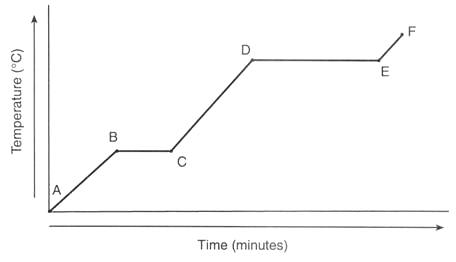
What line segment represents only the solid state? (Diagram F)

a)

A-B

b)

B-C

c)

C-D

d)

D-E

2.

Between which points is the temperature of the substance remaining constant? (Diagram F)

a)

A-B only.

b)

A-B, C-D, E-F

c)

B-C only.

d)

B-C, D-E

3.
True or false: melting and freezing occur at the same temperature!
a)
True
b)
False
c)
I don't know
4.

A substance's heating curve is shown in the graph. What is its boiling point? (Diagram B)

a)

100 C

b)

60 C

c)

80 C

d)

20 C

5.

Is the substance gaining or losing energy? (Diagram D)

a)

Gaining

b)

Losing

6.

Which line segment demonstrates vaporization occurring? (Diagram E)

a)

B-C

b)

C-D

c)

D-E

d)

E-F

7.

What will occur when the substance transitions from B to A? (Diagram A)

a)

condensation

b)

evaporation

c)

melting

d)

freezing

8.

What will occur when the substance changes from 1 atm to 30 at a constant temperature of -15oC? (Diagram A)

a)

condensation

b)

deposition

c)

melting

d)

sublimation

9.

What will occur when the substance changes from 0o C to 100oC at a constant pressure of 30 atm? (Diagram A)

a)

condensation

b)

evaporation

c)

melting

d)

freezing

10.

What is the normal boiling point of this substance? (Diagram C)

a)

150 °C

b)

100 °C

c)

-50 °C

d)

0 °C

11.

What is the normal melting point of this substance? (Diagram C)

a)

150 °C

b)

100 °C

c)

-50 °C

d)

0 °C

12.

What is point A? (Diagram C)

a)

triple point

b)

critical point

c)

equilibrium point

d)

normal melting point

13.
What is the correct term for "bond that forms between a metal and a nonmetal"?
a)
ionic bond
b)
metallic bond
c)
nonpolar covalent bond
d)
polar covalent bond
14.
What is the correct term for "atom with a full valence shell"?
a)
positive ion (cation)
b)
negative ion (anion)
c)
neutral atom
d)
stable atom
15.

What is the formula for tin (IV) oxide?

a)

Tn4O2

b)

SnO

c)

TnO2

d)

SnO2

16.

Name the following compound: Li3P

a)

lithium (I) phosphide

b)

lithium phosphide

c)

lithium phosphorus

d)

lithium (II) phosphide

17.

Name the following compound: Fe2O3

a)

iron (II) oxygen

b)

iron (II) oxide

c)

iron (III) oxygen

d)

iron (III) oxide

18.

Name the following compound: AuO

a)

gold (III) oxide

b)

gold (I) oxide

c)

gold (II) oxide

d)

gold oxide

19.

What is the name of the compound Ni3N2?

a)

nickel (I) nitride

b)

nickel (II) nitride

c)

nickel nitride

d)

nickel (III) nitride

20.

Name the compound CaF2.

a)

calcium (I) fluoride

b)

calcium fluorine

c)

calcium (II) fluoride

d)

calcium fluoride

21.

Which of the following is the chemical formula for silver (I) phosphide?

a)

AgP3

b)

Ag2P3

c)

AgP

d)

Ag3P

22.
Ionic compounds are bonds between
a)
Metals and Metals
b)
Metals and Nonmetals
c)
Nonmetals and Nonmetals
d)
None of the above
23.
Which of these combinations is an ionic compound made of?
a)
Metal and Metal
b)
Nonmetal and Nonmetal
c)
Metal and Nonmetal
d)
Cation and Cation
24.
diphosphorus pentoxide
a)
P2O5
b)
PO5
c)
P5O2
d)
P2O6
25.
SiCl4
a)
silicon tetrachloride
b)
silicon quadchloride
c)
monosilicon tetrachloride
d)
silicon chloride
26.
The chemical formula of dinitrogen textroxide is
a)
Ni₂O₄
b)
NiO
c)
N₂O₄
d)
NiO₂
27.
The name of P₄S₁₀ is
a)
phosphorous sulfide
b)
phosphorus sulfide
c)
tetraphosphorus decasulfide
d)
phosphorus (X) sulfide
28.
A binary covalent bond exists between
a)
2 metals
b)
1 metal and 1 nonmetal
c)
2 nonmetals
d)
Any 2 elements
29.
Group  15 elements form what type of charge?
a)
-1
b)
-3
c)
+3
d)
15
30.

What is the formula for Sodium Nitrate?

a)

NaN

b)

NaN2

c)

Na(NO3)2

d)

NaNO3

e)

SN

31.
What is the name of NH4Cl?
a)
nitrogen tetrahydrogen chloride
b)
ammonium chlorine
c)
ammonium chloride
d)
ammonium chlorate
32.

Identify Cesium Nitrate

a)

CsNO3

b)

Cs2(NO3)3

c)

Cs2NO3

d)

Cs3NO3

33.
What is the name of Al(NO3)3?
a)
Aluminum trinitrate
b)
Monoaluminum nitrate
c)
Aluminum (III) nitrate
d)
Aluminum Nitrate
34.

If copper(II) and phosphate bond together, the formula would be:

a)

Cu2(PO4)3

b)

CuPO4

c)

Cu3(PO4)2

d)

Cu3PO4

35.
Name the following ionic compound: MgSO4
a)
magnesium sulfoxide
b)
magnesium sulfide
c)
magnesium sulfate
d)
magnesium oxide
36.
phosphorous acid
a)
H3PO4
b)
H2PO4
c)
H3P
d)
H3PO3
37.
sulfuric acid
a)
HSO3
b)
H2SO3
c)
H2SO4
d)
H3SO4
38.
H3PO4
a)
hydrophsophorus acid
b)
phosphoric acid
c)
hydrogen phosphorous
d)
phosphori hydroxide
39.
CH3COOH
a)
Acetic acid
b)
Ethanoic acid
c)
Acenous acid
d)
Hydroacetic acid
40.
Is the following compound an acid or a base? 
Ca(OH)2
a)
Acid
b)
Base
41.
chloric acid
a)
HClO3
b)
HClO2
c)
HClO
d)
HCl
42.
Mg(OH)2
a)
magnesium hydroxide acid
b)
hydromagnesium acid
c)
magnesium oxygen hydride
d)
magnesium hydroxide
43.
Potassium hydroxide
a)
KOH
b)
K2OH
c)
k(OH)2
44.
Matter can not be created nor destroyed: it can only be
a)
Destroyed a little bit
b)
Invisible
c)
Transformed, changed
d)
None of the above
45.
What atom matches this electron configuration?
1s2s2p3s2
a)
Neon
b)
Magnesium
c)
Aluminum
d)
Potassium
46.
Which is the electron configuration for an oxygen atom?
a)
1s22s22p63s23p64s2
b)
1s22s22p4
c)
1s22s22p6
d)
1s22s22p63s23p6
47.
Which electron configuration belongs to Chlorine (Cl)?
a)
1s2s2p3s3p5
b)
1s2s2p3s3p6
c)
1s2s2p3s3p7
48.
How many valence electrons are represented here?
a)
7
b)
5
c)
2
d)
8
49.
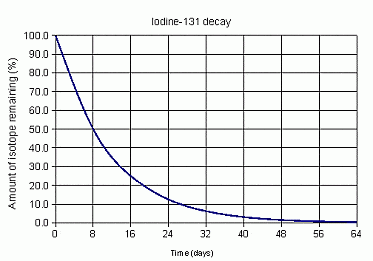
If 10 mg of iodine 131 is given to a patient, how much is left after 24 days? The half-life of iodine-131 is 8 days.
a)
1.25mg
b)
1.25g
c)
10g
d)
10mg
50.
What is the half-life of iodine-131?
a)
32 days
b)
8 days
c)
16 days
d)
24 days
51.
Imagine you have 50,000 atoms of uranium-238. If U-238 has a half-life of 4.5 billion years, how many U-238 atoms will be left after 4.5 billion years? 
a)
25,000
b)
50,000
c)
12,500
d)
0
52.

When the isotope 5024X releases an alpha particle we get another element Y that looks like

a)

5022Y

b)

4622Y

c)

4820Y

d)

5426Y

53.

When the isotope 5024X releases a beta particle we get another element, Y, that looks like

a)

5023Y

b)

4622Y

c)

5025Y

d)

5024Y

54.
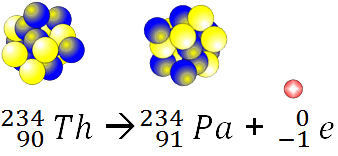
Which type of nuclear radiation is being emitted here?
a)
Alpha
b)
beta
c)
gamma 
d)
none
55.

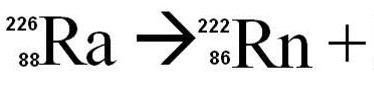
Complete the nuclear equation and determine the type of decay that is occurring in this reaction.

a)

alpha, 42He

b)

beta, 0-1e

c)

gamma

d)

none

56.
Takes two small nuclei and combines them into a larger nucleus
a)
fission
b)
fusion
57.

The splitting of a nucleus into smaller nuclei is

a)

fusion

b)

fission

58.

The rusting of iron is represented by the equation

4Fe + 3O2 --> 2 Fe2O3

If you have a 1.45 mol sample of iron, how many moles of Fe2O3 will form after the iron has rusted completely?

a)

0.483 mol

b)

0.725 mol

c)

0.97 mol

d)

1.45 mol

59.

For the following equation

4NH3 + 7 O2 --> 4 NO2 + 6 H2O

How many molecules of NO2 are produced when 5.38 moles of ammonia react completely?

a)

21.52

b)

6.48 x 1024

c)

3.24 x 1024

d)

247

60.
2Na + 2H2O → 2NaOH+ H2
How many grams of hydrogen are produced if 120 g of Na are available?
a)
5.2 g
b)
2.6 g
c)
690 g
d)
45 g
61.
When 12 moles of O2 reacts with 6 moles of C10H8, what is the limiting reactant?  
1 C10H8 + 12 O2 --> 10 CO2 + 4 H2O
a)
Oxygen
b)
C10H8
c)
Water
d)
Carbon Dioxide
62.
Identify the limiting reagent when 6.00 moles HCl combines with 5.00 moles Mg to form MgCl2.
 
1 Mg +  2 HCl --> 1 MgCl2  +  1 H2   
 
a)
Mg
b)
H2
c)
MgCl2
d)
HCl
63.

4NH3 + 5O2 --> 4NO + 6H2O


How many Liters of NO are formed if 6.30g of ammonia react with 1.80g of oxygen?

a)

1.5 L

b)

2.02 L

c)

1.01 L

d)

8.30 L

64.
CH4  +  2O2  →  CO2  +  2H2O
24 grams of CH4 was added to the above reaction. Calculate the theoretical yield of CO2.
a)
66 grams
b)
132 grams
c)
33 grams
d)
8.72
65.
When reacting Na with Cl2, we calculated that the theoretical yield should be 12.5 grams. Our actual yield was 13.0 grams. What is the percent yield?
a)
100%
b)
104%
c)
96%
d)
1.04
66.
At the end of chemical reactions, what is the total mass of the reactants compared to the total mass of the products?
a)
the product is doubled
b)
the product is half the mass of the reactants
c)
the mass is the same
d)
the mass changes depending on the reaction
67.
NH3 + HCl ---> NH4Cl 
a)
Synthesis
b)
Decomposition
c)
Single Replacement
d)
Double Replacement
68.
PbCl2 + AgNO3 ---> Pb(NO3)2 + AgCl 
a)
Synthesis
b)
Decomposition
c)
Single Replacement
d)
Double Replacement
69.
H2SO4 + Fe -->H2 + FeSO4
a)
Synthesis
b)
Decomposition
c)
Single Replacement
d)
Double Replacement
70.
C4H12 + O2 --> CO2 + H2O
a)
Synthesis
b)
Combustion
c)
Single Replacement
d)
Double Replacement
71.
2NO2 --> N2 + 2O2
a)
Synthesis
b)
Decomposition
c)
Single displacement
d)
Combustion
72.
What is the right ratio of chemicals for the BCE (Balanced Chemical Equation)?__CO + __Fe2O3--> __Fe + __CO2
a)
3,1 --> 2,3
b)
3,2 --> 1,1
c)
3,2 --> 2,4
d)
3,2 --> 2,1
73.
What is the right ratio of chemicals for the BCE (Balanced Chemical Equation)?__FeCl3 + __Ca(OH)2 --> __Fe(OH)3 + __CaCl2
a)
4,3--> 2,1
b)
3,2 --> 3,1
c)
2,3 --> 2,2
d)
2,3 --> 2,3
74.
Which is the correct net ionic equation for the reaction of AgNO3 and CaCl2?
a)
Ca2+(aq) +  2Cl- (aq) → CaCl(s)
b)
Ag+(aq)  +  Cl- (aq) → AgCl(s)
c)
Ag +  Cl  →  AgCl
d)
Ag+  +  Ca2+   →Ag2Ca (s)
75.
What are the spectator ions in the reaction of sodium chloride with silver nitrate?
a)
silver and nitrate
b)
sodium and chloride
c)
sodium and nitrate
d)
silver and chloride
76.
In this equation,
CuCl2 + NaOH  → Cu(OH)2 + NaCl
Which product is insoluble?
a)
copper(II) hydroxide
b)
sodium chloride
c)
sodium hydroxide
d)
copper(II) chloride
77.
You are given the following percentages: 40.05% S and 59.95% O. Find the empirical formula for these elements.
a)
SO
b)
SO2
c)
SO3
d)
SO4
78.
What is the molecular formula if the empirical formula is CH2O and the molecular molar mass is 180.18?
a)
CH2O
b)
C2H4O2
c)
C4H8O4
d)
C6H12O6
79.
Given the following: 42.07% Na, 18.89% P, and 39.04% O, determine the empirical formula.
a)
 NaPO2
b)
Na2PO3
c)
Na3PO4
d)
NaPO4
80.
What is the molecular formula for a compound with the empirical formula: K2SOand a molecular mass of 696g.
a)
K2SO
b)
K8SO16
c)
K8S4O
d)
K8S4O16 
81.
How many molecules are in 32.4 grams of phosphorous pentoxide?
a)
1.76 x 10²³ molecules
b)
0.29 moles
c)
1.76 x 10²² molecules
d)
0.29 molecules
82.
What is the mass of 0.75 moles of (NH4)3PO4?
a)
101.75 g
b)
121.75 g
c)
111.75 g
d)
131.75 g
83.
Find the percent composition of Mg in Mg3(PO4)2.
   

a)
27.75% Mg
b)
23.57% Mg
c)
48.68% Mg
d)
13.45% Mg
84.
Find the percent composition of N2S2.
a)
N: 69.6%  S: 30.4%
b)
N:36% S: 75.6%
c)
N: 96.6% S: 3.4%
d)
N: 30.4% S: 69.6%
85.
What did Thomson discover?
a)
electron
b)
proton
c)
neutron
d)
electron cloud
86.

He claimed that matter was made of small, hard particles that he called “atomos.”

a)

Democritis

b)

Dalton

c)

Moseley

d)

Einstein

87.
The scientist responsible for "discovering" the nucleus is:
a)
Bohr
b)
Rutherford
c)
Schroedinger
d)
Einstein
88.

John Dalton stated:

a)

Atoms are tiny, invisible particles.

b)

Atoms of one element are all the same.

c)

Atoms of different elements are different.

d)

Compounds form by combining atoms.

e)

All of the statements listed.

89.
Which of the following word pairs correctly completes the sentence below?
_______ are corrosive substances characterized as having a strong smell, a sour taste, and a _______.
a)
Acids; pH less than 7
b)
Acids; pH greater than 7
c)
Bases; pH greater than 7
d)
Bases; pH less than 7
90.
Which of the following statements is correct?
a)
Blue litmus paper turns red when placed in a base.
b)
Red litmus paper turns blue when placed in a base.
c)
Blue litmus paper stays blue when placed in an acid.
d)
Red litmus paper stays red when placed in a base.
91.
What would be considered the weakest base? 
a)
8
b)
14
c)
7.8
d)
11.6
92.
Pure water has a pH of 7. Pure water _______.
a)
is a base
b)
is a neutral substance
c)
could be either an acid or a base
d)
is an acid
93.
Many cleaning solutions are bases. Which of the following is a property of most bases?
a)
feels slippery
b)
white color
c)
can only be liquid
d)
tastes sour
94.
A substance that increases speed of chemical reaction without being being changed is called:
a)
Catalyst
b)
Acid
c)
Base
d)
pressure
95.
In an endothermic reaction, heat is 
a)
taken in
b)
given out
96.
In an exothermic reaction, heat is ...
a)
taken in
b)
given out
97.
Increase in temperature of the reactants can do one of the following
a)
Slow collision frequency
b)
Allow less effective collision between the particles
c)
Cause particles to lose speed
d)
Increase collision between the particles thus increasing the rate.
98.
Which factors increase the rate of a reaction.
a)
increasing temperature
b)
increasing concentration
c)
increasing surface area
d)
all of these
99.
This slows down or even stops a chemical reaction.
a)
de-activator
b)
catalyst
c)
enzyme
d)
inhibitor
100.
The following graph shows two different reaction pathways for the same overall reaction at the same temperature. Which pathway is slower and why?
a)
Red, because the activation energy is larger
b)
Blue, because the activation energy is lower
c)
both reaction progress at the same rate
101.
For the reaction...
SO2 + O2  <=>  SO3
If the concentration of SOis increased, the equilibrium position of the reaction will shift ___________.
a)
to the left
b)
to the right
c)
to the left and right 
d)
neither left nor right
102.
For the reaction...
SO2 + O2 <=>  SO3
If the equilibrium position shifts to the right, the concentration of O2 will ___________.
a)
increase
b)
decrease
c)
remain the same
d)
double
103.
For the reaction...
N2  +  O2  <=>  2NO
If  O2 is removed, the  concentration of N2 will _______.
a)
increase
b)
decrease
c)
remain the same
d)
double
104.
What is the formula to solve for the neutron?
a)
Mass + Atomic Number= Neutrons
b)
Mass x Atomic Number = Neutrons
c)
Mass - Atomic Number = Neutrons
d)
Mass + Number of Protons = Neutron
105.
What is the atomic mass of Neon?
a)
10
b)
30
c)
10.18
d)
20.18
106.
Which elements have the most similar chemical properties?
a)
K and Na
b)
K and Ca
c)
K and Cl
d)
K and S
107.
Group Name and Number for Magnesium
a)
Alkaline Earth Metals 2 or 2A
b)
Noble Gases 18 or 8A
c)
Halogens 17 or 7A
d)
Alkali Metals 1 or 1A
108.
what does the 6 represent?
a)
Atomic mass
b)
atomic number
c)
chemical symbol
d)
element name
109.
Atoms with similar properties are most likely located...
a)
in the same period.
b)
in the same group.
c)
in different periods.
d)
to the right and left of each other.
110.
Which is an alkali metal?
a)
Magnesium
b)
Iron
c)
Sodium
d)
Europium
111.
Which is a halogen?
a)
Helium
b)
Chlorine
c)
Oxygen
d)
Neptune
112.
As you move down the periodic table atoms get bigger.  This is because ____________.
a)
The atoms have more mass.
b)
The atoms have more protons.
c)
The atoms have more energy levels
d)
The atoms have more nuetrons
113.
As you move across the periodic table atoms tend to get smaller because, ______________.
a)
the atoms have more mass.
b)
the atoms have less mass
c)
the atoms have more protons.
d)
the atoms have less electrons.
114.
Order the following in increasing atomic radii: 
Ra, Be, Ca, Rb, H
a)
Ra, Be, Rb, H, Ca
b)
Rb, H, Ca, Be, Ra
c)
Ra, Rb, Ca, Be, H
d)
H, Be, Ca, Rb, Ra
115.
Chlorine and Fluorine are both very electronegative, as they are both missing a single electron from their valence energy level.  Why is Fluorine more electronegative than Chlorine? 
a)
Fluorine has less energy levels.
b)
Chlorine has more electrons in its outer shell
c)
Fluorine has more protons.
d)
None of these
116.

As you look down a group, ionization energy and electronegativity

a)

increases

b)

decreases

117.

As you look from left to right across a period, ionization energy and electronegativity both

a)

increase

b)

decrease

118.
List the following in order of weakest to strongest ionization energy.
P, Cs, Co, Sr
a)
P, Co, Sr, Cs
b)
Cs, Sr, Co, P
c)
Sr, Cs, Co, P
d)
P, Co, Cs, Sr
119.
Choose the set that goes from lowest to highest electronegativity?
a)
Cu, Mg, Sr, Ca
b)
F, Cl, Br, Si
c)
Cs, Rb, Ca, Mg
d)
Zn, Cd, Ag, Cu
120.

Which of these has the greatest ionic radius?

a)

potassium

b)

aluminum

c)

carbon

d)

oxygen

121.
If the pH of a solution is 5.6 the pOH is
a)
6.5
b)
12.4
c)
8.4
d)
5.6
122.
if the [H+] of a solution is 1.0 x 10⁻² mol/L the pH is
a)
2
b)
-2
c)
1
d)
12
123.
If the [OH-] of a solution is 2.7 x 10⁻⁴ mol/L the pOH of the solution is
a)
10.44
b)
3.56
c)
1.00
d)
-4.43
124.

If [OH-] = 1 x 10⁻⁴ M, what is the pH of the solution?

a)

-4

b)

10

c)

4

d)

-10

125.
What is the pH of a 4.3 x 10⁻⁷ M solution of H2CO3?
a)
7
b)
6.4
c)
7.6
d)
4.3
126.
acid + base ₋>
a)
salt + hydrogen
b)
salt + water
c)
salt + carbon dioxide + water
d)
salt
127.
I am titrating 1M HCl with 1M NaOH.  I have 25mL of HCl. How much NaOH will I need?
a)
2.5mL
b)
5mL
c)
25mL
d)
50mL
128.

An electron transitions from n = 6 to n = 3. Which wavelength is released?

a)

410 nm

b)

1875 nm

c)

1282 nm

d)

1094 nm

129.

What color visible light is released when an electron transitions from n = 3 to n = 2?

a)

Red

b)

Blue

c)

Violet

d)

Green

130.

An electron in n=4 has more _______ than an electron in n=2

a)

Stability

b)

Energy

c)

Spin

d)

Wave nature

131.
SiClhas what shape?
a)
square planar
b)
square pyramidal
c)
tetrahedral
d)
octahedral
132.

What shape would PH3 have?

a)

Trigonal Planar

b)

Trigonal pyramidal

c)

Bent

d)

Linear

133.
What molecular shape is the structure shown here? (BCl3)
a)
linear
b)
trigonal planar
c)
tetrahedral
d)
trigonal pyramidal
134.
What molecular shape is the structure shown here? (H2O)
a)
tetrahedral
b)
trigonal planar
c)
bent
d)
trigonal pyramidal
135.
What is the molecular shape of a silicon dioxide molecule?
a)
linear
b)
trigonal planar
c)
bent
d)
tetrahedral
136.

What completely ionizes in solution?

a)

Weak acids

b)

Strong acids

c)

Weak bases

d)

Strong bases

137.

What completely disassociates in solution?

a)

Weak acids

b)

Strong acids

c)

Weak bases

d)

Strong bases

138.

How many neutrons are found in this isotope? 3115P3-

a)

31

b)

15

c)

16

d)

3

139.

How many protons are found in this isotope? 3115P3-

a)

31

b)

15

c)

16

d)

3

140.

How many electrons are found in the following ion?

a)

3

b)

7

c)

10

d)

14

141.

How many neutrons are in the isotope Carbon-14

a)

6

b)

8

c)

14

d)

12

142.

What are the products for this combustion reaction:

C2H4 + 2 O2

a)

C2O2 + H4

b)

CO2 + HOH

c)

CO + H

d)

CO2 + H2O

143.

Predict the products for the this reaction:

Ag3N + KCl →

a)

AgCl + K3N

b)

AgK + ClN3

c)

AgN3 + KCl

d)

KAg + N3Cl

144.

What are the products of the following equation?

F2 + Ca →

a)

FCa

b)

F2Ca

c)

CaF2

d)

FCa

145.
Which of the following describes a precipitate?
a)
a liquid forms when a block of metal is heated
b)
a solid forms when one liquid is poured into another
c)
a gas forms when a solid is placed in a liquid
d)
bubbles form when an acid is poured on a rock
146.

What is the correct balanced equation for the following reaction?

Na2SO3 (aq) + Fe(NO3)3 (aq) -->

a)

3Na2SO3 (aq) + 2Fe(NO3)3 (aq) --> 6NaNO3(s) + Fe2(SO3)3 (aq)

b)

3Na2SO3 (aq) + 2Fe(NO3)3 (aq) --> 6NaNO3(aq) + Fe2(SO3)3 (s)

c)

3Na2SO3 (aq) + 2Fe(NO3)3 (aq) --> 6NaNO3(aq) + Fe2(SO3)3 (aq)

d)

Na2SO3 (aq) + Fe(NO3)3 (aq) --> Na2(NO3)3 (aq) + FeSO3 (s)

e)

No reaction

147.

Which is the proper balanced equation for the reaction

Zn(s) + FePO4(aq) -->

a)

Zn(s) + FePO4(aq) --> ZnPO4 (aq) + Fe(s)

b)

2Zn(s) + 3FePO4(aq) --> Zn2(PO4)3 (aq) + 3Fe(s)

c)

3Zn(s) + 2FePO4(aq) --> Zn3(PO4)2 (aq) + 2Fe(s)

d)

3Zn(s) + 2FePO4(aq) --> Zn3(PO4)2 (aq) + Fe2(s)

e)

No reaction

148.

What is the correct balanced equation for this reaction:

Fe(NO3)3(aq) +MgCl2(aq) -->

a)

Fe(NO3)3(aq) +MgCl2(aq) --> FeCl2(aq) + Mg(NO3)3 (aq)

b)

2Fe(NO3)3(aq) + 2MgCl2(aq) --> 2FeCl2(aq) + 2Mg(NO3)3 (aq)

c)

2Fe(NO3)3(aq) +3MgCl2(aq) --> 2FeCl3(aq) + 3Mg(NO3)2 (aq)

d)

2Fe(NO3)3(aq) +3MgCl2(aq) --> 2FeCl3(s) + 3Mg(NO3)2 (aq)

e)

No reaction

149.

Which is the correct balanced equation for the following reaction?

K(s) + HCl(aq) -->

a)

2K(s) + 2HCl(aq) --> 2KCl(aq) + H2 (g)

b)

K(s) + HCl(aq) --> KCl(aq) + H(g)

c)

K(s) + HCl(aq) --> KH(aq) + Cl(g)

d)

2K(s) + 2HCl(aq) --> 2KH(aq) + Cl2(g)

e)

No reaction

150.

At what temperature can you fully dissolve 140g of NaNO3?

a)

62

b)

73

c)

81

d)

You cannot determine this

151.

What type of a solution is 60g NaNO3 at 40ºC in 100g H2O?

a)

Saturated

b)

Unsaturated

c)

Supersaturated

152.

What type of a solution is 100g KNO3 at 40ºC in 100g H2O?

a)

Saturated

b)

Unsaturated

c)

Supersaturated

153.

What type of a solution is 260g sugar at 50ºC in 100g H2O?

a)

Saturated

b)

Unsaturated

c)

Supersaturated

154.

How much C12H22O11 solute is saturated at 40 degrees?

a)

240

b)

220

c)

230

d)

250