wayground logo

Free Printable Worksheets

Font size

S
M
L
XL
Worksheets

Unit 1 - Matter and Thermal Energy Review

Total questions: 161

Worksheet time: 8hrs 19mins

Name
Class
Date
1.
The state of matter having no definite shape or volume.
a)
solid
b)
liquid
c)
gas
2.
The ability or tendency to float.
a)
viscosity
b)
buoyancy
c)
kinetic theory
3.
The amount of energy needed to change a material from a solid to a liquid state.
a)
Heat of Solids
b)
Heat of Liquids
c)
Heat of Fusion
d)
Heat of Vaporization
4.
As a material is heated, it's particles....
a)
get smaller
b)
slow down
c)
get cooler
d)
move more quickly
5.
The state of matter with definite volume but no definite shape.
a)
solid
b)
liquid 
c)
gas
6.
What state of matter forms a geometric pattern?  It is also the coldest state of matter.
a)
solid
b)
liquid
c)
gas
7.
A measure of the average kinetic energy of the particles in a sample of matter.
a)
temperature
b)
meter
c)
second
8.
The amount of energy needed to change a material from a liquid to a gas.
a)
Heat of Liquids
b)
Heat of Gas
c)
Heat of Fusion
d)
Heat of Vaporization
9.

Which of the following statements about the particles of a gas is true?

a)

The particles vibrate about a fixed position.

b)

The particles are far apart and move freely.

c)

The particles are packed close together, but in a disorderly arrangement.

d)

The particles are stationary and orderly.

10.

Particles are always moving.

a)

True

b)

False

11.

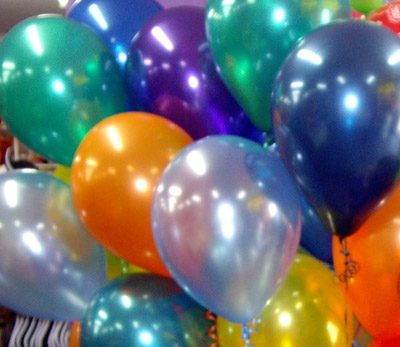
An inflated balloon is placed in a refrigerator. Which statement the movement of the gas particles in the balloon?

a)

The particles move faster and become further apart.

b)

The particles move more slowly and become further apart.

c)

The particles move faster and become closer together.

d)

The particles move more slowly and become closer together.

12.

When gas particles collide with other particles, they ...

a)

Travel in a spiral.

b)

Lose energy and move slowly.

c)

Stop motion.

d)

Rebound in a straight line.

13.

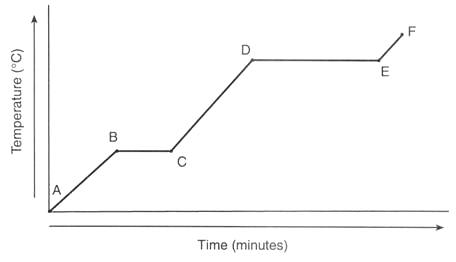
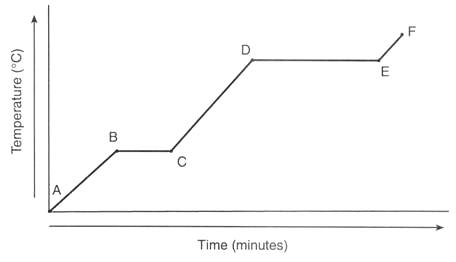
Which phase change occurs between points D and E if heat is removed?

a)

Freezing

b)

Melting

c)

Boiling

d)

Condensation

14.

What phase change occurs between points B and C if heat is added?

a)

Freezing

b)

Melting

c)

Boiling

d)

Condensing

15.

Thermal energy always moves from :

a)

Warm object to cool object

b)

Object with low KE to object with high KE

c)

Cool object o warm object

d)

Object with high mass to object with low mass

16.

A __________ has a definite shape and a definite volume.

a)

Gas

b)

Liquid

c)

Solid

d)

Plasma

17.

Temperature is a measure of an object's average :

a)

electro-static force

b)

heat

c)

density

d)

kinetic energy

18.

This diagram represents particles in a __________ state.

a)

solid

b)

liquid

c)

gas

d)

plasma

19.
All matter is made of _____ that are constantly moving.
a)
insulators
b)
particles
c)
convection
d)
pieces of plastic
20.
If an object has particles that are moving very slowly, the object's temperature is probably ______.
a)
hot
b)
small
c)
cold
d)
big
21.
What is the phase change called that occurs when a solid turns into a liquid?
a)
Melting
b)
Freezing
c)
Condensation
d)
Vaporization
22.
The energy of an object as it is in motion is defined as
a)
Kinetic Theory
b)
Kinetic energy
c)
Potential energy
d)
Electric energy
23.
The main idea of the Kinetic Molecular Theory is that all molecules have 
a)
mass
b)
motion/movement
c)
volume
d)
moles
24.

the atmosphere is a mixture of gases

a)

true

b)

true and false

c)

false

d)

neither true nor false

25.
Density is a measure of...
a)
mass in a given volume
b)
distance in a given volume
c)
distance in a given time
d)
speed in a given distance
26.
Two cubes have identical volume, but one has a higher density.  It is...
a)
heavier
b)
lighter
c)
softer
d)
rougher
27.
Particles in a solid are tightly bound and...
a)
do not change relative position
b)
flow down a slope
c)
float in the air
d)
are runny
28.
Particles in a liquid are loosely bound, can change their relative position and hence...
a)
flow into the shape of their container
b)
will never move
c)
have zero energy
d)
are always hot
29.
Between collisions with other particles and their container, gas particles...
a)
travel fast in straight lines
b)
do not move at all
c)
travel in ever decreasing spirals
d)
have no energy
30.
We cannot compress most solids and liquids, but a gas...
a)
can be compressed
b)
is not a state of matter
c)
makes an excellent chair
d)
is always heavier than a solid
31.
Absolute zero is the temperature (in Kelvin), at which, only in theory...
a)
all particles stop moving
b)
time stands still
c)
space and time merge
d)
energy goes to infinity
32.
If an object sinks in a fluid, _____.
a)
the density of the fluid is greater than the density of the object
b)
the density of the fluid is less than the density of the object
c)
the density of the fluid is equal to the density of the object
d)
density has nothing to do with whether an object sinks or floats, only which state of matter the object is
33.

What do we call the the amount of force exerted on a certain area?

a)

fluid

b)

pressure

c)

buoyant force

d)

normal force

34.

The upward force exerted by a fluid is called the...

a)

buoyancy force

b)

density force

c)

fluidity force

d)

normal force

35.
A fluid's resistance to flow is its
a)
viscosity.
b)
density.
c)
pressure.
d)
buoyancy.
36.

If an object has a density of 3.6 g/mL and you put it into water (density =1.0g/mL,) will it sink or float?

a)

sink

b)

float

37.
The ability of a fluid to exert an upward force of an object immersed in it is
a)
viscosity.
b)
buoyancy.
c)
vaporization.
d)
thermal expansion.
38.
According to Pascal, pressure applied to a fluid
a)
increases as it moves through the fluid.
b)
decreases as it moves through the fluid.
c)
fluctuates as it is transmitted throughout the fluid.
d)
is transmitted unchanged throughout the fluid.
39.
 The buoyant force on an object is equal to the weight of the fluid displaced by the object is stated in 
a)
Pascal's principle.
b)
Archimedes' principle.
c)
Boyle's law.
d)
Bernoulli's principle.
40.

Which principle do airplanes take advantage of to fly?

a)

Archimedes' Principle

b)

Bernoulli's Principle

c)

Pascal's Principle

41.

If you double the size of the larger pad of a hydraulic system, how much less force do you need to apply to the smaller pad to achieve the same result?

a)

1/4 the force

b)

1/3 the force

c)

1/2 the force

d)

The same amount of force

42.
Which box has a higher density?  
a)
Box A
b)
Box B
c)
cannot be determined
d)
they are the same
43.
If an object sinks in a fluid, _____.
a)
the density of the fluid is greater than the density of the object
b)
the density of the fluid is less than the density of the object
c)
the density of the fluid is equal to the density of the object
d)
density has nothing to do with whether an object sinks or floats, only which state of matter the object is
44.

What do we call the the amount of force exerted on a certain area?

a)

fluid

b)

pressure

c)

buoyant force

d)

normal force

45.
Car brakes and car jacks are examples of
a)
hydraulic systems
b)
archimedes' principle
c)
atmospheric pressure
d)
buoyancy
46.
Water pressure increases as depth increases. 
a)
True
b)
False
47.
When pressure is applied to a confined fluid, the increase in pressure is transmitted equally to all parts of the fluid. This fact is called________.
a)
Pascal's Principle
b)
Newton's Principle
c)
Archimedes' Principle
d)
Bernoulli's Principle
48.
Archimedes' Principle states that... 
a)
The buoyant force acting on an object equals the volume of the fluid displaced by the object. 
b)
The buoyant force acting on an object equals the weight (force of gravity) of the fluid displaced by the object.
c)
The buoyant force acting on an object will always be equal. 
49.
Frank has an eraser. It has a mass of 4g, and a volume of 2cm3. What is its density?
a)
8 g/cm3
b)
2 g/cm3
c)
1/2 g/cm3
d)
24 g/cm3
50.
If an object has a density of 3.6 g/mL and you put it into water, will it sink or float?  
a)
sink
b)
float
51.

What is the formula for calculating Force ?

a)

Density v Volume

b)

Length x Width

c)

3.142 x Atmospheric pressure

d)

Pressure x Area

52.

If an object is compressible it can be squeezed to fit into a smaller space than it normally does.

a)

True

b)

False

53.

In a simple enclosed hydraulic system with pistons of different surface area, which requires the most force to move it?

a)

The larger Piston

b)

The smaller Piston

c)

The force required to move each piston will be equal.

d)

Neither can move due to incompressibility of fluid.

54.

If a downward force is applied to piston A, it will be transmitted through the system to piston B.


According to Pascal’s law,the pressure at piston A (P1) equals the pressure at piston B (P2).

a)

True

b)

False

55.

The term fluids generally applies to:

a)

solid and liquid

b)

liquid and gas

c)

solid and plasma

d)

water only

56.

The pressure resulting from a force of 50 N exerted over an area of 5 m2 is

a)

10 Nm2

b)

0.1 Nm2

c)

10 N m-2

d)

0.1 Pa

57.
In what direction(s) does air exert pressure?
a)
everywhere
b)
no where
c)
there is no pressure
d)
downward
58.

A rock dropped into a glass of water raises the water level by 40 milliliters. What can you infer about the rock?

a)

It has a mass of 40 grams

b)

It has a desity of 40 grams per milliliter

c)

It has a volume of 40 milliliters

d)

It has a weight of 40 pounds

59.

from the image below which represents the correct force of the fluid pressure on solid objects ...

a)
b)
c)
d)
e)
60.

Buoyant force acts in the ________________ of gravity, making things feel lighter

a)

same direction

b)

opposite direction

61.

A helium balloon floats away because helium is _______ dense than air

a)

more

b)

less

62.
Which liquid is the least dense?
a)
oil
b)
water
c)
syrup 
d)
plastic bottle
63.
which of the following statements is true?
a)
oil floats on water because oil is less dense than water
b)
oil does not float on water because water is more dense
c)
water floats on oil because water is less dense
64.
Which is a quality that only gasses display
a)
Spread out to fill all available space
b)
Take the shape of their container
c)
Can't be compressed
d)
All of these
65.
If you increase the pressure of a constant volume of gas, what will happen to the temperature?
a)
Increase
b)
Decrease
c)
Stay the same
d)
It will Blow Up
66.
What will happen to the volume of a gas under constant temperature if the pressure increases?
a)
Increase
b)
Decrease
c)
Nothing
d)
Explosion!
67.
How are pressure and volume related?
a)
Directly
b)
Indirectly
c)
They aren't related
68.
If a balloon is cooled what will happen to the volume?
a)
Volume will increase
b)
Volume will decrease
c)
Volume will not change
69.
Gas molecules can easily be compressed  because ___________. 
a)
gas molecules are soft
b)
gas molecules are far apart
c)
gas molecules follow the shape of the container
70.
Pressure is caused by ______.
a)
gravity.
b)
gas molecules colliding with each other.
c)
gas molecules colliding with surfaces of the container.
d)
gas molecules reacting with each other.
71.
Which container will have lower pressure?
a)
left
b)
right
c)
they both have the same pressure
72.
You decide to make a balloon animal. As the balloon is being twisted, it increases the pressure inside of the balloon. What happens to the volume?
a)
It increases
b)
It decreases
c)
It stays the same
73.
You go camping and roast marshmallows over a campfire. What happens to the volume of the air bubbles inside the marshmallows? 
a)
It increased
b)
It decreased
c)
It stayed the same
74.
A balloon will pop in the atmosphere because..
a)
Pressure goes down volume goes up
b)
Pressure goes up volume goes down
c)
temperature goes down volume goes up
d)
volume goes down temperature goes down
75.
Which of the following would increase the (gas) pressure of a system? 
a)
Increase the Temperature 
b)
Decrease the volume 
c)
Pump in more gas 
d)
All of these
76.
How could you make the stopper pop out of the flask?
a)
Decrease pressure
b)
Decrease temperature
c)
Increase volume
d)
Increase temperature
77.
How could you "re-inflate" the balloon?
a)
Heat the balloon up 
b)
Cool the balloon down
c)
Remove some helium
d)
Ask the balloon to re-inflate
78.

What variable is held constant in the diagram?

a)

Volume

b)

Moles

c)

Pressure

d)

No constant

79.

What relationship can be interpreted from the diagram?

a)

As volume decreases, pressure decreases

b)

As pressure increases, volume increases

c)

As moles increase, temperature increases

d)

As pressure increases, volume decreases

80.
Pick the best answer to explain all properties of gases....
a)
They're fluids 
Can be compressed
Little space between particles 
b)
They're solids 
Can be compressed
Lots of space between particles 
c)
They're fluids 
Cannot be compressed
Lots of space between particles 
d)
They're fluids 
Can be compressed
Lots of space between particles 
81.
What 2 variables are used in a Hot Air Balloon? 
[Hint:  Space and Heat]
a)
Pressure and Volume
b)
Volume and Temperature
c)
Temperature and Pressure
d)
Pressure, Temperature and Volume 
82.
Why does a car get low tire pressure in the COLD...what two variables are to blame? 
a)
Pressure and Temperature
b)
Temperature and Volume
c)
Volume and Pressure
d)
Temperature and Weight 
83.
What happens to the average kinetic energy of matter when it is heated?
a)
It increases
b)
It decreases 
c)
It doesn't change
d)
It cannot be determined
84.

When a substance mixes due to random moving particles, this is known as

a)

Effusion

b)

Diffusion

c)

Osmosis

d)

Kinetic-molecular movement

85.

How are pressure and temperature related?

a)

Directly

b)

Indirectly

c)

They aren't related

d)

Exponentially

86.
Gases have...
a)
A definite shape and volume
b)
A definite shape but no definite volume
c)
No definite shape but a definite volume
d)
No definite shape or volume
87.
a)
this is a graph representing Boyle's law
b)
this is a graph representing Charles's law
88.
a)
This is an example of Charles's law
b)
This is an example of Boyle's law
89.

The graph shows a(n) ____ relationship.

a)

Direct

b)

Inverse

90.

The graph shows a(n) _____ relationship.

a)

Inverse

b)

Direct

91.

You have a gas that has a pressure of 2 atm and a volume of 10 L. What would be the new volume if the pressure was changed to 1 atm?

a)

5 L

b)

20 L

c)

It would stay at 10L

d)

1 L

92.
Boyle's PV law : When _______ is held constant, the pressure and volume of a gas are ________  proportional
a)
temperature,  equally
b)
mass, inversely
c)
temperature, inversely
d)
mass, equally
93.
You have a gas that has a pressure of 2 ATM and a volume of 10L.  What would be the new volume if the pressure was changed to 1 ATM?
a)
5 L
b)
20 L
c)
It would stay at 10L
d)
1 L
94.
With pressure constant, the temperature of a gas is increased from 30oC to 90oC.  The volume will _____. (Be sure to convert to Kelvin first.)  
a)
 increase by about 20%
b)
 triple
c)
decrease by 1/2 
d)
remain the same
95.
A gas of volume V is placed in a balloon.  Determine the new volume of the balloon if the pressure is tripled. The new volume will be ____ what it was originally.  
a)
1/3 of
b)
1/6 of
c)
1/9 of
d)
 9 times
96.
What is the formula for Boyle's Law?
a)
P1V1=P2V2
b)
P1V1/P2V2
c)
P1V2=P2V1
d)
P1/V1=P2/V2
97.
What is the new volume of the gas if the pressure on 350 L of oxygen at 720 mm Hg is decreased to 600 mm Hg?
a)
420 L
b)
29.16 L
c)
4200.0 L
d)
291.6 L
98.
A gas occupies 4.98 L at 2.6 atm of pressure. What volume does it occupy at 1.8 atm pressure?
a)
12.9 L
b)
0.72 L
c)
7.2 L
d)
3.44 L
99.
A gas at a volume of 4 liters is at a pressure of 2 atm. The volume is changed to 16 Liters, what must the new pressure be?
a)
2 atm
b)
12 atm
c)
10 atm
d)
0.5 atm
100.
The pressure on a sample of gas is increased from 1.0 atm to 3.0 atm. If the new volume is 0.52 L, find the original volume.
a)
0.52 L
b)
1.56 L
c)
0.173 L
d)
1.00 L
101.
What is the formula Charles' Law?
a)
V = T
b)
VT = VT
c)
T1 / V1 = T2 / V2
d)
V1 / T1 = V2 / T2
102.

(Charles Law) There are 65 liters of helium in a balloon at 35 K. If the temperature of the balloon is increased to 40 K, what will the new volume of the balloon be?

a)

40 L

b)

70 L

c)

74.3 L

d)

75.9 L

103.

(Charles Law) There are 40 liters of helium in a balloon at 100 K. If the temperature of the balloon is increased to 200 K, what will the new volume of the balloon be?

a)

80 L

b)

45 L

c)

54 L

d)

45.33 L

104.
Edelman and Gronkowski want to play a game of beach volleyball. If the beach ball has a volume of  261 L at a temperature of 502 K, what will the temperature of the balloon be if the volume decreases to 176 L?
a)
744 K
b)
0.0030 K
c)
339 K
d)
512 K
105.
Volume and temperature have a ______ proportionality.
a)
direct
b)
inverse
c)
linear
d)
exponential
106.
Julian and Jimmy are playing basketball outside in 82°C weather. If they leave the ball outside and temperature drops down to 53°C, what will happen to the volume of the gas in the ball if the pressure remains constant?
a)
volume will remain the same
b)
volume will increase
c)
volume will decrease
d)
volume will double in size
107.
For the problem below, what is the initial volume?
Edelman and Gronkowski want to play a game of beach volleyball. If the beach ball has a volume of 400 L at a temperature of 500 K, what will the temperature of the balloon be if the volume decreases to 176 L?
a)
176 L
b)
500 K
c)
400 L
d)
226 K
108.
Edelman and Gronkowski want to play a game of beach volleyball. If the beach ball has a volume of  261 L at a temperature of 502 K, what will the temperature of the balloon be if the volume decreases to 176 L?
a)
744 K
b)
0.0030 K
c)
339 K
d)
512 K
109.
A gas with a volume of 400 mL at 120 οC is heated until its volume is 700 mL.  What is the new temperature ( in degree Celsius) of the gas if the pressure is constant?
a)
4 14.75 οC
b)
687.75 οC
c)
210 οC
d)
68.57 οC
110.

In this heat curve

a)

water would be warming up

b)

water would be losing energy

c)

water is gaining energy

d)

water is changing phase

111.

Which heat curve would be an example of rain falling to the ground and then freezing

a)
b)
c)
d)
112.
Describe the substance between letters D and E. 
a)
Gas
b)
Liquid
c)
Melting
d)
Evaporating
113.
Between which points is the temperature of the substance remaining constant?
a)
A-B only. 
b)
A-B, C-D, E-F
c)
B-C only. 
d)
B-C, D-E
114.

The melting point of the sample is

a)

-60 ºC

b)

-100 ºC

c)

60 ºC

d)

100 ºC

115.

Given the heating curve of a solid being heated at a constant rate, what is the boiling point of this substance?

a)

20°C

b)

50°C

c)

110°C

d)

170°C

116.

Given the heating curve of a solid being heated at a constant rate, how much total time was required to boil this substance after it reached its melting point?

a)

3 minutes

b)

4 minutes

c)

10 minutes

d)

14 minutes

117.

NaCl(s) was heated up starting at an initial temperature of 0°C. The heating curve is shown in the picture. What is the melting point of this substance?

a)

0°C

b)

801°C

c)

1000°C

d)

1465°C

118.

Given the heating curve of water, what is happening to potential and kinetic energy during segment CD?

a)

the potential energy and kinetic energy both increase

b)

the potential energy increases while the kinetic energy decreases

c)

the potential energy is constant while the kinetic energy increases

d)

the potential energy increases while the kinetic energy is constant

119.

Given the heating curve for water, during which line segment could I find water in both the solid and liquid phase at the same time?

a)

AB

b)

BC

c)

CD

d)

DE

e)

EF

120.
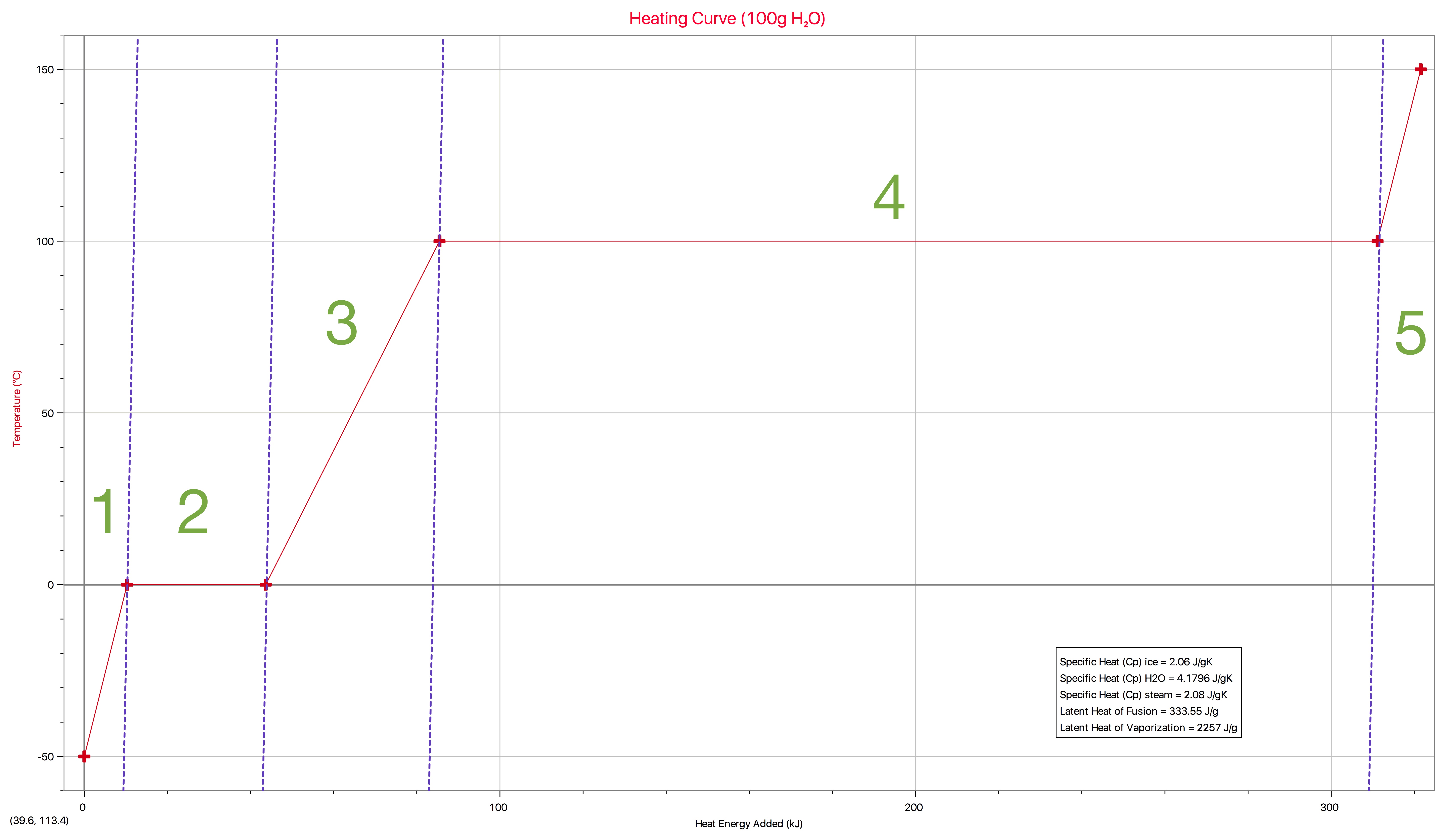
In which region(s) does temperature remain constant?
a)
Region 1, 3, & 5
b)
Region 2 & 4
c)
Region 1 only
d)
Region 1 & 2
121.
In which region(s) does temperature increase?
a)
Region 1, 3, & 5
b)
Region 2 & 4
c)
Region 1 only
d)
Region 1 & 2
122.

This curve indicates what about the heat energy?

a)

Heat energy is being added or absorbed

b)

Heat energy is being released

123.

In which region(s) of the graph would the substance be a liquid and a gas at the same time?

a)

Region 1

b)

Region 2

c)

Region 3

d)

Region 4

e)

Region 5

124.

The melting point of the sample is

a)

-60 ºC

b)

20 ºC

c)

60 ºC

d)

100 ºC

125.

Which letter indicates where water is in both the solid and liquid phase at the same time?

a)

A

b)

B

c)

C

d)

D

e)

E

126.

In which region(s) does temperature increase?

a)

Region C only

b)

Regions B and D

c)

Regions A, C, and E

d)

Regions A and B

127.

Describe the substance at letter A.

a)

Solid

b)

Liquid

c)

Melting

d)

Evaporating

128.

How many states of matter are present during line segment BC?

a)

One

b)

Two

c)

Three

d)

Depends on the temperature

129.

Heat __________ depend on the amount of substance, while temperature __________.

a)

Does not, does

b)

Does, does not

130.

In which region of the graph would use the Heat of fusion(ΔHfus) to calculate heat energy?

a)

Region 2

b)

Region 3

c)

Region 4

d)

Region 5

131.

In which region of the graph would use the Heat of vaporization(ΔHvap) to calculate heat energy?

a)

Region 2

b)

Region 3

c)

Region 4

d)

Region 5

132.

Which of the following best suit the statement below?

Pressure applied to an enclosed fluid is transmitted undiminished to every point in the fluid and to the walls of the container.

a)

Bernoulli’s principle

b)

Pascal’s principle

c)

Archimedes principle

d)

Newton’s law

133.
What is the pressure in the hydraulic fluid?
a)
1210 N
b)
484 N/m2
c)
8000 N
d)
3025 N/m2
134.
What is the force up on the mailbox?
a)
1210 N
b)
8000 N
c)
7744 N
d)
5655 N
135.

In a car lift, compressed air exerts a force, F1 on a small piston having a radius of 5.5cm. This pressure is transmitted to a second piston of radius 20cm as shown in figure above. The mass of the car is 1250kg. Acceleration due to gravity g=10ms-2.


Calculate the pressure on the smaller piston F1.

a)

100kPa

b)

130kPa

c)

99.47kPa

d)

151.2kPa

136.

What will be the output force?

a)

20 N

b)

2 N

c)

50 N

d)

500 N

137.

In a factory, a hydraulic press used for lifting cars is at equilibrium, as shown in the figure. The car on the bigger piston has a mass of 1.2 metric tons and the weight on the smaller piston has a mass of 70 kg. What is the diameter of the smaller cylinder?

a)

4.8 m

b)

48 cm

c)

4.1 m

d)

24 cm

138.

The figure shows a hydraulic press system which is made of one small piston and 3 large pistons. If the cross-sectional area of the small piston is 12.5 cm212.5\ cm^2  and the cross-sectional area of each of the large pistons is 130 cm2130\ cm^2 ,calculate the resultant force on each of the large pistons if a force of 220 N acts on the small piston.

a)

4‎ ‎234 N

b)

2‎ ‎288 N

c)

762.67 N

d)

6‎ ‎864 N

139.

In the figure below, a hydraulic press is used to lift up a mass 𝑀 a distance of 1 cm. If the efficiency of the press is 90% and the work exerted on the smaller piston is 800 J. Calculate the maximum mass which can be lifted by the press, given that the acceleration due to gravity is 10 m/s210\ m/s^2 .

a)

8‎ ‎889 kg

b)

72 kg

c)

7‎ ‎200 kg

d)

8‎ ‎000 kg

140.

A cubic container holds water. The lid of the container can be pushed downward, exerting pressure on the water in the container. Which of the following statements most correctly describes how the pressure exerted by the water is changed when the lid is pushed downward?

a)

The pressure exerted on the cube’s vertical sides is increased.

b)

The pressure exerted on the base of the cube and its lid is increased.

c)

The pressure exerted on the base of the cube is increased.

d)

The pressure exerted on the base of the cube, its vertical sides, and its lid is increased.

e)

The pressure exerted on the base of the cube and its vertical sides is increased.

141.

In Pascal’s Principle, input pressure is always equal to output pressure.

a)

True

b)

False

142.
According to Bernoulli's Principle, when the wind speed is high, wind pressure is ________
a)
high
b)
low
c)
not enough information
d)
None of the above
143.
If you blow air between these two balloons, the pressure between the balloons would_________.
a)
Increase
b)
Decrease
c)
Stay the same
144.
Think about Bernoulli's Principle.  What do you think will happen when you have running water next to a shower curtain?
a)
Curtain goes outward from the shower
b)
Curtain goes in towards the shower
c)
Curtain stays the same
d)
Water gets the curtain wet
145.
Bernoulli's principle creates ___ in airplanes
a)
Drag
b)
Lift
c)
Weight
d)
Friction
146.
Why is the top of an airplane wing curved?
a)
To create an area of low pressure above the wing
b)
To create an area of high pressure above the wing
c)
To create equal pressure above and below the wing
d)
To make the wing look really cool
147.

Air travels ______________ over the top of a curved (airfoil) wing.

a)

faster

b)

slower

c)

doesn't move at all

d)

the same speed as

148.
Whose Principle is used to describe why flight is possible?
a)
Newton
b)
Descartes
c)
Bernoulli
d)
Pascal
149.
The design of a wing:
a)
causes the air above a wing to move faster than the air below the wing
b)
helps create lift
c)
creates a low pressure area above the wing
d)
all of these answers are correct
150.

In area 1 there is _____________ speed

a)

High

b)

Low

151.

In area 1 there is _____________ pressure

a)

High

b)

Low

152.
Which Letter, A-D is experiencing the least amount of air pressure?
a)
A
b)
B
c)
C
d)
D
153.
When an airplane is taking off, lift needs to be ___________ the weight.
a)
greater than
b)
less than
c)
the same as
154.
What does this image represent?
a)
Einstein's Theory
b)
Bernoulli's Principle
c)
Oxidation
d)
Thrust
155.
Bernoulli's Principle states...
a)
The air moves faster under the wing which generates lift
b)
That as the speed of air travels faster, its pressure decreases
c)
Pasta takes about 7 minutes to cook
d)
You can only fly if your principal says its ok
156.

How do Formula 1 cars use Bernoulli's principle? (choose 2)

a)

Formula 1 cars use an aerodynamic shape and material to reduce the friction on the car from air resisitance and drag.

b)

Formula 1 cars use aerodynamics to make the cars as ligth and slippery in the air as possible.

c)

Formula 1 cars use air flowing over a surface to push the car into the road to provide more grip.

157.

Diagram 9 shows two similar ping-pong balls suspended on strings of the same length. Which of the following diagrams shows the condition of the ping-pong balls when air is blown between them?

a)
b)
c)
d)
158.

Diagram 11 shows the roof of a house being lifted by strong winds. Which explains the above phenomenon?

a)

Pascal’s Principle

b)

Bernoulli’s Principle

c)

Archimedes’ Principle

d)

Newton’s First Law

159.

Diagram 12 shows a student blows strongly between two candle flames. Why the candle flames approach one another when being blown?

a)

Temperature between the candle flames becomes low

b)

Pressure between the candle flames become low

c)

Exist a vacuum area between the candle flames

d)

Hot air at the bottom of the candles rises

160.

Diagram 10 shows a boy blowing over a glass rod. Which principle explains the situation?

a)

Pascal’s Principle

b)

Bernoulli’s Principle

c)

Archimedes’ Principle

d)

Principle of conservation of momentum

161.

Diagram 11 shows an aerofoil attached to the back of Formula One car. Which statement is correct when the car is moving fast?

a)

Pressure at X is lower than at Y

b)

Pressure at X and Y is the same

c)

Velocity at X and Y is the same

d)

Velocity at Y is greater than at X