
 Worksheets
Electricity & Magnetism
Total questions: 193
Worksheet time: 6hrs 35mins
How do objects become positively charged?
They gain electrons
They lose electrons
Rubbing or Friction
How do objects become negatively charged?
They gain electrons
They lose electrons
Rubbing or Friction
This is the measure of the movement of the electric charge
Voltage
Volt
Ohm
Ampere
As the distance between magnets increases-the attraction between them will
Decrease
Stay the Same
Increase
How can the strength of an electromagnet increase?
Remove the battery
Remove loops (coils) of wire from around the iron nail
Add more loops (coils) of wire around the iron nail
Remove the iron nail, leaving only the coils of wire

Students attached both ends of a long wire to the poles of a battery and wrapped the wire around a spoon. In this arrangement, the spoon is able to pick up five paper clips. The students wrap more wire around the spoon and want to determine if the strength of the magnetic force has increased. Which of the following observations would indicate that wrapping more wire has increased the strength of the electromagnet?
More wire was needed to wrap around the spoon.
The spoon now picks up seven paper clips.
Eventually, the battery runs out of energy.
The ends of the wire must touch the battery's poles.

The table provided shows data collected by students during an investigation of two electromagnets. Which of the following conclusions is supported by data on the table?
When two electromagnets are of like charges, they attract each other.
Electromagnets that repel each other have more force than those that attract each other.
The greater the charges of two electromagnets, the greater the size of the force.
If the charge on one magnet is positive, the charge on the other must be negative.

The illustration shows a hand generator. Turning the handle of the generator spins a magnet and creates an electric current that lights the bulb. Which of the following observations can be used to indicate the strength of the current created by the generator?
The brightness of the bulb
The size of the magnet
The length of the handle
The mass of the generator

This table shows the magnitude of electromagnetic force exerted by two electromagnets on each other as the distance between the two electromagnets is varied. The data on the table provide evidence for which of the following conclusions?
The force between any two magnets is always constant, regardless of distance.
As distance between electromagnets increases, the electromagnetic force also increases.
The smaller the distance between two electromagnets, the greater the force.
The force between two magnets depends only on the charge of the electromagnets.
What will happen as an electron (-) gets closer to a proton (+)?
The repulsion will be stronger.
The attraction will be stronger.
The attraction will be weaker.
Nothing will happen to the electric field.
What is an electric force?
The size or quantity of something
Attractive or repulsive interactions between any two charged objects
A directional flow of electrical charge through an object or medium
How strong a magnet is
What will happen if the north ends of two magnets are placed near each other?
Both magnets will get weaker.
They will repulse (repel) each other.
They will attract each other.
Nothing will happen.
The region in which a magnetic force acts is called a
line of force
pole
magnetic field
field of attractio
Unlike poles of different magnets
attract each other
cancel each other out
repel each other
Electromagnets can be
turned on and off
made stronger
made from iron
made weaker
The magnetic field is strongest
at the poles
in the middle
at the north pole
at the south pole
Earth acts like a magnet because its core contains
molton carbon
solid nickel and iron
rocks
molten nickel and iron
Which of the following would be an example of an insulator?
iron
aluminum
rubber
silver
These are responsible for the flow of electricity
protons
electrons
neutrons
wires

If the magnets above were brought close together they would…
attract each other with a a strong force
repel each other with a strong force
attract each other with a weak force
repel each other with a weak force

Which position of the two magnets results in the greatest attraction between them?
A
B
C
D
Current, or the flow of charge through a wire is measured in
volts
amps
Joules
Newtons
Do magnets have to make contact with an object to attract or repel it?
Yes
No
How are magnets oriented when they attract each other?
North pole to North pole
South pole to South pole
North pole to South Pole
This material allows electrons to flow easily
Conductor
Insulator
Grounding
This material does not allow electrons to flow easily.
Conductor
Insulator
Grounding
Metal is a good conductor
True
False
Wood is a good conductor.
True
False
Which of the following is the best insulator?
metal paper clip
wood log
bowl of water
penny
Which of the following is a conductor?
sheet of paper
t-shirt
penny
plastic bottle
To build a basic circuit, you need wires, a light bulb, and
an insulator
another light bulb
a battery
a rubber band

Which of the pairs of balloons will repel each other?
Set A
Set B
Set B and Set C
Set A and set D
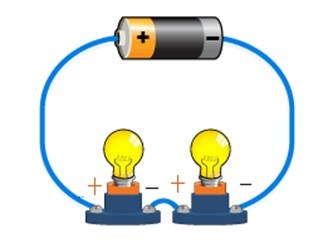
What will happen when you remove a bulb from the circuit pictured?
The other bulb will become brighter.
The other bulb will turn off.
The other bulb will become dimmer.
It will remain a closed circuit.

In the drawing of the electromagnet, letter B is the
wires
metal nail
negative charges
battery
Which type of magnet can be turned off?
bar magnet
horseshoe magnet
iron filings
electromagnet
Which type of magnet is permanent?
bar magnet
electromagnet
What happens to the flow of electric current in an open circuit?
The electric current continues to flow.
The electric current cannot flow.
The electric current jumps to another object.
The lights get brighter.
In a basic circuit, what is considered to be the power source?
battery
wires
switch
bulb
If an object gains electrons, what charge will the object have?
positive
negative
neutral
no charge
A source of electricity with more than one cell.
Magnet
Circuit
Battery
D-Cell
A series of loops that has been wound or gathered
Strings
Roller Coaster
Copper
Coils
A source of electricity also known as a battery
A-Cell
D-Cell
B-Cell
C-Cell


If a glass plate is placed over a magnet and iron filings are sprinkled over the glass, a pattern will be visible. What does this pattern indicate?
The magnetic field
The electrostatic field
The piezoelectric effect
The chemical reaction of the magnet and the filings

Magnets on refrigerator cannot be turned off. Which type of magnets they belong?
electromagnets
battery
permanent magnets
copper wire
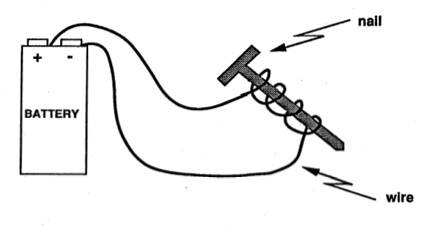
What are the components of the electromagnets?
battery, wire and bulb
battery , copper wire and plastic bottle
battery, copper wire and iron nail
battery, wire and aluminum

What would happen if you took one end of the wire off the battery?
The nail will be a magnet.
The nail would no longer be a magnet
Nothing will happened.
The nail will heats up.

Which electromagnet is stronger?
A
B

Which electromagnet is stronger?
A
B
___, ____, and ____ are magnetic metals.
Iron, Nickel, Cobalt
Copper, Chromium, Gadolinium
Aluminum, Iron, Copper
Cobalt, Mercury, Sodium

What is the device shown?
Electromagnet
Solenoid
Generator
Motor
Which of the following is the most appropriate definition for magnetism?
the force of attraction or repulsion of magnetic materials
the force of attraction only of magnetic materials
the force of repulsion only of magnetic materials
none of the above
Which of the following is the most appropriate definition for magnetic field?
an area surrounding a magnet that does not apply a force (a push or pull)
an area directly on the magnet that applies a force (a push or pull) without actually touching an object
an area of magnetism surrounding a magnet that applies a force (a push or pull) without actually touching an object
an area surrounding a magnet that applies a force (a push or pull), but only by directly touching an object

How does the electromagnet in the diagram above demonstrate the relationship between magnetism and electricity?
The wire is wrapped around the iron core, but no electric circuit is present.
The wire is wrapped around the iron core, but no energy source is present.
The wire in the electric circuit is wrapped around an iron core producing a magnetic field.
No circuit is present.

Which of the following is flowing through the electromagnet above?
electric current
magnetic current
magnetic energy
chemical energy

In order for the electromagnet above to lose its magnetism, which of the following must occur?
The wire of the circuit must be tightened.
The battery in the circuit must be switched for a different brand.
The electric current must stop flowing in the circuit.
No circuit is present.

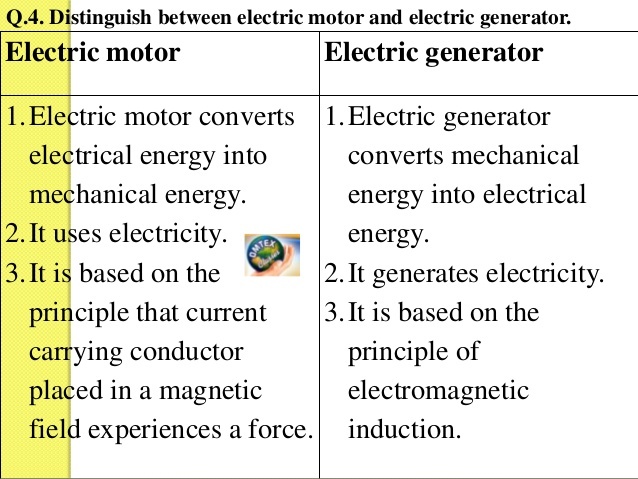
How is the device above different from an electric motor?
Electric motors turn mechanical energy into electrical energy.
Electric motors turn electrical energy into mechanical energy.
Electric motors turn chemical energy into mechanical energy.
Electric motors turn mechanical energy into chemical energy.

What energy transformation occurs in this device? (Generator)
electrical energy to mechanical energy
chemical energy to mechanical energy
mechanical energy to chemical energy
mechanical energy to electrical energy

What would happen if another light was added to the circuit pictured?
All the lights would go off
All the lights would glow dimmer
All the lights would glow brighter
The lights would stay lit and the same brightness

Rubber tires are an example of--
a semiconductor
an insulator
a conductor
a cool science experiment
Which of the following are good conductors?
Steel
Glass
Copper
Water
Rubber

The motor in the fan pictured converts--
electrical energy to mechanical energy
mechanical energy to electrical energy
chemical energy to electrical energy
nuclear energy to solar energy

Which of the following can make an the electromagnet stronger? (Choose all)
Add more wire coils
Wrap the wires closer together
Add another battery
Space the wires farther apart
Overlap the wires
A ____ is a device that changes mechanical energy into electrical energy.
motor
generator
transformer
circuit

Which of the following is true about the broken magnet?
Each piece will have a north and south pole
1 piece will be north and 1 piece will be south
Both pieces will be a north
Both pieces will be a south

This MRI machine is an example of a(n)--
circuit
electromagnet
fuse
dry cell

The lines around the magnet show the ---
poles
magnetic field
area the magnet won't work
circuit area
The ends of a magnet are called the--
poles
field
fuse
breaker
After completing an investigation of how distance affects the strength of electric forces, you graphed your data. Imagine your graph shows that the longer the distance, the strength of the electric field is minimal. What conclusion can you draw from your data?
The strength of the electric field is strongest at a long distance.
The strength of the electric field is strongest at a short distance.
The strength of the electric field is weakest at both ends of the graph.
The strength of the electric field is strongest at both ends of the graph.

The image depicts two bar magnets immersed in oil that contains small needle-like particles of iron. What is the BEST interpretation of the pattern created by the iron particles?
The pattern of iron particles is created by the north pole of one magnet facing the south pole of the other magnet.
The pattern of iron particles is created by the south pole of one magnet facing the south pole of the other magnet because south poles attract each other.
The pattern of iron particles is created by the repulsion of like magnetic poles, we cannot determine if the poles are north or south polarization.
The pattern of iron particles is created by the north pole of one magnet facing the north pole of the other magnet because north poles attract each other.

A group of students carried out an investigation in which they caused the surface of a balloon to become electrically charged by rubbing the balloon on a piece of wool. They then brought the charged portion of the balloon close to a classmate’s hair and watched as the hair stuck to the balloon. The teacher explained that this was due to the negative charge on the hair. What was the charge on the balloon?
negative
neutral
no charge
positive
Students conducted an investigation to compare the strength of two electromagnets by determining how many paper clips they could pick up. They constructed the two electromagnets shown, Electromagnet A (9V) and Electromagnet B (3V), and used each of them to pick up paper clips for 10 seconds.
Conclusion: Electromagnet A is stronger than Electromagnet B.
Once the students completed the investigation they replaced the 3V battery on Electromagnet B with a 9V battery and repeated the experiment; however, Electromagnet A had more coils around its nail.
What will the results be when the students repeat the experiment?
Electromagnet B will pick up more paper clips than Electromagnet A.
Electromagnet A will pick up more paper clips than Electromagnet B.
Electromagnet A will pick up twice as many paper clips as Electromagnet B.
Electromagnet A and Electromagnet B will pick up the same number of paper clips.

A group of students built an electromagnet using a 9-volt battery, an iron nail and copper wire.
What can the students do to make the electromagnet stronger?
Increase the thickness of wire used.
Replace the iron nail with a smaller iron nail.
Decrease the number of turns in the wire coil.
Replace the battery with a higher voltage battery.
Isabella was standing directly below a power line, and her compass failed to give an accurate reading. How could she explain why her compass was not working?
A compass works with a magnetic field, and the electric current running through the lines above it would interfere with the magnetic field.
The compass works because of an electric field, and the electric current running through the lines above would interfere with the electric field.
The compass works because of a gravitational field, and the magnetic current running through the lines above would interfere with the gravitational field.
A compass works because of a magnetic field, and the magnetic current running through the power lines above it would interfere with the magnetic field below it.
After completing an investigation of how distance affects the strength of electric forces, you graphed your data. Imagine your graph shows that the longer the distance, the strength of the electric field is minimal. What conclusion can you draw from your data?
The strength of the electric field is strongest at a long distance.
The strength of the electric field is strongest at a short distance.
The strength of the electric field is weakest at both ends of the graph.
The strength of the electric field is strongest at both ends of the graph.
The image depicts two bar magnets immersed in oil that contains small needle-like particles of iron. What is the BEST interpretation of the pattern created by the iron particles?
The pattern of iron particles is created by the north pole of one magnet facing the south pole of the other magnet.
The pattern of iron particles is created by the south pole of one magnet facing the south pole of the other magnet because south poles attract each other.
The pattern of iron particles is created by the repulsion of like magnetic poles, we cannot determine if the poles are north or south polarization.
The pattern of iron particles is created by the north pole of one magnet facing the north pole of the other magnet because north poles attract each other.
A group of students carried out an investigation in which they caused the surface of a balloon to become electrically charged by rubbing the balloon on a piece of wool. They then brought the charged portion of the balloon close to a classmate’s hair and watched as the hair stuck to the balloon. The teacher explained that this was due to the negative charge on the hair. What was the charge on the balloon?
negative
neutral
no charge
positive
Students conducted an investigation to compare the strength of two electromagnets by determining how many paper clips they could pick up. They constructed the two electromagnets shown, Electromagnet A (9V) and Electromagnet B (3V), and used each of them to pick up paper clips for 10 seconds.
Conclusion: Electromagnet A is stronger than Electromagnet B.
Once the students completed the investigation they replaced the 3V battery on Electromagnet B with a 9V battery and repeated the experiment; however, Electromagnet A had more coils around its nail.
What will the results be when the students repeat the experiment?
Electromagnet B will pick up more paper clips than Electromagnet A.
Electromagnet A will pick up more paper clips than Electromagnet B.
Electromagnet A will pick up twice as many paper clips as Electromagnet B.
Electromagnet A and Electromagnet B will pick up the same number of paper clips.
You and your sister both have a small camping tent set up in the backyard. You each have two strings of lights to hang inside the tent. You power your lights with a 9-volt battery and your sister uses an extension cord and powers her lights from an electrical outlet on the deck.
What is the BEST conclusion the you can make about this situation?
Your lights shine the brightest because your battery produces less power.
Your lights shine the brightest because your battery produces more power.
Your sister’s lights shine the brightest because the electrical outlet has less power.
Your sister’s lights shine the brightest because the electrical outlet has more power.
A group of students built an electromagnet using a 9-volt battery, an iron nail and copper wire.
What can the students do to make the electromagnet stronger?
Increase the thickness of wire used.
Replace the iron nail with a smaller iron nail.
Decrease the number of turns in the wire coil.
Replace the battery with a higher voltage battery.

How can levitating trains support the claim that magnetic fields exist between objects exerting magnetic force on each other even when there is no physical contact?
Levitating trains are controlled by the attraction of two similar magnetic poles being brought close together.
Levitating trains are controlled by the repulsion of two similar magnetic poles being brought close together.
Levitating trains are controlled by the attraction and connection of magnets on the train to magnets on the train tracks.
Levitating trains are controlled by the repulsion and connection of magnets on the train to the magnets on the train tracks.
Allison is working on a science activity. She takes an iron rod and wraps insulated copper wire around it. She connects the ends of the copper wire to the battery. Allison switches on the circuit and brings some paper clips near the iron rod. The paper clips are attracted to the iron rod.
Which of the following will cause the paper clips to fall off the iron rod?
increase the current flow through the circuit
switch on the circuit to start the current flow
increase the copper wiring around the iron rod
switch off the circuit to stop the electric current
A group of students was discussing whether the concept of magnetic fields is just a theory or if magnetic forces can be shown to exist between objects that are not touching. Some of the students were convinced that these forces only exist in theory while the rest of the students decided to prove that these forces actually exist.
How can the students prove that magnetic forces exist between objects that are not touching each other?
Place two bar magnets on a table six inches apart with similar poles facing each other.
Place two bar magnets on a table six inches apart with opposite poles facing each other.
Use two magnets, one on the door and one on the door frame, to hold a cabinet door closed.
Tape a bar magnet to the top of a toy car and use a second bar magnet to move the car without allowing it to touch the car.

Where does a magnet have the strongest magnetic field?
at the poles
in the middle
only at the north pole
only at the south pole

A student rubs a neutral balloon with a cloth on a cool, dry day. The balloon gains electrons.
Which of the following is an accurate description of what occurred, and why?
The balloon gains a positive charge through conduction.
The balloon gains a negative charge through friction.
The balloon gains a negative charge through conduction.
The balloon gains a positive charge through friction.

CONSTRUCTED RESPONSE QUESTION: In terms of movement of positive and negative charges, what can cause a shock when you touch a metal door knob?
Protons from the person move to the metal door knob when touched, creating an electric current.
Neutrons from the person move to the metal door knob when touched, creating a parallel circuit.
Extra electrons jump from the person to the metal door knob, because negative charges attract to positive charges, which creates a static electric shock.
Atoms from the person move to the metal door knob when touched, creating a static electric shock.

CONSTRUCTED RESPONSE QUESTION: What could you do in order to prevent the static electric shock from metal objects?
ground yourself to drain off those excess static charges
rubbing your feet on wool carpet
wearing shoes with rubber soles
wearing polyester materials

A material that does not allow electric charges to flow freely through them (ex.- wood, rubber) is called a(n)....
conductor
insulator
frictionator
magnet

A material that allows electrical energy to flow through it easily (ex.- copper wire, metal) is called a(n)...
conductor
insulator
frictionator
magnet

If two objects, one with a negative charge and one with a positive charge, come into close contact with one another, what would you expect to see happen?
They will repel.
They will attract.
They will divorce.
They will unite.

If two objects, both with negative charges, come into close contact with one another, what would you expect to see happen?
They will repel.
They will attract.
They will divorce.
They will unite.

A student rubs a neutral balloon with a cloth on a cool, dry day. The balloon gains electrons.
Which of the following is an accurate description of what occurred, and why?
The balloon gains a positive charge through conduction.
The balloon gains a negative charge through friction.
The balloon gains a negative charge through conduction.
The balloon gains a positive charge through friction.
Where does a magnet have the strongest magnetic field?
at the poles
in the middle
only at the north pole
only at the south pole
A student rubs a neutral balloon with a cloth on a cool, dry day. The balloon gains electrons.
Which of the following is an accurate description of what occurred, and why?
The balloon gains a positive charge through conduction.
The balloon gains a negative charge through friction.
The balloon gains a negative charge through conduction.
The balloon gains a positive charge through friction.
CONSTRUCTED RESPONSE QUESTION: In terms of movement of positive and negative charges, what can cause a shock when you touch a metal door knob?
Protons from the person move to the metal door knob when touched, creating an electric current.
Neutrons from the person move to the metal door knob when touched, creating a parallel circuit.
Extra electrons jump from the person to the metal door knob, because negative charges attract to positive charges, which creates a static electric shock.
Atoms from the person move to the metal door knob when touched, creating a static electric shock.
A material that does not allow electric charges to flow freely through them (ex.- wood, rubber) is called a(n)....
conductor
insulator
frictionator
magnet
A material that allows electrical energy to flow through it easily (ex.- copper wire, metal) is called a(n)...
conductor
insulator
frictionator
magnet
If two objects, one with a negative charge and one with a positive charge, come into close contact with one another, what would you expect to see happen?
They will repel.
They will attract.
They will divorce.
They will unite.
If two objects, both with negative charges, come into close contact with one another, what would you expect to see happen?
They will repel.
They will attract.
They will divorce.
They will unite.
A student rubs a neutral balloon with a cloth on a cool, dry day. The balloon gains electrons.
Which of the following is an accurate description of what occurred, and why?
The balloon gains a positive charge through conduction.
The balloon gains a negative charge through friction.
The balloon gains a negative charge through conduction.
The balloon gains a positive charge through friction.
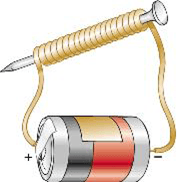

Joan rubs two balloons with a woolen sock and suspends them from a fixed point with string. The balloons push away from each other. Which of the following is most likely true?
One balloon has a positive charge, and one balloon has a negative charge.
One balloon has a neutral charge, and one balloon has a negative charge.
Both balloons have a negative charge.
Both balloons have a neutral charge.
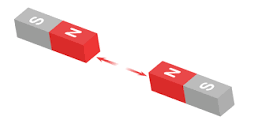
What will happen when these magnets are brought close together?
They will attract each other.
They will repel each other.
Both magnets will turn to the left.
Both magnets will turn to the right

Where is Earth's magnetic field strongest?
along the outside lines
along the inside lines on either side
where the lines are close together at the poles
In the space outside of the lines

The strongest part of a bar magnet is/are
the bars
the force field
the poles
the middle

This object is
magnetized
unmagnetized
positively charged
negatively charged

Where are the magnetic force the strongest in this picture?
Location 1
Location 2
Location 3
Location 4

In this image, matching north poles from two magnets are introduced. What do you predict will be the outcome?
There will be no interaction. The poles of magnets do not have an effect on one another.
The two north poles will attract each other.
The two north poles will repel each other.
The two magnets will combine and become one magnet.

How could the strength of an electromagnet be increased?
By reducing the length of the nail of the electromagnet.
By using the rubber material as the core for the electromagnet.
By decreasing the amount of batteries used for the electromagnet.
By increasing the number of coils in the wire of the electromagnet.

The center magnet in the picture is hovering between two magnets, making it appear to float. Which best explains how the center magnet is able to hover between two other magnets?
The magnets are stacked so similar poles are facing one another, so they repel.
The magnets are stacked so that opposite poles are facing each other, so they repel.
The middle magnet is repelling the top magnet while attracting the bottom.
The middle magnet is attracted to the top magnet while repelling the bottom.

Using the materials provided, how could you create an electromagnet?
Replace the iron nail with a wooden nail.
Add more loops of wire to the iron nail.
Connect the ends of the wire to each other.
Touch the ends of the wire to the ends of the battery.

In which location is the bar magnet the strongest?
1
2
3
4

The masses of 4 objects (W,X,Y,Z) are shown in the table. In which of the following situations is the gravitational force the greatest?
When objects W and X are 1 m from each other.
When objects Y and Z are 1 m from each other.
When objects W and Y are 2 m from each other.
When objects X and Z are 2 m from each other.
A student builds an electromagnet and attaches it to a fan. The fan blades begin to turn. What would most likely happen if she were to connect the fan to two batteries?
The fan blade would turn faster.
The fan blade would turn slower.
The fan blade would not turn at all.
The fan blade would turn in the opposite direction.

The table shows electromagnetic force exerted by two electromagnets on each other as the distance between the two electromagnets varies. The table provides evidence for which of the following conclusions?
The force between any two magnets is always constant, regardless of distance.
As distance between two electromagnets increases, the force between them also increases.
The smaller the distance between two electromagnets, the greater the force between them.
The force between two magnets depends only on the charge of the electromagnets.

How does DECREASING the number of turns in the coil of wire affect the strength of the magnetic field for the electromagnet?
The magnetic field becomes stronger.
The magnetic field becomes weaker.
The magnetic field does not change.
The magnetic field disappears.
As an astronaut travels from Earth to a space station orbiting Earth, what happens to her mass and weight?
Her mass increases as her weight decreases.
Her mass remains the same, but her weight decreases.
Her mass decreases and her weight also decreases.
Her mass decreases, but her weight remains the same.
The force that holds you to Earth's surface is
weight
pressure
mass
gravity
Which is true about friction and gravity?
both cause heat
both cause things to speed up
both are forces
both cause energy loss

Which conclusion is best supported by the results in the table?
all metals are magnetic
some metals are magnetic
some nonmetals are magnetic
all nonmetals are magnetic
Which of the following is a true statement about the magnetic field between two magnets?
The south pole of one magnet is attracted to the south pole of the other magnet.
The north pole of one magnet is attracted to the north pole of the other magnet.
The south pole of one magnet is attracted to the north pole of the other magnet.
The south pole of one magnet is attracted to both poles of the other magnet.
Jane puts the north pole of a bar magnet near an object on her desk. As the magnet gets closer to the object, the object is repelled and moves away from the magnet. Which of the following statements about the object on Jane’s desk is true?
The object is a magnet or has been magnetized.
The object has a north pole but no south pole.
The object has randomly-arranged domains.
The object is not made of metal.

The two magnets are placed near each other on a table top. Which statement about the magnetic force of these two magnets is true?
they will attract
they will repel
What will happen if you break a magnet in half?
The north pole will demagnetize.
The south pole will demagnetize.
Two new magnets will form.
Both poles will demagnetize.

When the switch is closed the buzzer will sound because -

Opposite charged particles always ______ and like charged particles always_____.
attract, repel
repel, repel,
attract, attract
repel, attract
Objects can become charged by these three methods


Opposite charged particles always ______ and like charged particles always_____.
attract, repel
repel, repel,
attract, attract
repel, attract
An electric charge has an invisible electric ______around it.
force
field
fence
feirce

Current flows from ____potential energy to ____ potential energy.
lower, higher
higher, lower
girl here who
glow her her I
_____ do not allow charge/current to flow.
Coconut Drs
Insulators
Insult oars
Conductors
_____ allow the charge/current to flow.
Coconut Drs
Insulators
Latin sours
Conductors
Objects can become charged by these three methods

The area of force that surrounds a magnet.
Magnetic field
Celt magnified
Magnetic force
Force magnetic


electrons are transferred as clothes rub against each other in the dryer
the vibration of molecules.
a moving magnetic field.
the movement of atoms.
the movement of electrons
a magnet sticking to a metal refrigerator door
a ceiling fan turning on after you flip the wall switch
a dry cell battery lighting up a light bulb

This circuit is...
Series
Parallel
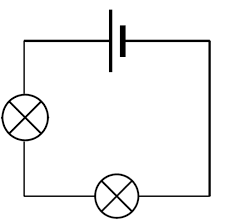
If one of the bulbs in this circuit breaks, the other one will...
Go off
Stay on
electrons are transferred as clothes rub against each other in the dryer
the vibration of molecules.
a moving magnetic field.
the movement of atoms.
the movement of electrons
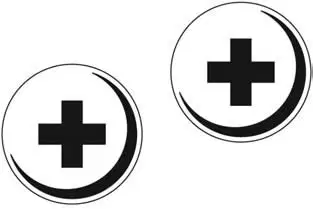
The following image shows two circular objects. Each object has an electric charge, as shown:
What will happen to these objects when they are placed near each other?
The objects will remain still.
The objects will both move to the left.
The objects will move towards each other.
The objects will move away from each other.



Max tested some objects with the circuit tester. Then, he recorded his results in the table below.
Choose all of true statements below.
A, B and C are probably plastic.
B is an insulator
A and C are probably made of metal.
B might be made of plastic or wood.
Choose all of the items that will conduct electricity.
Glass marble
Rubber balloon
Copper penny
Paper clip
Wooden block
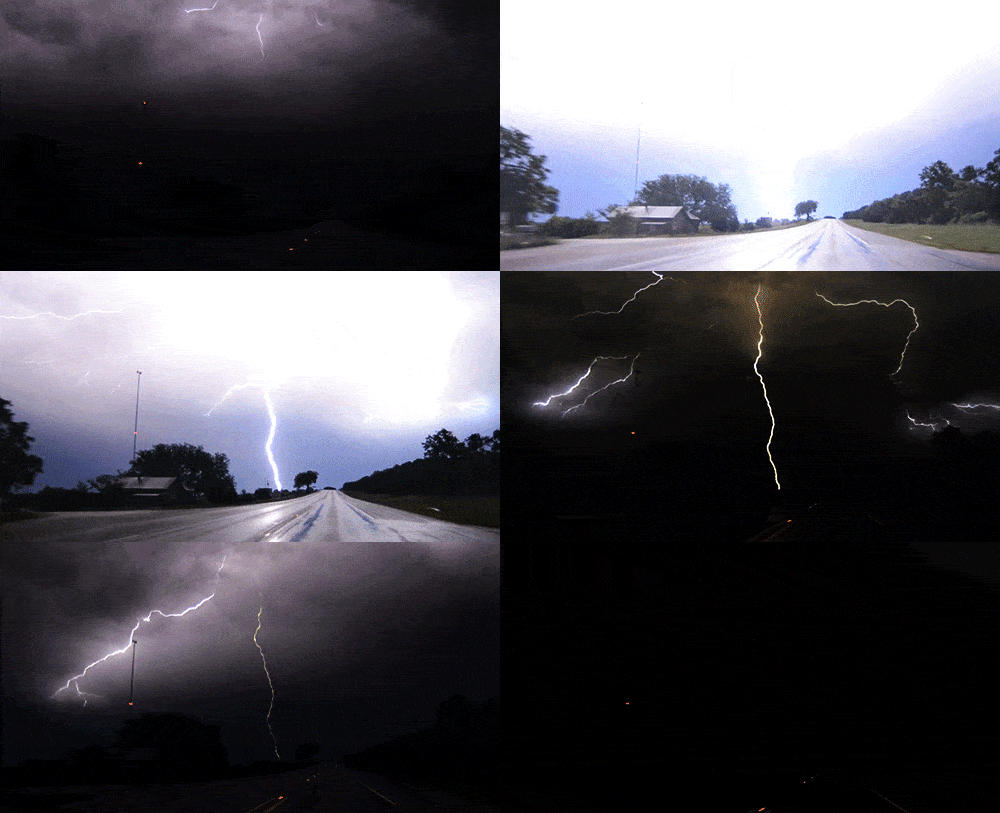
Lightning occurs because ___.
the negative charges at the bottom of clouds are attracted to the positive charges on the ground.
the positive charges at the bottom of clouds are attracted to the negative charges on the ground.
the positive and negative charges inside clouds are attracted to each other
All of these reasons are correct.
How many types of electric charges are there?
0
1
2
3

Diagram C
Diagram D
Diagram E

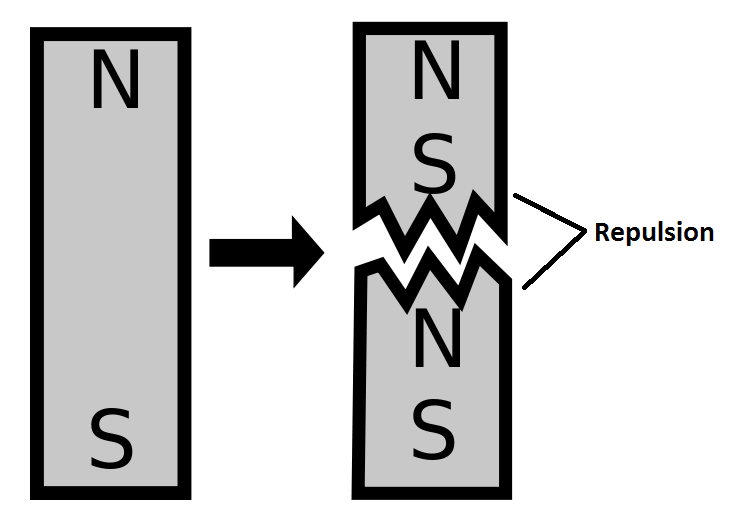
If you break a bar magnet in half, each half...
contains one magnetic pole.
becomes a bar magnet with two poles.
becomes unmagnetized.
is only temporarily magnetized.

Where are the magnetic lines the strongest and why?
the poles, the magnetic field lines are further apart at the poles
between the poles, the magnetic field lines are closer together between the poles
between the poles, the magnetic field lines are further apart
the poles, the magnetic field lines are closer together at the poles

Look at the diagram shown. Explain what will happen if there are two positive charges near each other.
they will attract
they will repel
nothing will happen

Look at the diagram shown. Explain what will happen if there are two positive charges near each other.
they will attract
they will repel
nothing will happen

A student creates an electromagnet and holds it near two paper clips. Paper clip Y is not attracted to the magnet. Which step should the student take to attract it?
The student should use a battery with less energy.
The student should use a smaller core in the magnet
The student should wrap the coil fewer times around the nail
The student should move the magnet closer to the paper clip.
Markeisha needs to create an electromagnet for her science project. She needs to create a magnet that can pick up iron filings out of a mixture of substances. Which list of materials would best help Markeisha build her electromagnet?
string, battery, metal nail
battery, metal nail, wire
glass rod, wire, battery
glass rod, string, battery
Seamus made an electromagnet from an iron nail, a piece of copper wire with three coils spread out across the nail, and a AAA-sized battery. His magnet attracts only one paper clip, and he wants to boost the power of his magnet to attract at least four paper clips. What two things can Seamus do to accomplish his goal?
Seamus can add batteries to decrease the voltage, and he can decrease the space between the wire coils.
Seamus can add batteries to increase the voltage, and he can increase the space between the wire coils.
Seamus can add batteries to increase the voltage, and he can decrease the space between the wire coils.
Seamus can add batteries to decrease the voltage, and he can increase the space between the wire coils.

