
Font size
 Worksheets
Science Test
Total questions: 80
Worksheet time: 1hrs 20mins

. A boy is whirling a stone tied with a string in a horizontal circular path as shown in the following figure:
Will move along a straight line towards the centre of the circular path
Will move along a straight line the tangential to the circular path
Will move along a straight line perpendicular to the circular path away from the boy
Will continue to move in the circular path
Gravitation is the force of ________________
attraction
repulsion
both
none
What is F = Gm1m2/r^2 ?
Newton's Law of gravitation
Newton's first law of motion
Newton's Universal law of gravitation
None
What is the SI unit of G?
Nm2/kg
Nm2/kg2
unitless
none
Gravity is the phenomenon between
Earth and moon
Earth and you
Earth and any object
none
The value of g is
9.8
9.6
8.6
none
The value of g is maximum at
Poles
Equator
both
none
What is the difference between mass and weight ?( multiple select)
Mass of an object is the quantity of matter contained in it whereas weight of an object is the force with which it is attracted towards the centre of earth
Mass is a vector and weight is scalar
Mass is constant whereas weight is not
SI unit of mass is Kg and SI unit of weight is Newton
When a body is partially or wholly immersed in a liquid ,the upward force acts on it which is called :
Buoyant force
Presure
Area
None


moving or tending to move toward a center...
centripetal force
centrifugal force
Tangent
Curvature
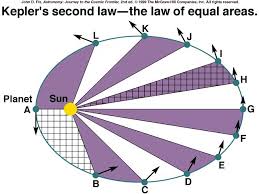
Pluto's orbit lasts over over 90,000 days.
Mercury's orbit lasts 88 days.
1.Newlands relation is called
a) Musical Law
(b) Law of Octaves
(c) Periodic Law
(d) Atomic Mass Law
4.The arrangement of elements in the Modem Periodic Table is based on their
(a) increasing atomic mass in the period
(b) increasing atomic number in the horizontal rows
(c) increasing atomic number in the vertical columns
(d) increasing atomic mass in the group
The elements with atomic numbers 2, 10, 18, 36, 54 and 86 are all
halogens.
nobel gases.
nobel metals.
light metals.
Upto which element, the Law of Octaves was found applicable?
CALCIUM
MAGNESIUM
ALUMINIUM
POTASSIUM
Select the correct arrangement of following elements in doberieners triads Sr, K, Ca, Br, Na, Ba, Cl, I, Li
i) Li Sr K ii) Ca Na Ba iii) Cl Br I
i) Li Na K ii) Ca Sr I iii) Cl Br Ba
i) Li Na K ii) Ca Sr Ba iii) Cl Br I
i) Ca Na K ii) Li Sr Ba iii) Cl Br I
Upto which element, the Law of Octaves was found applicable?
CALCIUM
MAGNESIUM
ALUMINIUM
POTASSIUM
What does the period number in the modern periodic table indicate?
Select the correct arrangement of following elements in doberieners triads Sr, K, Ca, Br, Na, Ba, Cl, I, Li
i) Li Sr K ii) Ca Na Ba iii) Cl Br I
i) Li Na K ii) Ca Sr I iii) Cl Br Ba
i) Li Na K ii) Ca Sr Ba iii) Cl Br I
i) Ca Na K ii) Li Sr Ba iii) Cl Br I
Which of the following elements has the largest atomic size?
At the time of Mendeleev, the number of elements known was
62
61
63
56
Choose the correct statement from the following:
Mendeleev considered oxides and halides made by elements as criteria for classification
Newland's law of octaves was valid upto the element vanadium
Doberieneer could identify only 5 triads
modern periodic table removed the anomaly of position of isotopes
Up to which element,law of octaves found to be applicable
Oxygen
Calcium
Cobalt
Potassium
The vertical columns on the periodic table are called:
periods
elements
groups
matter
The horizontal rows on the periodic table are called:
periods
elements
groups
matter
Which of the following is not true of Metals?
they make up a majority of elements
they are shiny
they are good conductors
they are poor conductors
True or False? - Nonmetals can be solids, liquids, or gases.
True
False
Which group are the Alkali Metals in?
1
2
17
18
Which group are the Halogens in?
1
2
17
18
What is the significance of the "lanthanides" and "actinides" in the modern periodic table?
What period is Lead (Pb) in?
6
4
Metals
4A
What are valence electrons?
Any of an atom's electrons
Electrons located on the first energy level
Electrons not attached to any atom
electrons located on the outer energy level


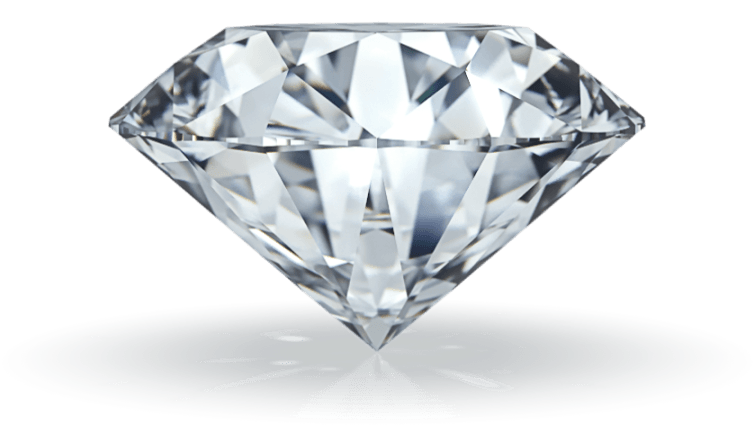
Which element is this?
H
He
Li
B
What does the term "periodicity" refer to in the context of the modern periodic table?
The repeating pattern of element properties.
Number of protons and neutrons
atomic number
atomic mass
noble gases
Non-metals
2 rows beneath the main periodic table
Lanthanide
Lanthanide and Actinide
Lanthanide and Hydrogen
Actinide and Hydrogen
What is one of the merits of Mendeleev's periodic table?
What is one of the demerits of Mendeleev's periodic table?
Which aspect of Mendeleev's periodic table is considered a demerit in modern terms?
What is a key feature of the modern periodic table?
What is the significance of the atomic number in the modern periodic table?
What is valency?
The number of electrons in the outermost energy level of an atom.
If an element has a valency of 3, how many electrons are in its outermost energy level?
3
In the periodic table, as you move from left to right across a period, what generally happens to the atomic size of elements?
In the periodic table, as you move down a group, what generally happens to the atomic size of elements?

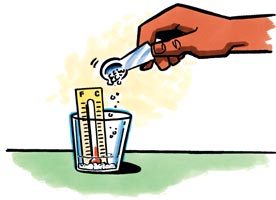


2H2 + O2 --> 2H2O
Al + O2 --> 2Al2O3
An electric current can produce
heating effect
chemical effect
magnetic effect
all of the above
Pure or distilled water is a
poor conductor
good conductor
Both
None of the above
What is the electronic configuration of sodium (Na)?
Flow of electron is called
Electroplating
Electric current
Electrodes
Electrolyte
conductors can allow electricity because of the presence of
free ions
free electrons
free protons
atoms
Magnetic field inside a long solenoid carrying current is
same at all points (uniform)
different at poles and at the centre
zero
different at all points
An Electric charge in a uniform motion produces
An Electric Field only
An Magnetic field only
Both Electric Field & Magnetic field
Neither of them
A soft iron bar is inserted inside a current-carrying solenoid. The magnetic field inside the solenoid will
Increase
Decrease
Remains same
Becomes zero
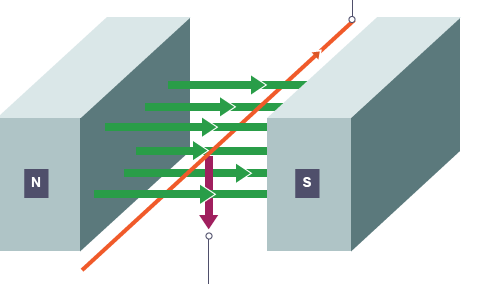
What direction is the force/motion in the following diagram?
Perpendicular to the magnets
Downwards
Parallel and through the magnets
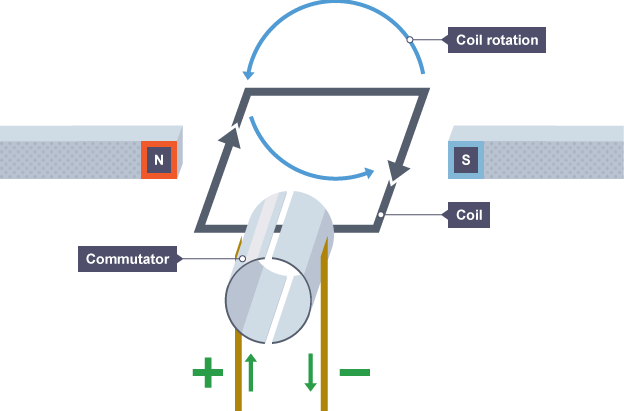
How does a split ring commutator work?
Swaps the contact evert full turn, so that the left-hand and right-hand arms of the coil always experience a force in the same direction.
Swaps the contact evert half turn, so that the left-hand and right-hand arms of the coil do not experience a force in the same direction.
Swaps the contact evert half turn, so that the left-hand and right-hand arms of the coil always experience a force in the same direction.
The device which is used to detect current is called a:
Galvanometer
Ammeter
Motor
Generator
What is the electronic configuration of Helium (He)?
What is the electronic configuration of carbon (C)?
2,6
2
2,4,8
2,4

