
Font size
 Worksheets
Unit 4
Total questions: 79
Worksheet time: 42mins
What is the most important force in venous flow?
The one-way flow due to valves
The skeletal muscle pump
Cardiac suction
The pressure generated by the heart
The thoracic (respiratory) pump
Allows only passage of water and small ions
Continuous Capillaries
Fenestrated Capillaries
Sinusoidal Capillaries
Decreased stroke volume
If blood pressure increases
If blood pressure decreases
Increased capillary hydrostatic pressure (CHP)
Fluid moving into the capillary
Fluid moving out the capillary
Low blood volume/dehydration
Fluid moving into the capillary
Fluid moving out the capillary
Contains small pores that allow small molecules (like glucose) and hormones to pass through).
Continuous Capillaries
Fenestrated Capillaries
Sinusoidal Capillaries
Capillaries of the pituitary.
Continuous Capillaries
Fenestrated Capillaries
Sinusoidal Capillaries
Capillaries of the heart
Continuous Capillaries
Fenestrated Capillaries
Sinusoidal Capillaries
Large open slits through which cells could escape.
Continuous Capillaries
Fenestrated Capillaries
Sinusoidal Capillaries
Capillaries of the heart
Continuous Capillaries
Fenestrated Capillaries
Sinusoidal Capillaries
Capillaries in the bone marrow
Continuous Capillaries
Fenestrated Capillaries
Sinusoidal Capillaries
Which of the following would decrease the velocity of blood flow?
Increased viscosity
Decreased vasomotor
Increased preload
Increased blood pressure
Increased vessel radius
As blood circulates from arteries into capillaries, the total cross-sectional area of capillaries?
Decreases and causes the blood velocity to decrease.
Is the same as the total cross-sectional area of arteries and blood velocity is equal between arteries and capillaries.
Increases and causes the blood velocity to decrease.
Increases and causes the blood velocity to increase.
Decreases and causes the blood velocity to increase.
The continual movement of fluid through interstitial spaces produces by capillary filtration serves which of the following functions?
Accelerates the distribution of nutrients and hormones.
Flushes hormones and wastes from the interstitial spaces.
Assists the transport of insoluble substances that cannot enter the capillaries.
Helps carry toxins and bacteria to cells of the immune system.
Negative Net Filtration Pressure (NFP)
Fluid moving into the capillary
Fluid moving out the capillary
Positive Net Filtration Pressure (NFP)
Fluid moving into the capillary
Fluid moving out the capillary
Low levels of ADP, AMP, and Adenosine
Vasoconstriction
Vasodilation
Presence of histamine
Vasoconstriction
Vasodilation
Decreased temperature
Vasoconstriction
Vasodilation
Increased CO2 level
Vasoconstriction
Vasodilation
Increased O2 level
Vasoconstriction
Vasodilation
When a person rises quickly from a sitting position……
Venous return is decreased
The carotid baroreceptors become less active
Reflex vasoconstriction of peripheral blood vessels occurs.
Heart rate is reflexively elevated
Which of the following statements regarding auto-regulation of local blood flow is true?
Contraction of precapillary sphincters will increase blood flow to a capillary bed.
Blood flow through capillaries is continuous.
Increased metabolic rate in a tissue increases capillary blood flow into the tissue.
Increased levels of carbon dioxide increase the contraction of precapillary sphincters.
Tissue need for oxygen and amino acids will cause precapillary sphincters to contract.
Increased respiratory rate
If blood pressure increases
If blood pressure decreases
Widespread vasoconstriction of muscular arteries and arterioles.
If blood pressure increases
If blood pressure decreases
Increased parasympathetic stimulation of the heart.
If blood pressure increases
If blood pressure decreases
All of the following are true about fetal circulation except……
The ductus arteriosus and formen ovale shunt blood away from the pulmonary circulation.
Mixed oxygen blood is carried to the right atrium via the inferior vena cava.
The organ of nourishment and gas exchange for the fetus is the placenta.
The ductus venous carries oxygenated blood from the placenta.
Changes in fetal circulation occur just prior to birth to the ready for life outside the womb.
The process by which dissolved gases are exchanges between the blood and interstitial fluids?
Breathing
External respiration
Cellular respiration
Pulmonary ventilation
Internal respiration
What is the order in which air passes through?
Trachea
Primary & Secondary bronchus
Bronchiole
Terminal bronchiole
Respiratory bronchiole
The respiratory membrane of the gas exchange surfaces consists of….
Moist cuboidal epithelium
Simple squamous epithelium
Ciliated squamous epithelium
Pseudostratified ciliated columnam epithelium
Surfactant cells
Tina is singing a song. At a certain point in the song, she forces a large volume of air out of the glottis and at the same time increases the tension on her vocal cords. The sound that she produces is………
Low pitched
High pitched
Soft
Loud
The expansion of the lungs during inspiration generates a pressure gradient causing air to flow into the lungs. This is an example of Boyle’s Law?
True
False
Diaphragm
Quiet Inspiration
Quiet Expiration
Forced Inspiration
Forced Expiration
External Intercostals
Quiet Inspiration
Quiet Expiration
Forced Inspiration
Forced Expiration
Rectus Abdominus
Quiet Inspiration
Quiet Expiration
Forced Inspiration
Forced Expiration
Sternocleidomastoid
Quiet Inspiration
Quiet Expiration
Forced Inspiration
Forced Expiration
Internal intercostals
Quiet Inspiration
Quiet Expiration
Forced Inspiration
Forced Expiration
Formula for Inspiratory Reserve Volume: VC, TV, ERV, IRV
(a)
A patient shows a reduced total lung capacity and a reduced vital capacity.
Restrictive
Obstructive
A patient shows a normal vital capacity and a FEV1/FVC ratio of 60%.
Restrictive
Obstructive
A patient shows increased residual volume and increased total lung capacity.
Restrictive
Obstructive
A patient shows a FEV1/FVC ratio of 90% and a reduced vital capacity.
Restrictive
Obstructive
Which law states that the total atmospheric pressure is the same of the contributions of the individual gases?
Henry
Charles
Boyle
Dalton
Newton
Which of the following would slow down gas exchange between the blood and alveolar air?
An increase in membrane thickness
An increase in alveolar surface area
An increase in respiratory rate
A decrease in membrane thickness
A decrease in nitrogen solubility
Conditions around metabolically active tissues do what to the oxyhemoglobin dissociation curve?
shift it right
shift it left
decrease the slope
Increase the slope
Low pH alters hemoglobin so that the oxygen bind less strongly to hemoglobin at low PO2. This increases the effective’s of….
Internal respiration
Acid-base balance
External respiration
Hemoglobin synthesis
Carbon dioxide transport
The chloride shift occurs in order to…..
Transport bicarbonate ions out of gastric cells.
Pump hydrochloride acid out of gastric cells.
Produce carbonic acid
Produce salt for the cytosol of blood cells.
Force oxygen out of the blood and into tissues.
The pontine respiratory neurons…..
Are located in the medulla oblongata in the brain.
Are active only during expiration.
Are active only during inspiration.
Is essential for respiratory rhythm.
Play a role in switching between inspiration and expiration.
The normal rate and depth of breathing is established by ____ center(s).
Ventral respiratory
Expiratory
Pneumotaxic
DRG & VRG
Apneustic
Which of the following enzymes in an RBC breaks H2CO3 down to water and carbon dioxide?
Hemoglobinase
Carboxyhemoglobinase
Carbonicanhydrate
Bisphosphoglycerase
Carbaminoreductase
Increased sympathetic stimulation of the heart.
If carbon dioxide levels increase
If carbon dioxide levels decrease
Decreased respiratory rate
If carbon dioxide levels increase
If carbon dioxide levels decrease
Increased respiratory rate.
If carbon dioxide levels increase
If carbon dioxide levels decrease
Decreased heart rate
If carbon dioxide levels increase
If carbon dioxide levels decrease
In which of the following would the blood flow be highest?
A vessel 1.0 cm in diameter and 2 meters long.
A vessel 1.0 cm in diameter and 10 meters long.
A vessel 0.5 cm in diameter and 2 meters long.
A vessel 0.5 cm in diameter and 4 meters long.
Which of the following is associated with vasomotion?
Endothelium in the tunica interna
Collagen and elastic tissue in the tunica media
Elastic tissue in the tunica externa
Fenestrated in the tunica externa
Smooth muscle in the tunica media
Blood colloid osmotic pressure is produced by……
Large non-diffuse lie proteins in the blood plasma.
The force of blood pushing against the vessel wall.
Hypertonic solutions separated by a cell membrane.
Osmosis of water.
A greater salt concentration in blood cells.
Homeostatic mechanisms in response to blood loss include all of the following except……
Inhibition of EPO secretion
Activation of aldosterone secretion.
Increased thirst and water intake.
Activation of ADH secretion.
Uptake of interstitial fluid due to reduced capillary pressure.
Which of the following decreases blood pressure?
Natriuretic peptides
Aldosterone
Angiotensin II
Norepinephrine
Antidiuretic hormone
Which of the following changes does not occur at birth when an infant takes his or her first breaths?
Changes in blood flow cause the foramen ovale to closes.
Gas diffuses across the alveolar-capillary membrane.
Blood flow to the lungs decreases.
The resistance in the pulmonary arteries decreases.
Air enters the alveoli.
The addition of CO2 to the blood generates ____ ions in the RBCs, which in turn stimulates RBCs to unload more oxygen.
Nitrogen
Sodium
Hydrogen
Chloride
Gas transport is the process of carrying gases from the alveoli to the systemic tissues and vice versa.
True
False
Damage to the Type II pneumocystis of the lungs would result in….
An increased rate of gas exchange
Expansion of alveoli
A loss of surfactant
Decreased surface tension in the alveoli
All of the answers are correct
When there is no air movement, the relationship between the intrapulmonary and atmospheric pressure is that….
Intrapulmonary pressure is greater than atmospheric pressure.
Intrapulmonary pressure is less than atmospheric pressure.
Intrapulmonary pressure is equal to atmospheric pressure.
Atmospheric pressure is more than intrapulmonary pressure.
Atmospheric pressure is less than intrapulmonary pressure.
Oxygen diffusion from the alveolus to the pulmonary capillary occurs because…..
Alveolar PCO2 is greater than capillary PCO2.
Oxygen diffuses faster than carbon dioxide.
Alveolar PO2 is less than capillary PCO2.
Carbon dioxide diffuses faster than oxygen.
Alveolar PO2 is greater than capillary PO2.
Which of the following increases the rate of gas exchange across the respiratory membrane?
Increased connective tissue in the alveolar wall.
Increased thickness of the respiratory membrane.
Increased fluid in the alveoli.
Increased surface area of the respiratory membrane.
Which of the following factors would increase the amount of oxygen discharged by hemoglobin to peripheral tissues?
Increased tissue PO2
Decreased temperature
Decreased pH
Decreased amounts of DPG
All of the answers are correct
The amount of air in excess of tidal volume that can be inhaled with maximum effort is the ______.
Vital capacity
Inspiratory reserve volume
Expiratory reserve volume
Residual volume
Inspiratory capacity
Metabolically active tissues have which of the following sets of conditions that shift the oxyhemoglobin dissociation curve to the right?
↓ PO2, ↑ PCO2, ↑ temperature, ↑ BPG
↑ PO2, ↑ PCO2, ↓ temperature, ↑ BPG
↑ PO2, ↓ PCO2, ↓ temperature, ↓ BPG
↓ PO2, ↑ PCO2, ↑ temperature, ↓ BPG
The blood transport more CO2 in the form of ______ than in any other form.
Carbaminohemoglobin
Carboxyhemoglobin
Bicarbonate ions
Dissolved CO2 gas
Bisphosphocarbonate
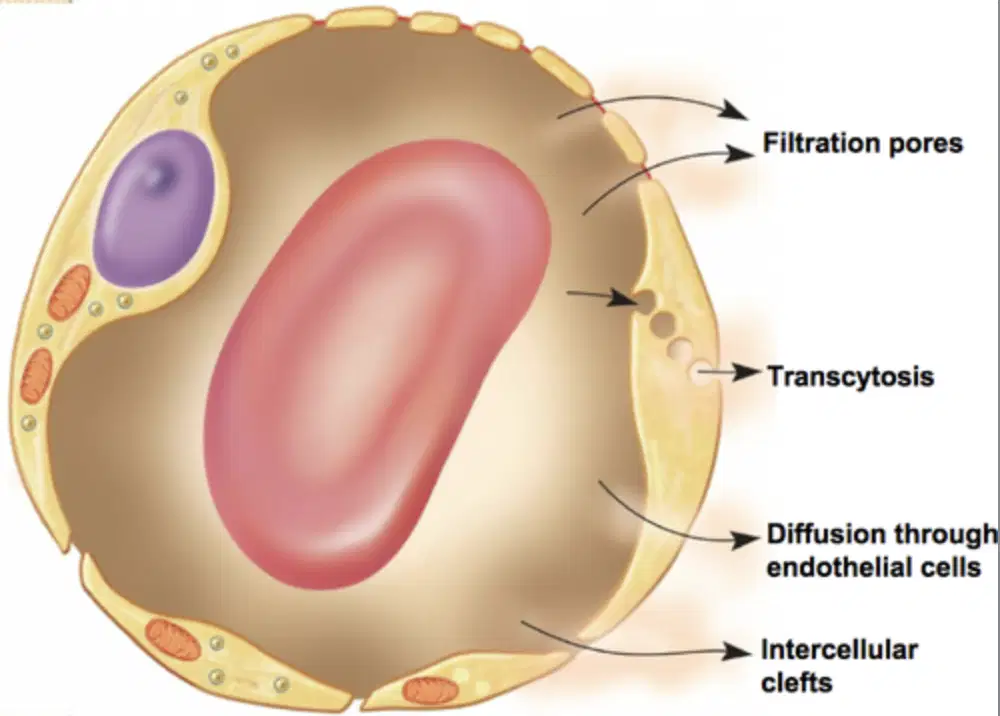
This diagram shows the four routes by which materials are able to move across the capillary wall. Which solute uses the route labeled transcytosis?
Glucose
Transport proteins
Red blood cells
Insulin
Oxygen
This diagram shows the four routes by which materials are able to move across the capillary wall. Which solute uses the route labeled filtration pores?
Glucose
Transport proteins
Red blood cells
Insulin
Oxygen
The pneumotaxic center of the pons
Suppresses the expiratory center in the medulla.
Sets the at-rest respiration pattern.
Prolongs inspiration
Modifies the rate and depth of breathing.
Stimulates the dorsal respiratory group.
Which of the following is directly related to respiratory production of carbon dioxide?
Regulation of blood pressure
The synthesis of vasodilators
AIDS indefecation
Regulation of pH
Regulation of body temperature
Which of the following statements is false concerning the movement of fluid between capillaries and interstitial space?
The hydrostatic pressure of the interstitial fluid is largely unimportant in determining fluid movement.
Blood osmotic pressure moves fluid from the interstitial space to the capillary.
The net filtration pressure is usually zero.
Capillary hydrostatic pressure forces fluid from the capillary to the interstitial space.
The osmotic pressure of the interstitial fluid is less than the blood osmotic pressure.
Which of the following has the most important effect on blood velocity?
Vessel radius
Vessel length
Blood viscosity
Blood osmolarity
Hematocrit
The respiratory membrane of the gas exchange surfaces consists of.......
surfactant cells
ciliated squamous epithelium
Simple squamous epithelium
Moist cuboidal epithelium
Which of the following is the term for the lungs' resistance to expansion?
Pulmonary ventilation
Pulmonary Compliance
Pulmonary stenosis
Pulmonary surfactant
Pulmonary impedance
About 70% of carbon dioxide is transported in deoxygenated blood.
As bicarbonate ions in the blood plasma.
As bicarbonate ions bound to hemoglobin in red blood cells.
As dissolved CO2 in the blood plasma.
As carbonic acid in the red blood cells
Combined with hemoglobin as carbaminohemoglobin.

