wayground logo

Free Printable Worksheets

NEW

Font size

S
M
L
XL
Worksheets

Units 1-3 Review

Total questions: 72

Worksheet time: 54mins

Name
Class
Date
1.

What type of bond is found BETWEEN water molecules?

a)

hydrogen bonds

b)

ionic bonds

c)

nonpolar covalent bonds

d)

polar covalent bonds

2.
Which end of the water molecule has a slightly positive charge?
a)
the oxygen end
b)
the hydrogen end
c)
both ends are slightly positive
d)
neither end is positive
3.
What word describes when water is attracted to other substances?
a)
cohesion
b)
adhesion
c)
capillary action
d)
surface tension
4.
When water molecules stick easily to other water molecules, this is called what?
a)
cohesion
b)
adhesion
c)
solution
d)
polar molecule
5.
The fact that ice floats on liquid water is due to the fact that water's solid is ___________ than it's liquid form
a)
less polar
b)
more polar
c)
less dense
d)
more dense
6.
Which statement explains why water molecules stick together?
a)
both sides are negative
b)
one side has a positive charge and the other side has a negative charge
c)
one side has a negative charge adn the other side has a neutral charge
d)
both sides are positive
7.

The Earth is surrounded by a atmosphere made of water vapor. Which property allows us to consider Earth a "Goldilocks" planet based on this information.

a)

High Specific Heat Capacity

b)

Adhesion

c)

Cohesion

d)

Heat of Fusion

8.
Proteins are made of monomers called ___________
a)
Nucleotides
b)
Monosaccharides
c)
Amino Acids
d)
Glycerol and fatty acids
9.
DNA and RNA are examples of 
a)
Carbohydrates
b)
Lipids
c)
Proteins
d)
Nucleic Acids
10.
Monosaccharides are monomers of
a)
Carbohydrates
b)
Lipids
c)
Proteins
d)
Nucleic Acids
11.
Waxes, oils and fats are examples of
a)
Carbohydrates
b)
Lipids
c)
Proteins
d)
Nucleic Acids
12.
What is the function of nucleic acids?
a)
store genetic information
b)
store energy (long-term)
c)
store energy (short-term)
d)
build skin, hair, nails, muscles
13.
Which of the following organic compounds is the main source of energy for living things?
a)
carbohydrates
b)
lipids
c)
nucleic acids
d)
proteins
14.
What are the monomers of DNA?
a)
glycerols
b)
amino acids
c)
fatty acids
d)
nucleotides
15.

Enzymes belong to which class of macromolecules?

a)

lipids

b)

carbohydrates

c)

proteins

d)

nucleic acids

16.
What is the purpose  of an enzyme?
a)
give permission for the reaction
b)
raise activation energy
c)
speed up reactions
d)
control how many reactions occur
17.
Where do substrates bind on an enzyme?
a)
voltage-gated channels
b)
surface receptor
c)
calcium channels
d)
active site
18.
How do enzymes increase the speed of chemical reactions?
a)
reducing the number of products   
b)
reducing the activation energy
c)
increasing the temperature of the cell
d)
increasing the concentration of reactants 
19.
After the enzyme and substrate bind together and perform the reaction, what does the substrate become?
a)

asubstrate (s)

b)

enzyme(s)

c)

product(s)

d)

inhibitor(s)

20.
Which of these is NOT true?
a)
Enzymes can denature (change shape) when the temperature gets too high.
b)
Enzymes can only be used once in a chemical reaction. 
c)
Extreme pH can denature enzymes.
d)
Enzymes speed up chemical reactions. 
21.
Letter D...
a)
active site
b)
enzyme
c)
substrate
d)
products
22.
Letter B...
a)
active site
b)
enzyme
c)
substrate
d)
products
23.
What is the pigment in chloroplasts that performs photosynthesis?
a)
Chlorosynthesis
b)
Chlorophyll
c)
ADP
d)
Electron Transport
24.

Which of the following equations represents the overall chemical reaction for photosynthesis?

a)

6O2+ 6H2O → C6H12O6+ 6O2

b)

C6H12O6 + 6H2O→ 6O2+ 6O2

c)

6CO2+ 6H2O→ C6H12O6+ 6O2

d)

6O2 + 6H2O→ C6H12O6 + 6CO2

25.
Glucose is a ...
a)
sugar
b)
carbohydrate
c)
source of quick energy
d)
all are correct
26.

The organic molecule that is the cell's primary form of energy?

a)

Glucose

b)

ATP

c)

ADP

d)

GMP

27.
What are the products of photosynthesis?
a)
oxygen and carbon dioxide
b)
oxygen and glucose
c)
carbon dioxide and water
d)
water and glucose
28.
What is the chemical formula for water?
a)
H2O
b)
HO2
c)
CHO2
d)
CO2H
29.

In which way are photosynthesis and cellular respiration different?

a)

Cellular respiration stores ATP, while photosynthesis releases ATP.

b)

Cellular respiration produces oxygen, while photosynthesis uses oxygen.

c)

Photosynthesis releases energy, while cellular respiration stores energy.

d)

Photosynthesis uses carbon dioxide, while cellular respiration produces carbon dioxide.

30.

Which organism go through cellular respiration?

a)

animals

b)

plants

c)

both animals and plants

d)

none

31.
This process releases chemical energy from sugars and other carbon-based molecules to make ATP when oxygen is present.
a)
photosynthesis
b)
light-independent reaction
c)
cellular respiration
d)
light-dependent reaction
32.
The energy needed for photosynthesis is
a)
Light energy from the sun
b)
Chemical energy stored in molecules
c)
Potential energy
33.
Who discovered and named cells? 
a)
Captain Hook
b)
Robert Hooke
c)
Zacharias Janssen
d)
Rudolf Virchow
34.
Which of the following controls movement of materials in and out of a cell? 
a)
Cell wall
b)
Cell membrane
c)
Cytoplasm
d)
Nucleus
35.
The jellylike substance that contains proteins, nucleic acids, minerals, ions, and organelles is what?
a)
Prokaryote
b)
Nucleus
c)
Cytoplasm
d)
Eukaryote
36.
The ___ is the basic unit of sturucture and function of organisms
a)
atom
b)
cell
c)
matter
d)
all other answers are correct
37.
Which statement is a part of the cell theory?
a)
all cells come from preexisting cells
b)
bacteria are prokaryotic cells
c)
eukaryotic cells are complex
d)
humans are multicellular
38.
All plants are made of cells.  This was discovered by....
a)
Matthias Schleiden
b)
Rudolf Virchow
c)
Robert Hooke
d)
Aristotle
39.

What are two types of cells

a)

prokaryote and eukayote

b)

animal and kingdom

c)

phyl a and class

d)

humans and animals

40.

Prokaryotes are

a)

double stranded

b)

single cell

c)

multiple cellec

d)

have no cell

41.

Which has no true nucleus

a)

eukaryote

b)

prokaryotes

42.

single cell and multi celled organisms

a)

prokaryotes

b)

eukaryotes

43.

cells contain internal membrane bound structures

a)

eukaryotes

b)

prokaryotes

44.

Has a true nucleus

a)

eukaryotes and prokaryotes

b)

eukaryotes

c)

prokaryotes

45.
Multicellular Organisms
a)
Made of 1 cell
b)
Made of more than 1 cell
46.

Is composed of a single cell

a)

Unicellular

b)

Multicellular

c)

Both

47.
Which organism performs all life processes in one cell?
a)
grass
b)
bacteria
c)
mushroom
d)
butterfly
48.
Which best describes a multi-celled organism?
a)
basic
b)
simple
c)
uniform
d)
complex
49.

Which organelle produces the energy a cell needs to carry out its function

a)

Mitochondria

b)

Golgi Bodies

c)

Cytoplasm

d)

Nucleus

50.

What is the function of the Vacuoles

a)

Store food, water and waste

b)

Receive proteins

c)

Assembles amino acids

d)

Found inside the nucleus

51.

what is the function of ribosomes

a)

to assemble amino acids to create proteins

b)

to pack proteins

c)

to clean proteins

52.

The control center of cell is

a)

the nucleus

b)

ribosomes

c)

chromatin

53.

Which organelle is the location where protein is made?

a)

Ribosome

b)

Nucleus

c)

Cytoplasm

d)

Nucleotide

54.

During transcription, this type of ribonucleic acid is responsible for copying the DNA and brining it out of the nucleus.

a)

tRNA

b)

mRNA

c)

rRNA

d)

dRNA

55.

When these bond together, they form a protein

a)

Amino Acids

b)

Peptide Bonds

c)

Ribose

d)

Nucleotides

56.

mRNA occurs during this process

a)

Translation

b)

Transcription

c)

Replication

d)

Delivery

57.
What is the term for a three-nucleotide sequence that codes for an amino acid?
a)
base
b)
codon
c)
amine
d)
serine
58.
What is diffusion?
a)
The movement of particles from low conc. to high conc. in a given space
b)
The movement of particles from high conc. to low conc. in a given space
59.

Which type of passive transport uses proteins to help molecules pass through the membrane?
a)
Diffusion
b)
Facilitated diffusion
c)
Osmosis
d)
All of the above
60.
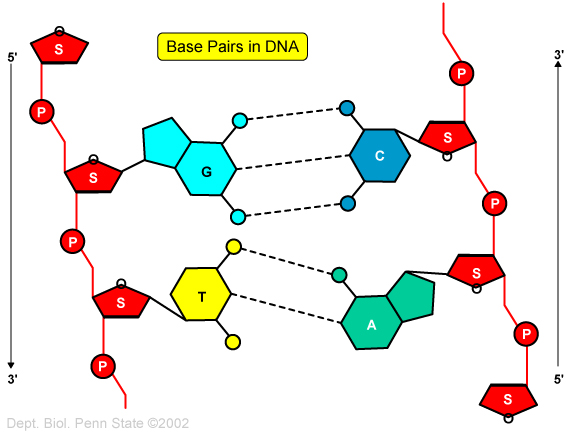
Adenine bonds with ______________.
a)
Guanine
b)
Thymine
c)
Cytosine
d)
Adenine
61.
Guanine bonds with ______________.
a)
Adenine
b)
Guanine
c)
Cytosine
d)
Thymine
62.
Nitrogenous bases are joined by which type of bond?
a)
polar bonds
b)
ionic bonds
c)
covalent bonds
d)
hydrogen bonds
63.
A protein coat surrounding a virus is called a 
a)
prophage.
b)
virus.
c)
capsid.
d)
bacteria.
64.
What was the example of prokaryotes that was referred to in your drawing?
a)
bacteria
b)
fungus
c)
animal cells
d)
protists
65.

Observe the diagram of the two viruses.

Part C is the ______________

a)

Genetic material

b)

Capsid

c)

Ligand

d)

Envelope

66.

Viruses are considered

a)

Living

b)

Nonliving

67.

Antibiotics work to cure viruses?

a)

True

b)

False

68.

Which pathogens are largest in size?

a)

Viruses

b)

Bacteria

c)

Both viruses and bacteria are about the same size

69.

Which are considered pathogens which can cause diseases?

a)

Viruses

b)

Bacteria

c)

Both viruses and bacteria

70.

These are considered to be living organisms _________________.

a)

Viruses

b)

Bacteria

c)

Both viruses and bacteria

71.

Which one(s) reproduce on their own both sexually and asexually?

a)

Viruses

b)

Bacteria

c)

Both viruses and bacteria

72.

Which one(s) reproduce by hi-jacking a host cell machinery?

a)

Viruses

b)

Bacteria

c)

Both viruses and bacteria