Wayground logo

Free Printable Worksheets

Font size

S
M
L
XL
Worksheets

Atomic Structure and Periodic Trends

Total questions: 102

Worksheet time: 1hrs 7mins

Name
Class
Date
1.

What is the atomic mass of an element?

a)

The mass of the nucleus

b)

The mass of the protons

c)

The average mass of all naturally occurring isotopes

d)

The mass of the valence electrons

2.

How is the atomic mass calculated?

a)

By comparing it to the mass of ¹²C

b)

By adding the mass numbers of all isotopes

c)

By dividing the mass number by the atomic number

d)

By subtracting the mass number from the atomic number

3.

What is the difference between atomic mass and mass number?

a)

Atomic mass is the same as mass number

b)

Atomic mass is the average mass of all isotopes, while mass number is the total number of protons and neutrons

c)

Atomic mass is the total number of protons and neutrons, while mass number is the average mass of all isotopes

d)

Atomic mass is the mass of the valence electrons

4.

How is the atomic mass of an element calculated?

a)

By multiplying the mass of each isotope by its percentage abundance

b)

By dividing the mass of each isotope by its percentage abundance

c)

By adding the mass of each isotope

d)

By subtracting the mass of each isotope

5.

What is the atomic mass of magnesium?

a)

12.01 amu

b)

16.00 amu

c)

24.31 amu

d)

32.07 amu

6.

What is the atomic mass of chlorine?

a)

34.97 amu

b)

35.45 amu

c)

36.97 amu

d)

39.10 amu

7.

What is the atomic mass of carbon?

a)

12.01 amu

b)

16.00 amu

c)

24.31 amu

d)

32.07 amu

8.

What is the atomic mass of oxygen?

a)

12.01 amu

b)

16.00 amu

c)

24.31 amu

d)

32.07 amu

9.

What is the atomic mass of fluorine?

a)

12.01 amu

b)

16.00 amu

c)

19.00 amu

d)

32.07 amu

10.

What is the atomic mass of sulfur?

a)

12.01 amu

b)

16.00 amu

c)

24.31 amu

d)

32.07 amu

11.

What is the atomic mass of potassium?

a)

12.01 amu

b)

16.00 amu

c)

39.10 amu

d)

32.07 amu

12.

What is the atomic mass of copper?

a)

12.01 amu

b)

16.00 amu

c)

24.31 amu

d)

63.55 amu

13.

What is the atomic mass of lithium?

a)

6.941 amu

b)

12.01 amu

c)

24.31 amu

d)

63.55 amu

14.

What is the atomic mass of helium?

a)

6.941 amu

b)

4.00 amu

c)

24.31 amu

d)

63.55 amu

15.

What is the atomic mass of neon?

a)

6.941 amu

b)

4.00 amu

c)

20.18 amu

d)

63.55 amu

16.

Which one of the following is a property of non-metals?

a)

has luster

b)

malleability

c)

ductility

d)

brittleness

17.

Which symbol represents an atom in the ground state with the most stable valence electron configuration?

a)

B

b)

O

c)

Fe

d)

Ar

18.

In the formula X2(SO4)3, the X represents a metal. This metal could be located on the Periodic Table in

a)

1

b)

2

c)

13

d)

14

19.

Sodium and potassium have similar chemical properties because a sodium atom and a potassium atom have the same

a)

total number of valence electrons

b)

atomic number

c)

mass number

d)

total number of electron shells

20.

Which phrase best describes an atom?

a)

A positively charged electron cloud surrounding a positively charged nucleus

b)

A positively charged electron cloud surrounding a negatively charged nucleus

c)

A negatively charged electron cloud surrounding a positively charged nucleus

d)

A negatively charged electron cloud surrounding a negatively charged nucleus

21.

When an atom of Lithium becomes a Li1+ ion, it

a)

gains a proton

b)

gains an electron

c)

loses an electron

d)

loses a proton

22.

When an atom of Oxygen becomes a O2- ion, it

a)

gains 2 protons

b)

gains 2 electrons

c)

loses 2 electrons

d)

loses 2 protons

23.

How does an atom’s ability to attract an electron change from left to right across a period?

a)

It increases

b)

It decreases

c)

It remains constant

d)

There is no obvious trend

24.

How does an atom’s ability to attract an electron change from top to bottom in a group?

a)

It increases

b)

It decreases

c)

It remains constant

d)

There is no obvious trend

25.

How does an atom’s first ionization energy change from top to bottom in a group?

a)

It increases

b)

It decreases

c)

It remains constant

d)

There is no obvious trend

26.

How does an atom’s first ionization energy change from left to right across a period?

a)

It increases

b)

It decreases

c)

It remains constant

d)

There is no obvious trend

27.

Which statement describes the relative energy of the electrons in the shells of a copper atom?

a)

An electron in the first shell has more energy than an electron in the second shell.

b)

An electron in the first shell has the same amount of energy as an electron in the second shell.

c)

An electron in the third shell has more energy than an electron in the second shell.

d)

An electron in the third shell has less energy than an electron in the second shell.

28.

Which statement identifies the element antimony?

a)

Antimony has an atomic number of 51

b)

Antimony has eight valence electrons

c)

An atom of antimony in the ground state has a radius of 120 pm.

d)

has a boiling melting point of 904K.

29.

Which element is a liquid at 400 K at standard pressure?

a)

indium

b)

gallium

c)

aluminum

d)

boron

30.

Solid samples of the element carbon can be clear, black, or grey in color. The variations in color are due to different

a)

atomic masses

b)

molecular structures

c)

nuclear charges

d)

ionization energies

31.

Oxygen atoms, sulfur atoms, and selenium atoms have the same

a)

atomic radius

b)

first ionization energy

c)

total number of protons

d)

oxidation state

32.

Which represents the electron configuration of a metalloid in the ground state?

a)

2-6

b)

2-8-4

c)

2-8-3

d)

2-8-8

33.

Which Group 16 element exists as diatomic molecules at STP?

a)

oxygen

b)

sulfur

c)

selenium

d)

tellurium

34.

The atomic mass of silver is 107.868 atomic mass units. This atomic mass represents the

a)

Total mass of all the protons and neutrons in an atom of Ag

b)

Total mass of all the protons, neutrons, and electrons in an atom of Ag

c)

Weighted average mass of the most abundant isotopes of Ag

d)

Weighted average mass of all the naturally occurring isotopes of Ag

35.

Which electron configuration represents an excited state for a magnesium atom?

a)

2-8-2

b)

2-8

c)

2-7-3

d)

2-7-2

36.

Which electron configuration represents a magnesium ion?

a)

2-8-2

b)

2-8

c)

2-7-3

d)

2-7-2

37.

Which of the following have the same electron configuration as each other?

a)

Na and Na+1

b)

Na and Ne

c)

Na+1 and Ne

d)

Na+1 and Ar

38.

An atom of an element has a total of 19 electrons. An ion of the same element has a total of 18 electrons. Which statement describes the charge and radius of the ion?

a)

The ion is positively charged and its radius is smaller than the radius of the atom.

b)

The ion is positively charged and its radius is larger than the radius of the atom.

c)

The ion is negatively charged and its radius is smaller than the radius of the atom.

d)

The ion is negatively charged and its radius is larger than the radius of the atom.

39.

An atom of an element has a total of 16 electrons. An ion of the same element has a total of 18 electrons. Which statement describes the charge and radius of the ion?

a)

The ion is positively charged and its radius is smaller than the radius of the atom.

b)

The ion is positively charged and its radius is larger than the radius of the atom.

c)

The ion is negatively charged and its radius is smaller than the radius of the atom.

d)

The ion is negatively charged and its radius is larger than the radius of the atom.

40.

Which atom in the ground state has a partially filled second electron shell?

a)

hydrogen

b)

oxygen

c)

sulfur

d)

helium

41.

An atom in the ground state of which of the following elements requires the least amount of energy to remove an electron?

a)

Na

b)

Li

c)

K

d)

H

42.

As the elements in Group 13 on the Periodic Table are considered from top to bottom, what happens to the atomic radius and the metallic character?

a)

The atomic radius and the metallic character both increase.

b)

The atomic radius increases and the metallic character decreases.

c)

The atomic radius decreases and the metallic character increases.

d)

The atomic radius and the metallic character both decrease.

43.
What is the number of protons that the element in this image contain?
a)
14
b)
7
c)
15
d)
18
44.
If an atom has 12 positively charged subatomic particles, which of the following must it also have to be considered a neutral atom?
a)
12 neutrons
b)
12 electrons
c)
12 protons
d)
24 protons and neutrons
45.
An atom has 10 protons, 15 neutrons and 10 electrons what is its mass number.
a)
20
b)
10
c)
5
d)
25
46.
In the modern periodic table elements are arranged by:
a)
atomic mass
b)
atomic number
c)
valence electrons
d)
number of isotopes
47.
The family in the periodic table that contains the most reactive metals is the_______
a)
Alkaline Earth Metals
b)
Transition Metals 
c)
Alkali Metals
d)
Other Metals
48.
Which group of the periodic table is composed of inert (not reactive)  gases?
a)
alkali metals
b)
alkaline earth metals
c)
halogens
d)
noble gases
49.
What do these isotopes of carbon all have in common?
a)
neutrons & mass number
b)
atomic number and neutrons
c)
atomic number and electrons
d)
protons, atomic number, and mass number
50.
How many neutrons does the isotope of lithium have?
a)
8
b)
3
c)
4
d)
5
51.
Which particle has a positive charge?
a)
electron
b)
orbital
c)
proton
d)
neutron
52.
Choose the particle that has no charge.
a)
nucleus
b)
neutron
c)
proton
d)
electron
53.
This particle determines what element you have - the elements identity.
a)
electron
b)
proton
c)
neutron
d)
valence shell
54.
What is the mass of a proton and a neutron?
a)
1amu
b)
2grams
c)
13amu
d)
10cm
55.
An electron has a _____ charge.
a)
negative
b)
positive
c)
neutral
56.
Describe an Electron Cloud?
a)
the mist outside of an atom
b)
home of the protons
c)
where electrons are located
d)
nucleus
57.
What are the maximum number of electrons that go on the first 3 energy levels?
a)
2,4,16
b)
2,8,18
c)
4,8,12
d)
3,4,6
58.
What are valence electrons?
a)
electrons on the first orbital always
b)
nucleus
c)
the outermost shell
d)
the number of electrons on the outermost orbital
59.
Which particles make up the nucleus of an atom?
a)
protons and neutrons
b)
electrons and protons
c)
electrons, protons, and neutrons
d)
electrons and neutrons
60.
The particles of the atom you can find by knowing the atomic number.
a)
neutrons
b)
protons and electrons
c)
protons and neutrons
d)
atomic mass
61.
The subatomic particle that determines the identity of an element.
a)
neutron
b)
proton
c)
electron
d)
outer shell
62.
What charge does the nucleus have and why?
a)
positive - the neutrons do not have a charge
b)
positive - the neutrons and protons are positively charged particles
c)
neutral - the neutral charge dominates the positive charge
d)
neutral - electrons cancel out the positive charge of the atom
63.
What is the mass number and name of an element with 8 protons and 8 neutrons?
a)
16 - Carbon
b)
16 - Oxygen
c)
24 - Oxygen
d)
8 - Neon
64.
An element with a mass number of 10 and an atomic number of 6 has how many protons?
a)
5
b)
8
c)
6
d)
10
65.
An element with a mass number of 11 and an atomic number of 5 has how many neutrons?
a)
11
b)
5
c)
6
d)
16
66.
An atom has 10 protons, 15 neutrons and 10 electrons what is its mass number.
a)
20
b)
10
c)
5
d)
25
67.
Matter that cannot be broken down into a simpler substance – building blocks of life.
a)
neutron
b)
atom
c)
electron
d)
quarks
68.
Elements on the periodic table increase by...
a)
atomic mass
b)
size
c)
mass number
d)
atomic #
69.
Most of the mass of an atom is contained here.
a)
electron orbitals 
b)
nucleus
c)
shells
d)
atomic #
70.
What is the number that gives you the element and the number of protons contained in each elemental atom?
a)
atomic mass
b)
mass number
c)
symbol
d)
atomic #
71.
What is the difference between the atomic mass and the mass number?
a)
the atomic mass is always a whole number
b)
the atomic mass equals the atomic #
c)
mass number is the rounded atomic mass - always a whole number
d)
electrons
72.
What do the following properties describe? : shiny, ductile, good conductor, high melting point
a)
metal
b)
nonmetal
c)
metalloid
73.
 Which of the following statements are FALSE?
a)
metals are located to the LEFT of the zig-zag line
b)
metals are less reactive than nonmetals
c)
nonmetals are located to the RIGHT of the zig-zag line
d)
metalloids have properties of both metals and nonmetals
74.
Which is an example of a nonmetal?
a)
Platinum
b)
Carbon
c)
Silver
d)
Lead
75.
Which is an example of a metalloid?
a)
Boron
b)
Lead
c)
Radon
d)
Gold
76.
Which element is located at Period 5, Group 2? 
a)
Niobium
b)
Strontium
c)
Nitrogen
d)
Phosphorus
77.
Which element is located at Period 7, Group 4? 
a)
Maganese
b)
Chlorine
c)
Rutherfordium
d)
Iodine
78.
Elements in the periodic table are arranged in order by their ...
a)
atomic number
b)
atomic mass (mass number)
c)
metal, nonmetal, or metalloid properties
79.
How many proton are in this element?
a)
238
b)
92
c)
146
80.
How many electrons are in this element?
a)
238
b)
92
c)
146
81.
How many neutrons are in this element?
a)
238
b)
92
c)
146
82.
Which has the greater EN: 
Cl or Al?
a)
Cl
b)
Al
83.
Which of the following will have a larger radius than Zinc?
a)
Gallium
b)
Aluminum
c)
Magnesium
d)
Strontium
84.
Which of the following will have a higher electronegativity than arsenic (As)?
a)
Carbon (C)
b)
Neon (Ne)
c)
Antimony (Sb)
d)
Germanium (Ge)
85.
Which atom has the largest atomic radius?
a)
potassium
b)
rubidium 
c)
francium
d)
cesium
86.
As you move down the periodic table atoms get bigger.  This is because ____________.
a)
The atoms have more mass.
b)
The atoms have more protons.
c)
The atoms have more energy levels
d)
The atoms have more nuetrons
87.
As you move across the periodic table atoms tend to get smaller because, ______________.
a)
the atoms have more mass.
b)
the atoms have less mass
c)
the atoms have more protons.
d)
the atoms have less electrons.
88.
Atoms that have a high electronegativity, _______________.
a)
give up their electrons more easily.
b)
hold on to their electrons more tightly.
c)
have more electron shells.
89.
Electronegativity is...
a)
how good an atom is at attracting electrons
b)
the ability of an atom to lose electrons
c)
the energy required to remove an electron from a specific atom
d)
how easy it is to make friends. 
90.
The element with the largest electronegativity in the halogens is - 
a)
At
b)
F
c)
Cl
d)
Br
91.
Atomic radius generally increases as we move __________.  
a)
down a group and from right to left across a period 
b)
up a group and from left to right across a period 
c)
down a group and from left to right across a period 
d)
up a group and from right to left across a period 
92.
How many neutrons in C-14?
a)
6
b)
7
c)
14
d)
8
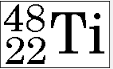
93.
How many protons does this isotope of titanium have?
a)
48
b)
22
c)
26
d)
70
94.
How many neutrons does the isotope of lithium have?
a)
8
b)
3
c)
4
d)
5
95.
What do these isotopes of carbon all have in common?
a)
neutrons & mass number
b)
atomic number and neutrons
c)
atomic number and electrons
d)
protons, atomic number, and mass number
96.
What quantities vary between isotopes of an element?
a)
protons, electrons, and atomic mass
b)
protons, electrons, and atomic number
c)
neutrons and electrons
d)
neutrons and atomic mass
97.
How many neutrons does the isotope below have?     89 36Kr
a)
53
b)
36
c)
89
d)
125
98.
What charge does a neutron have?
a)
positive
b)
negative
c)
no charge
d)
neutral
99.
What is the number of protons that the element in this image contain?
a)
14
b)
7
c)
15
d)
18
100.
Isotopes are atoms of the same element with different #’s of __________ & therefore different __________.
a)
n0 ;  atomic #’s
b)
p+ ; atomic #’s
c)
e- ; atomic masses
d)
n0 ; atomic masses
101.

The columns on a periodic table are referred to as

a)

Groups

b)

Periods

102.

The rows on the periodic table are referred to as

a)

Groups

b)

Periods