wayground logo

Free Printable Worksheets

Font size

S
M
L
XL
Worksheets

Mega Chem quiz

Total questions: 72

Worksheet time: 2hrs 25mins

Name
Class
Date
1.

E- involved in bonding between atoms are

a)

valence e-

b)

inside the nucleus

c)

closest to the nucleus

d)

positively charged

2.

When at atom loses an e-, it becomes a

a)

positive ion

b)

negative ion

c)

neutral ion

d)

neutral atom

3.

Magnesium bromide is an ionic compound with the chemical formula   MgBr2MgBr_2  ...what does the "2" tell you?

a)

Bromine has a -2 charge

b)

There are 2 Magnesium ions

c)

There are 2 Bromine ions

d)

Bromine has a +2 charge

4.

A chemical bond formed when 2 atoms share e- is called a(n)

a)

ionic bond

b)

covalent bond

c)

metallic bond

d)

neutral ions

5.

Which of the following terms means that metals can be rolled into thin sheets:

a)

polar

b)

alloy

c)

ductile

d)

malleable

6.

What is a double bond?

a)

a bond between two atoms

b)

1 PAIR of e- shared between 2 atoms

c)

2 PAIRS of e- shared between 2 atoms

d)

2 PAIRS of e- shared between 4 atoms

7.

E- involved in bonding between atoms are

a)

valence e-

b)

inside the nucleus

c)

closest to the nucleus

d)

positively charged

8.

When at atom loses an e-, it becomes a

a)

positive ion

b)

negative ion

c)

neutral ion

d)

neutral atom

9.

Which is a property shared by most covalent bonds?

a)

high boiling point

b)

high melting point

c)

low melting point

d)

nonpolar bonds

10.

Magnesium bromide is an ionic compound with the chemical formula   MgBr2MgBr_2  ...what does the "2" tell you?

a)

Bromine has a -2 charge

b)

There are 2 Magnesium ions

c)

There are 2 Bromine ions

d)

Bromine has a +2 charge

11.

A chemical bond formed when 2 atoms share e- is called a(n)

a)

ionic bond

b)

covalent bond

c)

metallic bond

d)

neutral ions

12.

Which of the following is a property of ionic compounds?

a)

Low melting points

b)

Are brittle crystals

c)

Contain no charged particles

d)

Low boiling points

13.

Which of the following terms means that metals can be rolled into thin sheets:

a)

polar

b)

alloy

c)

ductile

d)

malleable

14.

Which of the following groups contains the most reactive elements?

a)

alkali metals

b)

transition metals

c)

noble gases

d)

carbon family

15.

Which of the following best describes a metal crystal?

a)

metal atoms held together by covalent bonds

b)

metal atoms held together by ionic bonds

c)

positive metal ions surrounded by freely moving valence electrons

d)

neutral metal atoms surrounded by freely moving valence electrons

16.

Ionic compounds are electrically

a)

positive

b)

negative

c)

neutral

17.

Ionic compounds that dissolve in water conduct electricity because they break into _________ that move freely.

a)

covalents

b)

ions

c)

metals

d)

elements

18.

How many valence e- does lithium have?

a)

8

b)

11

c)

2

d)

1

19.

How many more valence e- does fluorine need in order to be stable?

a)

7

b)

17

c)

1

d)

8

20.

Where are e- located in the atom?

a)

in a proton

b)

electron cloud

c)

nucleus

d)

Spongebob's pineapple house

21.
What are the three types of chemical bonds we have learned about?
a)
Iconic, Convalescent, and Mental
b)
Ionic, Covalent, and Metallic
c)
Ionian, Cloven, and Meticulous
d)
Diatomic, Malleable, and Ductile
22.
What do we call the outermost electrons in an atom?
a)
Neutrons
b)
Ions
c)
Electrons-at-large
d)
Valence electrons
23.
Which of the following is not true about electron energy levels?
a)
The first level can hold 2 electrons
b)
No one know how many electrons they can hold
c)
Each level after the first can hold 8 electrons
d)
Atoms with more electrons have more energy levels than atoms with fewer electrons
24.
Which type of bond involves atoms giving up and gaining electrons?
a)
Ionic bonds
b)
Covalent bonds
c)
Metallic bonds
d)
Electro bonds
25.
Which particles in the atom are positively charged?
a)
Croutons
b)
Neutrons
c)
Electrons
d)
Protons
26.
Which particles in the atom are negatively charged?
a)
Protons
b)
Electrons
c)
Neutrons
d)
Frowntrons
27.
What do we call an atom that has given up or gained electrons?
a)
An ion
b)
An iron
c)
A different atom
d)
A metalloid
28.
If an ion has lost an electron and has more protons than electrons, what is its charge?
a)
Negative
b)
Positive
c)
Neutral
d)
This is impossible
29.
Which groups of the periodic table are most likely to become positively charged ions?
a)
All of them
b)
18
c)
1 and 2
d)
Nonmetals
30.
Is sodium (Na) more likely to lose an electron or gain an electron?
a)
Lose
b)
Gain
31.
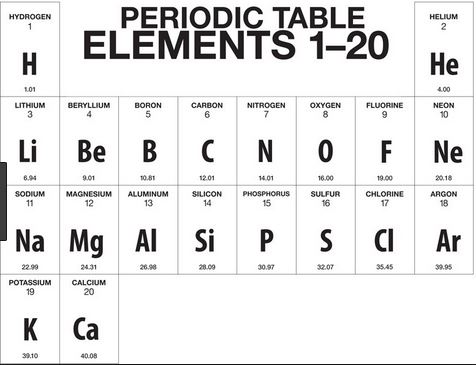
Based on this diagram, how many electrons is Calcium likely to lose?
a)
0
b)
1
c)
2
d)
3
32.
If Calcium loses 2 electrons, what will its charge be?
a)
0
b)
2+
c)
2-
d)
1
33.
In ionic bonds, the atoms are ultimately bonded by the...
a)
Gravitational force
b)
Electrostatic force (opposite charges attract)
c)
Strong force
d)
The Force
34.
Which type of bonds is stronger?
a)
Ionic
b)
Covalent
35.
True or false: an atom can share electrons with more than one electron at a time.
a)
True. They often form complex arrangements of atoms called molecules.
b)
False. That doesn't even make sense.
36.
Which type of atoms tend to form covalent bonds with each other?
a)
Metals
b)
Metalloids
c)
Nonmetals
d)
Noble Gases
37.
Metallic bonds join...
a)
Metals to nonmetals
b)
Metals to metals
c)
Metals to metalloids
d)
Metalloids to nonmetals
38.
What atom matches this electron configuration?
1s2s2p3s2
a)
Neon
b)
Magnesium
c)
Aluminum
d)
Potassium
39.
Which is the electron configuration for an oxygen atom?
a)
1s22s22p63s23p64s2
b)
1s22s22p4
c)
1s22s22p6
d)
1s22s22p63s23p6
40.
How many valence electrons are represented here?
a)
7
b)
5
c)
2
d)
8
41.
How many electrons can the d sublevel hold?
a)
8
b)
10
c)
2
d)
4
42.
How many electrons can the first energy level hold?
a)
1
b)
2
c)
8
d)
0
43.
How many valence electrons does phosphorus have?
a)
5
b)
2
c)
8
d)
15
44.
What is the electron configuration for this atom?
a)
1s22s22p6
b)
1s22s22p5
c)
1s22s22p3
d)
2s22p3
45.

The positive ions tend to _____________ electrons.

a)

lose

b)

gain

46.

The negative ions tend to _____________ electrons.

a)

lose

b)

gain

47.

Why do all bonds form?

a)

so the number of protons equals the number of electrons

b)

so an atom can become unstable

c)

to fill the outermost energy level

48.
Ionic bonds are between...
a)
Metal and Non-metal
b)
Non-metal and Non-metal
c)
Metal and Metal
49.
Why do elements bond?
a)
To be friends
b)
To create a new element
c)
To become stable
50.
Ionic bonds form between two ions that have...
a)
ionic compounds
b)
negative charges
c)
positive charges
d)
opposite charges
51.

What type of elements form cations?

a)

metals

b)

nonmetals

c)

metalloids?

52.

Anions

a)

Gain electrons, has an overall positive charge

b)

Lose electrons, has an overall positive charge

c)

Lose electrons, has an overall negative charge

d)

Gain electrons, has an overall negative charge

53.

Cations

a)

Gain electrons, has an overall positive charge

b)

Lose electrons, has an overall positive charge

c)

Lose electrons, has an overall negative charge

d)

Gain electrons, has an overall negative charge

54.
Is hydrogen considered a metal or a non-metal?
a)
A metal
b)
Nonmetal
c)
Metalloid
55.

How many Aluminum atoms are in Al2O3?

a)

3

b)

5

c)

2

d)

1

56.
phosphorus trichloride
a)
KCl3
b)
PCl3
c)
K3Cl
d)
P3Cl
57.
silicon dioxide
a)
SO2
b)
NaO2
c)
SiO2
d)
SiO
58.

dinitrogen pentoxide

a)

N2O5

b)

NO5

c)

N5O2

d)

N2O6

59.

SO₃

a)

sulfate

b)

sulfur oxide

c)

sulfur trioxide

d)

monosulfur trioxide

60.

tetraphosphorus heptoxide

a)

K₄O₁₀

b)

P₄O7

c)

KO

d)

P₁₀O₄

61.

Identify the following compound as ionic or covalent: SO2

a)

ionic

b)

covalent

62.

This could be the dot diagram of

a)

Mg

b)

Cl

c)

C

d)

O

63.

This is a correct dot diagram for neon (Ne)

a)

true

b)

false

64.

How many valence electrons does Aluminum Have?

a)

1 Valence electron

b)

2 Valence electron

c)

3 Valence electron

d)

4 Valence electron

e)

5 Valence electron

65.

How would you draw a Lewis dot diagram for Magnesium?

a)
b)
c)
d)
66.

Which of these is correct?

a)
b)
c)
67.
What's a valence electron?
a)
electrons in the second energy level
b)
electrons in the outermost energy level
c)
the atomic number
d)
electrons in the first level
68.

Why do carbon, silicon, and tin all react similarly?

a)

They are located in the same period

b)

They have an even atomic number

c)

They have the same number of energy levels

d)

They are located in the same group

69.

Which element is most similar to potassium (K)

a)

argon

b)

chlorine

c)

phosphorus

d)

sodium

70.

What are the elements found along the "staircase" called? They have properties of both metals and non-metals.

a)

Metalloids

b)

Non-metals

c)

Transition metals

d)

Metals

71.

Family 1 is _____ than Family 18

a)

More reactive

b)

Less reactive

72.

Which family contains all gases?

a)

1

b)

2

c)

5

d)

8